





— Blogs —
—Products—
 Consumer hotline +8618073152920
 WhatsApp:+8615367865107
Address:Room 102, District D, Houhu Industrial Park, Yuelu District, Changsha City, Hunan Province, China
Product knowledge
Time:2026-09-07 16:27:30 Popularity:312
Soil EC and salinity are related, but they are not interchangeable measurements. Electrical conductivity describes how readily an electrical current passes through the material around the electrodes. Dissolved salts contribute to that conductivity, while water content, temperature, soil structure and electrode contact also affect a field reading. Use a buried soil EC sensor to follow changes at a defined location. Use an appropriate laboratory extraction method when the decision depends on a crop salinity threshold expressed as ECe.
A grower may receive an EC result from a laboratory, another from a fertigation controller and a third from a root-zone probe. Even when all three displays show mS/cm, they may describe different samples. Before deciding that one instrument is wrong, identify what each instrument actually measured.
| Measurement | What is measured | Useful comparison |
|---|---|---|
| In-place soil conductivity | The conductive response of the soil surrounding the probe, including its water-filled pathways and solid surfaces | The same location and depth under comparable moisture and temperature conditions |
| Soil solution conductivity | Liquid collected from the pore space using a defined sampling procedure | Other solution samples collected by the same procedure |
| ECe | Conductivity of the extract from a saturated soil paste | Laboratory ECe results and crop guidance expressed on that basis |
| Fixed-ratio soil extract | A prepared soil-to-water mixture, such as a 1:5 extraction | Results using the same ratio, preparation and temperature basis |
| Irrigation water EC | The incoming water or nutrient solution before it enters the soil | Water-source changes, blending and fertigation consistency |
FAO guidance on salinity terminology explains why saturated-paste extract conductivity is used as a standardized soil salinity reference. It also distinguishes salinity from sodium-related soil problems. A buried probe reading is not automatically an ECe result, and EC alone cannot identify a specific ion or establish a sodium hazard.
For example, a laboratory result of 2.0 dS/m and a field reading of 1.2 mS/cm do not establish a 40% sensor error. First check the extraction method, sampling depth, soil moisture and temperature treatment. A calibration adjustment made before resolving those differences can make a previously consistent field sensor less useful.
The unit conversion is exact: 1 dS/m = 1 mS/cm = 1,000 uS/cm. A reading of 2.5 mS/cm is therefore 2,500 uS/cm or 2.5 dS/m. Changing the display unit does not turn an in-place soil measurement into a laboratory extraction result.
Record the temperature basis as well. A controller may display measured conductivity at the current temperature or conductivity compensated to a reference temperature. Two systems using different compensation settings can disagree even when their electrode measurements are consistent. Do not apply a second compensation in the PLC if the sensor has already applied it.
Conversion from EC to a salt concentration in mg/L or a salinity percentage is different from converting conductivity units. It requires a relationship appropriate to the solution composition and measurement method. A single multiplication factor should not be used to label every soil EC channel as an accurate salt concentration.
Continuous monitoring reveals changes that occasional sampling may miss. However, an EC trend needs a moisture trend beside it. Irrigation can improve electrical contact and connect water-filled pores, increasing the measured bulk conductivity. At the same time, added water can dilute the dissolved salts in the pore water. The net probe response depends on which effect dominates.
| Observed pattern | Possible explanation | What to check next |
|---|---|---|
| EC and moisture rise together after watering | Wetting improves conductive pathways; incoming water or fertilizer may also add ions | Irrigation-water EC, fertilizer timing and readings after redistribution |
| EC falls as the soil dries | Loss of connected water pathways can reduce the bulk reading | Do not assume salts have left the root zone; compare at a similar moisture condition |
| One probe changes abruptly while nearby probes remain stable | Local wetting, a fertilizer deposit, disturbed contact or an electrical fault | Emitter position, recent field work, connector condition and a local sample |
| Comparable post-irrigation readings rise over several cycles | Possible accumulation near the monitored depth | Repeat soil sampling, irrigation-water quality and drainage below the root zone |
A single falling EC trace does not prove successful leaching. To investigate salt movement, sample relevant depths and consider drainage, irrigation volume and the wetting pattern. A shallow probe may show improvement while salts move into another part of the active root zone. Conversely, a short-lived spike beside an emitter may not represent the whole bed.
For a greenhouse trial, mark each probe's depth and distance from the dripper. Compare the same stage of the irrigation cycle rather than mixing a just-watered bed with a dry bed. In an orchard, separate markedly different soil zones instead of averaging their conductivity values into one irrigation decision.
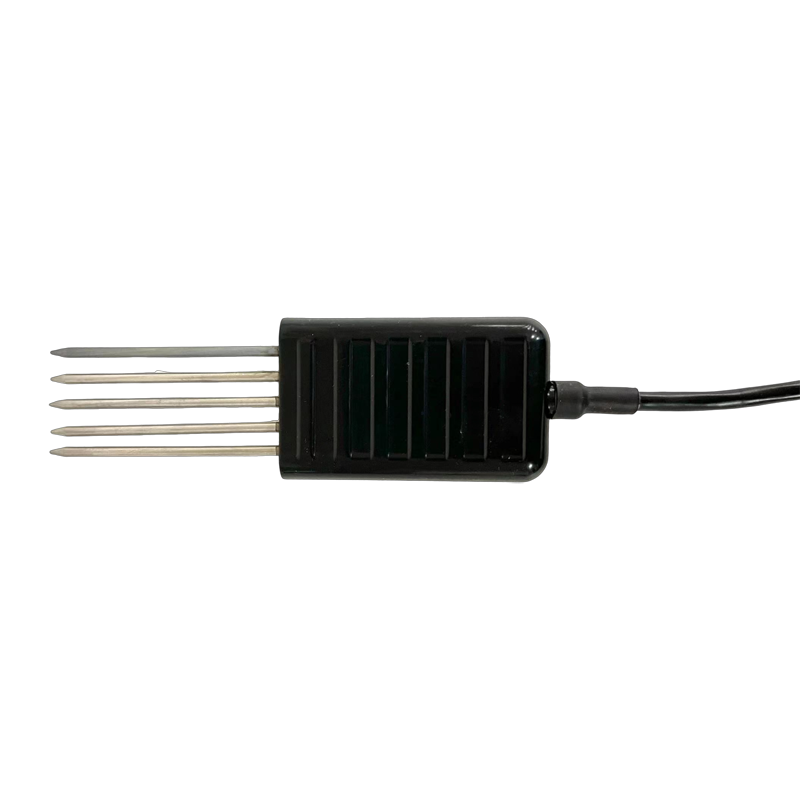
The NiuBoL NBL-S-TMC-7 soil sensor combines several channels in one probe. For soil EC interpretation, its moisture and temperature channels are particularly useful: they provide context at the same installed point without requiring three separate positions. This does not remove the need for representative placement or local comparison testing.
| NBL-S-TMC-7 parameter | Specification | Practical significance |
|---|---|---|
| EC measurement range | 0-10,000 uS/cm | Equivalent to 0-10 mS/cm; leave room above the expected operating values |
| EC accuracy specification | ±10% | Agree the error basis and comparison conditions before using it as an acceptance tolerance |
| Soil moisture range | 0-100% | Use the channel to interpret wetting and drying alongside EC |
| Temperature range and accuracy | -40 to 80 C; ±0.5 C | Track temperature changes during comparison measurements |
| Supply and current | 5-24 VDC; 15 mA at 12 V | Check voltage at the probe and include the logger separately in the power budget |
| Digital output | RS485, Modbus RTU; 9600 baud | Allows addressed acquisition by a compatible PLC, RTU or data logger |
Channel count should not be confused with independent laboratory analysis. The model's nutrient estimates are based on an empirical conductivity relationship; they are not a substitute for selective laboratory nitrogen, phosphorus and potassium tests. Its pH channel is a reference measurement, not a reason to omit a suitable pH verification method where dosing or compliance depends on pH accuracy.
A separate EC probe is not automatically more accurate than a combined probe. Compare the measurement method, supported medium, uncertainty and validation procedure. For a nutrient tank or pipe, select a probe explicitly suitable for that liquid installation. Some soil-sensor versions support solution measurements, but that permission cannot be assumed for every housing, cable junction or electrode design.
Do not add water simply to force a more plausible field reading and then treat that reading as the original soil condition. If a standardized wetting procedure is part of a comparison experiment, label it accordingly. Keep the unaltered field observations separate from the prepared-test results.
For RS485 Modbus RTU integration, assign each sensor a unique address and verify the register scale against the actual device version. Store the conductivity unit explicitly. A value interpreted as mS/cm when it is actually uS/cm creates a thousand-fold error without causing a communication fault.
Display moisture, temperature and EC on a shared time axis, together with irrigation and fertilizer events. Mark missing or invalid measurements rather than replacing them with zero, which would look like an abrupt loss of salinity. An alarm should distinguish an out-of-range measurement from a failed response.
Water availability is a separate question. A NBL-S-WPS soil water potential sensor can add a matric-potential measurement, indicating how tightly soil retains water. It does not measure EC, and its matric response does not include the whole osmotic effect of dissolved salts. Pairing the channels helps distinguish a drying root zone from a salinity concern; it does not merge them into one interchangeable number.
No. EC responds to the combined conductive ions and the measurement conditions, not to a specific nutrient deficiency. Use it to investigate changes or check consistency, then base nutrient additions on crop needs and appropriate nutrient analysis.
The laboratory may report saturated-paste or fixed-ratio extract conductivity, while the probe measures soil in place. Match the sampling depth, method, moisture and temperature basis before treating the difference as instrument error.
Not as a threshold for an unrelated field EC channel. Establish a site-specific relationship using paired samples, or keep the laboratory threshold and the field trend alarm as separate decisions with clearly identified units and methods.
No. Compensation addresses temperature effects within its supported model. It does not remove differences in texture, moisture, electrode contact or extraction method. Compare similar conditions and validate each materially different soil zone.
Provide the medium, expected EC range, installation depth, irrigation method, required comparison test and receiving equipment. State whether the purpose is trend monitoring, nutrient-solution control or a laboratory-correlated soil study; those tasks need different evidence of suitability.
Investigate persistent drift, damaged electrodes, unstable responses under repeatable conditions or failed communication. Clean only by a procedure compatible with the electrode materials. Confirm power, wiring and contact before deciding that the sensing element has failed.
Useful soil EC and salinity monitoring starts with knowing the measurement basis. Keep units consistent, compare like conditions and interpret EC with moisture, temperature and irrigation history. NiuBoL combined soil probes can supply these channels to a compatible monitoring system; laboratory extraction remains necessary when the decision depends on an ECe-based salinity limit.
Prev:Why Soil Moisture Readings Differ in Sandy and Clay Soil
Next:Soil NPK Sensor Guide: Principle, EC Conversion, Accuracy and Fertilizer Use
Related recommendations
Sensors & Weather Stations Catalog
 Agriculture Sensors and Weather Stations Catalog-NiuBoL.pdf
Weather Stations Catalog-NiuBoL.pdf
Agriculture Sensors Catalog-NiuBoL.pdf
Water Quality Sensor Catalog-NiuBoL.pdf
Related products
 Combined air temperature and relative humidity sensor
 TDR Soil Moisture & Temperature Sensor for irrigation| RS485 |4-20mA| NBL-S-THR
 Soil pH sensor RS485 soil Testing instrument soil ph meter for agriculture |NBL-S-PH
 Wind Speed sensor Output Modbus/RS485/Analog/0-5V/4-20mA
 Tipping bucket rain gauge for weather monitoring auto rainfall sensor RS485/Outdoor/stainless steel
 Pyranometer Solar Radiation Sensor 4-20mA/RS485

Screenshot, WhatsApp to identify the QR code
WhatsApp number:+8615367865107
(Click on WhatsApp to copy and add friends)

