





— Blogs —
—Products—
 Consumer hotline +8618073152920
 WhatsApp:+8615367865107
Address:Room 102, District D, Houhu Industrial Park, Yuelu District, Changsha City, Hunan Province, China
Product knowledge
Time:2026-09-07 16:27:29 Popularity:293
Soil moisture readings differ in sandy and clay soil for two separate reasons: the soils can genuinely contain different amounts of water, and a dielectric sensor's calibration can respond differently to their physical and electrical properties. Before changing a probe or its calibration, compare the measurement definition, depth, soil contact and reference method. A percentage without its basis is not enough to judge accuracy.
If two instruments show 23% and 70%, do not begin by deciding which one is faulty. One may report volumetric water content, another a relative wetness scale, and a laboratory sheet may report water mass relative to dry soil. Even two genuine volumetric readings can differ because the probes sample different depths, irrigation positions or soil volumes.
Volumetric water content, or VWC, is water volume divided by the total bulk soil volume. A value of 0.25 m3/m3 is the same as 25% VWC. Gravimetric water content on a dry-mass basis is water mass divided by dry soil mass. Those values cannot be compared directly without the dry bulk density of the sampled soil.
| Displayed quantity | Meaning | What to check before comparison |
|---|---|---|
| VWC, % or m3/m3 | Water volume per bulk soil volume | Depth, soil contact, calibration and whether the display uses fraction or percent |
| Gravimetric moisture, % dry basis | Water mass per dry soil mass | Dry bulk density is required to convert to VWC |
| Relative moisture, % | A normalized scale that may use a chosen reference | Find its definition; do not assume it is VWC |
| Soil water tension, kPa | An indication of how tightly water is held | Use a soil-water relationship, not a direct percentage conversion |
University of Minnesota Extension's article, Soil moisture sensors for irrigation scheduling, distinguishes VWC measurement from soil tension and identifies clay content, salinity, temperature and bulk density as influences on capacitance sensors. For a project comparison, record these conditions alongside the readings instead of comparing numbers taken from different soils on different days.
Sandy soil generally drains more freely after wetting, while finer-textured soil can retain water in smaller pores. A sandy sample that looks dark or feels wet is not necessarily holding the same VWC as a clay sample. Equal irrigation depth also does not produce equal water content at the sensing point: infiltration, redistribution, drainage and the initial moisture state all matter.
Dielectric probes estimate water content from the electrical response of the surrounding soil. Their response includes the effects of water, mineral particles, air and other material within the sensing volume. Changing compaction changes the solid and air fractions. Clay mineralogy, bound water and conductivity can also change the relationship between electrical response and water content.
These are different questions to investigate. A correctly calibrated sensor can show a real difference between sand and clay. A sensor with good repeatability can still have a soil-dependent bias. Do not remove genuine field variation by forcing all textures to show the same number, and do not accept a consistent trend as proof of absolute accuracy.
For dry-basis gravimetric water content, use the following relationship with consistent units: VWC = gravimetric water content x dry bulk density / water density. Use fractions in the calculation, then multiply by 100 to express the result as a percentage. Dry bulk density means dry soil mass divided by the original bulk sample volume, including its pores.
Consider a hypothetical sample with 20% gravimetric water content and dry bulk density of 1.30 g/cm3. Using water density of approximately 1.00 g/cm3 gives 0.20 x 1.30 / 1.00 = 0.26, or 26% VWC. Comparing the sensor's 26% with the laboratory's 20% without this conversion would create an apparent six-percentage-point error that is only a unit-basis difference.
A fixed-volume core allows a direct calculation. If an intact 100 cm3 sample loses 15 g between wet weighing and drying to constant mass, that loss represents approximately 15 cm3 of water and therefore 15% VWC. The container tare cancels in the wet-minus-dry difference only when the same container is used without loss of soil. The dry soil mass still needs the tare removed if bulk density is being calculated.
Do not use a loose, disturbed handful to infer the original in-situ bulk volume. Compaction during sampling, missing soil and an incompletely filled core change the reference. Drying conditions also need to suit the sample and laboratory method; a single fixed drying time is not proof that constant mass has been reached.
Check the complete sensing section, not just whether the cable is connected. Rod probes need close contact along their active length. A tube needs contact around each sensing zone. Oversized holes, cracks and pockets of air can make an otherwise functioning dielectric sensor read differently from the surrounding soil.
In dry clay, shrinkage can open a gap after an initially satisfactory installation. In loose sand, repeated insertion can change local packing. Near a drip emitter, two probes only a short distance apart may lie on opposite sides of a steep wetting gradient. Record distance from the emitter and depth before describing a mismatch as a sensor defect.
Inspect the data path as well. A raw value of 234 with a scale of 0.1 corresponds to 23.4, not 234 or 2.34. This is a scaling illustration, not a universal register assignment. For a multi-depth instrument, confirm that the displayed layer labels match the returned channels. Correct RS485 Modbus RTU communication does not establish that the software has attached the right unit or depth.
For each pair, calculate sensor VWC minus reference VWC in percentage points. Examine the errors by moisture level and soil group. A roughly constant difference might support an offset within the tested range; a changing slope or curved residual pattern requires a different explanation. Large scatter often calls for better sampling or contact rather than a more elaborate fitted equation.
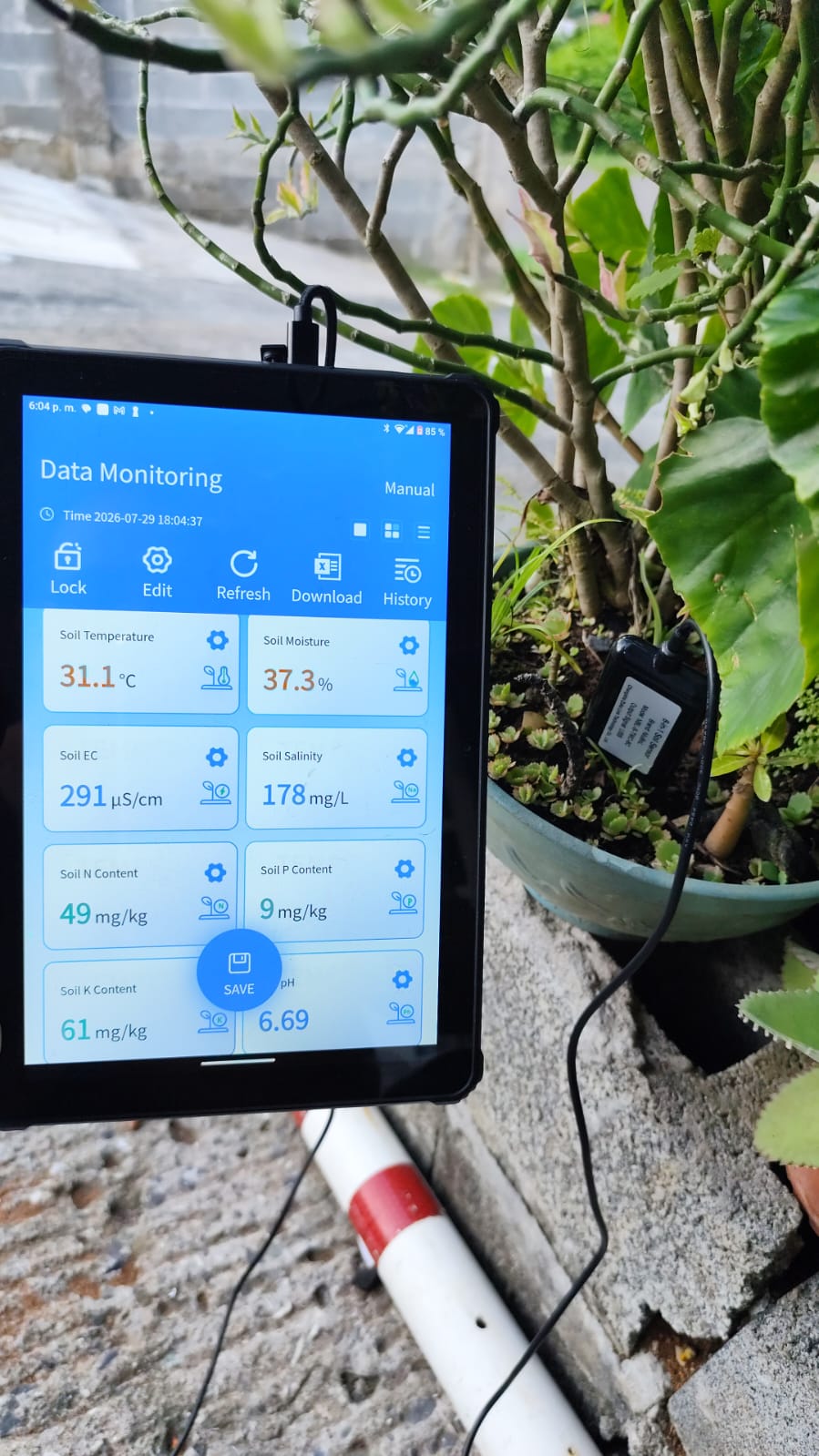
A portable instrument is useful for visiting several locations and checking spatial patterns. The NiuBoL Type-C soil tester can support that workflow with a compatible phone. It is not automatically a reference standard for an installed sensor. Its measurement volume, insertion disturbance and timing must be considered before using a difference to adjust the fixed installation.
For irrigation trend monitoring, the first task may be to establish repeatable wetting and drying patterns and locally appropriate action thresholds. For research, a water-balance calculation or comparison between soil textures, absolute VWC bias can matter more. Decide what error the intended decision can tolerate before paying for a calibration program.
Do not apply a coefficient developed in one repacked sandy sample to every clay layer on a farm. Define the soil class, density range, temperature and conductivity conditions for which the correction has been evaluated. Retain the uncorrected value and the correction version so later analysis can distinguish a real moisture change from a configuration change.
Field capacity and plant-available water are not fixed numbers for every soil called sand or clay. Use local soil and crop information when setting irrigation triggers. A single VWC percentage transferred between sites can trigger too early in one soil and too late in another. Texture classification helps organize the investigation but does not replace measurement of the local water-retention behavior.
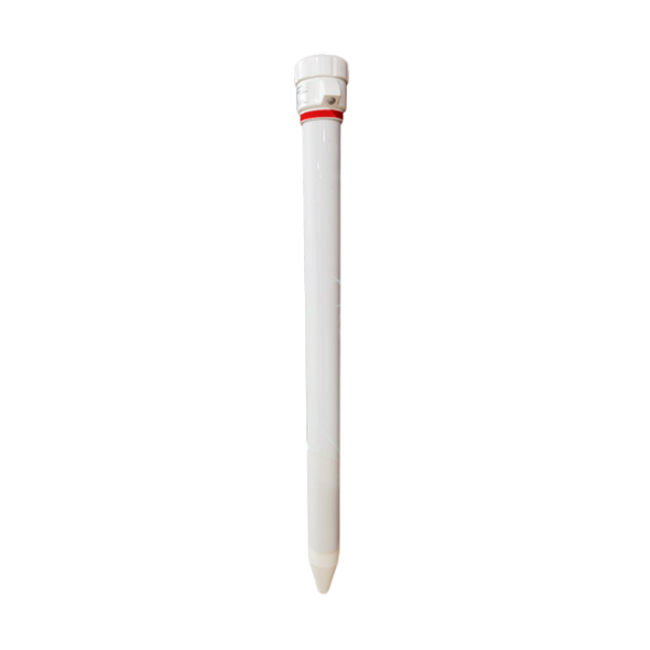
When the problem is vertical water movement, a NiuBoL NBL-S-TMSMS multi-depth soil sensor can track moisture and temperature at configured layers through one tubular assembly. It helps distinguish a wet surface from a deeper layer that has not yet responded. It does not independently identify soil texture or calibrate every horizon.
| NBL-S-TMSMS item | Configuration detail | Relevance to a soil comparison |
|---|---|---|
| Moisture method and range | FDR; dry to moisture-saturated soil | Evaluate the calibration in the intended soil, rather than inferring accuracy from range |
| Moisture performance | 0.1% resolution; +/-3% laboratory accuracy specification | Resolution is not field accuracy; agree the error basis and test conditions |
| Temperature | -40 to +80 degrees C; +/-0.5 degrees C accuracy | Record soil temperature with moisture; this range is not a liquid-water calibration guarantee in frozen soil |
| Measurement layers | Common 10, 20, 30 and 40 cm arrangement; deeper layouts available | Specify the actual depths, particularly where soil horizons change |
| Power and communication | 12 VDC configuration; RS485 Modbus RTU | Keep layer identity and scaling intact in the logger |
| Protection | IP67 above ground; IP68 below ground | Protect connections and preserve soil contact during installation |
For sensor selection, provide the soil groups, root-zone depths, salinity conditions and whether the task is local trend tracking or absolute water-content comparison. That information is more useful than asking for a universal accuracy figure without specifying the soil or installation method.
No. Water content depends on recent wetting, drainage, roots, depth and starting conditions. Texture affects retention, but it does not prescribe the value at a particular moment. Compare matched conditions and a defined reference before concluding that the reading order is wrong.
Those checks may help identify gross response problems when supported by the instrument, but they do not represent the density, mineralogy and pore structure of actual soil. Soil-specific validation needs representative soil at several moisture levels.
It demonstrates short-term stability under those conditions, not agreement with true water content. Check repeated paired reference samples for bias and scatter. A stable air gap or incorrect scale can produce a stable wrong value.
Only after evidence shows that the relevant soil properties and calibration response are sufficiently similar. Different horizons can have different texture, density or salt conditions. Keep layer-specific comparisons when those differences matter to the project.
Compare matched VWC values with defined sampling depth, reference method, density and moisture range. State the allowable error in clear units and include repeat measurements. Comparing two unspecified handheld percentages is not a reproducible acceptance test.
No. First assess contact, scaling, timestamp and the surrounding soil condition. Keep suspect data flagged while investigating. A correction introduced without checking the cause can conceal a wiring or installation problem and shift the irrigation threshold unnecessarily.
Interpret soil moisture readings by separating genuine soil-water differences from unit errors, installation effects and calibration bias. Match the measurement basis first, then validate representative soil conditions. Select portable testing or fixed multi-depth monitoring according to the comparison required, and use local evidence to set irrigation or research thresholds.
Prev:What Is a Soil Moisture Sensor? VWC, FDR, TDR and RH Explained
Next:Soil EC and Salinity: Units, Field Readings and Laboratory Tests
Related recommendations
Sensors & Weather Stations Catalog
 Agriculture Sensors and Weather Stations Catalog-NiuBoL.pdf
Weather Stations Catalog-NiuBoL.pdf
Agriculture Sensors Catalog-NiuBoL.pdf
Water Quality Sensor Catalog-NiuBoL.pdf
Related products
 Combined air temperature and relative humidity sensor
 TDR Soil Moisture & Temperature Sensor for irrigation| RS485 |4-20mA| NBL-S-THR
 Soil pH sensor RS485 soil Testing instrument soil ph meter for agriculture |NBL-S-PH
 Wind Speed sensor Output Modbus/RS485/Analog/0-5V/4-20mA
 Tipping bucket rain gauge for weather monitoring auto rainfall sensor RS485/Outdoor/stainless steel
 Pyranometer Solar Radiation Sensor 4-20mA/RS485

Screenshot, WhatsApp to identify the QR code
WhatsApp number:+8615367865107
(Click on WhatsApp to copy and add friends)

