





— Blogs —
—Products—
 Consumer hotline +8618073152920
WhatsApp:+8615367865107
Address:Room 102, District D, Houhu Industrial Park, Yuelu District, Changsha City, Hunan Province, China
Product knowledge
Time:2025-11-21 13:56:51 Popularity:1152
A soil moisture sensor specification should distinguish the buried measuring probe from the complete monitoring station. NiuBoL single-point and tubular multi-depth sensors provide different observation layouts; EC, salinity, tilt and remote communication are not automatically included in every moisture sensor. Select the required channels and depth positions, then specify the logger, power and communication equipment separately.
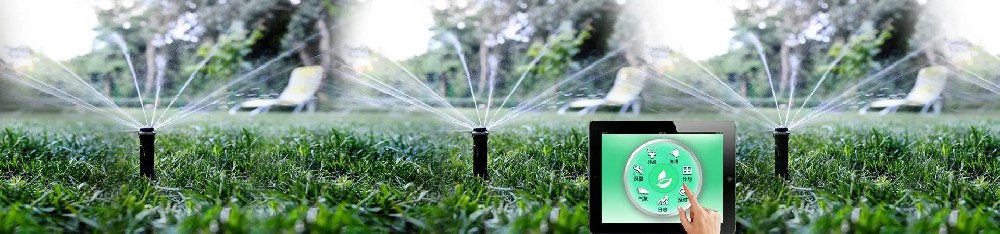
A single-point probe measures conditions around its sensing electrodes at the installed position. It can answer whether a selected root-zone point is becoming wetter or drier. A tubular profile sensor provides readings at several configured depths along one installation. It helps compare the progress of wetting through those layers, but still samples one location rather than the entire field.
Choose the layout from the question. A uniform shallow-rooted crop block may need a defined point observation, while an orchard project may need several depths to interpret water movement. Neither arrangement discovers root depth or calculates irrigation volume automatically. Crop information, soil structure and irrigation layout remain necessary to interpret the readings.

The NBL-S-TM combines soil temperature and volumetric moisture using FDR moisture measurement. It does not acquire every channel shown elsewhere in a soil-monitoring catalogue. The NBL-S-TMC adds EC, while the NBL-S-TMCS provides temperature, moisture, EC and salinity.
| Model | Measurement scope | Do not assume |
|---|---|---|
| NBL-S-TM | Temperature and moisture at one probe position | Separate EC, salinity or tilt channels |
| NBL-S-TMC | Temperature, moisture and EC | That an EC value is a direct fertilizer recipe |
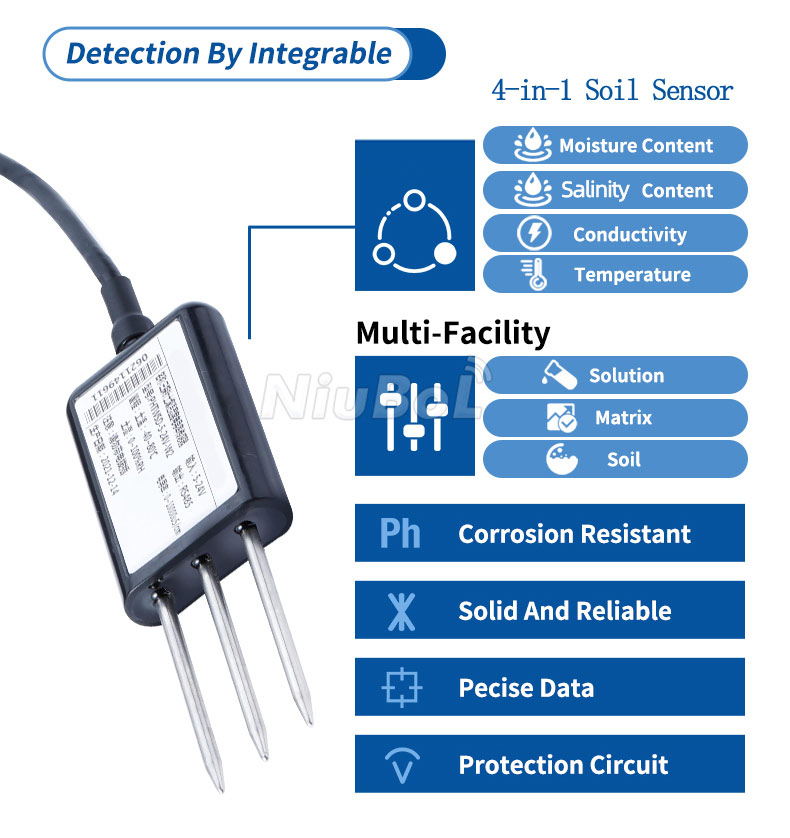
| NBL-S-TMCS | Temperature, moisture, EC and salinity | That four parameters mean four soil depths |
| NBL-S-TMSMS | Temperature and moisture at configured profile depths | Optional positioning or movement functions in every version |
Parameter count and depth count describe different things. A four-parameter probe can measure four quantities at one position. A four-layer tube can provide moisture and temperature at four depths. Confirm both lists in the equipment schedule so the received channels match the software design.
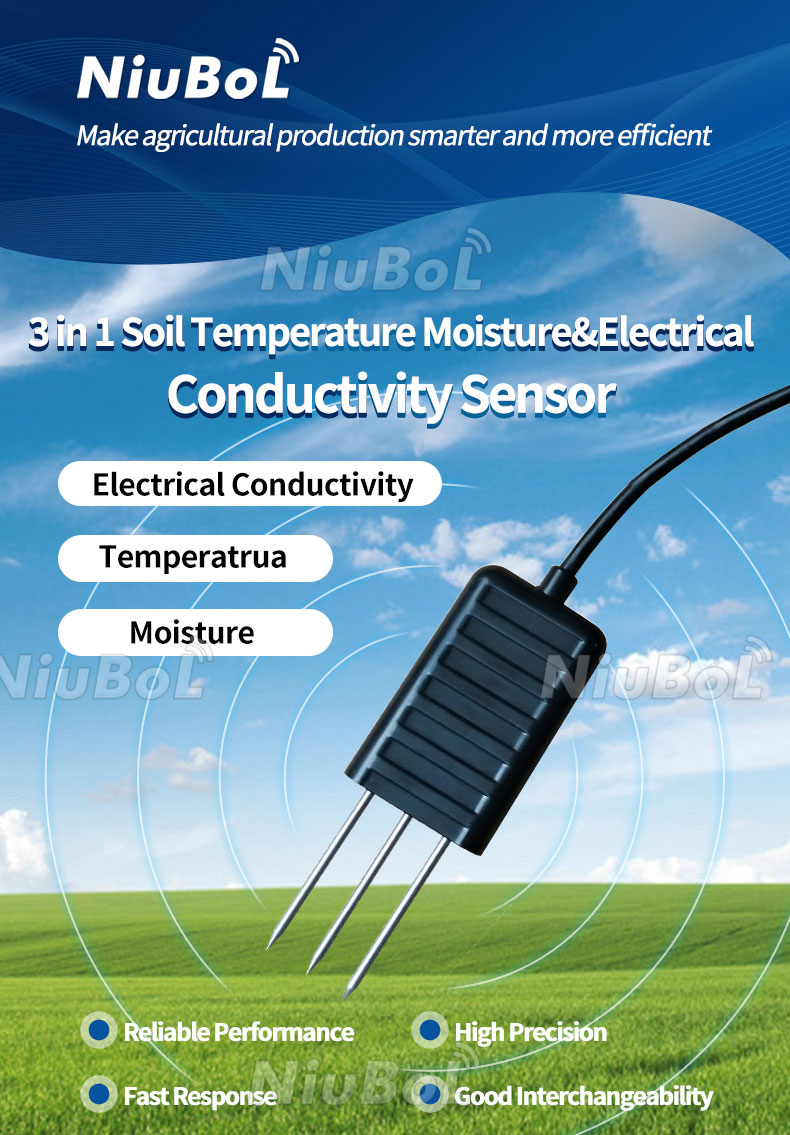
Volumetric water content describes a water volume relative to soil volume. It is not atmospheric relative humidity, even if a legacy screen or document uses an RH label. EC in uS/cm describes electrical conductivity, while a salinity channel reported in mg/L uses a different quantity and conversion basis. Preserve the selected instrument's units in the receiving application.
A rising EC value can accompany changes in water content, temperature and dissolved ions. It does not identify individual nutrient concentrations. If salt conditions matter to the project, compare a suitable EC or salinity channel with the agreed soil assessment method rather than treat the moisture value as a salt measurement.
| Equipment | Selected specification | Ordering check |
|---|---|---|
| NBL-S-TM | Temperature -40 to 80 C, accuracy +/-0.5 C; volumetric moisture 0-100%, accuracy +/-5% | Keep temperature and moisture ranges separate |
| NBL-S-TM integration | RS485 Modbus RTU; IP68; standard cable 5 m; DC 5-24 V or 12-24 V configuration | Confirm the approved supply and cable for the delivered version |
| NBL-S-TMSMS | FDR profile moisture; temperature -40 to 80 C; moisture accuracy +/-3% under laboratory conditions | Specify actual depth nodes and field comparison requirements |
| NBL-S-TMSMS configuration | RS485 Modbus RTU; up to 10 layers depending on configuration; IP67 above ground and IP68 below ground | List depth positions and any optional functions explicitly |
Do not infer the delivered depth list from the maximum number of layers. For example, a requested 10, 20, 30 and 40 cm arrangement must be agreed as that arrangement. Additional depths change the sensor configuration; they are not created by adding labels to a dashboard.
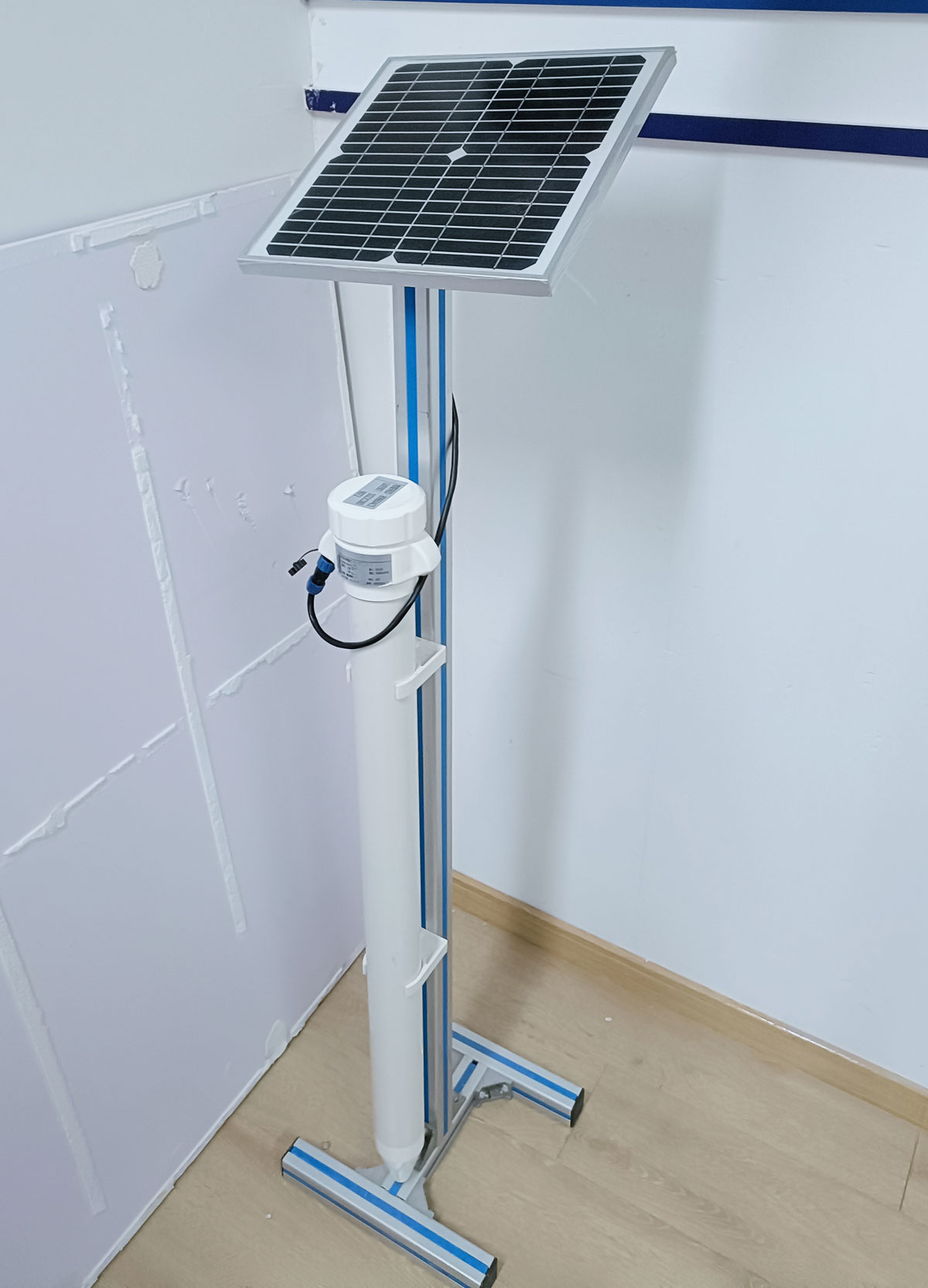
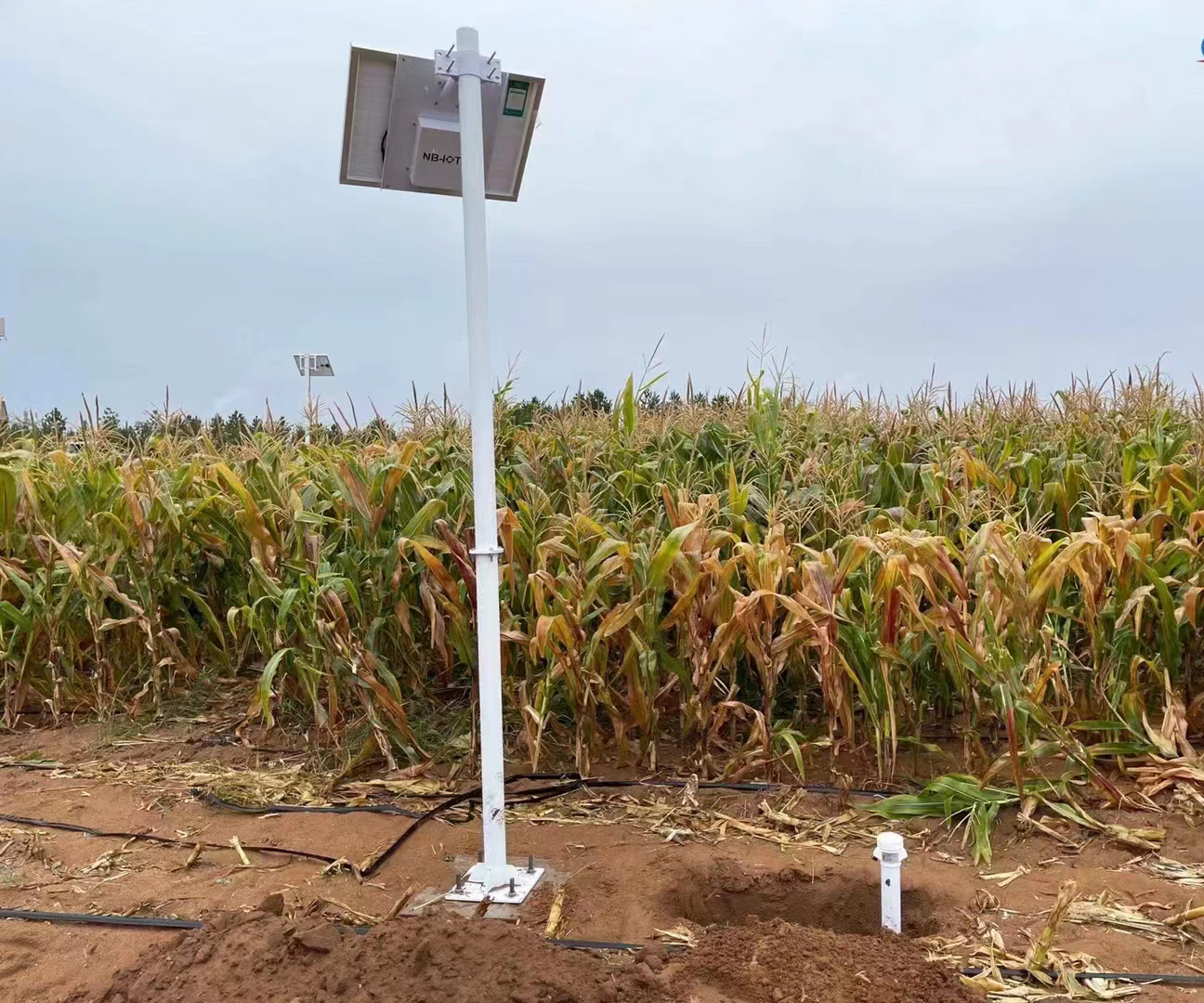
The NBL-S-TMSMS supports RS485 connection to compatible collection equipment. Solar power, battery supply and remote 4G communication can be configured at system level. Determine which parts are included, where the cable terminates and which equipment holds the history before ordering a remote station.
Optional GPS, tilt or vibration monitoring must be identified separately. A tilted tube does not by itself establish ground displacement or slope instability; movement interpretation requires a suitable reference and project method. Do not specify a standard soil-moisture tube as a complete geotechnical warning system merely because an optional movement function is available.
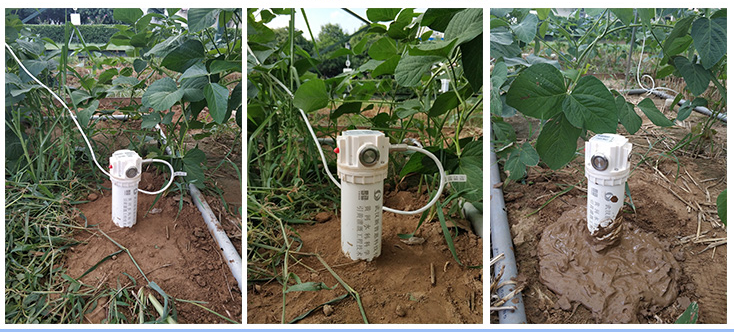
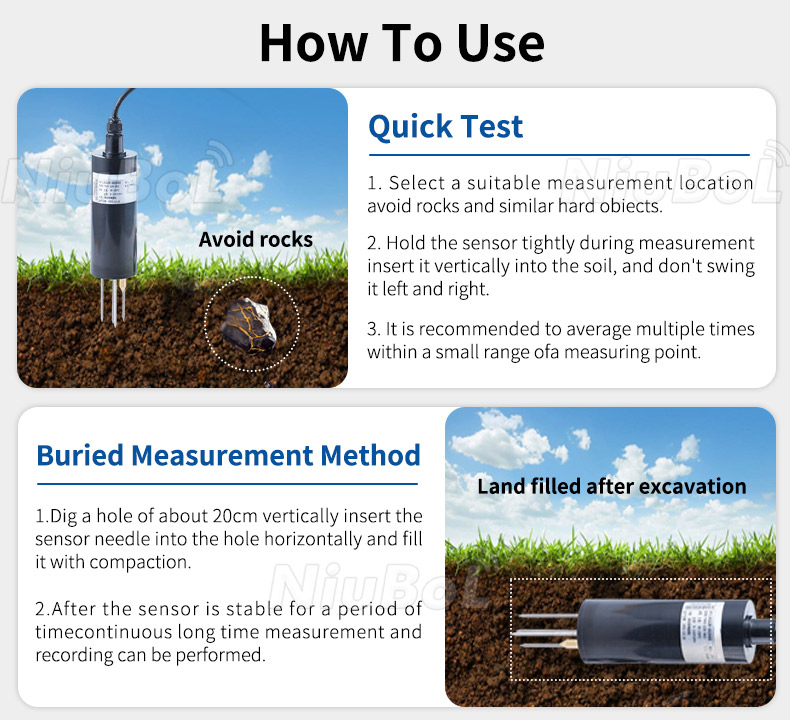
Dielectric measurement depends on the soil around the sensing area. Air gaps, disturbed soil, density, texture and salinity can affect interpretation. The NBL-S-TM electrodes need close contact; shaking the probe after insertion can create gaps. A tubular sensor needs contact along the intended profile without an oversized void or an unintended water path around the tube.
For a buried single-point probe, select depth and orientation before backfilling, and protect the cable from tools and rodents. For a profile sensor, record the ground reference and each configured depth. A wet sensor body with IP68 protection does not make an unsealed cable joint suitable for standing water. Keep buried measurement and above-ground electrical protection separate.
Read each named channel through the intended data logger, PLC or RTU. Match RS485 Modbus RTU addresses, serial settings and scaling; retain units and depth identity in saved records. Check a plausible response under controlled observation and compare with the chosen field method. A plausible number on a screen is not enough if the depths or units are interchanged.
Monitoring does not imply direct valve actuation. An automatic irrigation system also needs an appropriate controller, actuator interface and operational logic. Ask for those items separately when required. For a quotation, send crop and soil information, measurement depths, desired channels, power availability and the receiving equipment instead of requesting an unspecified all-in-one soil sensor.
No. The NBL-S-TM measures temperature and moisture. Select a model with a named EC channel, such as NBL-S-TMC or NBL-S-TMCS, if conductivity is part of the project requirement.
No. Layers are depth positions, whereas four-in-one describes different measured parameters. Specify the depth list and parameter list independently.
No universal immunity should be assumed. Soil electrical properties, texture, density and probe contact can influence dielectric measurements. Evaluate the intended soil and operating conditions when setting comparison criteria.
Those can be configured for a complete station, but they are not implied by an RS485 probe alone. Confirm the logger, modem, power components, data access and installation scope in the offer.
Do not assume it. Identify any optional tilt or vibration function by configuration and required output. Ordinary soil moisture and temperature observations are not ground-displacement measurements.
Use the same parameter and depth schedule, output version, supply, cable and recording scope for each offer. Ask NiuBoL to identify deviations so a bare probe is not compared with a complete remote station as if they were equivalent.
Model-specific instructions: use the document matching the delivered probe and configuration.
NBL-S-THR temperature and moisture instructions (PDF)
 NBL-S-THR-Soil-temperature-and-moisture-sensors-Instruction-Manual-V4.0.pdf
NBL-S-TMC temperature, moisture and EC instructions (PDF)
NBL-S-TMC-Soil-temperature-and-moisture-conductivity-sensor.pdfNBL-S-TM temperature and moisture instructions (PDF)
NBL-S-TM-Soil-temperature-and-moisture-sensor-Instruction-Manual-4.0.pdfNBL-S-TMCS four-parameter instructions (PDF)
NBL-S-TMCS-Soil-Temperature-Humidity-Conductivity-and-Salinity-Sensor.pdfNBL-S-TMSMS profile sensor instructions (PDF)
NBL-S-TMSMS-Tubular-Multi-depth-Soil-Moisture-Sensor-Instruction-Manual.pdfA useful soil moisture sensor specification identifies what is measured, where it is measured and how the result is collected. Separate point and profile layouts, optional parameters and complete-station functions. This avoids purchasing extra channel names without the instruments, installation or data path needed to make those channels useful.
Prev:Integrated vs Conventional Weather Station: Repair and Replacement Scope
Next:Rainfall Monitoring Station Data: Observations Are Not Forecasts
Related recommendations
Sensors & Weather Stations Catalog
Agriculture Sensors and Weather Stations Catalog-NiuBoL.pdf
Weather Stations Catalog-NiuBoL.pdf
Agriculture Sensors Catalog-NiuBoL.pdf
Water Quality Sensor Catalog-NiuBoL.pdf
Related products
 Combined air temperature and relative humidity sensor
 TDR Soil Moisture & Temperature Sensor for irrigation| RS485 |4-20mA| NBL-S-THR
 Soil pH sensor RS485 soil Testing instrument soil ph meter for agriculture |NBL-S-PH
 Wind Speed sensor Output Modbus/RS485/Analog/0-5V/4-20mA
 Tipping bucket rain gauge for weather monitoring auto rainfall sensor RS485/Outdoor/stainless steel
 Pyranometer Solar Radiation Sensor 4-20mA/RS485


Screenshot, WhatsApp to identify the QR code
WhatsApp number:+8615367865107
(Click on WhatsApp to copy and add friends)

