





— Blogs —
—Products—
 Consumer hotline +8618073152920
 WhatsApp:+8615367865107
Address:Room 102, District D, Houhu Industrial Park, Yuelu District, Changsha City, Hunan Province, China
Product knowledge
Time:2026-09-07 16:27:32 Popularity:292
Solar radiation sensor units identify what an instrument reports. W/m2 measures radiant power per unit area; PPFD, expressed in umol/(m2 s), measures photosynthetically active photon flux per unit area. PAR names a spectral region, conventionally 400-700 nm, rather than a unique output unit. Lux describes illumination weighted for human vision. Choose the required quantity first, then the sensing technology and interface. Changing the label on a logger does not convert one measurement into another.
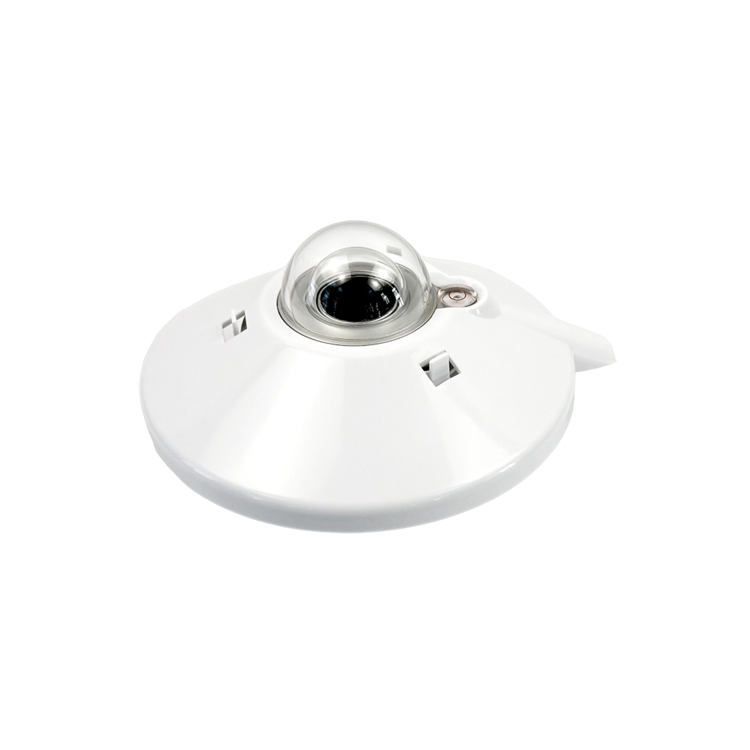
A photovoltaic monitoring engineer needs the irradiance incident on a defined plane. A greenhouse engineer may need the photon flux reaching a crop canopy. Both instruments can look like small upward-facing radiation sensors, yet their signals answer different questions. Matching only the electrical output, such as RS485 or 0-5 V, does not establish measurement equivalence.
| Quantity | Typical unit | What the result tells you |
|---|---|---|
| Solar irradiance | W/m2 | Radiant power arriving per unit area within the instrument's spectral response |
| Solar irradiation | Wh/m2 or kWh/m2 | Irradiance integrated over a stated period |
| PAR irradiance | W/m2 within the defined PAR band | Energy arriving in that spectral band |
| PPFD | umol/(m2 s) | Photosynthetically active photons arriving per unit area per second |
| Daily light integral | mol/(m2 day) | PPFD integrated over a day |
| Illuminance | lux | Light weighted by the standard visual response of the human eye |
For example, a constant irradiance of 600 W/m2 over three hours gives 1.8 kWh/m2. A constant PPFD of 400 umol/(m2 s) over twelve hours gives a daily light integral of 17.28 mol/m2 for that day. These are separate integrations, not equivalent expressions of the same reading. Variable daylight requires integration of the measured series, not multiplication of the noon peak by the daylight duration.
A thermopile pyranometer absorbs radiation at a sensing surface and converts the resulting temperature difference into an electrical signal. Its broad shortwave response makes it useful for solar-resource and meteorological measurements where the integrated solar energy is the quantity of interest.
A silicon detector produces an electrical response to incident light over its supported wavelengths. Filters and calibration shape the response for a particular task. Silicon instruments can be useful for fast-response or compact monitoring, but a detector calibrated in sunlight may respond differently when the spectrum changes under glazing or artificial lighting.
Do not assume that all thermopile instruments have the same response time or uncertainty, or that all silicon instruments measure PPFD. Compare the spectral response, cosine behavior, calibration conditions and output definition of the actual model. A low purchase price is not meaningful if the selected instrument measures the wrong quantity for the project.
A broad-band pyranometer also does not separately identify ultraviolet, visible and infrared contributions. It integrates the radiation reaching its detector within its response band. Separate spectral measurements require appropriate instruments or optical configurations; a single total-irradiance channel is not a spectrometer.
PAR refers to photosynthetically active radiation in the conventional 400-700 nm band. Within that band, an instrument can report energy or a photon-based quantity. PPFD counts photons on a molar basis, whereas W/m2 weights them by their energy. Photon energy depends on wavelength, so a fixed conversion factor cannot be applied accurately to every lamp spectrum and daylight condition.
This matters when comparing a sunlight-calibrated sensor with a reference under narrow-band horticultural lighting. Before calling the difference a calibration error, check whether both instruments measure PPFD and whether their spectral responses suit the light source. Similar readings outdoors do not establish equivalence under red and blue LED channels.
The NiuBoL NBL-W-PARS PAR sensor uses a silicon photodetector and a 400-700 nm filter. Its energy-output configuration reports W/m2. For a project requiring PPFD or a photon-based daily light integral, specify the required quantum-calibrated output, range and register unit before ordering. Do not interpret an energy-output PAR register as umol/(m2 s).
Place a crop-light sensor at the plane relevant to the decision. A roof-level sunlight measurement does not describe the light beneath glazing, shade cloth and a developing canopy. Map representative crop positions when light uniformity matters, and identify any shading created by the mounting arm itself.
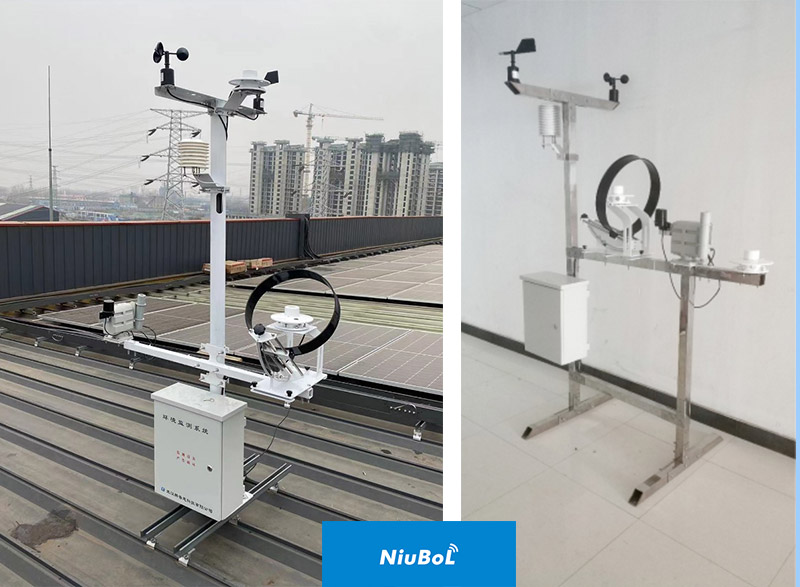
Global horizontal irradiance, or GHI, is measured on a horizontal plane and includes direct sunlight projected onto that plane plus diffuse sky radiation. Plane-of-array irradiance is measured in the plane of the photovoltaic modules. The same type of pyranometer can serve these roles, but the mounting orientation changes what it measures.
Direct normal irradiance, or DNI, measures the direct solar beam on a surface normal to the sun's rays. It calls for a suitable direct-radiation instrument and solar pointing. Diffuse horizontal irradiance, or DHI, excludes the direct beam using an appropriate shading arrangement. A bare horizontal pyranometer does not report GHI, DNI and DHI as three independent measurements.
For a tilted PV array, do not label a horizontal sensor's output as plane-of-array irradiance. A calculated estimate requires a suitable model and additional inputs; it should remain distinguishable from a direct measurement. Where both GHI and array-plane data are needed, allocate separate channels and describe each sensor's tilt and azimuth.
| Configuration | Relevant specifications | Integration consequence |
|---|---|---|
| NBL-W-HPRS thermopile pyranometer | 0.3-3 um spectral range; 0-2000 W/m2; response time up to 35 s at 99% | Use for broad-band shortwave irradiance; account for the response time when comparing rapidly changing signals |
| NBL-W-HPRS transmitter options | 12 or 24 VDC configuration; 4-20 mA, 0-5 V or RS485 output options | Order the required interface and apply its corresponding scaling, rather than treating all outputs as simultaneous |
| NBL-W-HPRS-A thermopile pyranometer | 280-3000 nm spectral range; 0-4000 W/m2; sensitivity 7-14 uV/(W/m2); response below 5 s at 95% | Use the individual calibration coefficient and a voltage input with sufficient sensitivity and headroom, or select a suitable transmitter |
| NBL-W-HPRS-A temperature range | -40 to 80 C | Check the receiving electronics and connectors separately; their limits may differ |
| NBL-W-PARS energy-output configuration | 400-700 nm; 0-2000 W/m2; 12-24 VDC; selected voltage or RS485 output | The band is PAR, but this configuration's energy unit is not PPFD |
The NBL-W-HPRS-A and NBL-W-HPRS response figures use different completion percentages, 95% and 99%. They should not be compared as though the test definitions were identical. Likewise, spectral limits do not by themselves describe the full uncertainty at every solar angle or temperature.
For a raw thermopile output, calculate irradiance from measured voltage divided by the individual sensitivity. As a hypothetical example, 9 mV from a sensor calibrated at 10 uV/(W/m2) corresponds to 900 W/m2. Entering 14 instead of 10 as the coefficient would understate the result. The coefficient belongs to the individual calibrated sensor, not merely to the model family.
For a 4-20 mA version scaled to 0-2000 W/m2, 12 mA represents 1000 W/m2. Subtract the 4 mA offset before scaling. For RS485 Modbus RTU, confirm the register unit, data type and scale, then compare a local raw reading with the PLC or data logger value. A successful response does not detect a wrong engineering unit.
Quantity and plane: compare instruments measuring the same physical quantity, at the same orientation and with comparable exposure. A shaded PAR sensor below glass should not be judged against an outdoor broad-band pyranometer as if both observed the same radiation.
Time response: use compatible sampling and averaging periods. During moving-cloud conditions, a fast detector and a slower thermopile can show different instantaneous peaks. Compare sufficiently stable conditions or suitable averages before changing a calibration coefficient.
Optical condition: inspect contamination, condensation, level and unintended shading. A dirty dome can reduce a valid reading without causing a communication alarm. Do not compensate for dirt by altering the sensitivity; clean and recheck the instrument first.
When requesting a NiuBoL configuration, name the required quantity and unit, then describe the measurement plane, natural or artificial light source, range and receiving interface. Include the uncertainty required by the application. This gives a more useful starting point than asking for a generic solar radiation sensor with an RS485 connector.
Not with a universal factor. Lux is visually weighted, while irradiance is an energy measurement. Any conversion depends on the spectrum and can change with lighting conditions. Use an irradiance sensor when the project needs measured W/m2.
No. PAR identifies a wavelength band. An instrument can report energy in that band or a calibrated photon-flux quantity. Check the configured output unit and calibration basis, not just the PAR label.
It means 300-3000 nm, spanning a broad shortwave range. It does not mean the instrument reports a separate value at each wavelength, nor that its sensitivity is perfectly uniform throughout that range.
It can be mounted for either measurement, but one fixed sensor does not measure both planes simultaneously. Use separate instruments or clearly identify any modeled estimate derived from other measurements.
Not automatically. A thermopile can generate its raw voltage without external power, while an added transmitter requires power. Specify the complete signal-conditioning configuration when checking supply voltage and station energy use.
Investigate low-angle cosine response, level, shading and spectral response before assuming a constant calibration offset. A noon-only comparison does not test performance across the daily solar-angle range.
Correct solar radiation sensor units prevent the wrong measurement from entering an otherwise functioning monitoring system. Select irradiance for solar energy, a suitable photon-based measurement for PPFD, and the correct plane for GHI or array monitoring. Then match the detector, calibration and interface to that task, keeping energy and photon-based records clearly separate.
Prev:Piezoelectric vs Tipping Bucket Rain Gauges: Uses and Error Sources
Next:Solar Power for Weather Stations: Panels, Batteries and Autonomy
Related recommendations
Sensors & Weather Stations Catalog
 Agriculture Sensors and Weather Stations Catalog-NiuBoL.pdf
Weather Stations Catalog-NiuBoL.pdf
Agriculture Sensors Catalog-NiuBoL.pdf
Water Quality Sensor Catalog-NiuBoL.pdf
Related products
 Combined air temperature and relative humidity sensor
 TDR Soil Moisture & Temperature Sensor for irrigation| RS485 |4-20mA| NBL-S-THR
 Soil pH sensor RS485 soil Testing instrument soil ph meter for agriculture |NBL-S-PH
 Wind Speed sensor Output Modbus/RS485/Analog/0-5V/4-20mA
 Tipping bucket rain gauge for weather monitoring auto rainfall sensor RS485/Outdoor/stainless steel
 Pyranometer Solar Radiation Sensor 4-20mA/RS485

Screenshot, WhatsApp to identify the QR code
WhatsApp number:+8615367865107
(Click on WhatsApp to copy and add friends)

