





— Blogs —
—Products—
 Consumer hotline +8618073152920
WhatsApp:+8615367865107
Address:Room 102, District D, Houhu Industrial Park, Yuelu District, Changsha City, Hunan Province, China
Product knowledge
Time:2026-09-21 11:00:00 Popularity:206
An online water quality sensor package for secondary water supply should be selected around the building's storage and distribution risks, not the largest available parameter count. Specify a low-range turbidity channel, the appropriate disinfectant measurement and pH where needed for interpretation; add conductivity only when source variation or mixing warrants it. Compare the complete sampling and data system with the existing pump-room controls before ordering. A multi-parameter immersion probe and a low-range drinking-water monitoring panel are not interchangeable packages.
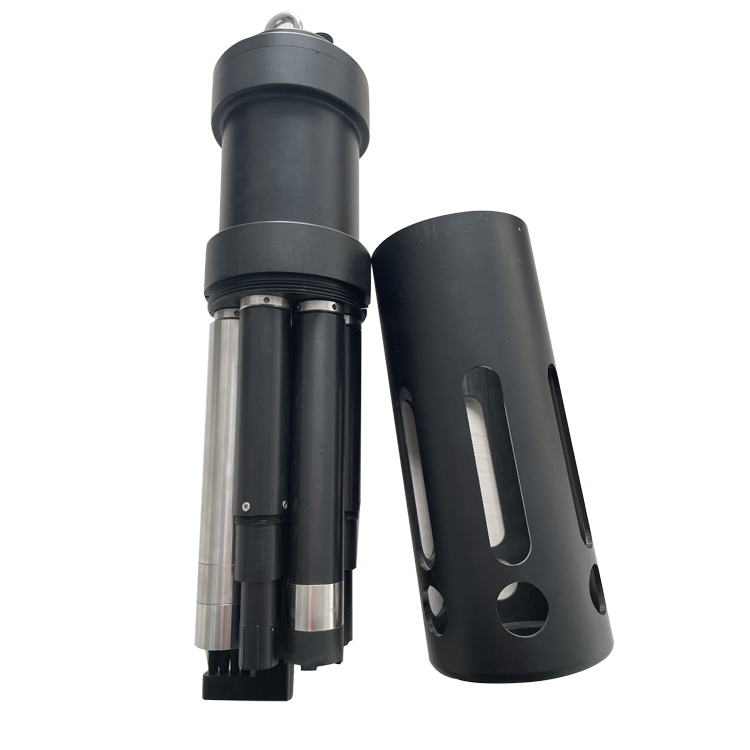
Secondary water supply usually involves storage, boosting or local distribution after the incoming supply. The useful monitoring question is what may change through that equipment: residual disinfectant, particle content, temperature, source composition or the availability of a fresh sample. The package must distinguish those changes from a stopped sampling line or a sensor being serviced.
For a tank-and-booster installation, a package at the delivery outlet can support continuous observation of the water being sent downstream. It does not, by itself, separate an incoming-water event from a change inside the tank. When that distinction is necessary, include a comparable upstream measurement or a defined upstream sampling routine. Do not claim that one downstream probe diagnoses every tank compartment.
| Operating question | Useful measurement | What to exclude or qualify |
|---|---|---|
| Has particle content changed after storage or pump operation? | Low-range turbidity with representative sampling | A broad wastewater range whose error allowance exceeds the change of interest |
| Is the required disinfectant residual present? | A channel matched to free, combined or total chlorine duty | A generic residual label without a defined chemical basis |
| Could water chemistry explain a chlorine-signal change? | pH and temperature at a comparable point | An assumption that a separate pH probe automatically corrects the chlorine output |
| Has the source or blend changed? | Conductivity at a range suitable for the local water | A seawater salinity range selected solely because it is available |
| Are the readings current? | Sample-flow status, instrument health and timestamps | A held value displayed as fresh data |
This is an operational monitoring package, not a complete test for drinking-water safety. Microbiological checks and any required laboratory analyses remain separate duties. Nor does an ORP channel substitute for a specified chlorine measurement simply because both respond to aspects of the water's chemistry.
The immersion turbidity probe below is a different installation option from the wall-mounted flow cell. Its own range and uncertainty must support the application; it does not inherit the TSA-4 specification.
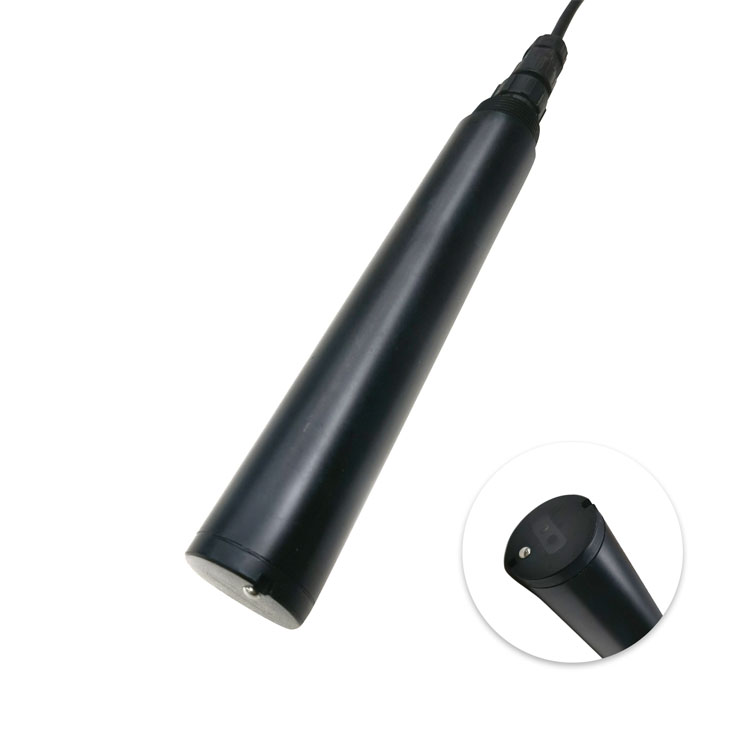
The NiuBoL NBL-WQ-TSA-4 is a wall-mounted flow-through turbidity instrument intended for low-range applications. Its 0-10.000 NTU range and 0.001 NTU resolution differ from the broader turbidity options in general-purpose immersion assemblies. Resolution describes the smallest reported increment, not the smallest change that can be accepted as real.
For example, a procurement decision that depends on distinguishing 0.03 NTU from 0.04 NTU cannot be justified by a three-decimal display alone. The TSA-4 accuracy expression includes an absolute 0.02 NTU term as well as a percentage term, with the larger governing. Establish the exact ordered accuracy basis and the required uncertainty at the decision point. If those requirements do not match, specify a different qualified measurement arrangement rather than relaxing the acceptance test after delivery.
| Item | NBL-WQ-TSA-4 | Package implication |
|---|---|---|
| Measurement | 90-degree scattered-light turbidity; 0-10.000 NTU | Select for the actual low-range duty and comparison method. |
| Resolution and accuracy | 0.001 NTU; accuracy expression +/-5% or +/-0.02 NTU, whichever is greater | Confirm the percentage basis and acceptance tolerance for the ordered instrument. |
| Power | 12-24 VDC; 0.2 W at 12 V | Add controller, communications and any pump loads separately. |
| Output | RS485 Modbus RTU; optional 4-20 mA | Choose the ordered interface before allocating pump-room inputs. |
| Operating conditions | 0-60 degrees C; pressure at or below 0.2 MPa | Check pressure reduction and the limits of every connected fitting. |
| Protection and mounting | IP65; wall-mounted flow cell; composite housing | Do not install it as a submerged probe. |
| Cable | Five-core shielded cable | Specify length, jacket suitability and termination protection for the room. |
An immersion-probe arrangement requires a different assessment. The NBL-WQ-MPS-5A family offers selectable water-quality channels, but parameter count alone does not establish suitability for low-turbidity secondary supply. Compare each proposed module's range, uncertainty and access requirements before choosing an integrated assembly.
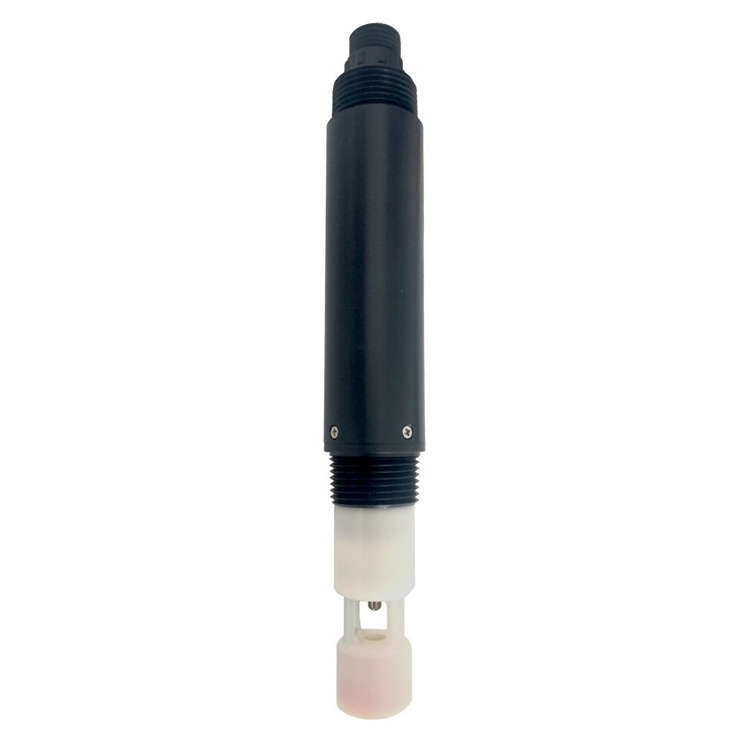
The NBL-WQ-EC-S salinity sensor has a 0-70 PSU span, 0.1 PSU resolution and a stated accuracy of +/-1.5% full scale. On that span, 1.5% corresponds to 1.05 PSU. It is not a sensible default for detecting small changes in ordinary freshwater simply because a package has a spare input.
If source mixing is the real concern, ask for conductivity in the appropriate uS/cm or mS/cm range and identify whether the output is temperature-compensated. Do not convert conductivity into a claimed universal TDS or salinity value without an appropriate relationship. The sensor shown later is relevant when a genuine salinity duty exists; it is not a compulsory component of every secondary-supply package.
A retrofit can be economical when the building already has a suitable controller, spare inputs, data storage and a maintained sample point. Its quotation should identify what remains with the building contractor: pressure reduction, flow control, drain connection, mounting, power protection and software changes. A probe-only offer is incomplete if those items have no assigned supplier.
A complete panel can simplify assembly, but request a drawing showing the actual sample path, isolation valves, reference-sample access and drainage. Different sensors may require different flows. Check that maintenance of one cell does not silently invalidate the others, and that the available room allows removal of each probe without dismantling the whole panel.
For remote buildings, decide whether the gateway only transmits data or also stores it during outages. The required archive should preserve measurement time, validity and service status, not merely the latest value. Existing building-management access may be preferable to an additional cloud connection, but confirm the actual protocol and responsible software integrator.
Acceptance should test more than one instant value: check the reference response, sample flow, bubbles, unit scaling and stability after cleaning. Run those checks during representative booster operation and tank filling, where practical. Pressure variation that changes flow can expose a sampling problem that a quiet bench test misses.
For RS485 Modbus RTU integration, verify the address and decoding of each delivered device. Compare the local reading, controller value and stored record at the same time. Test a disconnected sensor and a sample interruption separately. A communication fault must not become a genuine zero concentration, and a valid serial reply must not conceal stagnant water.
Record the approved operating response to each alarm. Monitoring can notify an operator without being authorized to stop a booster pump or change a disinfectant dose. Any automatic action needs separately designed interlocks and site approval. Do not let a generic gateway rule create an unreviewed water-supply shutdown.
When requesting a NiuBoL package quotation, send the disinfectant form, required parameters and tolerances, existing controller, inlet pressure range, sample disposal arrangement and room photographs. Ask for the proposed channel models, accessories and commissioning work as separate line items. This makes a retrofit and a complete panel comparable without pretending they have the same installed price.
No. Select the channels that answer the building's operating questions and meet its accuracy requirements. A compact immersion assembly may offer convenient shared wiring, while separate flow-through instruments can suit low-range measurements and individual servicing. Compare the actual modules, not the number on the package label.
It can if its communication hardware and program support the ordered RS485 Modbus RTU devices. Check registers, scaling, addresses and fault handling. Where only analog inputs are available, specify the appropriate output version or a suitable interface; do not assume every sensor includes 4-20 mA.
Only when the measurement has an identified use, such as source-change observation. Choose a range that resolves the expected change with adequate accuracy. A 0-70 PSU salinity probe is not equivalent to a low-range freshwater conductivity channel.
No. Online measurements cover selected parameters at a selected point. Reference checks remain necessary for instrument verification, and required microbiological or laboratory testing has its own purpose. The sampling programme should complement the online record rather than duplicate its timestamps without analysis.
Missing pressure-control hardware, an unusable drain, incompatible host inputs, inaccessible cells or an unplanned communications service can all require additional work. Compare these items before purchase, together with standards and replacement electrodes. Ask for a site-specific quotation rather than extrapolating a complete package price from one probe.
Possibly, after checking available capacity, voltage at the instruments, electrical noise and protection. Sensor power is only part of the load. Test the monitoring system through normal pump starts and power recovery, and confirm that a pump fault cannot leave stale values displayed as current water-quality data.
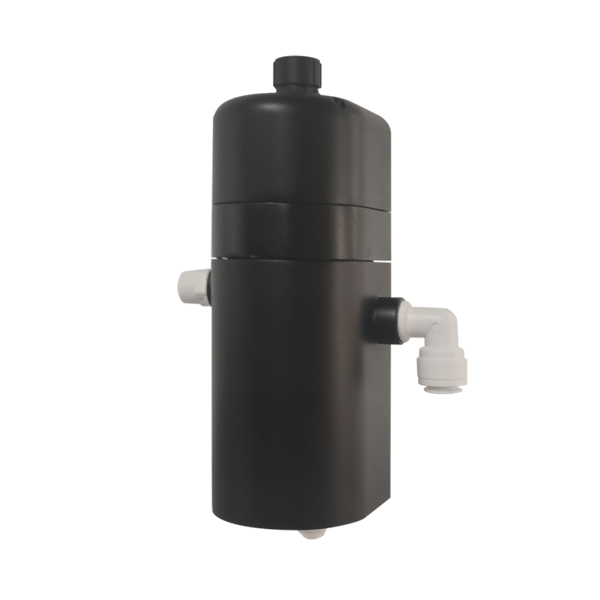
Choose an online water quality sensor package by the changes the secondary-supply operator needs to detect. Prioritize suitable low-range measurements, a defined disinfectant channel and a sample system that remains serviceable during building operation. NiuBoL can assess the required instruments and integration scope from the existing controls, water conditions and installation layout; additional parameters should earn their place through a specific use.
Prev:Residual Chlorine, pH and Turbidity Monitoring for Urban Water Supply Networks
Next:Multi-Parameter Water Quality Sensor: Choose Reservoir Monitoring Depths
Related recommendations
Sensors & Weather Stations Catalog
 Agriculture Sensors and Weather Stations Catalog-NiuBoL.pdf
Weather Stations Catalog-NiuBoL.pdf
Agriculture Sensors Catalog-NiuBoL.pdf
Water Quality Sensor Catalog-NiuBoL.pdf
Related products
 Combined air temperature and relative humidity sensor
 TDR Soil Moisture & Temperature Sensor for irrigation| RS485 |4-20mA| NBL-S-THR
 Soil pH sensor RS485 soil Testing instrument soil ph meter for agriculture |NBL-S-PH
 Wind Speed sensor Output Modbus/RS485/Analog/0-5V/4-20mA
 Tipping bucket rain gauge for weather monitoring auto rainfall sensor RS485/Outdoor/stainless steel
 Pyranometer Solar Radiation Sensor 4-20mA/RS485


Screenshot, WhatsApp to identify the QR code
WhatsApp number:+8615367865107
(Click on WhatsApp to copy and add friends)

