





— Blogs —
—Products—
 Consumer hotline +8618073152920
WhatsApp:+8615367865107
Address:Room 102, District D, Houhu Industrial Park, Yuelu District, Changsha City, Hunan Province, China
Product knowledge
Time:2026-09-21 12:00:00 Popularity:175
A multi-parameter water quality sensor for a reservoir should be selected around the water layer and event being monitored. A combined probe provides several observations at one location; it does not measure the entire water column. Decide whether the project needs a fixed-depth trend, several permanent depths or periodic profiling before choosing channels and mounting hardware.
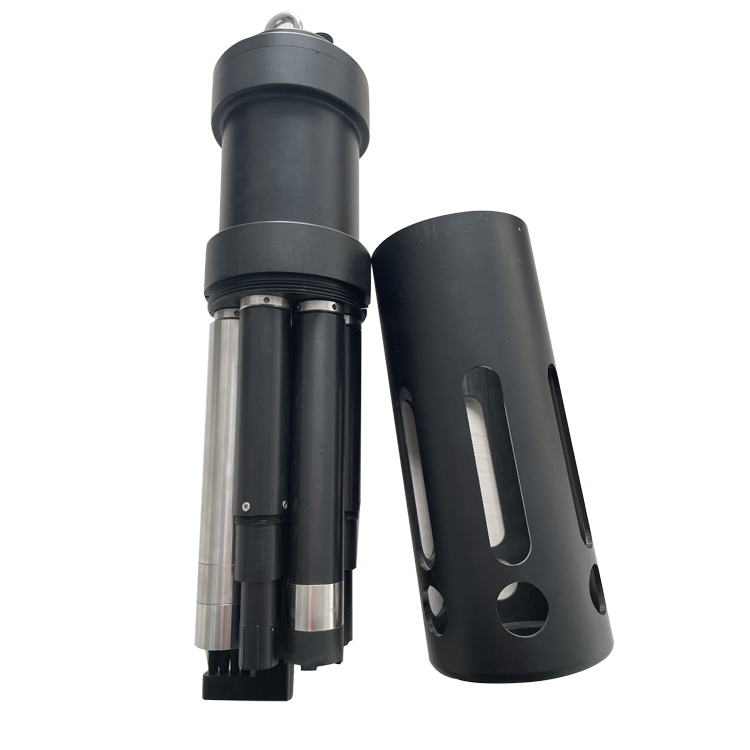
Start with the intake elevation, operating water-level range and intended response. A near-surface station may be useful for tracking an incoming plume, while a deeper intake requires observations representative of the water entering that intake. These duties may require different positions even when they use the same parameter list.
Reservoir stratification can separate water layers with different temperature and dissolved oxygen conditions. The USGS publication on reservoir temperature and oxygen describes vertical profiles and stratified conditions. A stable surface reading therefore does not establish a stable intake condition. Conversely, a bottom-mounted probe can become a sediment observation point rather than a useful intake indicator if placement and water movement are poorly chosen.
| Monitoring arrangement | What it can answer | Limitation to address |
|---|---|---|
| One fixed-depth probe | How the selected location changes over time | Cannot identify vertical structure by itself |
| Several fixed-depth probes | How selected water layers differ at approximately the same time | More instruments, cables and service points; depth and pressure approval for every assembly |
| A probe moved through a profile | How conditions vary with depth during the survey | Readings occur at different times; allow stabilization and record actual depth |
| Intake-focused measurement | What the operational intake is drawing under the current arrangement | May not characterize distant reservoir areas or another intake elevation |
Define how depth is maintained when water level changes. A surface-referenced float follows the surface; a fixed bracket does not. The distinction affects the meaning of every trend. Include a water-level or depth record where needed, without assuming that an ordinary water-quality probe measures its own depth.
The NiuBoL NBL-WQ-MPS-5A combines optional sensing modules, including dissolved oxygen, pH, conductivity/salinity, turbidity, ORP and ammonia nitrogen. The assembly supports up to eight parameters including temperature, subject to the offered configuration. Specify the actual installed modules and output list rather than ordering "eight parameters" as though each output were a separate independent sensor.
Temperature and DO are useful for comparing selected layers; conductivity can help distinguish changes in dissolved ionic content. Turbidity adds particle information but does not identify the particles. An ammonia module requires its own matrix and range review. Do not purchase a channel merely because space is available if nobody can explain how its result will be interpreted.
| MPS-5A item | Configuration information | Reservoir decision |
|---|---|---|
| DO module | 0–20 mg/L; accuracy ±0.4 mg/L; resolution 0.01 mg/L | Assess useful layer-to-layer differences against the offered accuracy. |
| pH module | 0–14 pH; ±0.1 pH; resolution 0.01 pH | Retain calibration and electrode-service access. |
| Conductivity/salinity options | 0–5000 μS/cm, 0–200 mS/cm or 0–70 PSU; ±1.5% FS | Order the relevant range and units; do not interchange EC and salinity labels. |
| Turbidity options | 0–100 NTU or 0–1000 NTU; resolution 0.1 NTU | Review expected clear-water and event conditions before choosing the span. |
| Supply and consumption | 12 VDC ±5%; 5 W at 12 V | Do not connect directly to a 24 V rail or size the supply as a loose 0.2 W probe. |
| Communication and cleaning | RS485 Modbus RTU; automatic brush cleaning | Identify channels and coordinate cleaning-related data handling. |
| Cable and exposure approval | Standard 5 m cable; customized lengths available | Specify cable jacket, connectors, immersion depth, pressure and protection requirements for the complete offered assembly. |
The 5 W figure corresponds to about 0.42 A at 12 V by calculation. It is not a declared peak starting current. Request the cleaning-cycle peak and supply requirements for the final module combination before sizing cable conductors, regulators or battery reserve. A nominal wattage alone is insufficient for a long submerged cable run.
A separate turbidity probe can provide a dedicated particle observation where an integrated assembly is unnecessary. The following single-parameter instrument is not the MPS-5A body; approve its mounting and limits separately if it is included in the reservoir design.
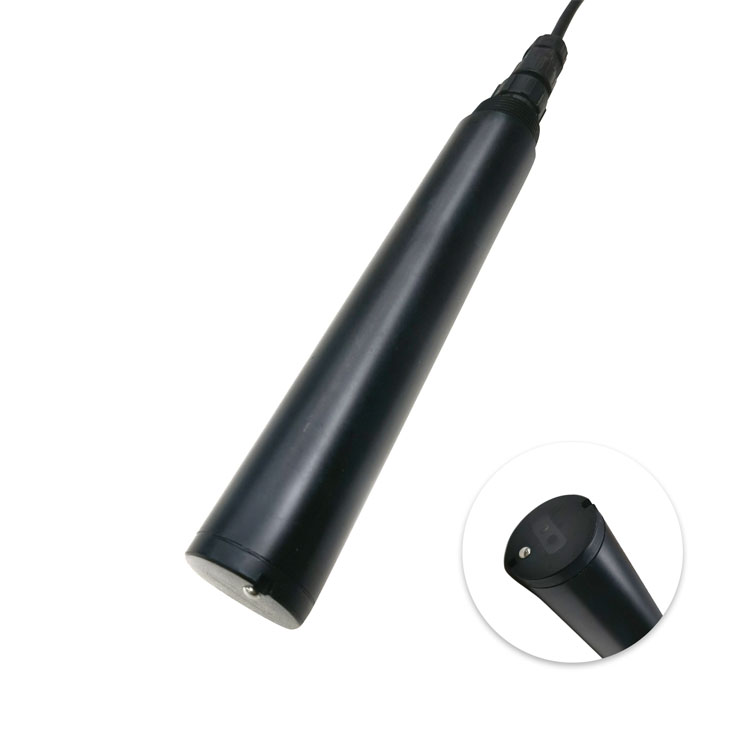
The NBL-WQ-FUV-200 uses spectral absorption to provide outputs such as COD equivalent, TOC, BOD, color and turbidity. Its several outputs do not replace electrochemical pH or dissolved oxygen modules. Likewise, they must not be counted as independent laboratory determinations simply because several values appear on the screen.
For an intake concerned with changing organic-water characteristics, spectral observations can complement a conventional multiparameter assembly. Establish sample-specific comparisons with suitable laboratory methods before relying on equivalent organic parameters. A correlation developed for one water type may not remain suitable after a runoff event changes its composition.
Keep product limits distinct. The FUV-200 specification lists 0–45 °C and pressure below 0.1 MPa, with installation no deeper than 2 m below the surface. It is therefore not an unrestricted deep-profile instrument; these are not pressure or depth specifications for MPS-5A. Neither an IP68 label nor a customizable cable length should be used to infer unrestricted deep-water deployment. Obtain depth and pressure approval for the selected body, modules, joints and cable.
Provide a lifting or mounting arrangement that supports the assembly without using its electrical cable as the lifting member. Locate the probe away from repeated sediment burial, dense bubbles and debris impact. Check the lowest operating water level so the selected modules remain in suitable water rather than intermittently exposed air.
The cleaning brush can reduce surface attachment, but inspection remains necessary. A jammed brush, worn cleaning component or fouled protective cover can affect several observations together. Plan a safe retrieval route and channel-specific checks after cleaning; a moving brush is not proof that every sensor is calibrated.
The separate multiparameter module and cleaning guide covers channel servicing in more detail. For reservoir deployment, access and depth consistency should determine whether a combined assembly is practical at each location.
At the RTU or data logger, assign each assembly a unique identity and retain parameter, unit, location and depth basis. If a probe is moved, record the new position instead of silently continuing the old depth label. Depth changes can produce genuine concentration changes that are otherwise mistaken for sensor drift.
When comparing several layers, align acquisition times and identify missing observations. Do not join an old deep-water value with a new surface reading to present a supposedly simultaneous profile. Cleaning periods and retrieval should be distinguishable from normal measurements, using supported instrument indications or recorded service events.
Send NiuBoL an intake sketch, water-level range, proposed depths, required modules, known turbidity events and retrieval method. Include cable routing and available power. This enables a review of the actual assembly rather than a quotation for a parameter count without an installable monitoring arrangement.
No. It observes its immediate measuring location. Reservoir-wide or vertical conclusions require a monitoring design with suitable locations, depths and timing.
Not necessarily. A floating mount normally follows surface level, whereas a fixed bracket maintains its elevation. Specify whether depth is referenced to the surface, structure or intake.
Its stated supply is 12 VDC ±5%. Use a suitable regulated supply arrangement and verify voltage at the assembly during operation; do not apply another instrument's 12–24 V rating to it.
No. Spectral equivalent organic parameters and modular pH, DO or conductivity measurements have different methods and uses. Compare the actual measurement list rather than the number of outputs.
No. The assembly still needs inspection, module-specific comparison and calibration where required. Safe retrieval and spare availability remain part of deployment planning.
Check the approved immersion conditions, useful channel performance, supplied power during cleaning, depth labeling and practical recovery for service. Repeat observations at the intended positions before treating the station as a reliable vertical comparison.
A reservoir sensor order begins with a location and depth decision. Select the MPS-5A modules or complementary FUV-200 observations that answer that decision, approve the actual immersion conditions and preserve depth identity throughout the data path. Several channels at one point cannot substitute for a properly designed water-column monitoring arrangement.
Prev:Online Water Quality Sensor Package for Secondary Water Supply Monitoring
Next:Self-Cleaning Multi-Parameter Water Quality Probe for High-Fouling Sites
Related recommendations
Sensors & Weather Stations Catalog
 Agriculture Sensors and Weather Stations Catalog-NiuBoL.pdf
Weather Stations Catalog-NiuBoL.pdf
Agriculture Sensors Catalog-NiuBoL.pdf
Water Quality Sensor Catalog-NiuBoL.pdf
Related products
 Combined air temperature and relative humidity sensor
 TDR Soil Moisture & Temperature Sensor for irrigation| RS485 |4-20mA| NBL-S-THR
 Soil pH sensor RS485 soil Testing instrument soil ph meter for agriculture |NBL-S-PH
 Wind Speed sensor Output Modbus/RS485/Analog/0-5V/4-20mA
 Tipping bucket rain gauge for weather monitoring auto rainfall sensor RS485/Outdoor/stainless steel
 Pyranometer Solar Radiation Sensor 4-20mA/RS485


Screenshot, WhatsApp to identify the QR code
WhatsApp number:+8615367865107
(Click on WhatsApp to copy and add friends)

