





— Blogs —
—Products—
 Consumer hotline +8618073152920
WhatsApp:+8615367865107
Address:Room 102, District D, Houhu Industrial Park, Yuelu District, Changsha City, Hunan Province, China
Product knowledge
Time:2026-09-22 11:00:00 Popularity:192
A water quality monitoring system needs a defined measurement record between its sensors, data logger and cloud database. A value without its unit, measuring point, acquisition time and quality status can be stored successfully yet interpreted incorrectly. Agree the record format and channel identity before programming the RTU or choosing a gateway configuration.
Consider a station with temperature, dissolved oxygen, pH, turbidity, conductivity and ORP. The installer sees six channels, but the database designer must decide whether one sampling event produces one record containing six values or six separate parameter records. Both arrangements can work; their identifiers, missing-value handling and storage calculations differ.
At a hypothetical five-minute acquisition interval, there are 288 sampling events per day. One combined record per event gives 288 records; one row per channel gives 1,728 rows for six channels. Neither number is a storage-capacity guarantee. Actual record size includes identifiers, timestamps, quality fields and database or file overhead.
The separate offline logging and store-and-forward guide explains outage retention. For a water-quality project, first settle what each retained record means. Otherwise the logger and server may count different things as one sample.
| Record field | Purpose | Error it prevents |
|---|---|---|
| Station and measuring-point identifiers | Identify the physical water location, not only the cabinet. | A moved probe silently continuing the old point's history |
| Instrument identity and configuration version | Associate a result with the installed model and conversion settings. | A changed range or replacement being hidden in an apparently continuous trend |
| Parameter, value and unit | Keep the engineering meaning with the number. | Conductivity being displayed as salinity, or mS/cm being read as μS/cm |
| Acquisition time and server receipt time | Distinguish when the observation was obtained from when it arrived. | Delayed uploads appearing to be current water conditions |
| Quality and operating state | Identify unavailable, stale or serviced observations. | A timeout or removed probe being interpreted as a valid zero |
| Record identifier | Allow a receiving application to recognize an already accepted record. | Retransmission producing duplicate historical measurements |
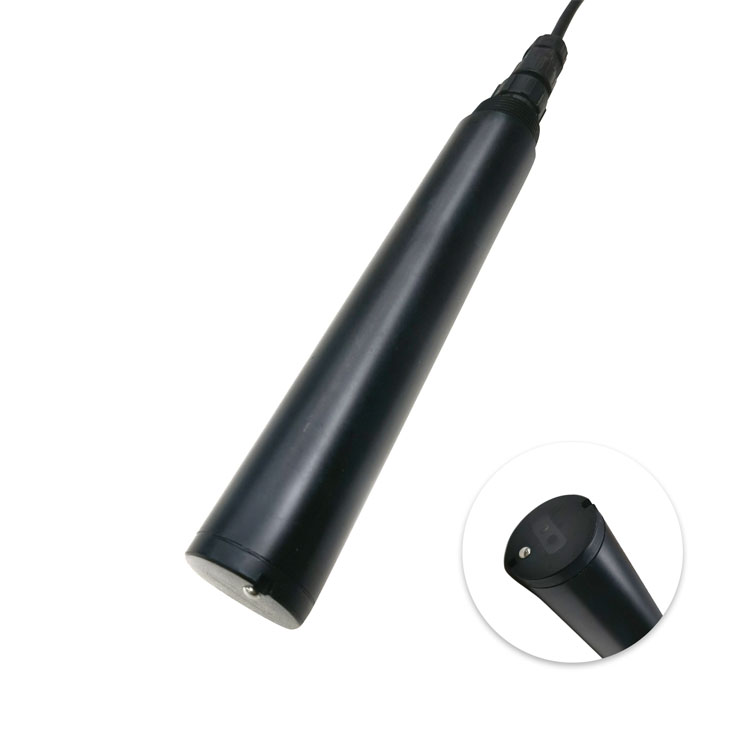
A station can contain several instruments, and an integrated instrument can return several parameters. Give these different identities. The turbidity probe pictured above is a single-parameter instrument; it is not a complete multiparameter station. Its Modbus address identifies a device on a particular serial bus, not a globally unique monitoring location.
For an MPS-5B assembly, store the module list with the configuration. If a module is not fitted, represent that condition explicitly rather than filling its channel with zero. If a probe is reassigned from one intake to another, start the appropriate location association while preserving the earlier records.
Keep unit conversion in an identified processing step. A value transmitted in mS/cm and displayed in μS/cm requires multiplication by 1,000. Record which system performs that conversion so it is not applied again at the server. Retain raw register words during commissioning when they help verify the decoder, without presenting them as engineering measurements.
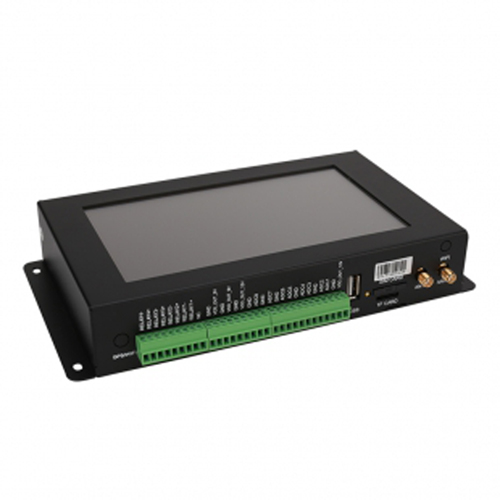
NiuBoL's TG462 and TG462S acquisition devices provide industrial interfaces and networking functions for compatible field instruments. Their serial ports can provide a route from RS485 Modbus RTU sensors toward an Ethernet or cellular network. The required sensor parser, outgoing payload and server behavior still need configuration for the project.
| Hardware item | Specification or option | What remains to configure |
|---|---|---|
| TG462/TG462S serial interfaces | 3 RS485 ports; 4 RS232 ports including one debug port | Bus assignment, serial settings and the model-specific register map |
| Network functions | 2 Ethernet ports; cellular by regional configuration; optional Wi-Fi | Site connectivity, destination server and the selected data exchange |
| Storage | TG462 256 MB flash, optional 1 GB; TG462S 1 GB; Micro SD up to 32 GB | Usable record capacity, retention policy and behavior after interruption |
| Gateway supply and exposure | 5–35 VDC input; IP30; -35 to +75 °C | Suitable field cabinet, complete power budget and non-condensing installation |
| MPS-5B sensor assembly | Up to 6 parameters including temperature; 12 VDC; 2 W at 12 V | Installed modules, supported channel mapping and cleaning-related data handling |
| MPS-5B wet assembly | 0–50 °C; pressure ≤0.2 MPa; IP68; POM/316L; standard 5 m cable | Actual immersion arrangement, cable jacket and protected joints |
Storage hardware does not establish automatic replay, power-loss preservation or a customer-specific JSON payload. Request these behaviors for the supplied application. Likewise, MQTT support does not by itself determine database field names, record deduplication or how maintenance states appear on a customer's platform.
Where an instrument has no usable source timestamp, the acquisition device must assign a suitable acquisition timestamp. Record the time basis, synchronization method and handling of an invalid clock. Keep server receipt time separately. A backfilled value may be historically useful but should not trigger a live-response alarm as though the water has just changed.
If a station loses network access while continuing acquisition, recovered history should retain the original acquisition times. Decide whether late data updates historical summaries and how duplicate arrivals are handled. Test this with the actual server application, not only with a terminal showing successful messages.
Cleaning, calibration, retrieval and module replacement can change the meaning of a record. Use supported instrument status where available; otherwise provide a deliberate service-event entry. A flat value during retrieval should not quietly become a long period of apparently stable process water.
Version changes to scaling, parameter assignment and units. Do not overwrite earlier values with a new conversion without preserving what changed and why. When replacing an assembly, record its identity and effective date so a later trend review can distinguish a real water event from a configuration change.
For system quotation, send NiuBoL the sensor and module list, acquisition interval, example outgoing record and receiving-server requirements. State the required local export and interruption behavior. This defines programming and verification work that a port-count comparison misses.

No. The same address can exist on different ports or stations and can be reassigned. Associate the device with a station, measuring point and instrument identity.
Either is possible. Define the record structure, partial-channel failure handling and record identity before sizing retention or writing an import routine.
Not where delayed transmission matters. Retain acquisition time for historical interpretation and receipt time for communication diagnosis. Specify how an invalid acquisition clock is flagged.
No. Capacity depends on the actual record format, storage allocation and software retention policy. Verify a representative export and the agreed behavior when storage becomes full.
Only if the acquisition application and server already support its module list, values, units and quality states. A shared protocol name does not prove compatible record structure.
Trace a known channel from the field response into a stored record, then test one unavailable channel, a late record and a configuration change. Confirm that the history remains correctly identified rather than merely populated.
Build a water quality monitoring system around identifiable observations. Keep location, parameter, unit, acquisition time and quality together from RS485 to the final database. Select the logger hardware and application configuration against that record design, then verify the receiving history under normal operation and interruption.
Prev:Water Quality Sensor Modbus Registers: Decode Decimal-Place Values
Next:Water Quality Sensor Acceptance Test: What to Recheck After Replacement
Related recommendations
Sensors & Weather Stations Catalog
 Agriculture Sensors and Weather Stations Catalog-NiuBoL.pdf
Weather Stations Catalog-NiuBoL.pdf
Agriculture Sensors Catalog-NiuBoL.pdf
Water Quality Sensor Catalog-NiuBoL.pdf
Related products
 Combined air temperature and relative humidity sensor
 TDR Soil Moisture & Temperature Sensor for irrigation| RS485 |4-20mA| NBL-S-THR
 Soil pH sensor RS485 soil Testing instrument soil ph meter for agriculture |NBL-S-PH
 Wind Speed sensor Output Modbus/RS485/Analog/0-5V/4-20mA
 Tipping bucket rain gauge for weather monitoring auto rainfall sensor RS485/Outdoor/stainless steel
 Pyranometer Solar Radiation Sensor 4-20mA/RS485


Screenshot, WhatsApp to identify the QR code
WhatsApp number:+8615367865107
(Click on WhatsApp to copy and add friends)

