





— Blogs —
—Products—
 Consumer hotline +8618073152920
 WhatsApp:+8615367865107
Address:Room 102, District D, Houhu Industrial Park, Yuelu District, Changsha City, Hunan Province, China
Product knowledge
Time:2026-02-09 14:53:22 Popularity:662
Solar radiation component closure compares global horizontal irradiance with the horizontal direct-beam contribution plus diffuse horizontal irradiance. It is a useful consistency check for a sun-tracking measurement station, because a live tracker and three plausible readings do not establish that the channels are correctly aligned, scaled and synchronized. For a NiuBoL NBL-W-ATSRM installation, perform this check alongside optical inspection and instrument calibration.
GHI is global horizontal irradiance, DNI is direct normal irradiance and DHI is diffuse horizontal irradiance. The Baseline Surface Radiation Network component relationship is GHI = DNI multiplied by cos(z) + DHI, where z is the solar zenith angle. All irradiance terms use W/m2.
The cosine converts the direct-normal beam to its horizontal contribution. It is not an instrument sensitivity correction. Do not add DNI and DHI directly unless the geometry makes that appropriate, and do not put a module-plane irradiance channel into the horizontal equation merely because it is another pyranometer reading.
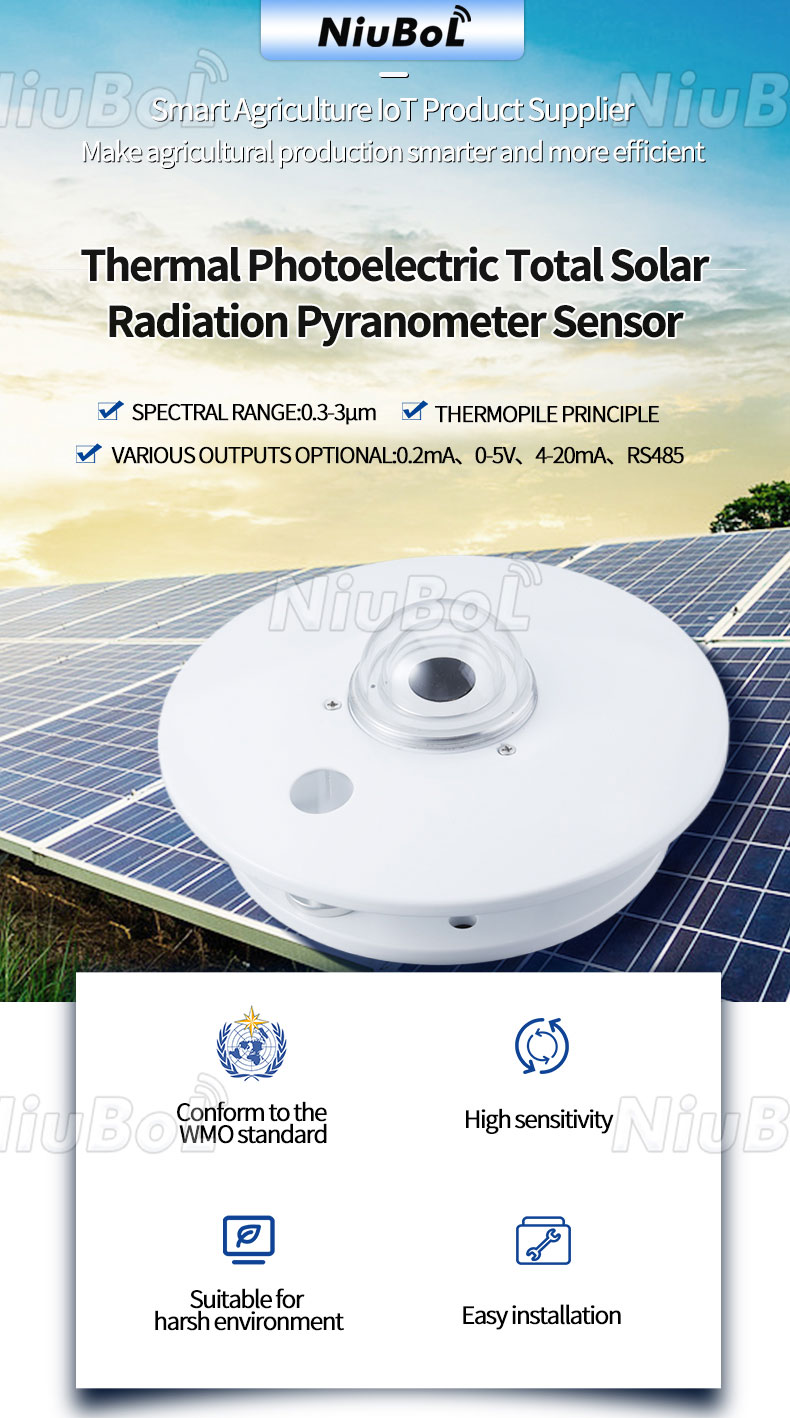
The separate pyranometer illustrated below can provide GHI when installed horizontally with the appropriate exposure. Its appearance alone does not identify whether a channel is GHI, POA or diffuse radiation. The mounting plane and presence of the correct shading arrangement determine the measurement being made.
For an illustrative clear-period observation, take DNI of 800 W/m2, DHI of 100 W/m2 and a zenith angle of 60 degrees. The expected horizontal sum is 800 multiplied by 0.5 plus 100, or 500 W/m2. If measured GHI is 540 W/m2, the residual defined as measured GHI minus the component sum is +40 W/m2.
Dividing that residual by the component sum gives +8% for this example. Dividing by measured GHI would give a different percentage. State the denominator and preserve the residual in W/m2 as well. Neither percentage is automatically a pass/fail tolerance or the calibration uncertainty of the station.
| Example quantity | Value |
|---|---|
| DNI | 800 W/m2 |
| DHI | 100 W/m2 |
| Solar zenith | 60 degrees |
| Horizontal component sum | 500 W/m2 |
| Measured GHI | 540 W/m2 |
| GHI minus sum | +40 W/m2; +8% of the sum |
Use values describing compatible times and locations. Rapid cloud changes can make sequential samples inconsistent even when every instrument is functioning. Align averaging windows and retain the observation timestamps before investigating a closure residual as an optical fault.
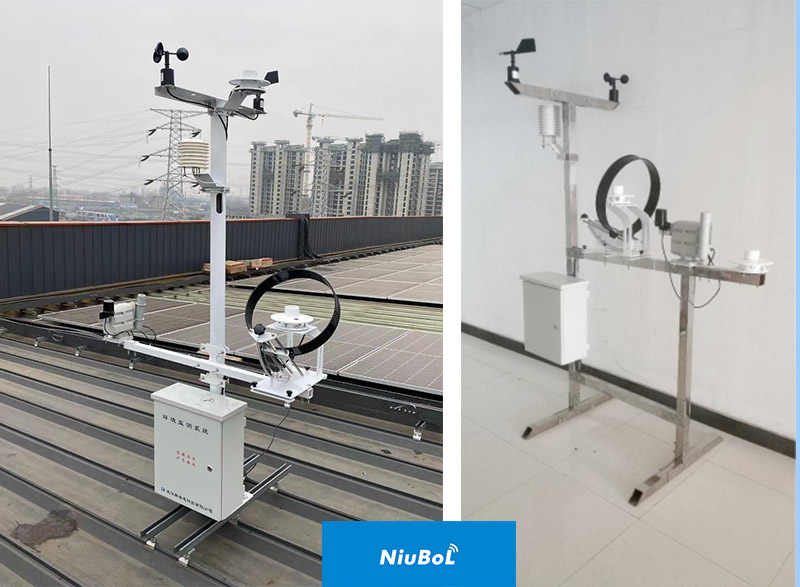
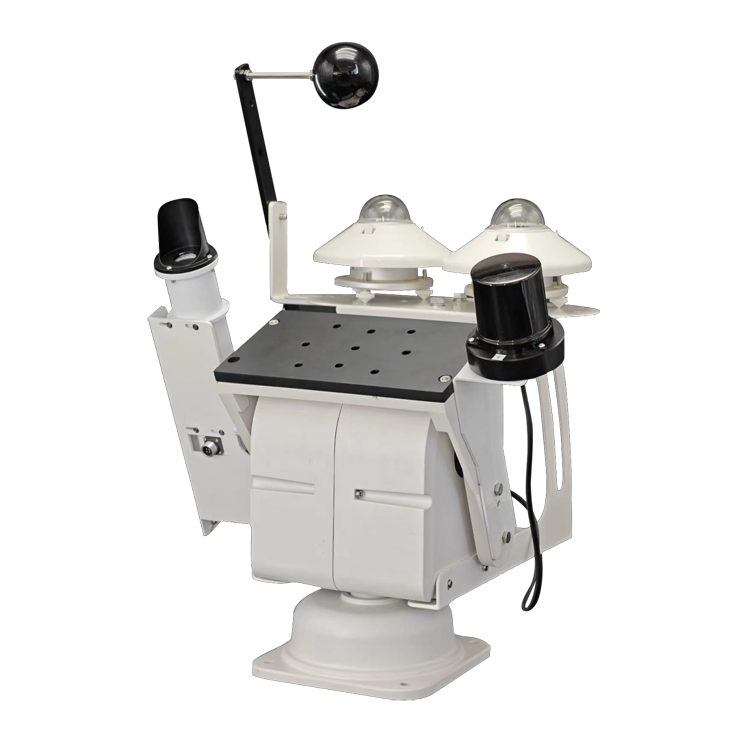
The NBL-W-ATSRM tracking radiation instrument combines direct, global and diffuse measurement arrangements. Time and location information support solar-position tracking, while a four-quadrant optical sensor supports pointing correction. The diffuse sensor needs the intended shade to exclude the solar beam, while the GHI sensor needs an unobstructed horizontal exposure.
| ATSRM item | Relevant specification |
|---|---|
| Tracker movement | Horizontal 0-360 degrees; tilt 0-120 degrees |
| Tracking accuracy | Less than 0.1 degree; an angular specification |
| Radiation range | 0-2,000 W/m2 for the direct and total/diffuse instruments |
| Spectral range | 280-3,000 nm |
| Thermopile sensitivity | 7-14 microvolts/(W/m2); apply the individual coefficient |
| Direct sensor response | Up to 15 seconds to 99% |
| Total/diffuse sensor response | Up to 30 seconds to 99% |
| Internal resistance | Approximately 90 ohms direct; 180 ohms total/diffuse |
| DC power option | 12 V DC; confirm the complete tracker and acquisition power package |
A less-than-0.1-degree tracking value is not a radiometric accuracy percentage. Similarly, a temperature-characteristic figure is not the complete operating-temperature envelope or total measurement uncertainty. Obtain the calibration information and environmental limits of the exact offered assembly for the project specification.
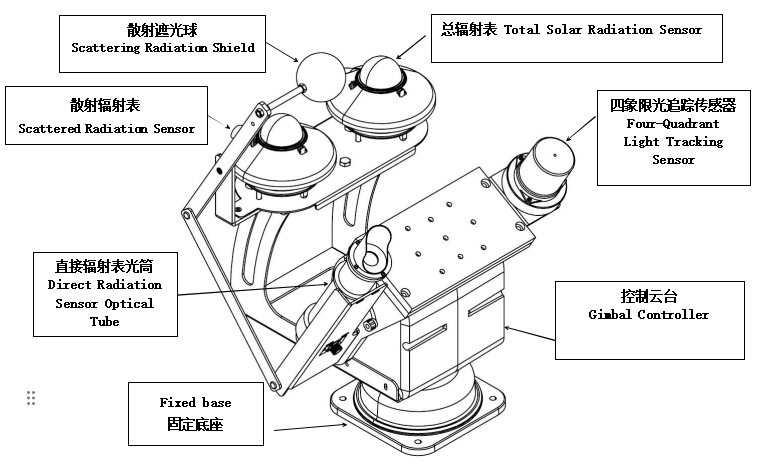
If the direct channel falls while the global and diffuse pattern remains credible, inspect the optical path and tracker. But a low DNI can also be normal under overcast conditions. Check actual sky conditions, the pointing target and instrument status where available before declaring a tracking failure.
If the diffuse sensor receives direct sun because its shade has moved, the DHI channel may no longer describe diffuse radiation alone. A global sensor shaded by a nearby instrument can create a different mismatch. Inspect the whole assembly through the required solar path; a correct midday setup does not guarantee morning and afternoon clearance.
At the acquisition input, apply each instrument's individual sensitivity rather than one coefficient to every thermopile. For a hypothetical coefficient of 10 microvolts/(W/m2), an 8 mV signal corresponds to 800 W/m2. A factor-of-1,000 unit error between millivolts and microvolts is an acquisition error, not a tracker problem.
If RS485 Modbus RTU is required, identify the conditioner or logger providing that interface. A raw thermopile signal needs a suitable low-level input or transmitter. The availability of a networked weather logger does not establish that the optical instrument itself has native Modbus, MQTT or remote storage.
Two or more channels can carry related biases and still produce an acceptable-looking closure result. Conversely, a residual may arise from timing, shading, response differences or solar-position errors. The test checks consistency under its assumptions; it does not establish traceable calibration of each channel or an instrument accuracy class.
Low sun requires particular care. If DNI is derived from GHI minus DHI by division by cos(z), a small horizontal error can become much larger. At a zenith angle of 80 degrees, a 10 W/m2 difference becomes approximately 57.6 W/m2 after that division. Do not use this sensitivity as evidence that the direct instrument suddenly became inaccurate.
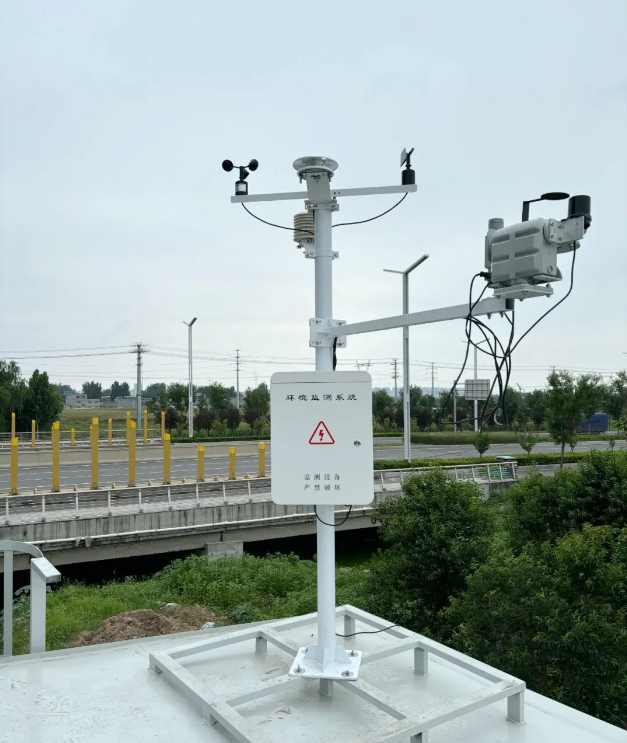
Choose a quality-check method and appropriate conditions for the application, with any excluded periods identified. Keep night, shading, tracker interruptions and missing observations distinct from valid zero irradiance. A generic fixed relative-error threshold is not a complete rule for every solar angle and irradiance level.
Keep POA or bifacial rear-side measurements outside this horizontal closure test unless they are transformed through a justified model. The component station can support solar research and resource analysis, but it does not automatically provide every array-plane or electrical-performance input required by a PV project.
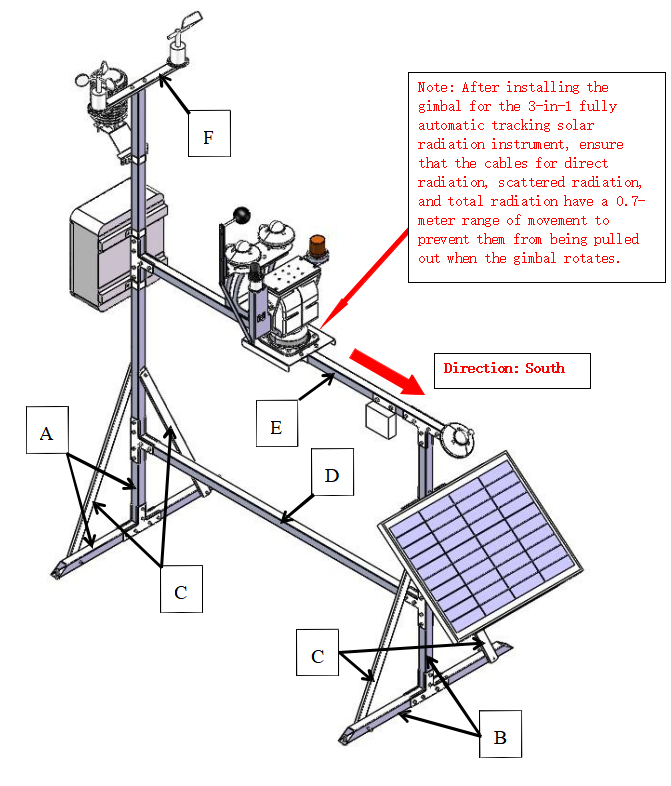
Level and orient the assembly through the applicable installation arrangement, then inspect the direct-tube pointing target and diffuse shade. Verify sufficient rotation clearance and cable movement. The ATSRM installation drawing calls for 0.7 m of cable movement allowance around the rotating assembly; check the actual route so cables neither pull tight nor interfere with the optics.
Schedule optical cleaning and tracking inspection with site conditions in mind. Monthly cleaning and tracking checks provide a starting service schedule for this assembly, with earlier inspection after contamination or an abnormal event. Mark cleaning and alignment changes in the data so a recovered channel is not mistaken for a sudden atmospheric change.
For a station enquiry, specify whether the task requires independently measured GHI, DNI and DHI, derived components or additional sunshine-duration recording. List the required output, logger, calibration documents, power arrangement and maintenance access. Agree the closure calculation and review method separately from instrument acceptance so the project does not buy an undefined three-channel display.
Consistency between measured GHI and DNI times cos(zenith) plus DHI under compatible geometry and timing. It can reveal data issues but is not a standalone calibration of each instrument.
The direct-normal value needs its horizontal projection. Use DNI times cos(zenith) in the horizontal equation. Omitting that projection creates a geometry error except in the corresponding limiting condition.
No. Pointing accuracy is angular. Irradiance uncertainty also involves the optical instruments, calibration, response, exposure and acquisition chain. Specify those separately.
No. Timing, shadow, diffuse-shade position, sensitivity coefficients and solar-position errors can also contribute. Inspect the relevant records and assembly before adjusting calibration or replacing a sensor.
Confirm the purchased recorder or software function, its input and accumulation method. The availability of direct-radiation measurement does not by itself define the delivered duration record.
Identify each optical instrument, tracker, conditioner or logger, required interfaces, power, mounting, calibration documents and service scope. Include how synchronized records and quality results will be exported.
Solar radiation component closure gives a practical consistency check for a three-component tracking station. Use the correct horizontal geometry, individual signal coefficients and matched time periods, then investigate residuals alongside pointing and shading. NiuBoL ATSRM measurements are most useful when their acquisition and quality-check methods are specified as clearly as the optical hardware.
 NBL-W-HPRS-Solar-Radiation-Sensor-Instruction-Manual-V3.0.pdf
NBL-W-SRS-Solar-radiation-sensor-instruction-manual-V4.0.pdf
Prev:Greenhouse Sensor Comparison: Check Bias Before Changing Setpoints
Next:Smart Pole Weather Instrument Integration: Power and Data Interfaces
Related recommendations
Sensors & Weather Stations Catalog
Agriculture Sensors and Weather Stations Catalog-NiuBoL.pdf
Weather Stations Catalog-NiuBoL.pdf
Agriculture Sensors Catalog-NiuBoL.pdf
Water Quality Sensor Catalog-NiuBoL.pdf
Related products
 Combined air temperature and relative humidity sensor
 TDR Soil Moisture & Temperature Sensor for irrigation| RS485 |4-20mA| NBL-S-THR
 Soil pH sensor RS485 soil Testing instrument soil ph meter for agriculture |NBL-S-PH
 Wind Speed sensor Output Modbus/RS485/Analog/0-5V/4-20mA
 Tipping bucket rain gauge for weather monitoring auto rainfall sensor RS485/Outdoor/stainless steel
 Pyranometer Solar Radiation Sensor 4-20mA/RS485

Screenshot, WhatsApp to identify the QR code
WhatsApp number:+8615367865107
(Click on WhatsApp to copy and add friends)

