





— Blogs —
—Products—
 Consumer hotline +8618073152920
WhatsApp:+8615367865107
Address:Room 102, District D, Houhu Industrial Park, Yuelu District, Changsha City, Hunan Province, China
Product knowledge
Time:2026-01-02 11:15:14 Popularity:1071
Quick Answer: Water and fertilizer management for grape cultivation should coordinate measured irrigation volume, an agronomist-approved nutrient plan and observations of the active root zone. Fertigation equipment delivers the chosen recipe; soil sensors help check its consequences. Soil conductivity is not a direct nitrogen, phosphorus or potassium assay, and installing automation does not guarantee a fixed yield increase or payback period.

A fertigation block should group vines that can reasonably share an irrigation decision. Review soil texture, root-zone depth, slope, emitter layout, vine age and production objective. A shallow sandy section and a heavier low-lying section may not respond to the same irrigation duration, even when both contain the same cultivar.
Check the existing system first. Measure flow and pressure under the intended number of operating zones and inspect emitter delivery at representative locations. A fertilizer injector cannot correct a blocked lateral, inadequate pump duty or a pressure difference that leaves some vines short of water.
Grape type also matters. Table-grape size targets, wine-grape production objectives and young-vine establishment are not interchangeable. Do not program a universal high-potassium sequence or water-stress schedule from crop name alone. Soil and plant analysis, source-water composition and local agronomic advice should determine the nutrient plan.
A vineyard fertigation system adds controlled fertilizer injection to a hydraulically suitable irrigation network. The arrangement may include source-water conditioning, filtration, injection equipment, mixing and measurement points, distribution valves and backflow protection. The order and design must suit the actual water source and selected injection system.
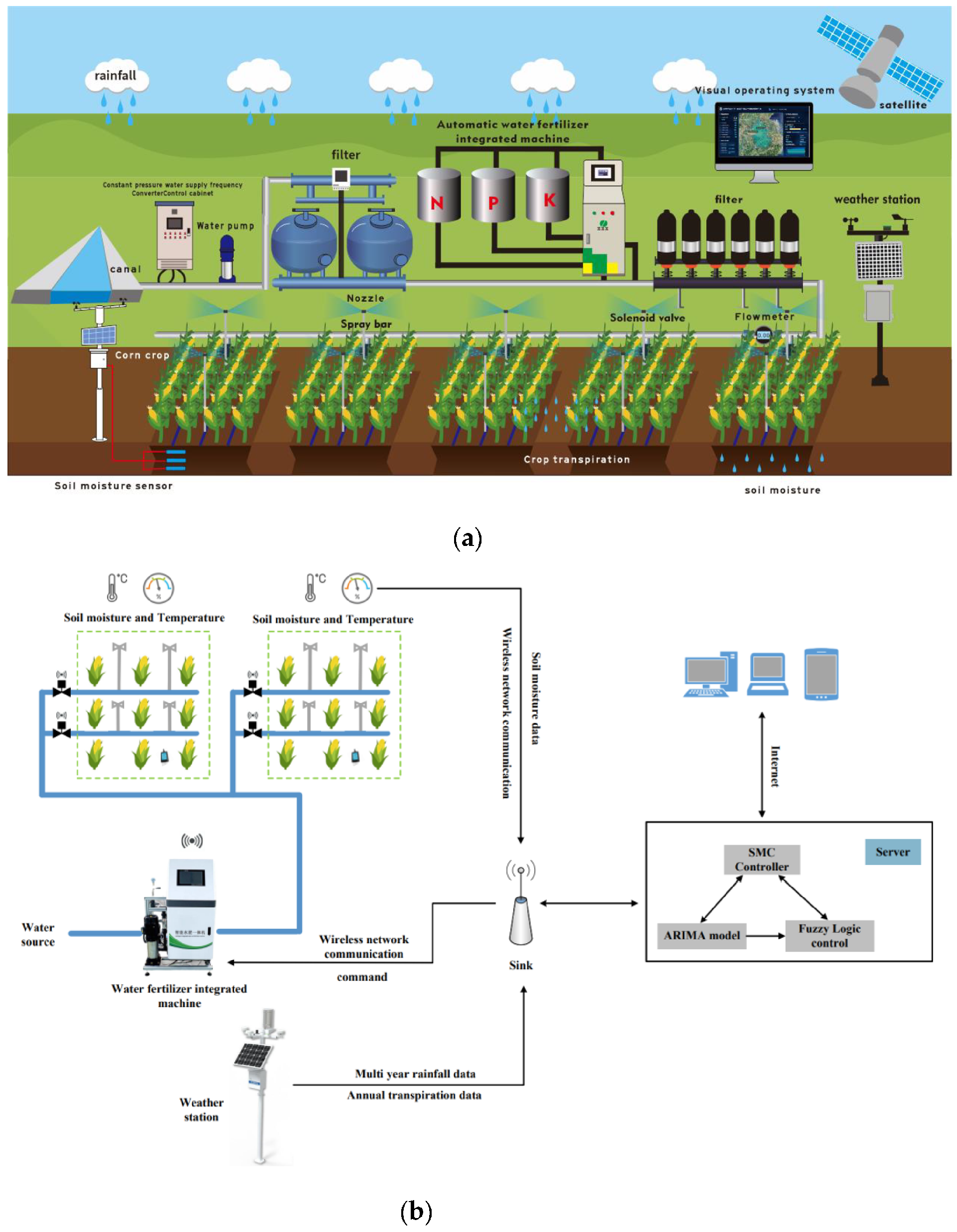
Use separate observations for separate tasks: flow confirms delivered water, pressure helps detect hydraulic problems, solution EC and pH describe the mixed stream, and soil moisture and EC reveal local root-zone changes. A controller combines these inputs with the approved operating sequence; the sensor alone does not operate a pump or dosing actuator.
NiuBoL's fertilizer management solution includes monitoring and control options. Specify the required injection channels, actuators and controller functions rather than treating the illustrative system layout as proof that every package includes identical equipment.
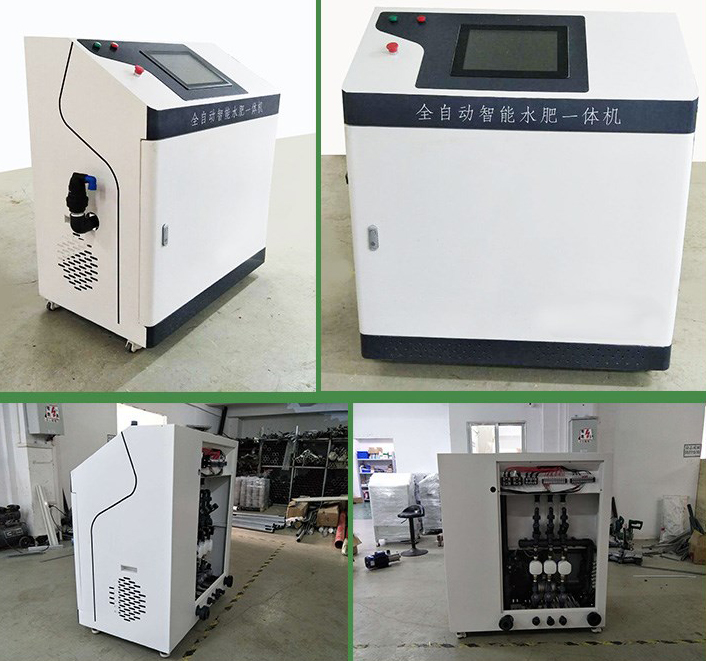
Record irrigation in cubic metres per block as well as operating time. Illustrative calculation: a measured flow of 20 m3/h maintained for 1.5 hours delivers 30 m3. If the flow is lower because of a pump or filter problem, the same timer setting delivers less water. A timer cannot verify that the target volume was reached.
For fertilizer, distinguish stock concentration, injected stock volume, product mass and nutrient mass. If stock contains 100 g of product per litre and 120 L is injected, the event applies 12 kg of product. A product containing 20% nitrogen contributes 2.4 kg N; spread over a 2 ha block, that is 1.2 kg N/ha. This is an arithmetic example, not a grape fertilizer recommendation.
Include nutrients already present in the source water. For example, 30 m3 containing 5 mg/L nitrate-N contributes 0.15 kg N. A laboratory value reported as nitrate rather than nitrate-N has a different mass basis. Use the stated analytical basis before deducting irrigation-water nitrogen from the nutrient budget.
Use flow-meter readings and actual stock depletion to check a dosing event. An injector run command shows that the controller requested dosing, not that the expected fertilizer mass reached the field. Suction leaks, an empty stock tank or loss of injection pressure can break that relationship.
Place soil probes within representative wetted and rooted soil, with an agreed offset from the emitter. A probe immediately beside the dripper can respond rapidly while much of the root zone remains dry. A deeper point can help identify downward wetting, but its depth must follow the actual soil and root distribution.
Compare trends over irrigation events rather than controlling from one isolated value. A near-surface rise followed by little change deeper down suggests a different operating issue from a sustained rise at every monitored depth. Use those observations with field inspection; soil layering and lateral flow can complicate the interpretation.
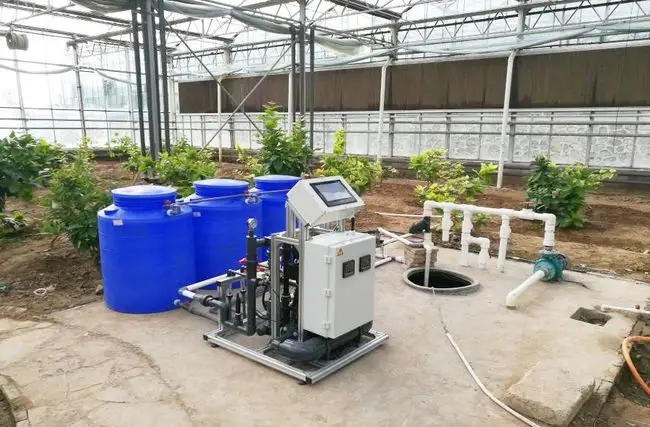
The NBL-S-TMC combines temperature, volumetric water content and electrical conductivity. It can add root-zone measurements to grape irrigation and fertigation monitoring, but it does not identify individual dissolved fertilizer ions or replace a laboratory nutrient analysis.
| Parameter | Specification and selection implication |
|---|---|
| Soil temperature | -40 to 80 degrees C; stated accuracy +/-0.5 degrees C; resolution 0.1 degree C |
| Volumetric water content | 0-100%; resolution 0.1%; stated accuracy 5%, with the error basis and soil calibration to be agreed for the application |
| Conductivity | 0-10000 uS/cm; resolution 1 uS/cm; stated accuracy +/-5% within that range |
| EC temperature compensation | 0-50 degrees C compensation range; distinct from the temperature measurement span |
| Supply version | 5-24 VDC or 12-24 VDC according to supplied version; match the order and controller supply |
| Communication | RS485 / Modbus RTU; configure address, serial settings and engineering-unit scaling |
| Protection and construction | IP68; treated electrode material and black flame-retardant epoxy sealing |
| Cable and installation | Standard 5 m cable; full electrode contact with the measured soil, without insertion air gaps |
Soil EC responds to water content, temperature and dissolved salts. A change after irrigation is not automatically a change in fertilizer concentration alone. For this probe, meaningful salt-trend interpretation needs sufficient moisture; values in dry soil should not trigger an automatic increase in fertilizer dose without investigation.
Solution EC, direct soil EC and laboratory extract EC are different measurements. Do not transfer a threshold from one method to another unchanged. Where salinity is a concern, use water and soil analysis with drainage assessment, not only the online probe's displayed number.
Establish water flow and pressure before enabling injection, and confirm that the correct field zone is open. During dosing, monitor the selected feedback signals and stop injection on conditions such as lost flow or unavailable stock. Which interlocks are implemented must be part of the controller specification and commissioning test.
Reserve enough clean-water operation after dosing for fertilizer to reach the intended laterals and for the required flushing procedure. This duration depends on pipe volume, flow and layout. A fixed 15-minute setting is not valid for every vineyard, and excessive flushing can move nutrients below the intended root zone.
As a simple transport estimate, a 200 m pipe with 32 mm internal diameter holds about 161 L. At 100 L/min, one nominal pipe volume takes about 1.6 minutes. Lateral branches, mixing, dead spaces and emitter discharge make this only a starting estimate, not proof of complete chemical removal.
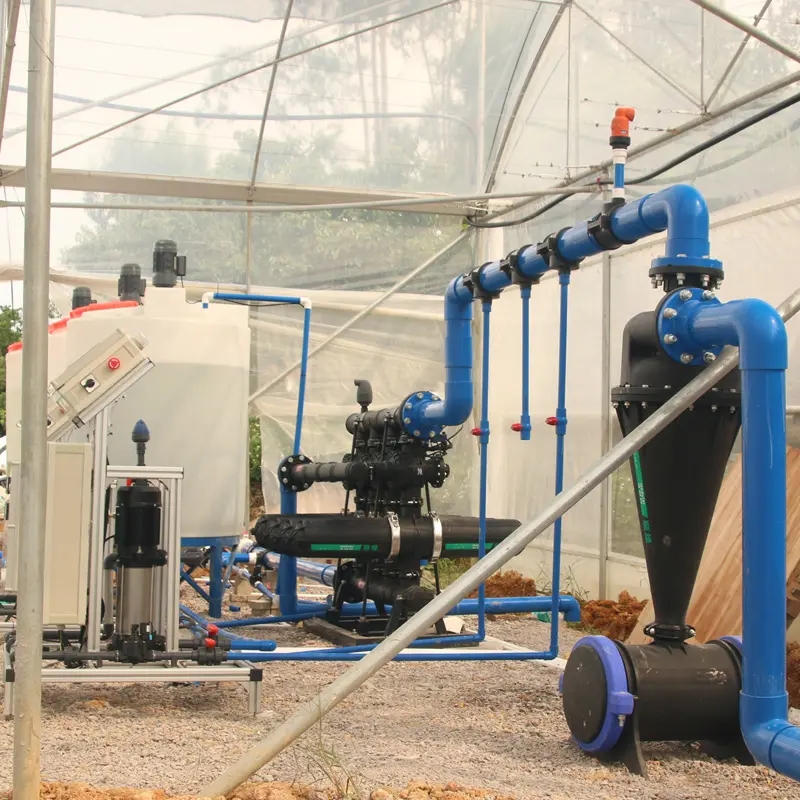
Choose fertilizer suitable for the water quality, concentration and injection equipment. A product being water-soluble does not ensure that every concentrated stock mixture remains compatible. Calcium-containing products and incompatible phosphate or sulfate concentrates may require separate stock arrangements and a reviewed mixing sequence.
Test proposed combinations at the intended concentration and temperature before full-scale use, with qualified agronomic or chemical support where necessary. Filtration removes appropriate particulate contamination; it does not by itself prevent precipitation after incompatible chemicals are mixed.
Soil pH and irrigation-solution pH also require separate interpretation. Soil buffering means that changing solution pH does not guarantee rapid correction of the root zone. Acid dosing needs source-water alkalinity, material compatibility, backflow protection and a controlled chemical-handling design. Do not program dosing directly from one soil pH value.
Local rain and weather observations can help explain a reduced irrigation need or a drying trend. They should be combined with effective rainfall, soil storage and the vineyard's management objective. Air temperature or light intensity alone is not a complete evapotranspiration calculation.
Drip irrigation can limit unnecessary wetting compared with some other application methods, but it does not eliminate fungal disease or root problems. Drainage, soil aeration, canopy conditions and disease management remain separate tasks. Likewise, intentional water deficit during ripening is a crop-specific strategy, not an automatic means of increasing sugar without quality or yield risk.

Connect RS485 soil sensors to a compatible logger, PLC or RTU with the required polling and data scaling. Keep the sensor data path separate from actuator wiring and power. A Modbus input does not establish that the controller can safely switch a pump or drive a dosing valve.
Test one block with water before introducing fertilizer. Compare measured block volume, operating pressure and emitter delivery against the hydraulic design. Then verify stock delivery and downstream solution response using an approved commissioning procedure. Confirm that a stop request and relevant faults inhibit injection as intended.
For remote operation, test the difference between command acknowledgement and a verified completed event. Define permitted behavior during a communication outage and provide local control appropriate to the installation. Do not assume that cloud access or an automatic restart sequence is included simply because the sensor has RS485 output.
Compare costs by the work required: monitoring points, block count, hydraulic equipment, injection channels, control cabinet, installation and ongoing service. There is no defensible universal one- or two-harvest payback without measured changes in inputs, labour and crop returns.
No. EC is an electrical response to dissolved salts and the surrounding soil conditions, not a nutrient-specific assay. Use it to investigate trends alongside soil, water and plant analysis and an approved nutrient budget.
Not where soil, root distribution or production objectives differ. Establish representative monitoring zones and relate sensor readings to actual wetting and plant condition before setting block-specific control limits.
No. It provides temperature, VWC and conductivity measurements through the ordered interface. A compatible controller and suitable actuators are needed to execute irrigation and injection, including the required interlocks.
Fertigation adds dissolved substances and can increase salt loading. Salinity management depends on source water, nutrient input, irrigation distribution and effective drainage. It cannot be promised from changing to liquid fertilizer alone.
The approved recipe, stock compatibility, required dosing flexibility and controller capability determine channel requirements. Separate incompatible concentrates where the chemical design requires it rather than selecting channels by vineyard area alone.
Compare stock concentration and actual stock consumption with the event's water volume and downstream response. A pump running for the programmed time is insufficient evidence of delivered nutrient mass.
Send block areas, soil and source-water information, emitter layout, operating flow and pressure, existing pump and filter details, nutrient-plan requirements and available power. Include controller and remote-access expectations so monitoring, hydraulics and automation can be scoped separately.
Water and fertilizer management for grape cultivation works through verified water delivery, a suitable nutrient plan and representative root-zone observations. Use NiuBoL soil monitoring and integration options to check the process, without treating EC as a nutrient recipe or automation as a guaranteed return. Provide the vineyard hydraulic layout and monitoring requirements for configuration review.
Prev:Fertigation System Working Principles: Injection, Feedback and Flushing
Next:Fertigation System Implementation: Zones, Filtration and Field Commissioning
Related recommendations
Sensors & Weather Stations Catalog
 Agriculture Sensors and Weather Stations Catalog-NiuBoL.pdf
Weather Stations Catalog-NiuBoL.pdf
Agriculture Sensors Catalog-NiuBoL.pdf
Water Quality Sensor Catalog-NiuBoL.pdf
Related products
 Combined air temperature and relative humidity sensor
 TDR Soil Moisture & Temperature Sensor for irrigation| RS485 |4-20mA| NBL-S-THR
 Soil pH sensor RS485 soil Testing instrument soil ph meter for agriculture |NBL-S-PH
 Wind Speed sensor Output Modbus/RS485/Analog/0-5V/4-20mA
 Tipping bucket rain gauge for weather monitoring auto rainfall sensor RS485/Outdoor/stainless steel
 Pyranometer Solar Radiation Sensor 4-20mA/RS485


Screenshot, WhatsApp to identify the QR code
WhatsApp number:+8615367865107
(Click on WhatsApp to copy and add friends)

