





— Blogs —
—Products—
 Consumer hotline +8618073152920
 WhatsApp:+8615367865107
Address:Room 102, District D, Houhu Industrial Park, Yuelu District, Changsha City, Hunan Province, China
Product knowledge
Time:2026-02-09 14:43:23 Popularity:624
Quick Answer: Rain and snow sensor integration begins by separating three measurements: precipitation presence, rainfall amount and snow depth. NBL-W-RSS provides a relay contact for presence detection. NBL-W-SNOW measures distance to a surface for snow-depth calculation through an RS485 interface. Their inputs, protocol handling and control logic are different; connecting both to one weather station does not make their outputs interchangeable.
A greenhouse contractor may need a rain indication to close a roof vent. A road-monitoring operator may need the duration of wet conditions and the depth of accumulated snow. A research station may need accumulated precipitation as well. These tasks require different channels, even when one enclosure and data logger serve the site.
Begin with the action or recorded quantity, then select the sensor. The NBL-W-RSS rain and snow sensor answers whether its sensing surface indicates wet precipitation conditions. It does not output millimetres, classify precipitation type independently or establish the condition of every nearby road surface. A rain gauge supplies amount; a snow-depth sensor supplies surface-height information.
For a roof closure, the sensor is an input to the controller, not the motor controller itself. The installation still needs position feedback, actuator protection and a defined response to sensor or power failure. For a remote station, the logger must distinguish a valid dry observation from a missing sensor channel.
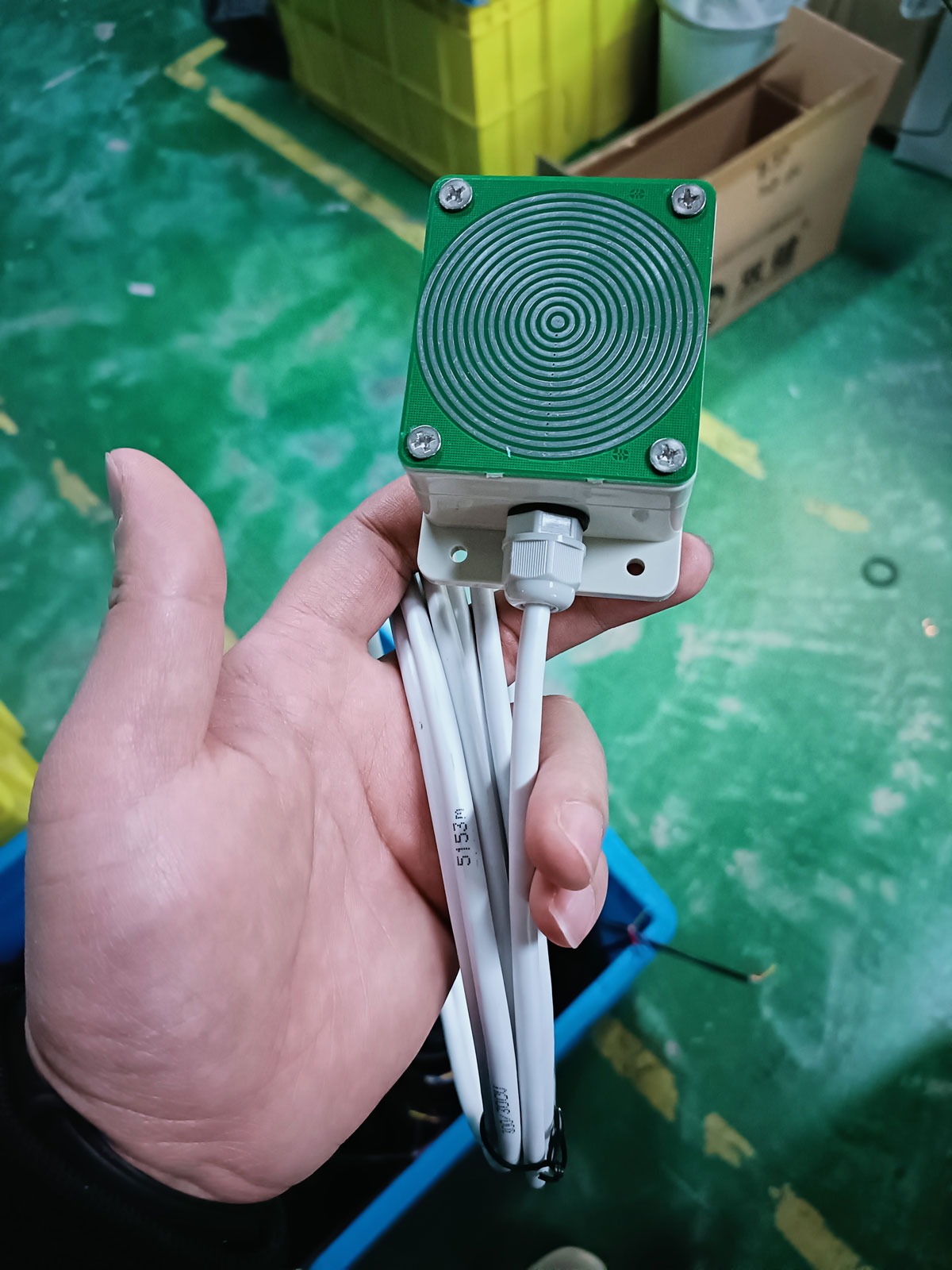
NBL-W-RSS uses a surface grid electrode. Water changes the electrical condition between the electrodes and the sensor changes its relay state. The built-in heating arrangement helps manage retained precipitation, but it does not prove immunity to freezing, contamination, dew or splash at every installation.
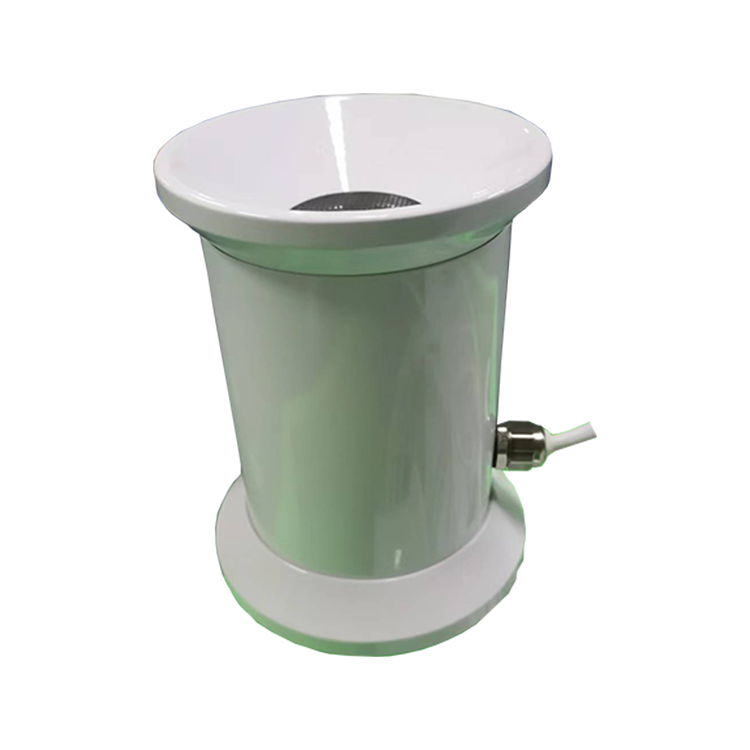
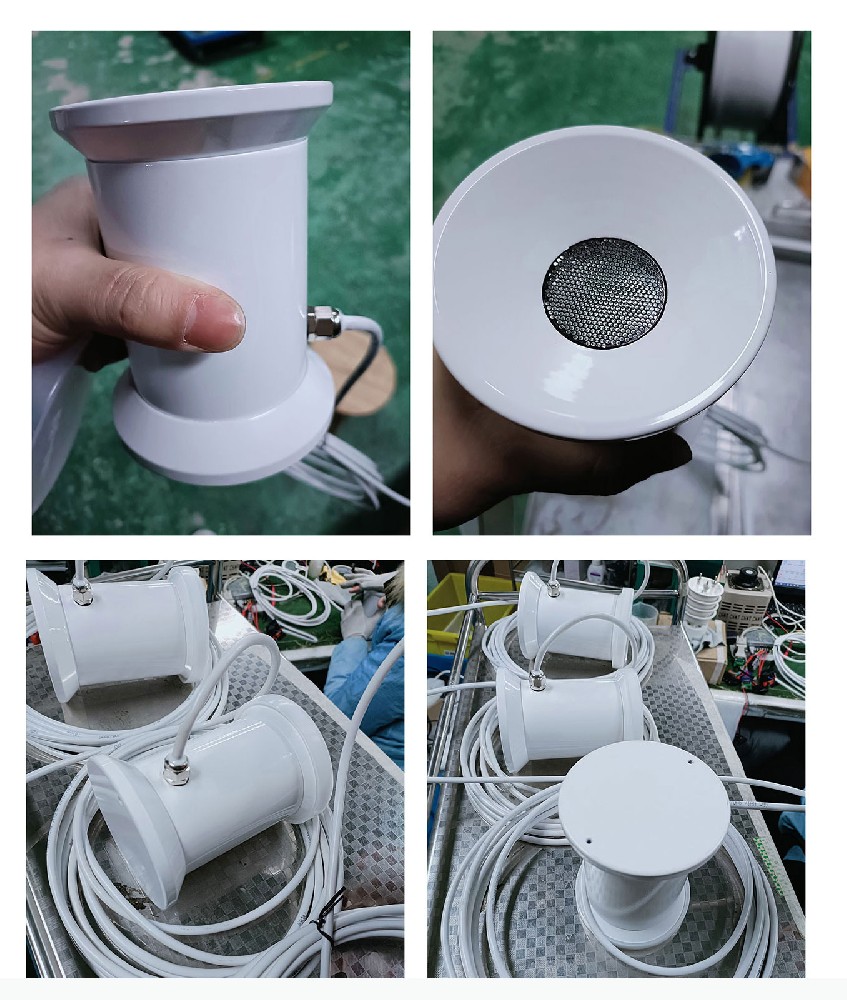
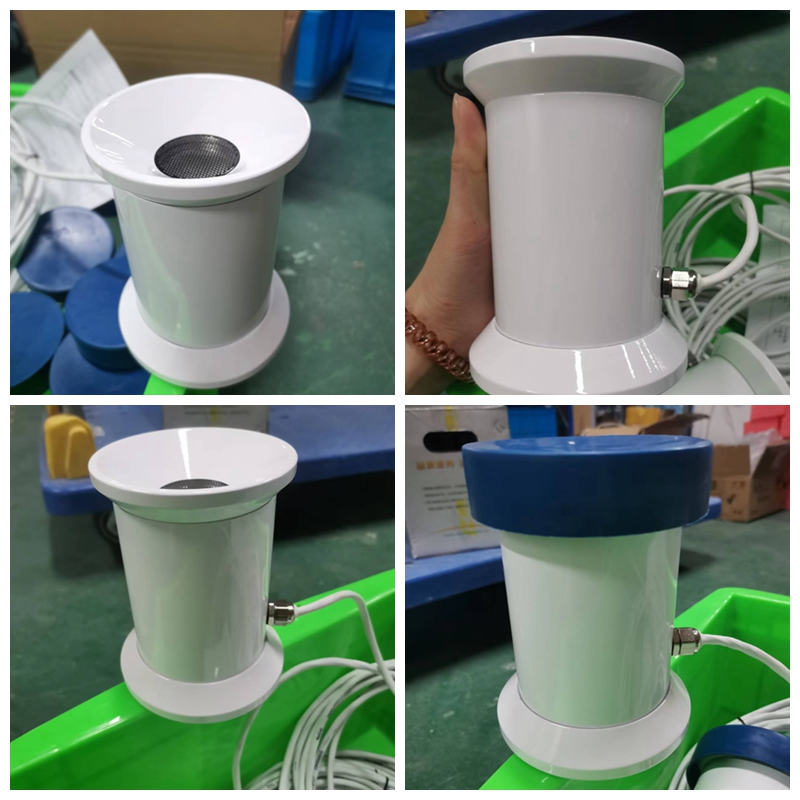
NBL-W-SNOW uses ultrasonic travel time to observe a target surface below the head. The difference from a snow-free reference can indicate accumulated snow depth. A bare-ground reference, fixed mount and clear measurement footprint are therefore as important as the serial connection.
| Measurement | Receiving channel | What it cannot establish alone |
|---|---|---|
| Rain/snow presence, NBL-W-RSS | Contact-compatible digital input on PLC, RTU or data logger | Precipitation amount, snow depth or separate rain/snow classification |
| Snow surface distance, NBL-W-SNOW | RS485 serial channel with the correct device driver | Snow water equivalent, roof load or complete road condition |
| Accumulated rainfall | Pulse counter or serial input for the selected rain gauge | Instantaneous rain status when no valid gauge increment has occurred |
A presence switch can change before a tipping bucket has collected enough water for one tip. Conversely, a wet plate can remain active after falling precipitation has stopped. Treat the channels as complementary observations, not redundant devices that must agree at every second.
Apply each rating to its own component. The RSS operating-temperature interval is not the SNOW operating interval, and RS485 on the snow sensor does not convert the RSS relay into a serial device.
| Parameter | NBL-W-RSS | NBL-W-SNOW |
|---|---|---|
| Measured quantity | Presence or absence of rain/snow | Ultrasonic snow-depth measurement |
| Range and accuracy | Qualitative switch; no numerical rainfall accuracy | 0-1000 mm; stated accuracy +/-0.1% FS |
| Power supply | 12-24 VDC | 12 VDC |
| Output | Normally open or normally closed relay contact configuration | RS485; default NBL private protocol, 9600 bit/s |
| Contact rating | 5 A, 250 VAC / 30 VDC; assess actual load type | Not a relay output |
| Power figures | Product power consumption 1.5 W; confirm heating load for the supplied version | 180 mW at normal temperature; 3 W with low-temperature heating below 5 degrees C |
| Operating temperature | -40 to 80 degrees C | -40 to 50 degrees C |
| Operating humidity | No more than 100% RH | No more than 100% RH |
| Standard cable | 5 m; cable voltage rating 300 V | 5 m |
| Protection and cable material | Confirm enclosure rating, cable jacket and connectors for the ordered assemblies; these must not be inferred from ambient humidity ratings | |
For a 1000 mm snow-depth span, 0.1% FS corresponds to 1 mm. That arithmetic does not eliminate reference, target or mounting errors. Snow settlement and drifting change local depth without necessarily indicating new snowfall, and the snow-free reference must not be reset over an existing snow layer.
For the described RSS cable, red is supply positive, blue is supply negative, and black and yellow are the contact pair. Verify the delivered lead labels before energizing. The contact pair itself is not polarized; that does not make the supply wires interchangeable. Isolate power while wiring and confirm the PLC input's wetting voltage and input arrangement.
The sensor's 12-24 VDC supply and the relay's switching rating describe different circuits. A 250 VAC contact rating is not permission to supply the sensor with mains voltage. Use the contact for a suitable control input; an actuator or heater may require a separately rated interposing device and protection, especially with inductive loads.
Test dry and wetted states at the sensor, digital input and displayed tag. Record which state means wet. Then test loss of sensor power and an open contact circuit separately. A simple normally open circuit can make a broken wire resemble dry conditions; choosing normally closed wiring alone does not diagnose every possible failure.
Where monitoring loss must be identified, select an input arrangement that supports the required supervision and report a fault state independently. Do not relabel the last valid dry state as a current observation after the channel has failed.
The standard snow sensor configuration uses an NBL private protocol at 9600 bit/s. Some read frames resemble familiar Modbus requests, but that resemblance does not establish complete compatibility with an arbitrary Modbus RTU driver. Confirm the actual firmware, frame interpretation, byte order and supported commands on a bench connection.
Use a compatible NiuBoL collector or a gateway with the appropriate driver. If a project requires standard Modbus RTU, request that protocol explicitly and confirm it for the supplied version before delivery. Do not assume that adjusting the baud rate changes the message format.
The snow serial configuration requires at least 1000 ms between communications. Configure addresses separately before adding devices to a shared bus. Custom address-configuration frames must not be broadcast onto a working multi-device network without confirming how every connected device will respond.
Mount the RSS sensing face about 15 degrees from horizontal, exposed to the precipitation being monitored and able to drain. Avoid roof drip lines, irrigation spray and a location sheltered by the instrument crossarm. A nearby gutter discharge can keep the plate wet even under a clear sky.
For the snow sensor, use a stable downward-looking support over a representative target. Its installation procedure uses a nominal 1.3 m position with a tolerance of +/-0.1 m; this is not a universal mounting height for every terrain or a permission to measure arbitrary deep drifts. Confirm the required clearances and range for the actual geometry.
Illustrative geometry: a snow-free distance of 1.30 m and a later surface distance of 1.08 m correspond to 0.22 m, or 220 mm, of local snow depth. Verify whether the received value represents distance or already calculated depth; subtracting the reference twice produces a plausible-looking but wrong result.
At 3 W continuously, snow-sensor heating demand is 72 Wh/day, compared with 4.32 Wh/day at 180 mW. These are sensor-only calculations for those operating conditions. Add the RSS, logger, transmission equipment and losses, and assess winter recharge. Room-temperature standby power is not a winter station sizing figure.
For greenhouses, use presence detection to request roof closure while checking position and control priorities locally. Reopening should depend on an agreed stable-dry rule and other weather conditions, not a single dry contact transition. A system that closes correctly but repeatedly reopens during intermittent rain has not passed a useful acceptance test.
For road and rail monitoring, combine precipitation status with the required pavement temperature, visibility or local inspection channels. Snow depth at one undisturbed target does not establish traction, clearance along a route or ice thickness. In substations, contact status can support environmental awareness without implying that it measures insulation condition.
For buildings, depth is not structural load. Snow density and distribution are needed for load assessment, which belongs to the building's engineering process. For meteorological research, retain event times, surface distance, reference settings and maintenance changes so an apparent step can be separated from remounting or a cleared target.
During acceptance, check sensor wet/dry behaviour, measured reference distances, decoding, time stamps and failed-channel indications. Observe drainage and heater behaviour under representative conditions rather than accepting a green communications indicator as proof of winter measurement performance.
No. NBL-W-RSS in this configuration provides relay contacts. Connect it to a compatible digital input; a data logger or remote I/O unit can then publish the state over a separate serial or network interface.
Do not assume so. The default version uses an NBL private protocol. Agree on the supplied protocol and confirm a sample reply and decoded physical value with the proposed logger.
No. Availability depends on supplied heating capability, power and exposure. Confirm the required cold-weather behaviour through an appropriate test; do not assign an unsupported sub-second detection time.
Retained water, nearby drips, contamination or snow melt can maintain the sensing condition. Inspect location and drainage first, then compare the physical contact with the digital-input state before adjusting control delays.
No. Snow depth and liquid-water equivalent are different quantities. Conversion requires density information or an appropriate precipitation measurement; no fixed conversion factor is valid for every snow condition.
State whether you need presence, accumulated amount or snow depth, then specify the controller, available inputs, temperature, power and intended action. Include mounting geometry and any required Modbus driver so the quotation covers the actual interface work.
Reliable rain and snow sensor integration depends on matching each measurement to its input and operational meaning. Keep relay presence, serial snow depth and rainfall amount as distinct channels. Ask NiuBoL to match the sensor, collector driver, winter power requirements and mounting arrangement to the project.
Prev:Non-Contact Road Condition Sensor: Target Spot and RWIS Checks
Next:Greenhouse Sensor Comparison: Check Bias Before Changing Setpoints
Related recommendations
Sensors & Weather Stations Catalog
 Agriculture Sensors and Weather Stations Catalog-NiuBoL.pdf
Weather Stations Catalog-NiuBoL.pdf
Agriculture Sensors Catalog-NiuBoL.pdf
Water Quality Sensor Catalog-NiuBoL.pdf
Related products
 Combined air temperature and relative humidity sensor
 TDR Soil Moisture & Temperature Sensor for irrigation| RS485 |4-20mA| NBL-S-THR
 Soil pH sensor RS485 soil Testing instrument soil ph meter for agriculture |NBL-S-PH
 Wind Speed sensor Output Modbus/RS485/Analog/0-5V/4-20mA
 Tipping bucket rain gauge for weather monitoring auto rainfall sensor RS485/Outdoor/stainless steel
 Pyranometer Solar Radiation Sensor 4-20mA/RS485

Screenshot, WhatsApp to identify the QR code
WhatsApp number:+8615367865107
(Click on WhatsApp to copy and add friends)

