





— Blogs —
—Products—
 Consumer hotline +8618073152920
WhatsApp:+8615367865107
Address:Room 102, District D, Houhu Industrial Park, Yuelu District, Changsha City, Hunan Province, China
Product knowledge
Time:2026-05-25 10:13:20 Popularity:472
Quick Answer: Specify an industrial online pH sensor by its complete configuration: electrode and wetted materials, temperature and pressure limits, electrical output and receiving-system interpretation. For NiuBoL digital pH sensors, verify the actual Modbus data structure rather than assuming that one register always contains a fixed-scale pH value. A compatible serial port is only the start of integration.
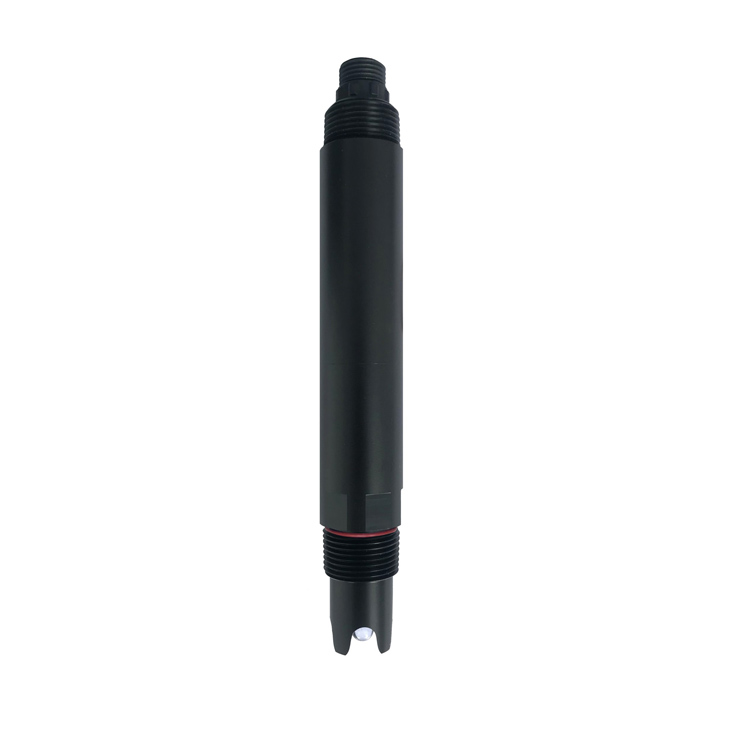
An online pH point combines the electrode, measurement electronics, cable, receiving input and process location. Replacing only the probe by thread size can leave a mismatch in power, materials or data format. Identify which part of the existing measurement chain will remain in service.
The NiuBoL NBL-WQ-PH configuration discussed here provides a processed digital value, not an unconditioned glass-electrode signal. It connects to a suitable RS485 Modbus RTU master. A controller with only Ethernet or Modbus TCP needs an appropriate serial interface or conversion arrangement; an Ethernet socket alone does not provide that connection.
A selected current-output version may suit an existing analog input. That is a practical choice where the plant already has suitable inputs and a clear current-loop design. Neither analog nor digital transmission automatically solves grounding, cable damage or an unsuitable sensing location. Compare the complete installation rather than declaring one interface universally superior.
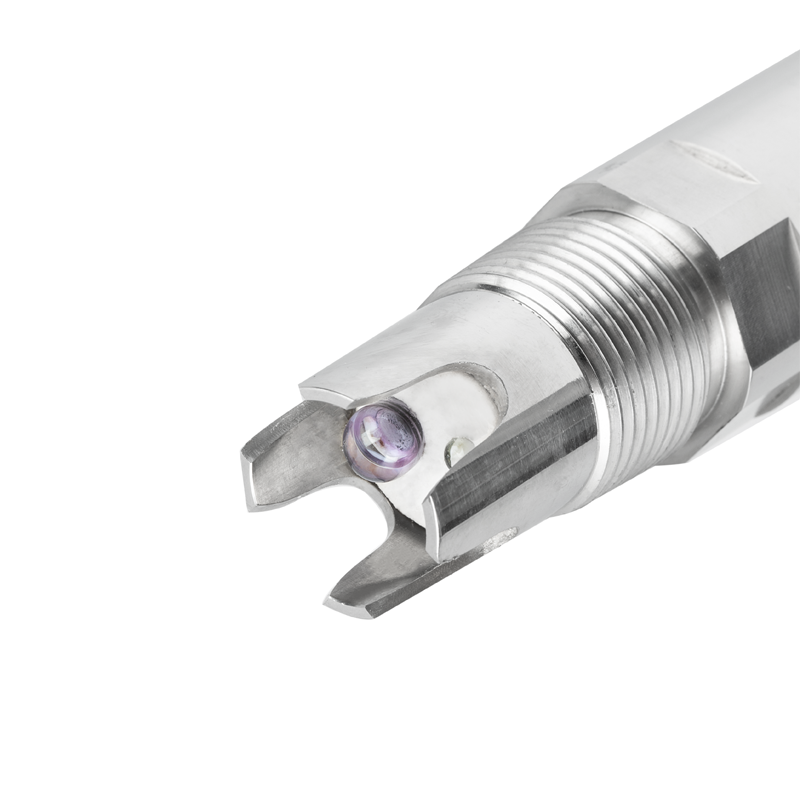
The following values describe the NTC-compensated, 0-65 degrees C configurations. Similar product families may have different temperature elements or housing arrangements. Keep the model and revision associated with the quotation, replacement stock and receiving configuration.
| Parameter | Specified configuration | Selection consequence |
|---|---|---|
| Measurement | Glass electrode; 0-14 pH; 0.01 pH resolution | The displayed increment does not establish the accuracy of the installed point. |
| Accuracy | +/-0.1 pH; temperature +/-0.3 degrees C | Include reference and installation uncertainty when setting acceptance limits. |
| Operating temperature | 0-65 degrees C | Check cleaning, startup and abnormal conditions at the probe, not only normal bulk temperature. |
| Pressure | Below 0.2 MPa | Check the holder and process connection separately; IP68 is not an unlimited pressure rating. |
| Temperature function | Automatic compensation using NTC | Electrode-response compensation does not remove real chemical changes in sample pH. |
| Supply and consumption | 12-24 VDC; 0.2 W at 12 V | Confirm the complete output arrangement and receiving-input requirements. |
| Output | RS485 Modbus RTU; optional 4-20 mA on designated variants | Order the required variant rather than assume every probe has both outputs. |
| Mounting and protection | 3/4 NPT; IP68 probe; standard 5 m cable | Provide service access and protect terminations; specify the cable jacket for the site. |
| Calibration | Two-point calibration | Keep the calibration procedure and references compatible with the delivered sensor. |
Materials need the same attention as range. POM and 316L are not interchangeable guarantees for every liquid. Evaluate all wetted parts, including the glass, reference junction, seals and holder. A metal outer body does not by itself establish suitability for high-pressure reactors, concentrated solvents or sanitary steam cleaning.
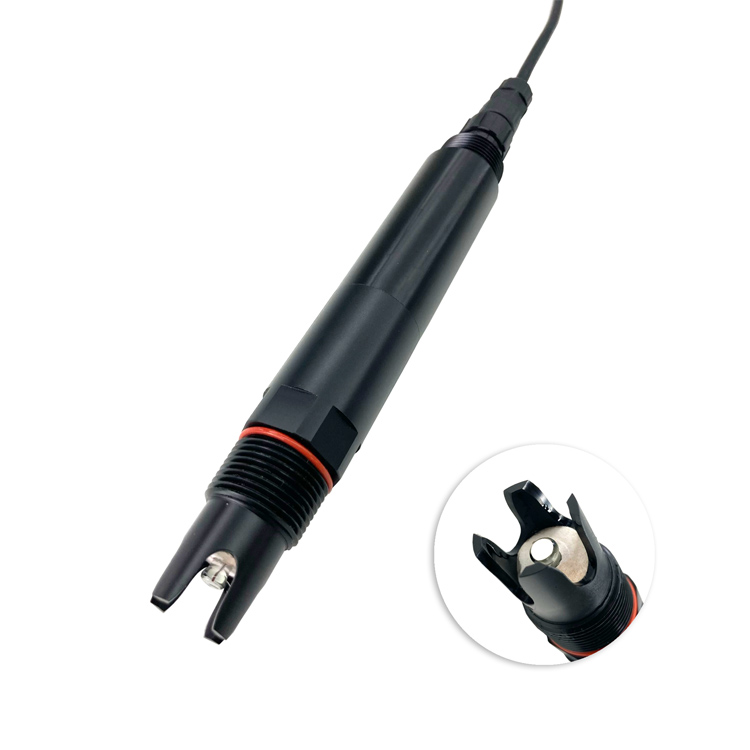
In the configurations below, NBL-WQ-PH and NBL-WQ-PH-4A use POM wetted construction, while NBL-WQ-PH-4S combines POM and 316L stainless steel. The electrical differences also matter when spares are issued to maintenance personnel.
| Configuration | RS485 conductors | Additional check |
|---|---|---|
| NBL-WQ-PH | Blue A, white B | Match the base digital output and its receiving settings. |
| NBL-WQ-PH-4A | Blue A, white B | Yellow is the optional current-output conductor; leave unused output unconnected as specified. |
| NBL-WQ-PH-4S | Blue A, green B | Yellow is the optional current-output conductor; use the matching five-core assembly. |
For these assemblies, red is supply positive and black is supply return. Confirm the actual identification before applying power, especially when replacing a similarly shaped sensor. Do not assign colors from another water-quality instrument merely because its connector also has five positions.
Support cables independently of the probe and protect joints against immersion and cleaning spray. Route instrument wiring away from motor-power circuits using the plant's electrical design. If isolation or surge protection is required, select it as part of that design rather than assuming the probe includes every protective component.
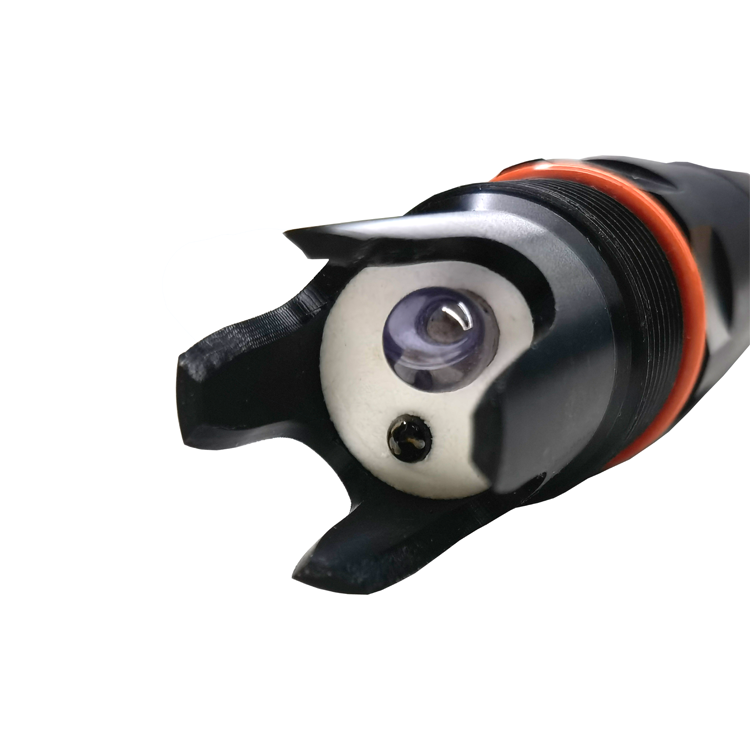
For the stated base NBL-WQ-PH format, the normal read begins at zero-based address 0x0000 with function 03 and returns four 16-bit words. The four words contain pH magnitude, pH decimal places, temperature magnitude and temperature decimal places. They are not two arbitrary floating-point numbers.
The decimal-place words tell the receiver how to scale the corresponding magnitude. In a decoding example, a pH magnitude of 0x0062 is decimal 98 and the decimal-place value is 2, giving 0.98 pH. Temperature magnitude 0x0101 is 257 with one decimal place, giving 25.7 degrees C. These are decoding examples, not a claimed process measurement.
Test the data representation for the delivered revision rather than reuse a parser from an unrelated sensor. Identify the controller's register-address convention too: a label such as 40001 may correspond to protocol address 0x0000 rather than an address literally transmitted as 40001.
The base serial format is 9600 bps, no parity, eight data bits and one stop bit, with default address 3. Commission addresses individually where several sensors have the same default. Keep routine reads separate from calibration, address changes and factory reset. Do not enable production writes merely to obtain measurements.
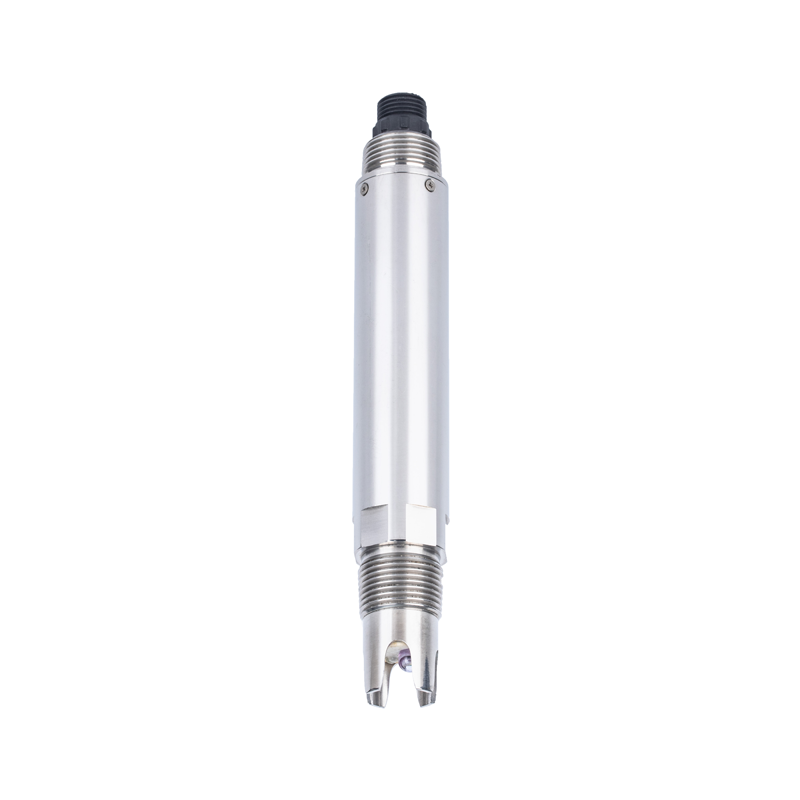
For pH sensor PLC integration using a selected 4-20 mA output, establish the ordered pH span and wiring arrangement. Confirm whether the receiving input supplies power or measures an externally powered signal and check the permitted load. Do not wire a current-output conductor into an RS485 terminal.
If the ordered current span is 0-14 pH, an illustrative conversion is pH = (I - 4) x 14 / 16, with I in mA. A 12 mA signal then corresponds to pH 7.00. This calculation does not establish that every optional output is configured to that span.
Use an appropriate current-input test to verify the receiver's scale and wiring. Then compare the sensor's measurement through the real output. If the digital reading agrees with a suitable reference but the analog display does not, investigate the current path before recalibrating the glass electrode.
Agree how an open circuit, unavailable sample and sensor fault are shown. Do not assign an arbitrary fault-current standard to a version that has not been specified to implement it. A healthy electrical signal can still describe an old sample trapped in a stopped bypass.
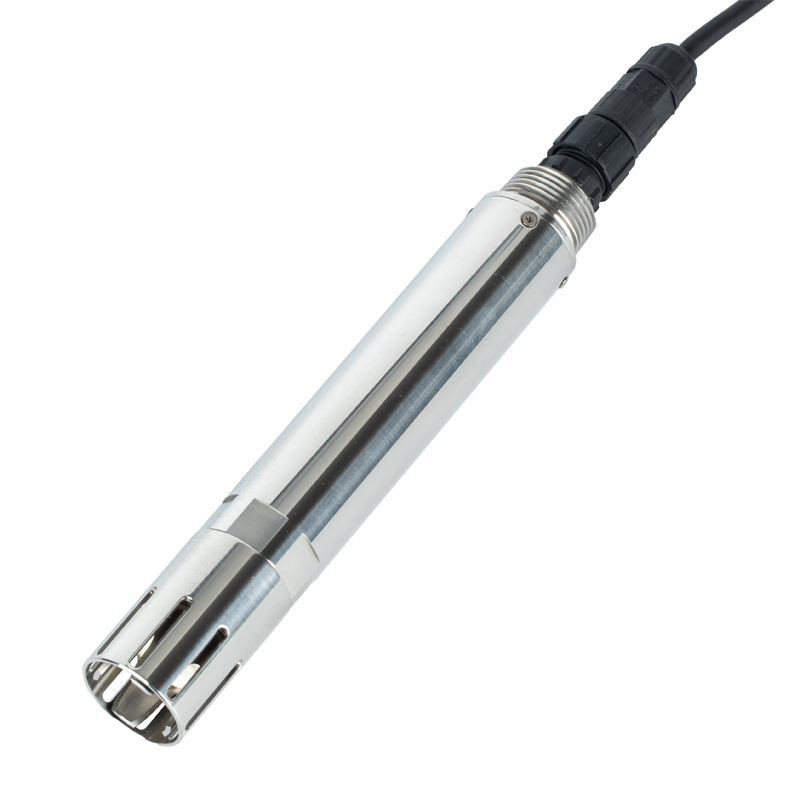
For wastewater neutralization, the pH point should observe a mixed, representative liquid rather than a concentrated dosing plume. The control design also needs mixing time, reagent delivery limits and an agreed response to an invalid input. A pH signal alone does not validate the dosing system.
For chemical batch work, confirm the full liquid composition and the temperatures and pressures reached during every stage. A bypass may improve access, but cooling, gas release or delay can alter the sample. Specify what condition the reported pH must represent rather than treating any accessible side stream as equivalent.
Low-conductivity water and hygienic processes need additional review. A general industrial pH range does not establish a suitable reference system for every high-purity sample, nor does a 3/4 NPT thread establish a sanitary connection. Identify those requirements before choosing a model by nominal accuracy alone.
Verify the probe in appropriate buffers, confirm temperature, and compare the decoded value at the final receiver. Test missing-sensor handling and any approved local fallback. A factory reset is a configuration change that may require calibration again, not a routine cure for an unexplained process reading.
Retain the variant, serial identity, wiring schedule, register interpretation and accepted output span with the installed point. These details help a distributor supply a compatible spare without recreating the integration from a photograph. For NiuBoL selection support, provide liquid composition, operating limits, receiving input and the required installation arrangement.
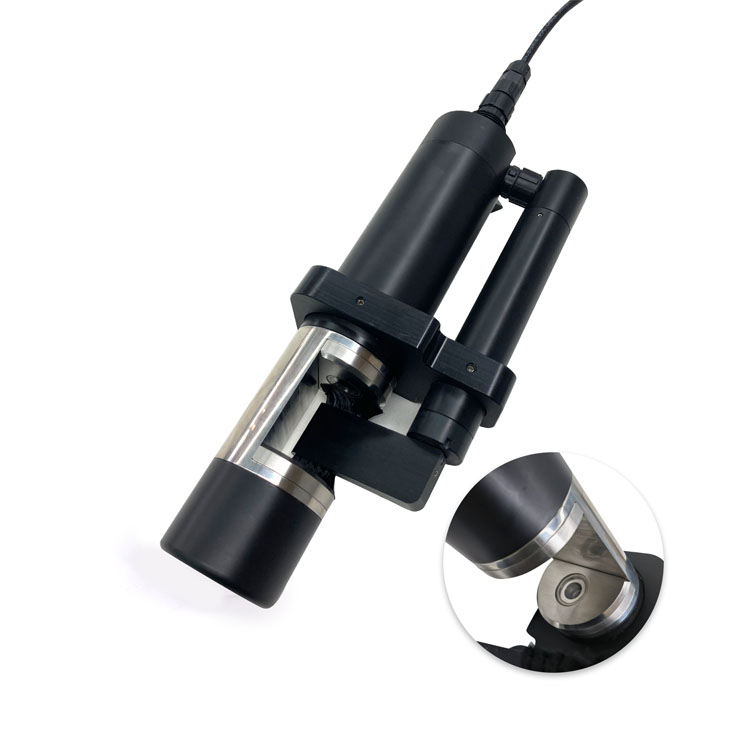
Where a transparency or other optical channel is also fitted, use it only for its own water-quality indication. Clear-looking water or a valid optical reading does not verify pH calibration. Diagnose the chemical measurement and its data path directly rather than treating another sensor's stable output as confirmation.
Only when the PLC has a compatible input or communication arrangement. The digital version needs an RS485 Modbus RTU master; an Ethernet-only controller requires an appropriate interface or gateway.
Do not assume that. The stated 4S version uses green for B, while the base and 4A versions use white. Verify the delivered cable and optional-output arrangement before connection.
No. The base format described here supplies a magnitude and a decimal-place field for each measurement. Read and interpret the full block according to the actual revision.
Not automatically. The stated function compensates electrode response. The sample's chemical pH may itself change with temperature, so compare measurements on an appropriate basis.
No. These configurations specify +/-0.1 pH accuracy. Display resolution, reference uncertainty and installation effects must be distinguished when setting acceptance or control criteria.
No. The specified operating pressure remains below 0.2 MPa for these configurations. The holder, seals and process connection also need suitable ratings and a safe removal procedure.
Check whether they use the same sensor value, output span, temperature basis and timestamp. Verify analog input scaling and digital decoding before changing electrode calibration.
Provide the model and revision, wetted materials, medium, temperature and pressure, cable requirements, output and receiving settings. Include the existing holder and any required approval or documentation.
An industrial online pH sensor should be selected and accepted as a complete measurement point. Keep the NiuBoL model's materials, operating limits and cable definition together, decode the actual digital format and verify the selected analog span where fitted. This makes integration and replacement more predictable without promising universal chemical compatibility or fixed maintenance savings.
 NBL-WQ-PH Online Water Quality pH Sensor.pdf
Prev:Turbidity Method Comparability: Particles, Color and Optical Geometry
Next:Broken pH Electrode: Isolate, Replace and Verify the Restored Channel
Related recommendations
Sensors & Weather Stations Catalog
Agriculture Sensors and Weather Stations Catalog-NiuBoL.pdf
Weather Stations Catalog-NiuBoL.pdf
Agriculture Sensors Catalog-NiuBoL.pdf
Water Quality Sensor Catalog-NiuBoL.pdf
Related products
 Combined air temperature and relative humidity sensor
 TDR Soil Moisture & Temperature Sensor for irrigation| RS485 |4-20mA| NBL-S-THR
 Soil pH sensor RS485 soil Testing instrument soil ph meter for agriculture |NBL-S-PH
 Wind Speed sensor Output Modbus/RS485/Analog/0-5V/4-20mA
 Tipping bucket rain gauge for weather monitoring auto rainfall sensor RS485/Outdoor/stainless steel
 Pyranometer Solar Radiation Sensor 4-20mA/RS485


Screenshot, WhatsApp to identify the QR code
WhatsApp number:+8615367865107
(Click on WhatsApp to copy and add friends)

