





— Blogs —
—Products—
 Consumer hotline +8618073152920
 WhatsApp:+8615367865107
Address:Room 102, District D, Houhu Industrial Park, Yuelu District, Changsha City, Hunan Province, China
Product knowledge
Time:2026-03-06 17:51:00 Popularity:771
Radar water level gauge troubleshooting requires different checks for a jump, a constant value or an offset. The fault may lie in the echo target, mounting reference, sensor configuration or receiving software. Before changing a zero setting or increasing filtering, compare the instrument's distance reading with its calculated level and the value stored by the logger.
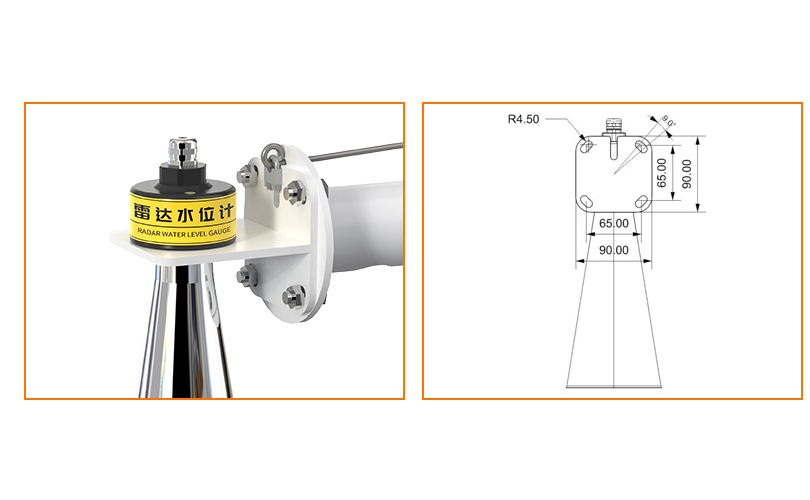
An overhead radar measures distance toward a reflecting surface. Water-surface elevation is then obtained using a defined measurement reference. For a fixed vertical installation, a rising water surface reduces the measured distance. A display that increases distance and level together may have the sign or calculation wrong even when the radar is measuring consistently.
Record the sensor reference plane, configured offset, any logger-side conversion and the display unit. One system may export distance in millimetres while another expects elevation in metres. Applying the offset twice or omitting a factor of 1,000 can create an error that cannot be repaired by cleaning the antenna.
For a hypothetical sensor reference elevation of 12.000 m and a vertical distance of 3.250 m, water elevation is 8.750 m. If the stored value is 3.250 m, determine whether it is deliberately a distance channel before calling it incorrect. The channel name must identify which quantity the record represents.
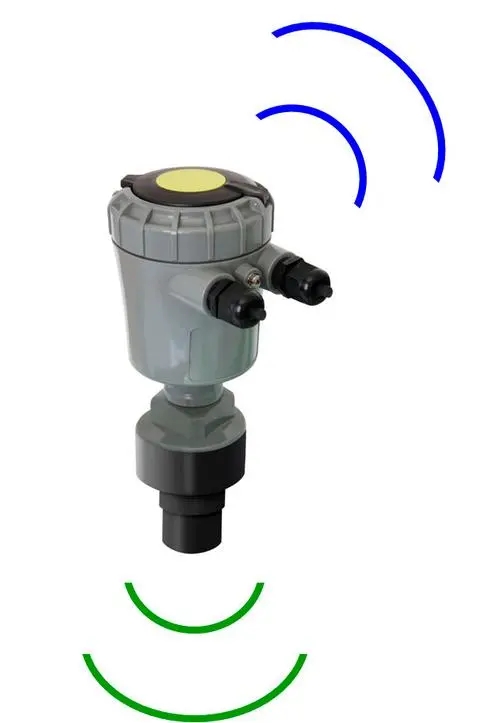
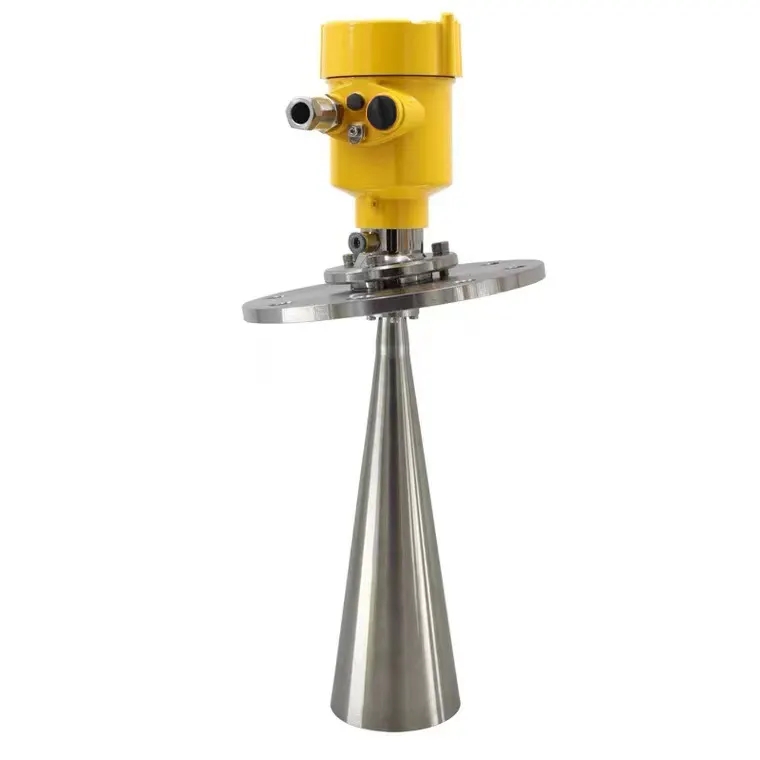
NiuBoL supplies different level instruments; a horn antenna, a compact lens radar and an ultrasonic head must not be assigned the same settings from their appearance. The values below apply to the linked high-frequency radar level configuration. Check the supplied model and revision before applying them to an existing station.
| Item | Configuration specification | Diagnostic significance |
|---|---|---|
| Principle and frequency | FMCW; 76-81 GHz | Not an ultrasonic transit-time instrument |
| Distance range | 0.1-65 m; extended configurations subject to selection | Check the nearest high-water target and farthest low-water target |
| Specified accuracy | +/-1 mm | Obtain applicable test conditions; installed level also depends on the reference |
| Beam angle and blind zone | 6 degrees; 0.1 m | Review obstructions over the full operating distance |
| Supply and consumption | 10-30 VDC; less than 0.2 W | Separate sensor load from modem, logger and accessories |
| Output | RS485 Modbus RTU | Check the exact distance or level register and scaling |
| Environment and protection | -40 to 60 C; non-condensing humidity up to 95% RH; IP67 | Not a guarantee of continuous operation under water |
Establish cable material, length and connector protection for the ordered assembly. A waterproof sensor housing does not establish the ingress rating of a field splice. Do not use an enclosure label or a nominal low sensor load to diagnose the complete station without checking its actual wiring and power behaviour.
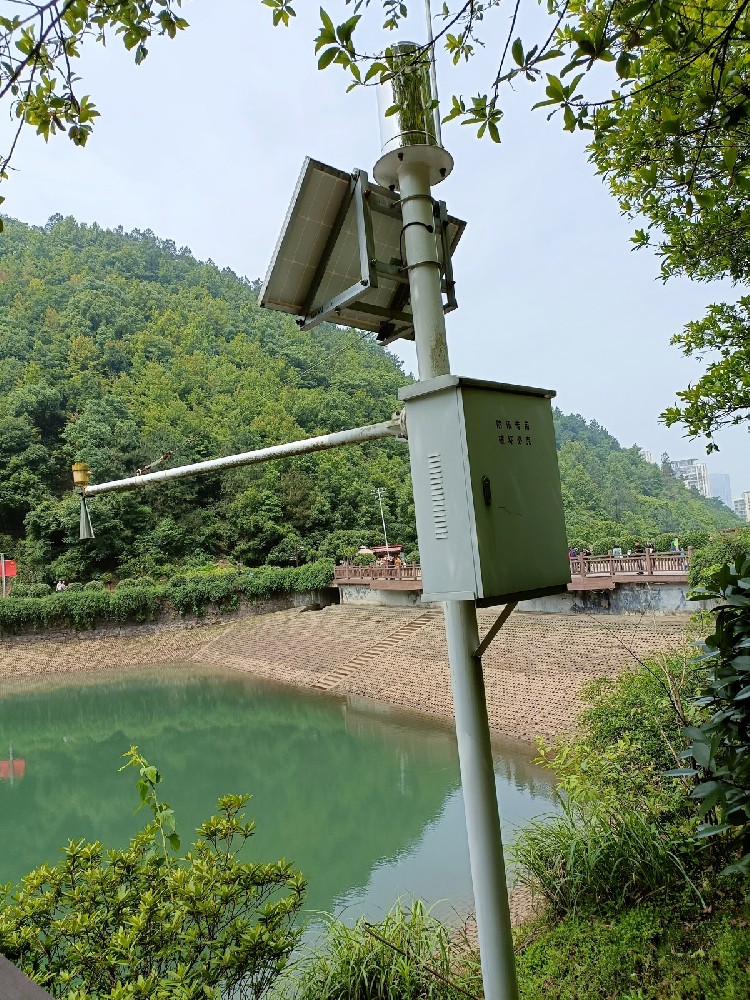
A steady river can legitimately produce little change, so a constant value is not sufficient evidence of failure. Compare acquisition times and communication status. Read the instrument locally through an appropriate interface and compare that result with the logger and server. A server can remain online while repeatedly displaying an old sensor value.
If local readings change but the stored channel does not, inspect polling, address, register mapping and retained-value behaviour. If local communication fails too, check supply at the sensor during operation and inspect the bus connection before altering any level calibration. An error code mapped to zero can also disguise a communication failure as a valid water level.
If the sensor responds but reports no valid target, review the measurement range, alignment, target exposure and antenna condition. Obtain whatever target-quality information the supplied unit actually supports. Do not assume every model provides an echo spectrum, signal-to-noise register or remotely editable suppression map.
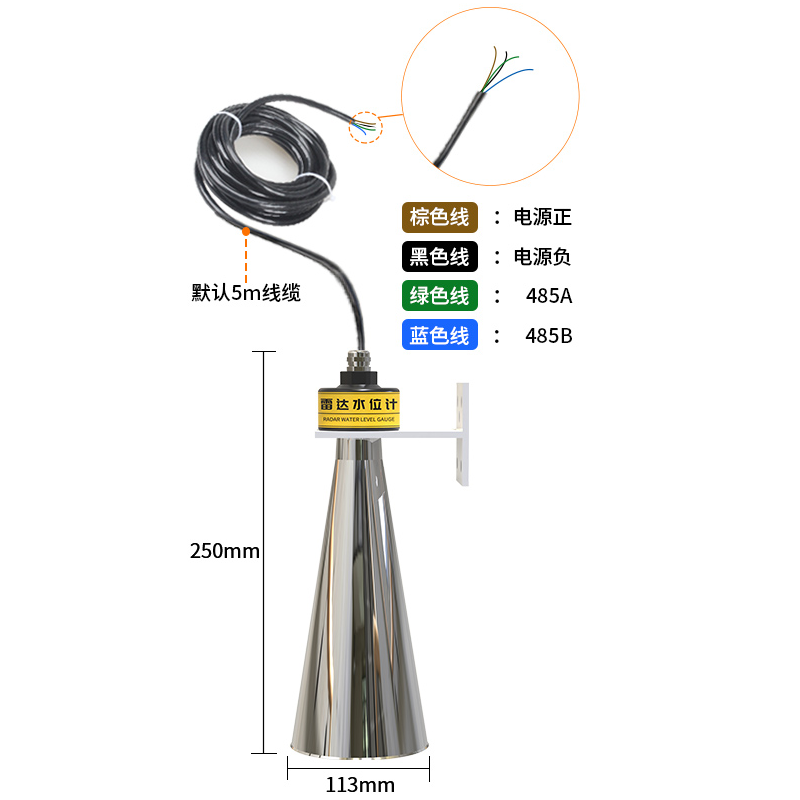
A nearby beam, bank projection, vegetation, floating object or temporary obstruction can produce a competing return. Note whether the abnormal distance corresponds to a physical object. Compare conditions during the event: water level, visible debris, bracket movement and recent work around the station.
For an idealized 6-degree full beam, the geometric radius at 10 m distance is 10 x tan(3 degrees), approximately 0.52 m. This is a planning illustration, not a guaranteed safe clearance. Reflective objects, side lobes, the actual antenna pattern and changing water level still need assessment. A centreline check alone does not inspect the full sensing region.
Increasing the averaging time can smooth a jump without removing its cause. It can also delay a real rising-water response. First establish the target problem; then adjust only settings available for the specific instrument and validate the resulting response. Do not teach a suppression function to reject a region that may contain the real high-water surface.
If distance follows the water consistently but level differs from a staff gauge by a nearly constant amount, compare both references. Check the staff-gauge zero, sensor reference elevation, configured offset and any logger-side conversion. Compare observations at matching times, particularly where waves or rapidly changing stage make a spot observation unrepresentative.
Inspect the bracket and supporting structure before changing coefficients. A moved cross-arm changes the measurement reference. Correcting the displayed offset may hide a mechanical problem and leave the structure vulnerable to further movement. Record the physical repair and effective time if the reference has genuinely changed.
If the disagreement grows with distance rather than remaining constant, investigate units, scale and installation geometry instead of treating it as one offset. Where level comes from a pressure instrument elsewhere at the site, confirm that the two instruments observe the same water surface and that the pressure reference is functioning.
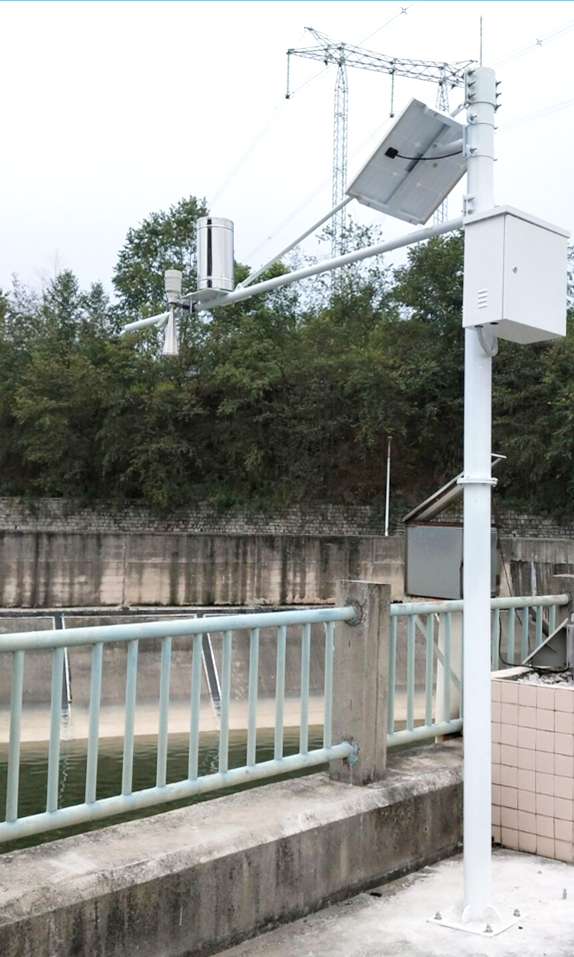
Retain the before-and-after settings, distance, converted elevation and reference observation. Change one relevant setting at a time when practical. A reading that looks correct immediately after editing is not enough; repeat the comparison over the operating conditions that revealed the problem.
Check the PLC, RTU or data logger record as well as the instrument's local response. Verify invalid-data handling, timestamps and restoration after power or communication loss. Remote diagnostics and firmware updates are separate capabilities to establish for the supplied unit, not assumed functions of RS485 Modbus RTU.
For support or replacement enquiries, send NiuBoL the unit identification, range, mounting photographs, measured reference distance, supply readings and relevant configuration. Include a short sequence showing the abnormality rather than only a cropped screen value. This helps separate a sensor problem from site geometry or a receiving-system error before hardware is replaced.
Not before checking communication and observation age. Determine whether the sensor itself is returning a current constant distance or the software is retaining an older reading.
Filtering may hide the symptom and delay real changes. Inspect target competition, mounting and available quality information first, then test any supported filter change against the required response.
No. It estimates an ideal cone only. Review the actual antenna pattern, reflective objects and the full water-level range before accepting the position.
No. Reference elevation, staff-gauge zero and duplicated conversions can create a stable difference. Compare the raw distance and reference calculations before adjusting the sensor.
No. Match the actual model, frequency, antenna, range and interface. An ultrasonic head and a radar head require different checks even when both output a distance.
Provide model identification, installation photographs, settings, supply measurements and timestamped local and logger readings. A reference observation during the problem is especially useful.
Radar water level gauge troubleshooting starts by identifying whether the problem is stale data, an incorrect target or a reference conversion. Compare distance, level and stored output before changing calibration. A model-specific investigation gives NiuBoL and the project integrator the information needed to decide whether the remedy is wiring, mounting, configuration or instrument service.
Prev:Agricultural Microclimate Monitoring Station: Light Data for Crop Trials
Next:Dual-Sensor Flow Monitoring System: Compare Radar and Acoustic Readings
Related recommendations
Sensors & Weather Stations Catalog
 Agriculture Sensors and Weather Stations Catalog-NiuBoL.pdf
Weather Stations Catalog-NiuBoL.pdf
Agriculture Sensors Catalog-NiuBoL.pdf
Water Quality Sensor Catalog-NiuBoL.pdf
Related products
 Combined air temperature and relative humidity sensor
 TDR Soil Moisture & Temperature Sensor for irrigation| RS485 |4-20mA| NBL-S-THR
 Soil pH sensor RS485 soil Testing instrument soil ph meter for agriculture |NBL-S-PH
 Wind Speed sensor Output Modbus/RS485/Analog/0-5V/4-20mA
 Tipping bucket rain gauge for weather monitoring auto rainfall sensor RS485/Outdoor/stainless steel
 Pyranometer Solar Radiation Sensor 4-20mA/RS485

Screenshot, WhatsApp to identify the QR code
WhatsApp number:+8615367865107
(Click on WhatsApp to copy and add friends)

