





— Blogs —
—Products—
 Consumer hotline +8618073152920
WhatsApp:+8615367865107
Address:Room 102, District D, Houhu Industrial Park, Yuelu District, Changsha City, Hunan Province, China
Product knowledge
Time:2026-06-06 09:36:36 Popularity:375
Quick Answer: Domestic water quality parameters after tank storage should be compared at the inlet, tank outlet and relevant downstream point using identified methods and sampling times. Chlorine-related readings, turbidity, pH, conductivity and temperature can help locate a change, but they do not identify every contaminant. Treat the monitoring station as an investigation tool alongside the supply's inspection and verification programme.
A complaint at a fixture, a tank-outlet alarm and a change in incoming supply are different observations. Before adding sensors, draw the incoming main, tank, booster arrangement and downstream branches. Mark bypasses, blending connections and sample take-offs. This prevents a sensor on one branch being treated as evidence for water it never samples.
Start with an inlet/outlet comparison when the question concerns storage. If both points change in a similar way, investigate the incoming supply and sampling conditions. If the outlet changes while the inlet remains consistent, inspect the tank operation, turnover and associated pipework. A downstream-only change points to another part of the investigation; it does not prove a particular cause.
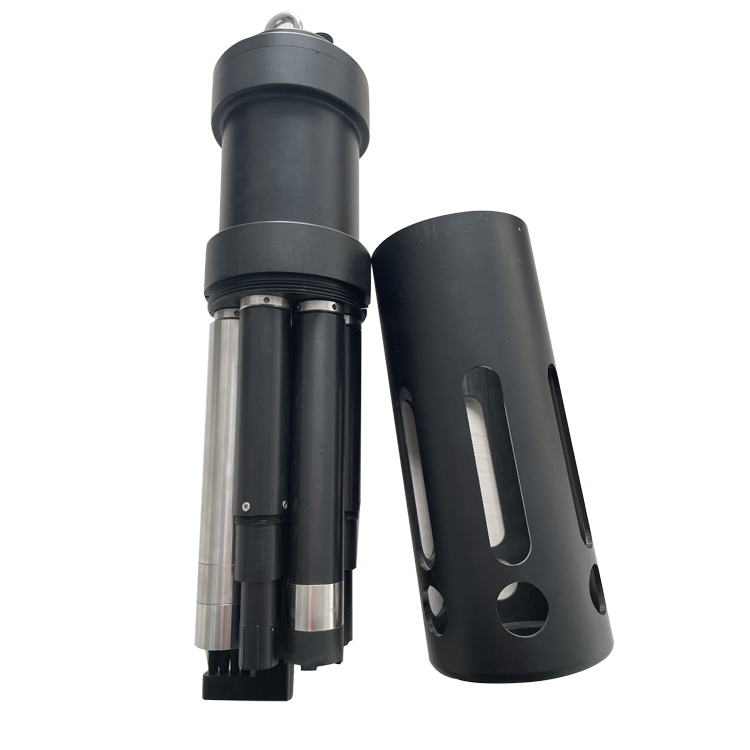
The multiparameter assembly above represents one possible way of collecting several observations. Specify the fitted elements and operating conditions. In particular, do not assume a general multiparameter housing contains a chlorine analyzer or a dedicated color instrument.
| Observation | What it contributes to the investigation |
|---|---|
| Chlorine-related result | Compare the defined disinfectant quantity across storage; check sample delay and test method before attributing a reduction to tank demand. |
| Turbidity | Investigate particle changes, deposits or disturbance. NTU does not identify the particles or replace a microbiological result. |
| pH and temperature | Provide context for water chemistry and chlorine interpretation; compare similar sampling conditions. |
| Conductivity | Check whether the ionic character changed, for example during source blending. It does not identify a specific ion. |
| Color or appearance | Document the complaint and use an appropriate color method where needed. Apparent color and turbidity are not the same measurement. |
Some concerns need another analytical route. Metals, specific chemicals and microorganisms cannot be ruled out merely because the five displayed channels remain inside their usual bands. The WHO drinking-water quality framework distinguishes operational monitoring from wider risk management and verification. Apply the requirements relevant to the actual supply rather than inventing a universal sensor-only acceptance list.
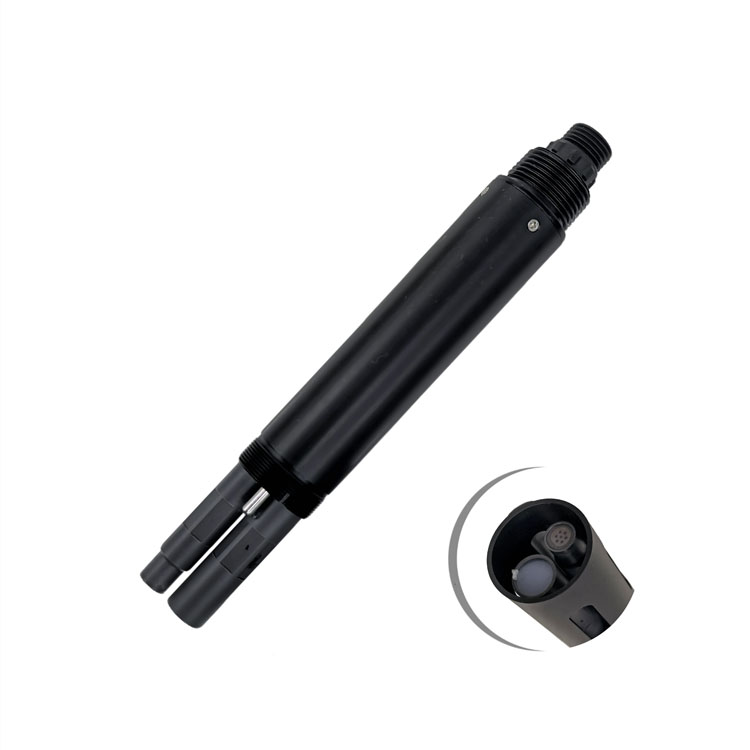
The ammonia nitrogen probe pictured below is a separate instrument. Include that channel only where the supply's risk assessment or investigation gives it a defined purpose, and establish the required nitrogen reporting quantity before selection.
The two samples should have clearly recorded locations and times. The water leaving a tank is not necessarily the water entering at that same instant, especially where the tank mixes, level changes or the operating flow varies. Use the tank and pump records to interpret the comparison instead of assuming a simple one-to-one match.
Check both sample lines for stagnant branches and deposits. At low building demand, an analyzer bypass may continue drawing while the main branch has little movement. Determine which condition the sample describes. Verify the sample route after maintenance or a change in valve position.
For chlorine, use the same analytical quantity and appropriate methods at both points. The basic NiuBoL CL measures HClO, not total chlorine. A lower HClO value can require pH and temperature interpretation before being described as an equivalent reduction in free chlorine. The chlorine probe below therefore needs its own sampling and verification arrangement.
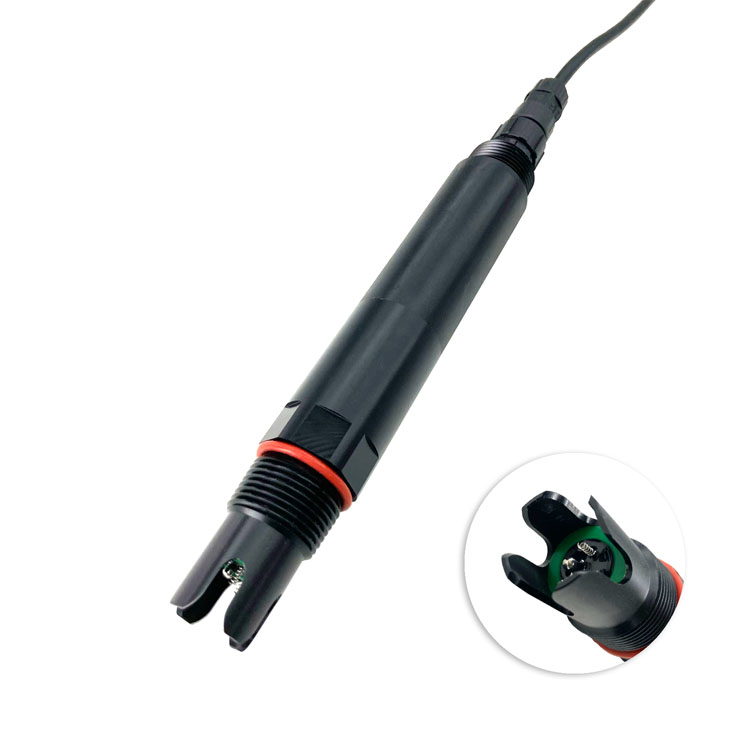
The NiuBoL NBL-WQ-EC-4A is one identified conductivity option. Use its actual full-scale accuracy when judging a small inlet/outlet difference, and keep the same temperature-compensation basis at both points.
| Parameter | NBL-WQ-EC-4A |
|---|---|
| Range / resolution | 0-5000 uS/cm / 1 uS/cm |
| Accuracy | +/-1.5% F.S.; temperature +/-0.3 degrees C |
| Water conditions | 0-50 degrees C; pressure below 0.6 MPa |
| Compensation | Pt1000 automatic temperature compensation; confirm the configured reporting basis |
| Output | RS485 Modbus RTU; optional 4-20 mA |
| Supply / consumption | 12-24 V DC; 0.2 W at 12 V |
| Wetted materials / protection | ABS and SUS316L default configuration; IP68 |
| Mounting / cable | Immersion or pipe installation, 3/4 NPT; standard 5 m cable, other lengths customizable |
The full-scale accuracy term corresponds to 75 uS/cm on a 5000 uS/cm range. It is not 1.5% of a small current reading, and a two-sensor comparison must also account for both instruments. Define an achievable comparison criterion rather than treating every one-digit difference as a water change. Confirm cable jacket and fitting compatibility separately.
Give each channel a physical point, method, model, unit and acquisition time. Keep a missing or stale result distinct from a normal reading. If inlet and outlet data arrive through different gateways, verify their clocks before comparing events. Record tank cleaning, pump changes, refill events and sensor servicing beside the trend.
Use the actual protocol supplied with each sensor for RS485 Modbus RTU mapping. A common bus does not give different probes the same pressure limit, sample flow or valid-data state. A chlorine flow cell and an immersion turbidity probe may need separate hydraulic arrangements even when they report to one logger.
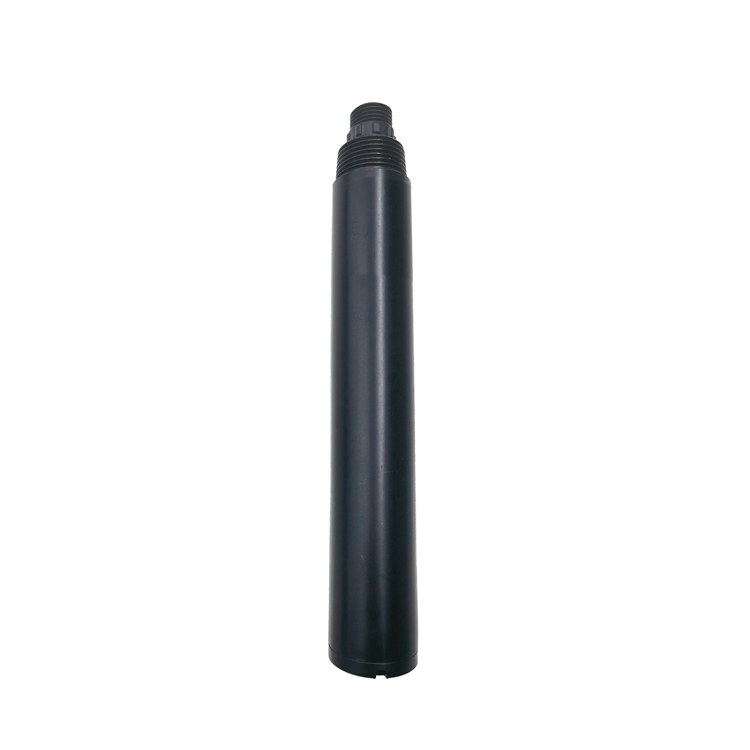
The turbidity probe below provides an optical particle channel. Confirm its range-specific error at the required decision level; the number of decimal places does not establish low-NTU suitability. For station placement rather than storage comparison, refer to the separate water-supply monitoring-point guide.
No. Check the chlorine quantity, sample delay, pH, temperature and tank operation, then inspect and verify according to the supply's procedure. A residual difference does not identify a cause by itself.
No. It indicates ionic conductivity, not a chemical identity. A meaningful unexplained change may justify targeted analysis, but it cannot identify or exclude every hazard.
It measures scattering under its optical design. Where color is part of the complaint or required reporting, use an appropriate color method and distinguish it from turbidity.
That can simplify comparison, but does not remove sampling and calibration differences. Confirm the same measurement basis and the uncertainty of the pair under relevant water conditions.
Provide the supply drawing, tank operating cycle, complaint or trend, proposed points, required analytical quantities and receiving system. Ask the supplier to distinguish continuous channels, sample hardware and separate verification tests.
Domestic water quality parameters are useful after storage when they help locate a change and select the next check. Compare identified points and methods, preserve tank-operation context and use targeted verification where the displayed channels cannot answer the question. Specify NiuBoL sensors for defined observations rather than a blanket claim of complete water testing.
Prev:Dissolved Oxygen Sensor for Aquaculture: Check Recovery After Feeding
Next:Industrial pH Electrode Maintenance and RS485 Integration
Related recommendations
Sensors & Weather Stations Catalog
 Agriculture Sensors and Weather Stations Catalog-NiuBoL.pdf
Weather Stations Catalog-NiuBoL.pdf
Agriculture Sensors Catalog-NiuBoL.pdf
Water Quality Sensor Catalog-NiuBoL.pdf
Related products
 Combined air temperature and relative humidity sensor
 TDR Soil Moisture & Temperature Sensor for irrigation| RS485 |4-20mA| NBL-S-THR
 Soil pH sensor RS485 soil Testing instrument soil ph meter for agriculture |NBL-S-PH
 Wind Speed sensor Output Modbus/RS485/Analog/0-5V/4-20mA
 Tipping bucket rain gauge for weather monitoring auto rainfall sensor RS485/Outdoor/stainless steel
 Pyranometer Solar Radiation Sensor 4-20mA/RS485


Screenshot, WhatsApp to identify the QR code
WhatsApp number:+8615367865107
(Click on WhatsApp to copy and add friends)

