





— Blogs —
—Products—
 Consumer hotline +8618073152920
 WhatsApp:+8615367865107
Address:Room 102, District D, Houhu Industrial Park, Yuelu District, Changsha City, Hunan Province, China
Product knowledge
Time:2026-04-02 12:04:25 Popularity:758
In the process of promoting green and sustainable agricultural development and water-saving irrigation, accurate and real-time soil moisture data is the core basis for formulating scientific irrigation systems and optimizing water resource allocation. Traditional manual survey methods have problems such as response lag and accuracy depending on experience, making it difficult to meet the needs of modern agriculture for dynamic monitoring and precise regulation. The soil moisture monitoring solution launched by NiuBoL, with the NBL-S-TM and NBL-S-THR series high-precision sensors as the core, combined with flexible communication interfaces and power supply methods, provides engineering-grade integration support for farmland soil moisture monitoring, drought management systems, and water-fertilizer integration projects.
The system can realize dynamic observation of multi-layer soil profile temperature and humidity and supports real-time data upload to cloud platforms or local hosts to meet the high-frequency monitoring requirements of important farming seasons and key crop growth periods, providing a decision-making data foundation for drought resistance scheduling and water-saving measure formulation.
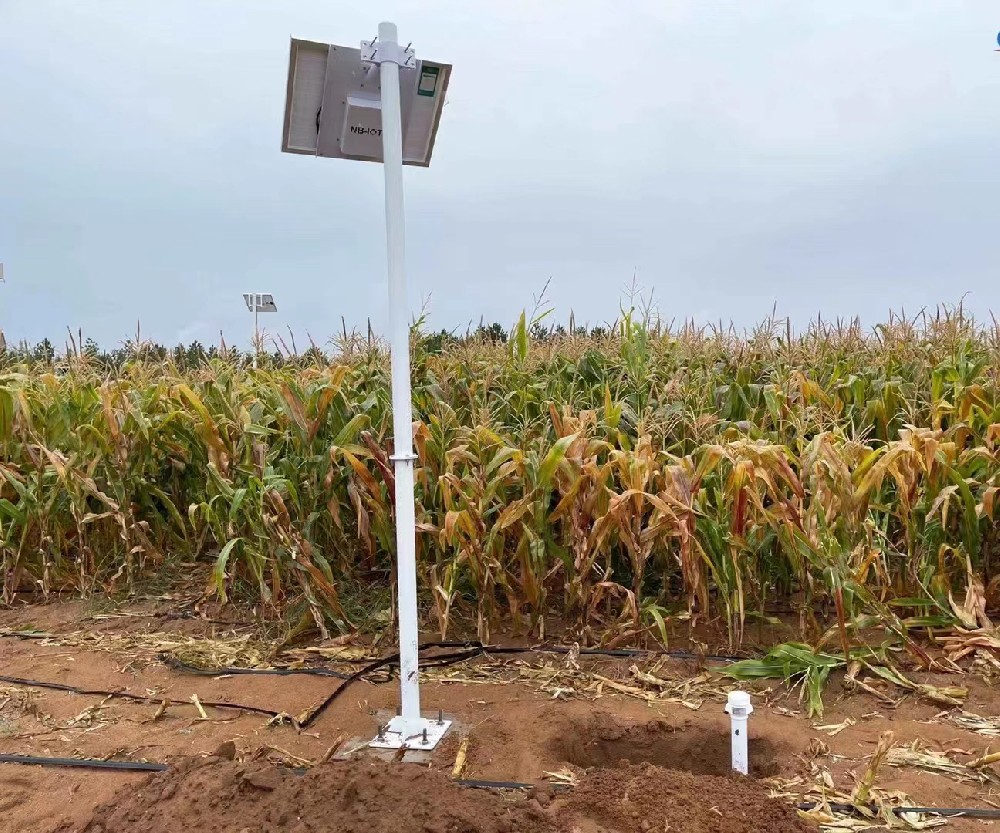
Soil moisture refers to the humidity condition of soil suitable for plant growth and development. Its core parameter is soil water content, which can be expressed as volumetric water content (%) or relative percentage relative to field capacity and saturated water content. Soil moisture, as a key limiting factor for crop growth, directly affects root water absorption, nutrient transport, and photosynthesis efficiency.
In water-saving agriculture projects, real-time soil moisture monitoring can be combined with crop water requirement patterns and local water resource conditions to generate precise irrigation scheduling plans, avoiding nutrient loss and water waste caused by excessive irrigation, while preventing the impact of drought stress on yield. By linking with meteorological data, agricultural information, and water conservancy project storage conditions, the soil moisture system can build a decision support model to assist in commanding drought resistance and disaster reduction, minimizing disaster losses to the greatest extent.
For system integrators, deploying a stable soil moisture monitoring network can significantly improve the technical content of the project and long-term operation and maintenance efficiency, meeting the requirements of smart agriculture, digital farmland, and high-standard farmland construction for perception layer equipment.
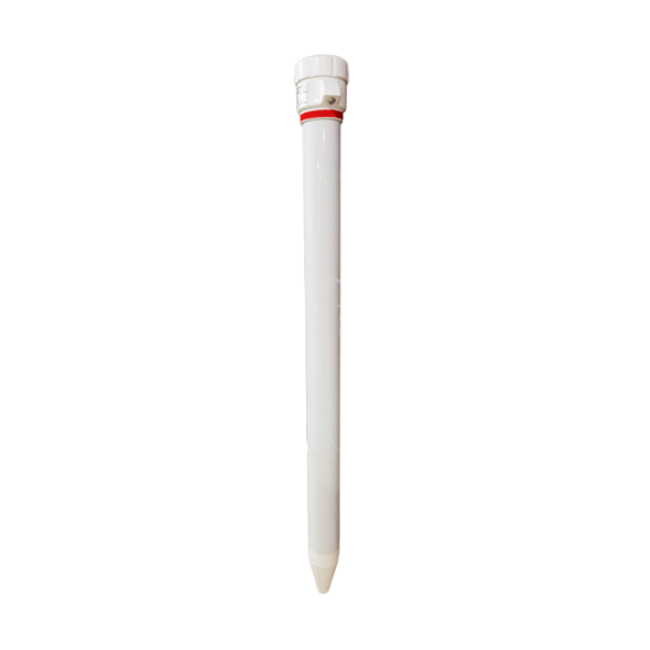
FDR (Frequency Domain Reflectometry) and TDR (Time Domain Reflectometry) are currently mainstream non-contact dielectric constant measurement technologies in the agricultural field. Both invert real water content by detecting the apparent dielectric constant of soil, complying with international standard soil moisture volumetric percentage measurement methods.
FDR Principle: The sensor emits high-frequency electromagnetic waves, uses soil as a dielectric, and calculates the dielectric constant by measuring electromagnetic wave frequency changes or capacitance characteristics. The NBL-S-TM adopts the FDR method, featuring fast response and low power consumption, suitable for large-scale and multi-point deployment scenarios. It has good adaptability to most soil types, is easy to install, and is suitable for conventional farmland soil moisture monitoring.
TDR Principle: The sensor sends high-frequency electromagnetic pulses through a coaxial cable and measures the propagation time difference of the pulse in the probe and soil medium to accurately calculate the dielectric constant. The NBL-S-THR adopts the TDR method, showing higher stability and anti-interference capability under high water content or complex soil conditions, especially suitable for scientific research experiments or saline-alkali land monitoring projects with strict precision requirements.
Both technologies are not significantly affected by factors such as fertilizers and metal ions in the soil and can simultaneously output soil temperature and humidity parameters. Compared with traditional resistance methods or tensiometers, FDR and TDR have the advantages of fast response, high long-term stability, and no need for frequent calibration.
NiuBoL sensors adopt special anti-corrosion alloy electrodes and flame-retardant epoxy resin fully sealed structures in design. The probe insertion installation supports long-term burial in soil or submersion in water, with a protection level of IP68.
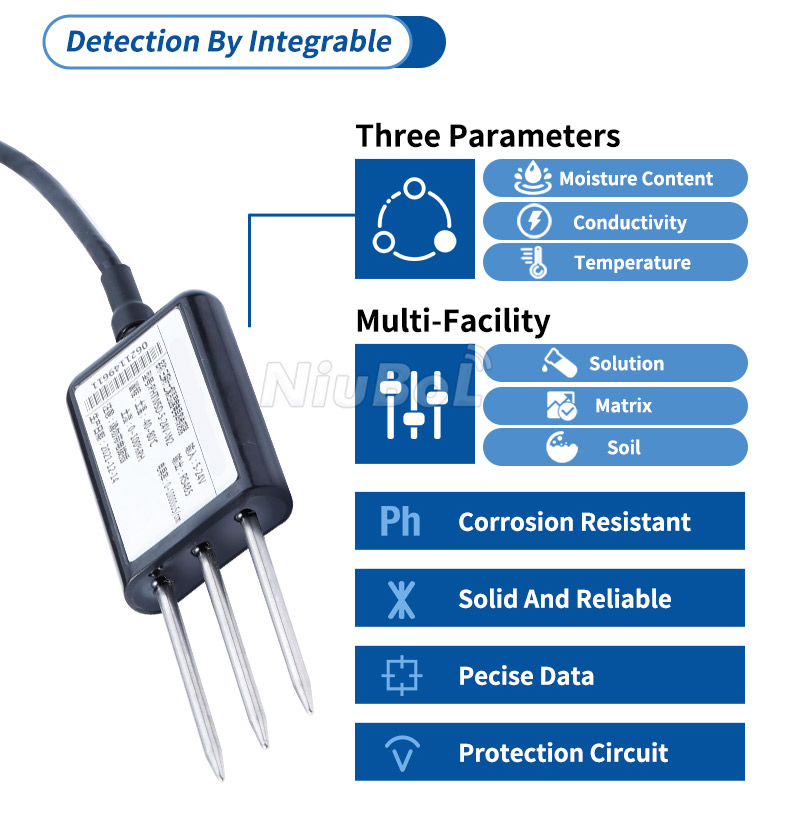
This sensor is a single-point design that can simultaneously measure soil temperature and humidity. It is suitable for farmland soil moisture quick measurement, scientific experiments, and irrigation control scenarios. The electrode uses specially treated alloy material, which is impact-resistant and acid-alkali corrosion-resistant, and is equipped with a complete protection circuit.
| Parameter | Range | Resolution | Accuracy |
|---|---|---|---|
| Soil Temperature | -40~80℃ | 0.1℃ | ±0.5℃ |
| Soil Humidity | 0-100% | 0.1% | ±5% |
Power Supply Voltage: DC 5V-24V
Signal Output: RS485 (Modbus protocol)
Protection Level: IP68
Operating Environment: -40~85℃
Probe Material: Anti-corrosion special electrode
Overall Dimensions: 45×15×135mm, electrode length 50mm
Default Cable Length: 5 meters (customizable)
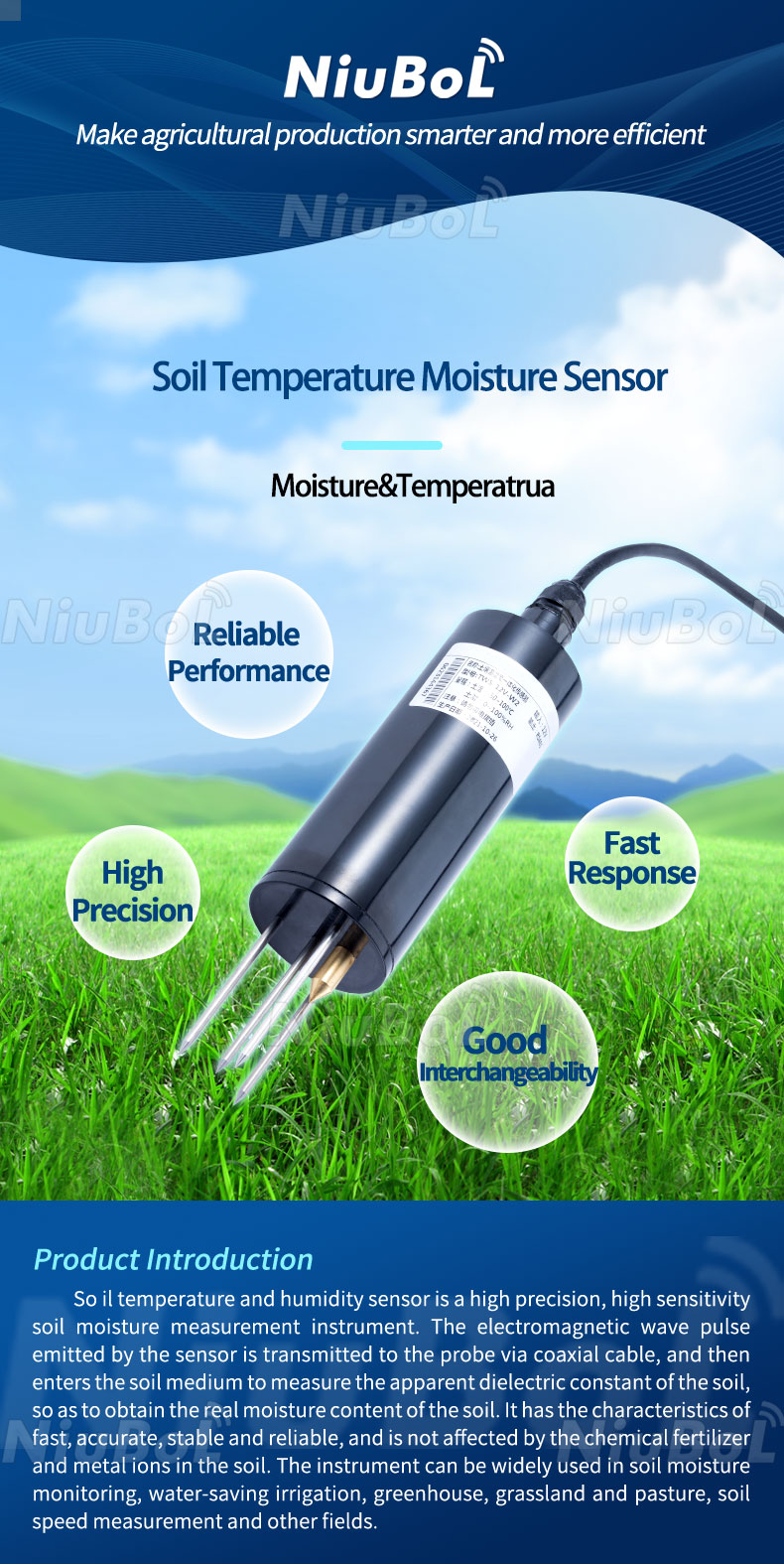
This sensor measures the apparent dielectric constant of soil through electromagnetic wave pulses, with higher precision and anti-saline-alkali interference capability. It is suitable for greenhouse, grassland pasture, water-saving irrigation, and soil quick measurement fields.
| Parameter | Range | Resolution | Accuracy |
|---|---|---|---|
| Soil Humidity | 0~100% | 0.1% | ±3% |
| Soil Temperature | -50~100℃ | 0.1℃ | ±0.5℃ |
Power Supply Method: DC 12-24V
Signal Output: RS485, current 4~20mA (RL≤250Ω), voltage 0-5V (RL≥1KΩ)
Product Power Consumption: about 0.3W
Operating Environment: -40℃~80℃
Protection Level: IP68
Both sensors support combination with multi-layer observation structures to achieve layered deployment of ground temperature observation points and underground soil temperature and humidity measurement points every 10cm, meeting the needs of dynamic profile soil moisture analysis.
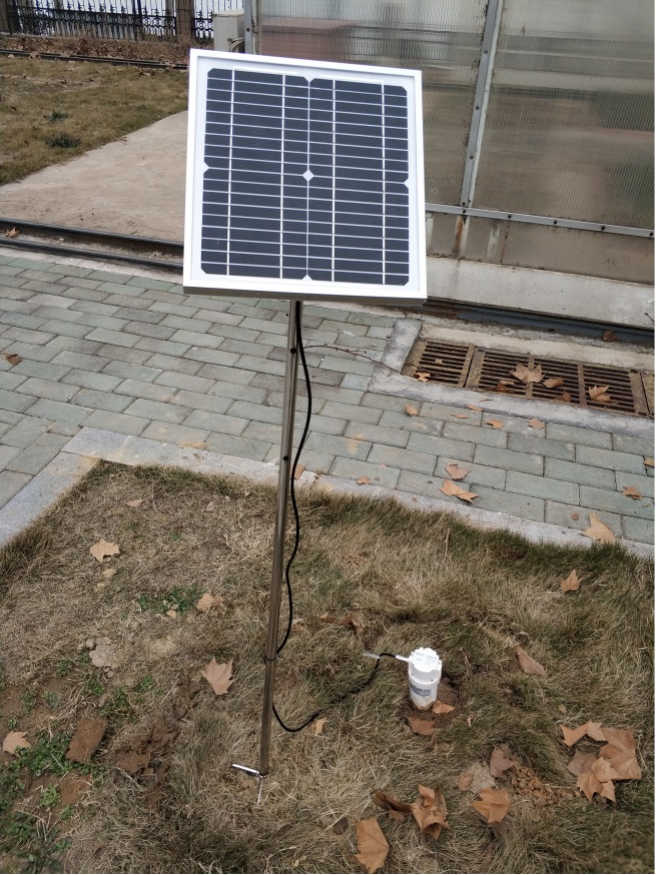
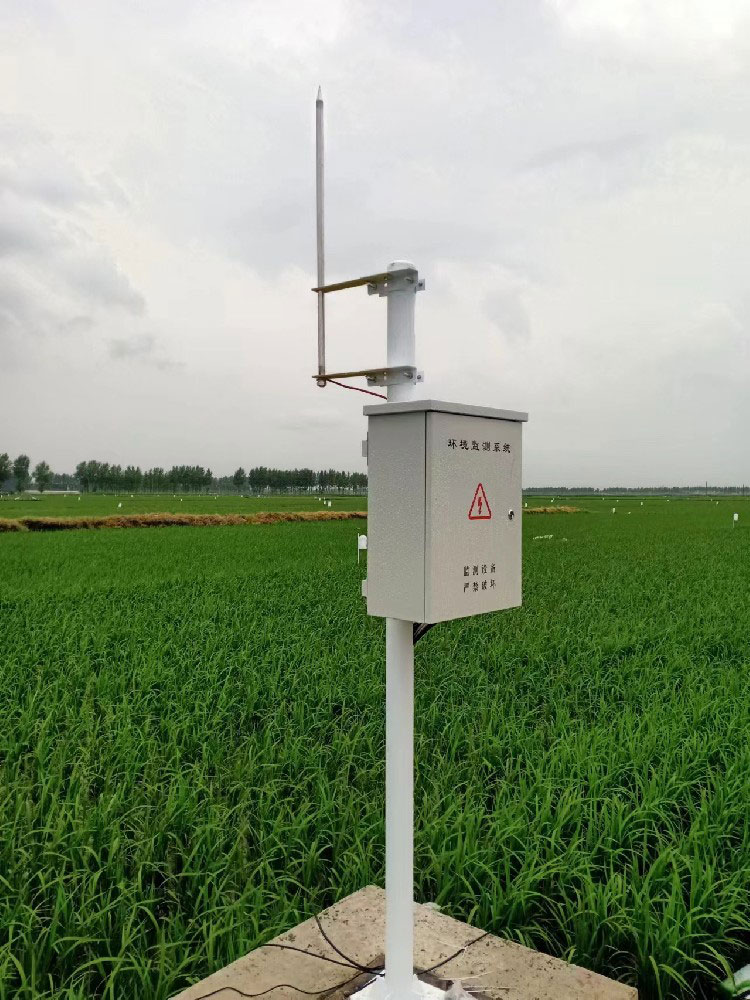
The NiuBoL soil moisture monitoring system host adopts IP65 rainproof design and is equipped with a large-size LCD screen, which can display the data collected by each sensor and trend curves in real time. It supports collection interval setting and historical data recording. Communication methods are flexible, including wired connection and wireless GSM/GPRS/4G/5G modules, facilitating remote data real-time transmission.
The sensors uniformly output the standard MODBUS protocol and can be directly connected to mainstream PLC, DTU, edge gateways, or agricultural IoT platforms to achieve linkage with water-fertilizer integration controllers, weather stations, video surveillance, and other equipment. Data supports export to Excel tables, curve graph generation, and docking with third-party analysis software.
Power supply solutions are diverse: mains power, solar panel + battery combination, particularly suitable for year-round deployment in areas without electricity or remote farmland. The system can simultaneously bind multiple monitoring stations to form a regional-level soil moisture monitoring network.
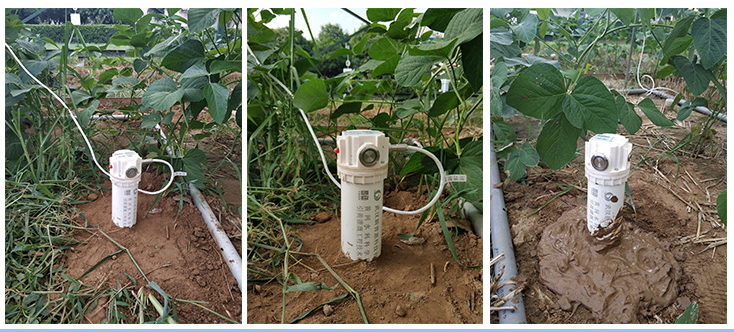
1. Field Crop Water-Saving Irrigation Projects: Deploy multi-point sensor networks in main grain producing areas such as wheat and corn. Combined with crop growth period water requirement models, dynamically adjust drip or sprinkler irrigation water volume to achieve precise water supply according to soil moisture. In actual engineering, such systems can significantly improve water resource utilization efficiency and support the promotion of soil moisture-based irrigation technology.
2. Facility Agriculture and Greenhouses: Use layered observation structures to monitor root zone soil moisture and link with water-fertilizer integration equipment to avoid humidity loss of control or disease occurrence caused by blind irrigation. Sensor data can be connected to intelligent controllers to achieve automated irrigation decisions.
3. Dryland Water-Saving Agriculture Demonstration Areas: In northern arid and semi-arid areas, combined with meteorological data to build a soil moisture-drought information management system to provide data support for drought resistance scheduling plans. Project cases show that real-time monitoring helps formulate irrigation plans in advance and reduce the impact of drought on yield.
4. Grassland Pasture and Ecological Restoration: Long-term burial of IP68 protective sensors to monitor soil moisture changes, assist in formulating reasonable grazing and vegetation restoration plans, and support ecological agriculture projects.
5. High-Standard Farmland and Smart Agriculture Platforms: Sensor data is connected to regional agricultural big data platforms and fused with remote sensing and drone data to achieve grid-based soil moisture management, providing visual decision-making tools for government supervision and agricultural technology promotion.
In the above scenarios, the NiuBoL solution replaces traditional multi-device combinations with single or multi-layer sensors, reducing wiring complexity and failure points, and lowering the total cost of ownership of the project.
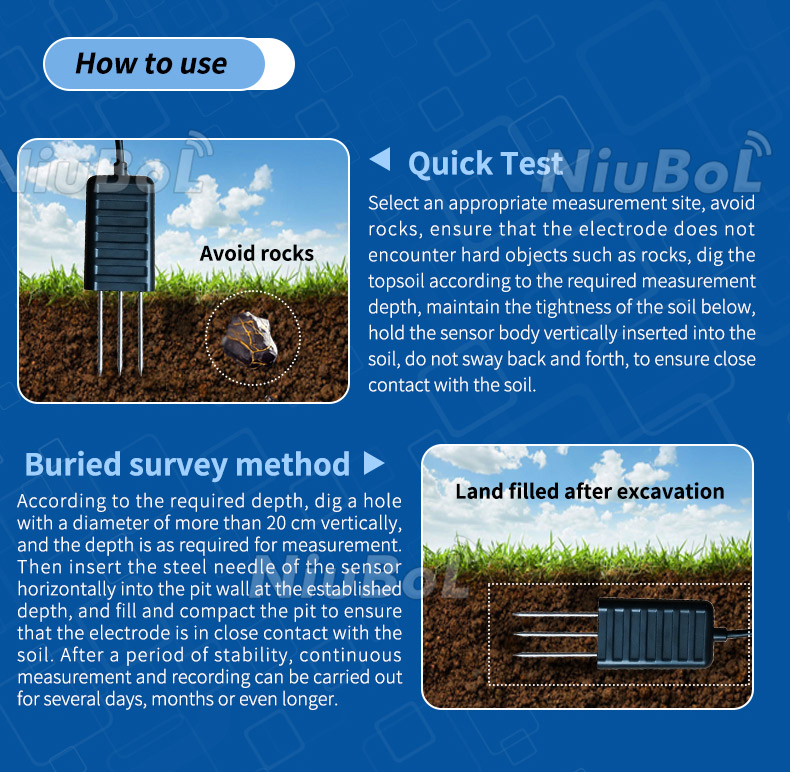
During installation, it is recommended to fully insert or bury the probe into the measured soil medium to avoid air gaps affecting measurement accuracy. For layered observation, set measurement points at 10cm intervals to ensure coverage of the main root distribution layer. It is recommended to use the original factory shielded cable for sensor cables and correctly ground it to improve anti-interference capability.
In daily operation and maintenance, due to the fully sealed anti-corrosion design, the sensor does not need frequent removal for maintenance. Regularly check the power supply and communication link status. The system host supports remote parameter setting and data download, further reducing on-site operation frequency.
Q1. How to choose between FDR and TDR soil sensors in agricultural projects?
FDR (NBL-S-TM) is suitable for cost-sensitive, large-scale deployment of conventional farmland monitoring. It is easy to install and has low power consumption. TDR (NBL-S-THR) performs better under high-precision requirements or complex soil conditions. Comprehensive evaluation can be made according to project precision requirements and budget.
Q2. Do the sensors support docking with existing irrigation controllers or IoT platforms?
Yes. RS485 MODBUS protocol is the standard output and is also compatible with multiple interfaces such as 4-20mA and 0-5V. It can be directly connected to PLC, DTU, or agricultural cloud platforms.
Q3. How to ensure long-term system operation in areas without electricity?
It is recommended to configure a solar panel + battery power supply solution. The low-power design (about 0.3W) combined with intelligent collection interval settings can achieve year-round unattended operation.
Q4. How is multi-layer soil profile monitoring realized?
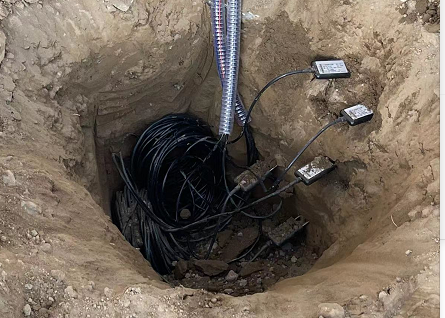
Through layered point setting structure, set temperature observation points on the ground and configure temperature and humidity measurement points every 10cm underground. Sensor data is uniformly summarized to the host or platform to achieve vertical profile dynamic analysis.
Q5. Will soil salinity or fertilizer application affect measurement accuracy?
FDR and TDR principles are based on dielectric constants and are less affected by fertilizers and metal ions. Especially TDR has higher stability under saline-alkali land conditions.
Q6. How is data remotely monitored and exported?
It supports GSM/GPRS/4G/5G wireless transmission. The platform can view the latest data, historical curves, and alarm records in real time and export Excel tables with one click for further analysis.
Q7. How reliable is the IP68 protection level in actual burial?
The sensor adopts fully sealed epoxy resin and anti-corrosion electrodes. It can be buried in soil or submerged in water for a long time and is suitable for harsh field conditions with an operating environment of -40℃ to 85℃.
Q8. As a manufacturer, what support does NiuBoL provide for engineering projects?
Complete technical parameters, communication protocol docking guidance, installation scheme references, and batch customization services are provided, focusing on providing stable and reliable perception layer equipment and technical support for system integrators, agricultural IoT solution providers, and project contractors.
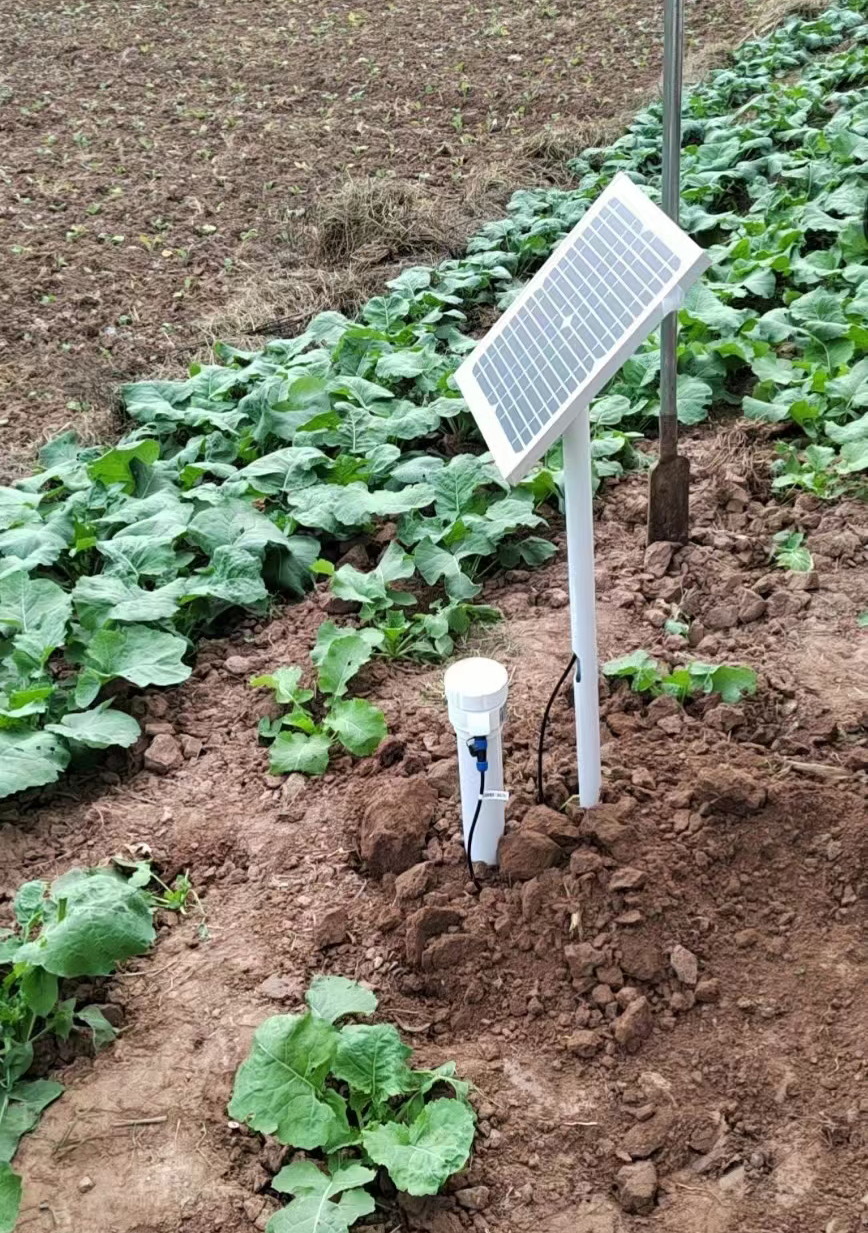
The NiuBoL soil moisture monitoring system builds an integrated solution from end-side perception to data integration with FDR and TDR high-precision sensors as the core. The NBL-S-TM and NBL-S-THR series products, with their IP68 protection, MODBUS compatibility, and low-power characteristics, can be widely used in water-saving irrigation, field monitoring, facility agriculture, and drought management systems to provide a reliable data foundation for modern agriculture.
For engineering companies pursuing stable project operation, integration efficiency, and long-term benefits, choosing NiuBoL sensors helps simplify deployment processes, reduce operation and maintenance costs, and improve the technical competitiveness of the overall solution. If you need detailed technical specifications, integration cases, or project customization support, please contact the NiuBoL professional team. We will provide targeted engineering solutions according to specific farmland conditions and system needs to help water-saving agriculture and smart farmland projects land efficiently.
 NBL-S-TMSMS-Tubular-Multi-depth-Soil-Moisture-Sensor-Instruction-Manual.pdf
NBL-S-TM-Soil-temperature-and-moisture-sensor-Instruction-Manual-4.0.pdf
NBL-S-THR-Soil-temperature-and-moisture-sensors-Instruction-Manual-V4.0.pdf
Related recommendations
Sensors & Weather Stations Catalog
Agriculture Sensors and Weather Stations Catalog-NiuBoL.pdf
Weather Stations Catalog-NiuBoL.pdf
Agriculture Sensors Catalog-NiuBoL.pdf
Water Quality Sensor Catalog-NiuBoL.pdf
Related products
 Combined air temperature and relative humidity sensor
 TDR Soil Moisture & Temperature Sensor for irrigation| RS485 |4-20mA| NBL-S-THR
 Soil pH sensor RS485 soil Testing instrument soil ph meter for agriculture |NBL-S-PH
 Wind Speed sensor Output Modbus/RS485/Analog/0-5V/4-20mA
 Tipping bucket rain gauge for weather monitoring auto rainfall sensor RS485/Outdoor/stainless steel
 Pyranometer Solar Radiation Sensor 4-20mA/RS485

Screenshot, WhatsApp to identify the QR code
WhatsApp number:+8615367865107
(Click on WhatsApp to copy and add friends)

