





— Blogs —
—Products—
 Consumer hotline +8618073152920
 WhatsApp:+8615367865107
Address:Room 102, District D, Houhu Industrial Park, Yuelu District, Changsha City, Hunan Province, China
Product knowledge
Time:2026-01-16 11:08:15 Popularity:970
The main types of water level sensors answer different measurement questions. A submerged pressure probe reports liquid head above the probe; an ultrasonic or radar instrument measures distance from a fixed mounting point to the surface; a float switch reports whether a set position has been reached. Before comparing accuracy or price, an engineer should define the level datum, expected range, liquid, mounting location and the action tied to the reading. Without that common basis, two instruments can both work correctly and still disagree at the PLC.
A storage-tank trend, river hydrograph or groundwater record needs continuous values with units and timestamps. Pump dry-run protection or a high-level interlock may need a discrete switch with an independent safety function. A float switch can serve the latter duty, but it cannot show how quickly a tank is filling between its switching points. Conversely, a networked level transmitter does not automatically replace a separate hardwired protective switch where the site's control design requires one.
Specify whether the output is depth above the probe, level above a local reference, distance below the mounting face, or percentage of vessel height. Include the installation datum on drawings and in the SCADA tag name. If a radar sensor reads a decreasing distance as water rises, the logger must convert it to a rising level using the surveyed reference height. A correctly decoded distance should not be published as a level without that conversion.
| Method | What it senses | Where it fits | Key selection check |
|---|---|---|---|
| Submersible hydrostatic | Pressure from liquid above an immersed probe | Wells, reservoirs and tanks where contact is acceptable | Density, sediment, wetted material, cable and vent path. |
| Ultrasonic non-contact | Echo travel time through air | Accessible tanks and channels with a clear acoustic path | Foam, vapour, false echoes, blanking distance and temperature compensation. |
| Radar non-contact | Microwave reflection from the surface | Open channels, reservoirs and installations where probe immersion is undesirable | Beam clearance, near-field blind zone, reference height and mounting stability. |
| Float or point switch | Crossing a fixed level position | Local pump or overflow state indication | Switching height, mechanical obstruction and whether a continuous record is also required. |
No method is universally 'more accurate' for a site. A clean laboratory specification cannot cancel a blocked vent, a radar beam striking a wall or a float jammed by debris. Choose the failure mode the maintenance team can inspect and control.
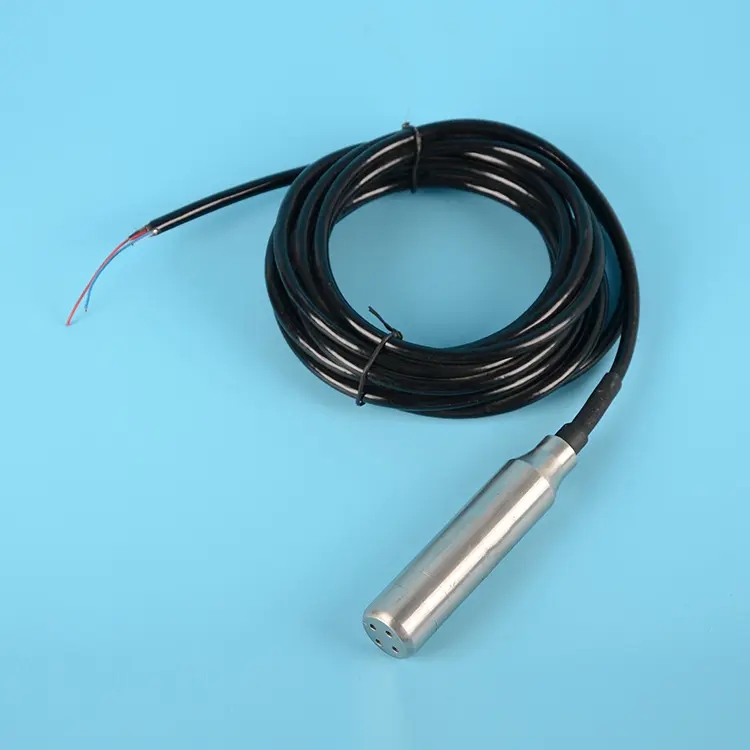
A submersible transmitter uses the relationship P = rho x g x H. Pressure P depends on liquid density rho as well as height H. If the measured liquid changes from fresh water to a denser brine, a conversion that assumes constant density can shift the displayed level. The NiuBoL submersible product page describes an RS485 Modbus RTU probe with an IP68 immersed body and selectable ranges. Its vented cable keeps the pressure reference open to the atmosphere; crimping, flooding or sealing that vent can create a slow error even when the probe electronics remain responsive.
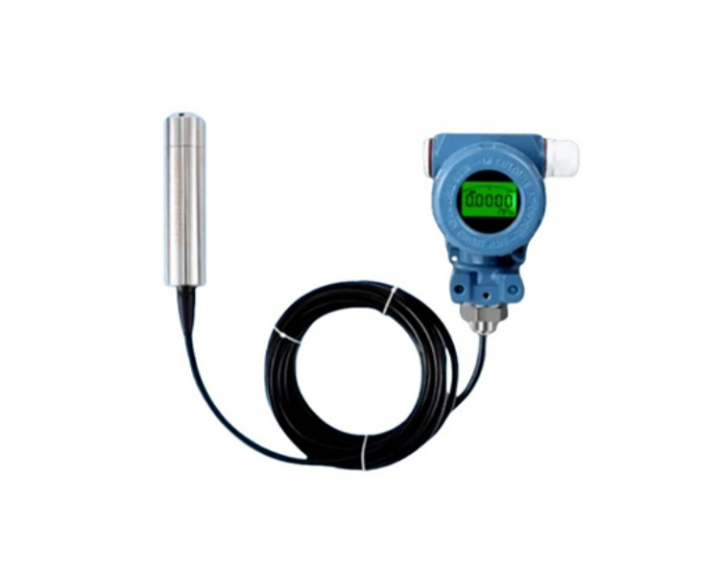
Place the pressure inlet below the lowest required reading but above sediment where possible. Provide cable strain relief, a dry termination and a service route that does not scrape the sensing diaphragm. The split-type arrangement pictured here adds a field housing or display on selected configurations; do not assume that housing is included with a probe-only quotation. Match the wetted material to wastewater, oil, saline water or chemicals before selecting a range.
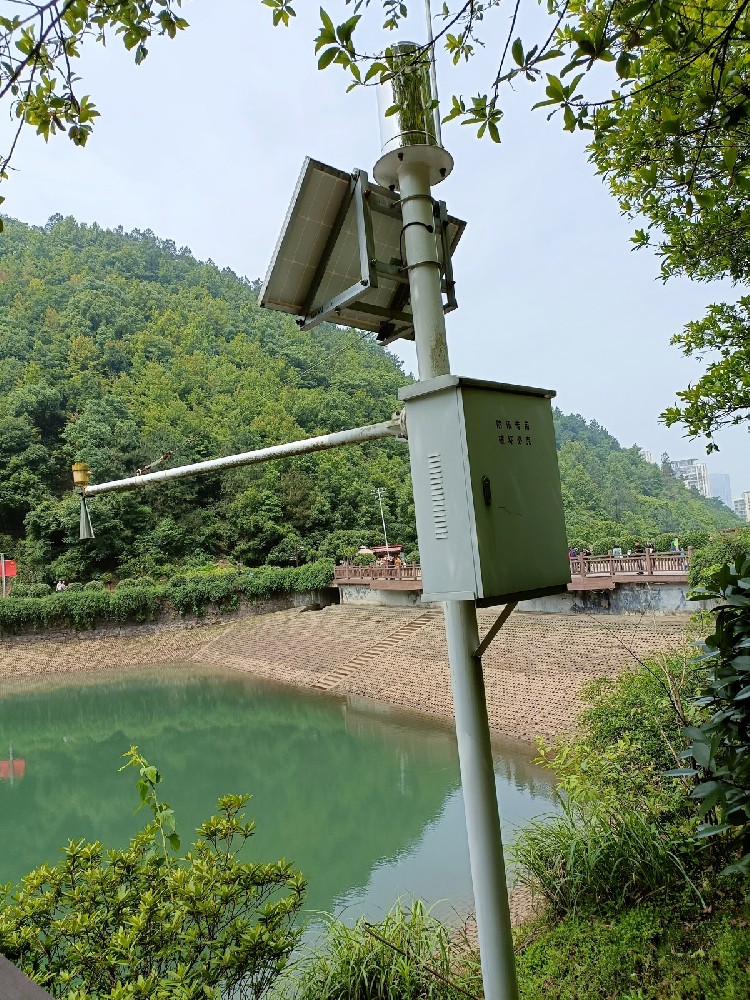
In a river or reservoir, protect the probe from floating debris and movement but do not hide it in a stagnant pocket that has a different water level from the main channel. Where waves matter, agree on sampling and averaging. Survey the probe's physical height relative to the project datum, and retain that offset when the instrument is replaced. Otherwise a maintenance replacement can look like an unexplained change in the water body.
An ultrasonic level sensor sends sound toward the surface and derives distance from the returning echo. It can be attractive where technicians need non-contact access to a tank, but foam, steam, internal ladders and narrow vessel walls may interfere. The air path and ambient temperature are part of the measurement. Mount the sensor square to the expected surface, keep the beam clear through minimum and maximum levels, and check its specified blanking distance. A level close to the sensor may fall inside the blind zone even if it is still physically below the housing.
The ultrasonic product image shows the general non-contact geometry. Before ordering, give the supplier the vessel diameter, nozzle, maximum fill level, material of nearby structures and likely foam or vapour condition. A reference measurement taken at the same datum during filling and emptying is more useful than comparing one static reading at mid-range.
NiuBoL's high-frequency radar level products use a narrow microwave beam to measure surface distance. The linked 76-81 GHz model lists a 6-degree beam, RS485 Modbus output and IP67 housing. That can help in a constrained channel, but the beam still needs an unobstructed target and a stable mounting arm. The selected model's range and near-field blind zone must be checked against both low-water and flood-water conditions. A bracket that flexes in wind changes the reference geometry.
At a bridge or culvert, inspect the full beam footprint at the lowest water level; it must not strike a bank or side wall instead of the surface. At high water, confirm that the sensor and cable remain outside the expected flood reach. Record the sensor's elevation and the conversion from measured distance to water level. A radar sensor does not directly report river discharge; flow calculation needs a valid cross-section and velocity relationship or a separate flow instrument.
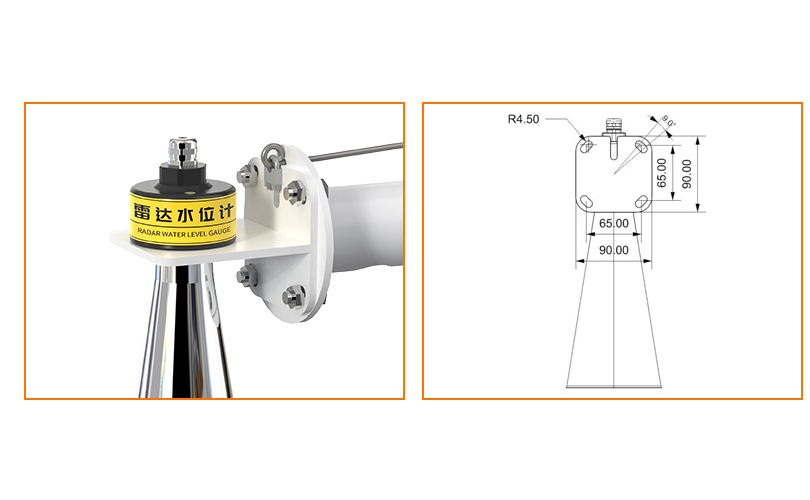
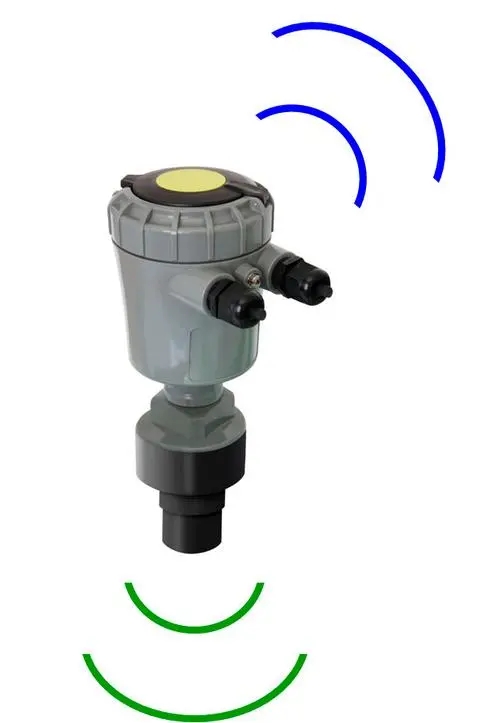
The yellow non-contact instrument in the next image illustrates a different housing and mounting arrangement. Product appearance is not a substitute for a model-specific datasheet. Verify frequency, range, supply voltage, interface, enclosure rating and the mounting interface on the exact quotation. A site requiring a level only may not need the more complex cabinet and network package shown in a full hydrological station photograph.
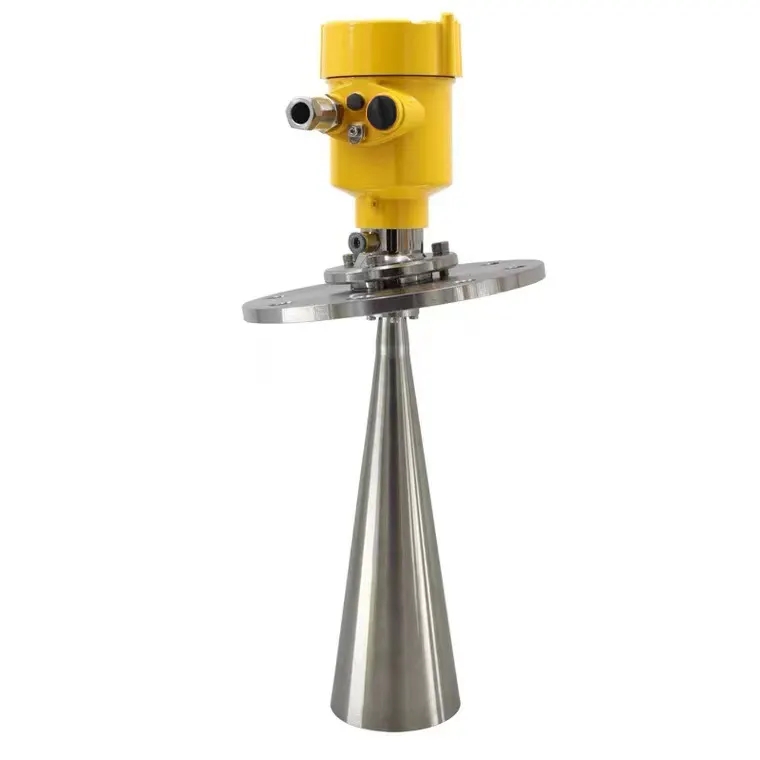
A critical reservoir may use a submerged probe and a non-contact sensor as independent channels. That pairing can reveal a blocked vent, a submerged probe displaced by debris, or a radar datum change. It does not create redundancy automatically: the two instruments must have independent power or fault reporting as required, known datum offsets, and a rule for handling disagreement. Display each raw channel and quality state before producing a reconciled level.
For a simpler water tank, one continuous transmitter plus a separate high-level switch may be more useful than two continuous sensors. In a remote river station, a radar sensor plus a surveyed staff gauge can support field checks without a second electronic level channel. Match the arrangement to the consequence of a wrong reading and the accessibility of the site.
A digital RS485 Modbus RTU sensor needs a documented register map, address, baud rate, data type, scaling and unit. A 4-20 mA version needs the intended span, loop supply and the controller's treatment of an out-of-range or broken-loop current. A discrete float needs contact type, switching level and wiring supervision if the control function requires it. Do not write 'RS485/analog' in the order and let the factory select an output without the receiving equipment's input drawing.
Test an unplugged cable and a power restart at the actual PLC or RTU. The host should show a fault or stale value, not an apparently valid low water level. For remote flood monitoring, record both the time of measurement and the time of upload so a delayed batch of data cannot be mistaken for current conditions. These interface checks are common to the sensor types, even though their physical measurement methods differ.

Send NiuBoL the minimum and maximum level, fixed datum, available mounting space, liquid composition, expected sediment or foam, power supply, cable run, existing PLC or RTU and required output. Ask for a model-specific drawing and register or analog-scaling information. A remote station offer should show sensor, bracket, logger, enclosure, power system, communications and installation separately; otherwise price comparisons mix unlike scopes.
At site acceptance, measure an independent water level from the same reference and compare it with the local device and host-system values. Repeat at another reachable level if the process allows. Check timestamps, engineering units, alarm setpoints and loss-of-signal behaviour. Photograph the surveyed reference, bracket, cable route and probe position. A single number on a dashboard cannot show whether its datum is correct.
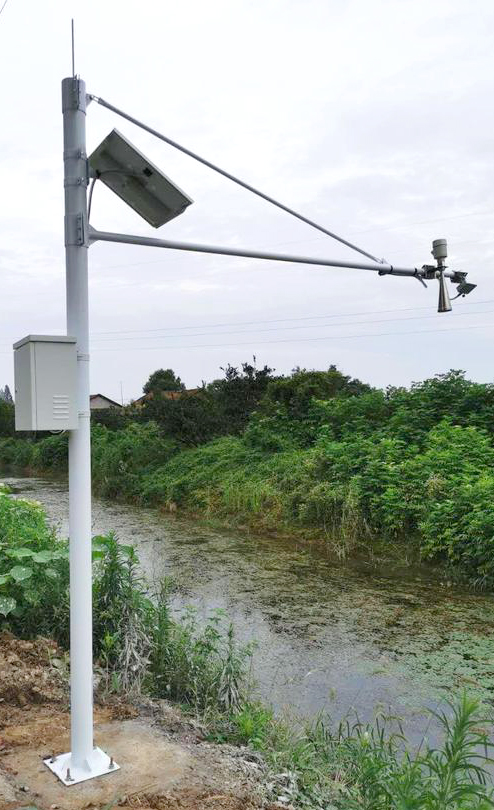
It depends on mounting, flood level, debris and service access. A non-contact radar avoids immersion, while a protected hydrostatic probe may suit a site with a stable installation point. Compare failure and maintenance conditions at the actual cross-section.
Check datum and zero offsets first. One may report depth above its probe and the other distance below its mounting point. Density assumptions and surveyed elevation also matter.
No. The IP68 rating applies to the specified probe body. Keep the vent and electrical termination protected according to the product design.
A level sensor reports distance or level. Discharge needs an additional stage-discharge relationship or a flow measurement system with a valid channel geometry.
When the job is a defined point-state action such as a pump inhibit or overflow alert. A continuous trend, reservoir level history or rate-of-rise calculation needs a continuous sensor as well.
Include the existing datum, physical mount, minimum and maximum levels, power, output, cable route and controller register or scaling expectations. Preserve the old reference offset during the changeover.
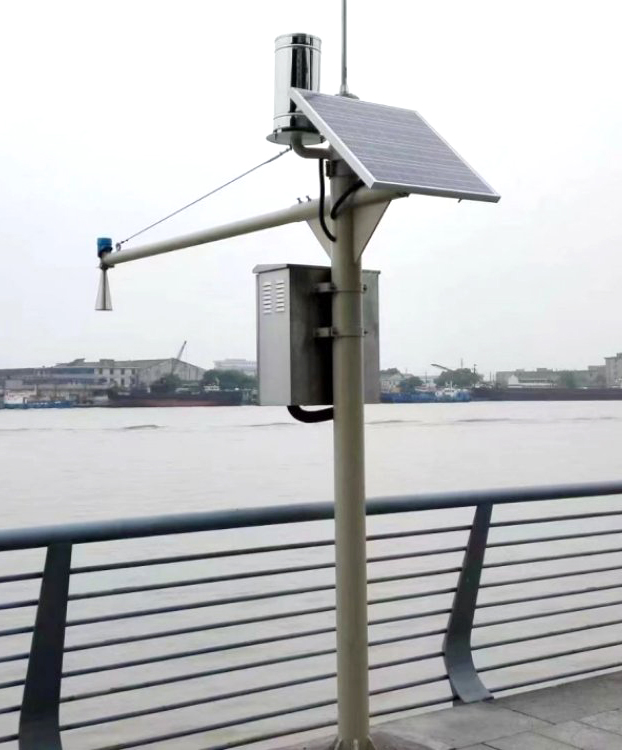
The types of water level sensors differ most in what they actually measure and how a site can make that measurement wrong. NiuBoL offers submerged and non-contact options; the buyer should select against the liquid, installation datum, failure modes and receiving system. Specify the reference and test it at the installed site before accepting any level trend or alarm.
Prev:Hydrological Monitoring Station Power Budget: Sensors, Battery and Solar
Next:Radar vs Submersible Water Level Sensor for Rivers: Field Selection
Related recommendations
Sensors & Weather Stations Catalog
 Agriculture Sensors and Weather Stations Catalog-NiuBoL.pdf
Weather Stations Catalog-NiuBoL.pdf
Agriculture Sensors Catalog-NiuBoL.pdf
Water Quality Sensor Catalog-NiuBoL.pdf
Related products
 Combined air temperature and relative humidity sensor
 TDR Soil Moisture & Temperature Sensor for irrigation| RS485 |4-20mA| NBL-S-THR
 Soil pH sensor RS485 soil Testing instrument soil ph meter for agriculture |NBL-S-PH
 Wind Speed sensor Output Modbus/RS485/Analog/0-5V/4-20mA
 Tipping bucket rain gauge for weather monitoring auto rainfall sensor RS485/Outdoor/stainless steel
 Pyranometer Solar Radiation Sensor 4-20mA/RS485

Screenshot, WhatsApp to identify the QR code
WhatsApp number:+8615367865107
(Click on WhatsApp to copy and add friends)

