





— Blogs —
—Products—
 Consumer hotline +8618073152920
WhatsApp:+8615367865107
Address:Room 102, District D, Houhu Industrial Park, Yuelu District, Changsha City, Hunan Province, China
Product knowledge
Time:2024-09-16 20:35:24 Popularity:2302
The benefits of a pyranometer include a repeatable broadband solar observation and an electrical signal that a compatible logger can turn into an interval and daily record. The useful result is not just a noon reading. It is measured solar energy over a defined period, with known orientation and data coverage. The sensor does not automatically supply wireless reporting, a daily total or an explanation of every energy-system loss.
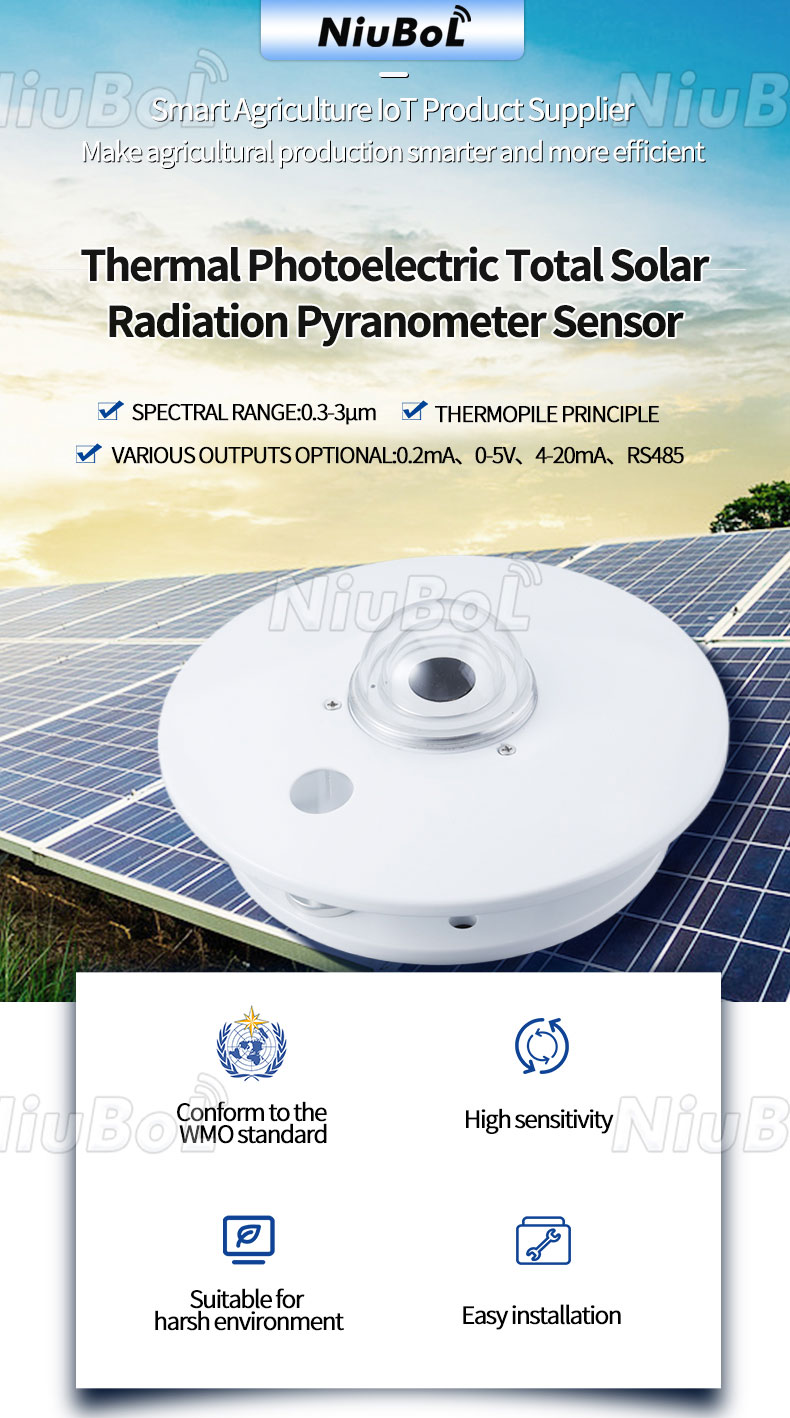
Two days can reach the same midday irradiance yet receive different total solar energy because cloud cover and daylight conditions differ. Repeated observations can distinguish those days. That helps resource studies, building-surface comparisons and weather monitoring use the measured exposure rather than an assumption based on the daily peak.
A thermopile pyranometer collects broadband short-wave radiation within its response band. It has no rotating measurement assembly, but that does not remove the need to inspect the optical surface and mounting. The observation remains dependent on calibration, the receiving plane and what the sensor can actually see.
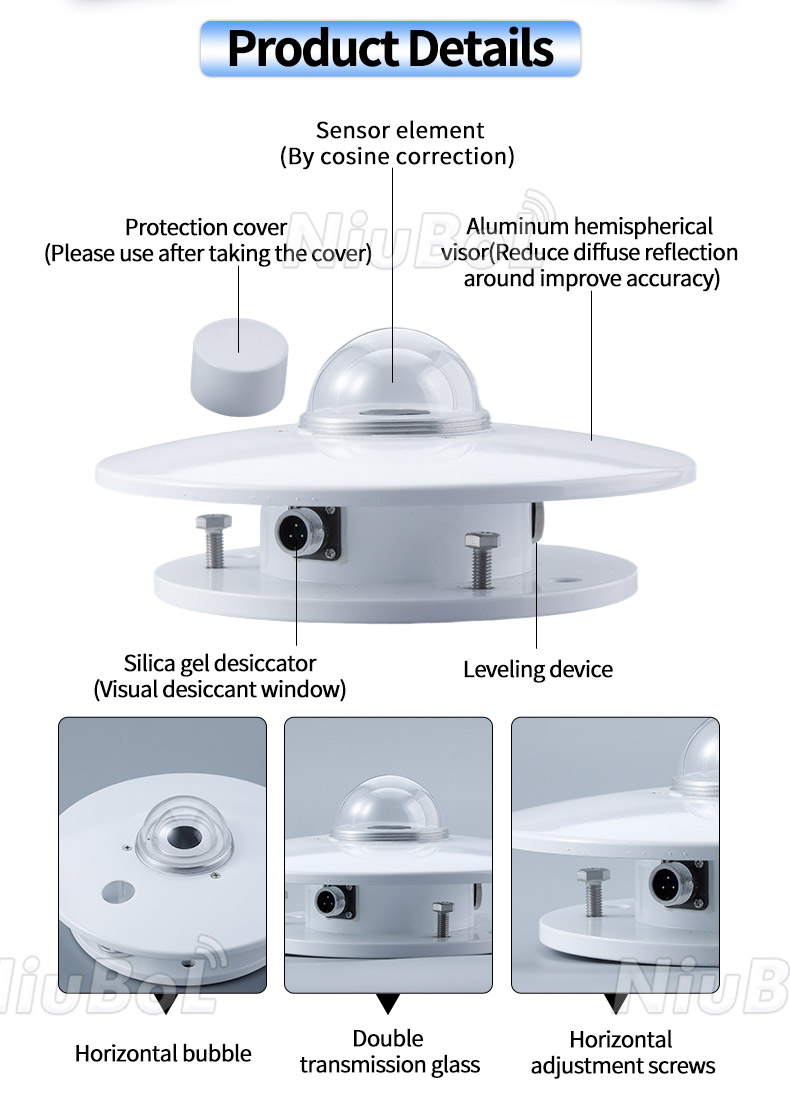
The NiuBoL NBL-W-HPRS provides the irradiance input. Its specifications help determine whether the proposed record is appropriate; they do not describe the capabilities of every connected logger.
| HPRS item | Specification | Implication for the record |
|---|---|---|
| Measuring span | 0–2000 W/m². | Store the irradiance unit and correct electrical scaling. |
| Spectral band | 0.3–3 μm. | The record is broadband short-wave irradiance, not separate spectral components. |
| Response time | ≤35 seconds to 99% response. | Polling every second does not create a one-second physical response. |
| Outputs | Raw millivolts, conditioned current/voltage or selected RS485 version. | Match the logger input and conversion to the delivered configuration. |
| Operating temperature | -40 to 50°C. | Check the sensor environment, separately from logger enclosure conditions. |
A daily total from a horizontal instrument describes a different exposure from one measured on a tilted building or PV surface. Record tilt and azimuth where relevant. If the mounting is changed, the before-and-after series should not be presented as an unchanged observation simply because the channel name stayed the same.

Compare like with like: the same plane, a compatible measurement method and a defined period. For a study comparing two surfaces, identify both orientations and avoid unintended local shading. A useful record can show that the measured exposures differ without claiming that the pyranometer alone establishes building energy savings or PV conversion efficiency.
If each G value is the mean irradiance in W/m² over an interval of duration Δt hours, the interval energy is G × Δt in Wh/m². Sum those interval energies for the required period. Divide Wh/m² by 1000 to obtain kWh/m². These calculations need the measurement duration as well as the measured value.
| Illustrative interval | Mean irradiance | Duration | Interval energy |
|---|---|---|---|
| First | 300 W/m² | 20 minutes = 1/3 hour | 100 Wh/m² |
| Second | 600 W/m² | 20 minutes = 1/3 hour | 200 Wh/m² |
| Third | 900 W/m² | 20 minutes = 1/3 hour | 300 Wh/m² |
| Complete hour | 600 W/m² time-weighted mean | 1 hour | 600 Wh/m² = 0.6 kWh/m² |
This is a constructed calculation, not a NiuBoL project result. Multiplying the 900 W/m² maximum by the full hour would give 900 Wh/m² and overstate this example. A sequence of instantaneous samples is not automatically a sequence of interval means; define the averaging or integration method before applying the calculation.
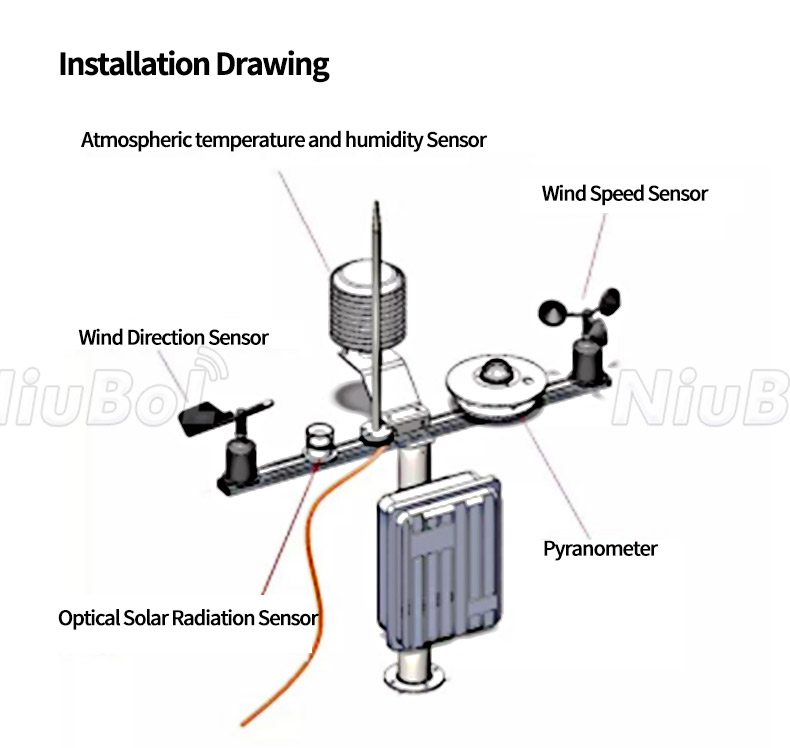
If the middle interval in the example is missing, the measured contribution is 400 Wh/m² from 40 minutes. It is not a complete one-hour total. Entering zero for the missing interval understates the unknown period; scaling the available energy to a full hour assumes a weather pattern that was not measured.
Report valid duration and missing intervals alongside the accumulated measured energy. If the project permits estimates, retain them as estimates with their method rather than overwriting the missing observations. A communication outage and a valid nighttime zero must remain distinguishable in the stored record.
Define the daily boundary and time zone. A logger using UTC and a report using local midnight can assign the same observations to different dates. For unequal intervals, weight by their actual valid durations; a simple arithmetic mean of irregularly spaced values is not automatically the daily time-weighted mean.
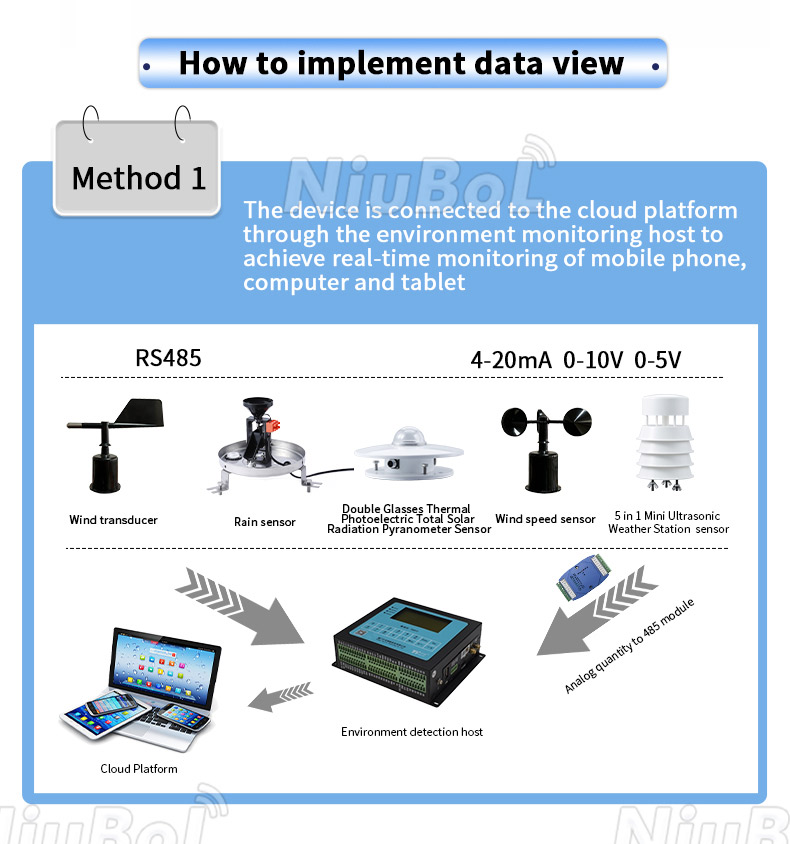
An RS485 Modbus RTU HPRS configuration provides a local instrument interface. A compatible data logger or gateway is needed for the selected recording and remote-data arrangement. Specify whether the retained fields are samples, interval means, accumulated energy or a combination, and test the export rather than assuming the displayed daily total can be retrieved.
Ask how the proposed system handles interrupted power, delayed uploads and a daily rollover. These functions depend on the acquisition implementation, not on the pyranometer's optical design. The logger proposal should identify which calculations are local, which are performed on the server, and how missing data is represented.
Retain calibration identity and changes that affect comparability. Cleaning or correcting a misaligned sensor can alter the series; the date matters when interpreting a step change. For servicing detail, use the solar-radiation sensor maintenance guidance rather than assuming that a lack of moving parts means no maintenance.
Do not assume that from the sensor name or output type. Confirm the delivered instrument's functions and the logger's calculation and storage behaviour. A measured W/m² value does not by itself establish a retained daily kWh/m² record.
It compares conditions near that observation time, not daily energy. Use a suitably sampled and integrated series over matching periods, with coverage checks, for a daily comparison.
Keep the missing duration identifiable. Report the valid measured contribution and completeness, or apply an explicitly permitted estimation method with estimated values separated from observations. Do not silently replace missing sunlight with zero.
No. Polling and detector response are different properties. Faster reads may capture the available output more frequently, but they do not remove the HPRS thermopile's specified response time or guarantee accurate reconstruction of faster irradiance changes.
Provide NiuBoL the receiving plane, required interval and daily records, time zone, data-retention period and export interface. Include power and network availability, calibration-document requirements and the required treatment of gaps so that both the sensor and acquisition scope can be evaluated.
 NBL-W-HPRS-Solar-Radiation-Sensor-Instruction-Manual-V3.0.pdf
The benefits of a pyranometer become useful project evidence when the irradiance series is correctly scaled, time-aligned and integrated. Specify the daily calculation and completeness checks along with the instrument. A credible energy record explains its coverage and measurement plane rather than presenting a total with an unknown basis.
Related recommendations
Sensors & Weather Stations Catalog
 Agriculture Sensors and Weather Stations Catalog-NiuBoL.pdf
Weather Stations Catalog-NiuBoL.pdf
Agriculture Sensors Catalog-NiuBoL.pdf
Water Quality Sensor Catalog-NiuBoL.pdf
Related products
 Combined air temperature and relative humidity sensor
 TDR Soil Moisture & Temperature Sensor for irrigation| RS485 |4-20mA| NBL-S-THR
 Soil pH sensor RS485 soil Testing instrument soil ph meter for agriculture |NBL-S-PH
 Wind Speed sensor Output Modbus/RS485/Analog/0-5V/4-20mA
 Tipping bucket rain gauge for weather monitoring auto rainfall sensor RS485/Outdoor/stainless steel
 Pyranometer Solar Radiation Sensor 4-20mA/RS485


Screenshot, WhatsApp to identify the QR code
WhatsApp number:+8615367865107
(Click on WhatsApp to copy and add friends)

