





— Blogs —
—Products—
 Consumer hotline +8618073152920
 WhatsApp:+8615367865107
Address:Room 102, District D, Houhu Industrial Park, Yuelu District, Changsha City, Hunan Province, China
Product knowledge
Time:2026-09-08 16:00:00 Popularity:229
Quick Answer: An air temperature and humidity monitoring station measures local air conditions only when its sensing element has representative airflow and protection from radiation, spray and nearby heat sources. A high-resolution display cannot correct a poor location. Select the exposure and required uncertainty first, then choose the sensor, output and recording method.
A sensor beside a greenhouse fan measures different conditions from one among the crop leaves. A rooftop sensor describes the rooftop environment, not automatically the nearby field. Before choosing hardware, identify whether the result is intended for general outdoor weather, crop-level control, storage ventilation or a local equipment environment.
For outdoor weather monitoring, use a representative, ventilated location away from walls, exhausts, reflective roofs, irrigation spray and local heat sources. Record the installation height. When a crop or process requires a different measuring position, label that purpose explicitly so the data are not later mistaken for standard weather observations.
One instrument cannot represent every zone in a building or growing area. A preliminary comparison at several candidate positions can reveal differences caused by ventilation, shade or heating. Add permanent points where those differences affect decisions, rather than applying a fixed sensor count to every project.
Relative humidity compares water-vapor pressure with saturation vapor pressure at the measured temperature. It is not a direct measure of water mass in the air. If the sensing element is warmer than the surrounding air, its temperature can read high and its relative humidity can read low even when the electronics are operating correctly.
Radiation shielding and airflow determine whether the sensor measures ambient air or a sun-heated enclosure. Direct sun is one source of error; a warm wall, roof or nearby cabinet can also influence the measurement. A ventilated shield reduces radiative heating while allowing air exchange, but it does not make the location irrelevant.
A naturally ventilated shield depends on air movement. During strong sun and weak wind, compare its performance with the application's tolerance. An aspirated arrangement may be appropriate for demanding exposure conditions, but it adds a fan, power consumption and a failure mode. Specify aspiration as an actual system feature; do not assume every louvered housing contains it.
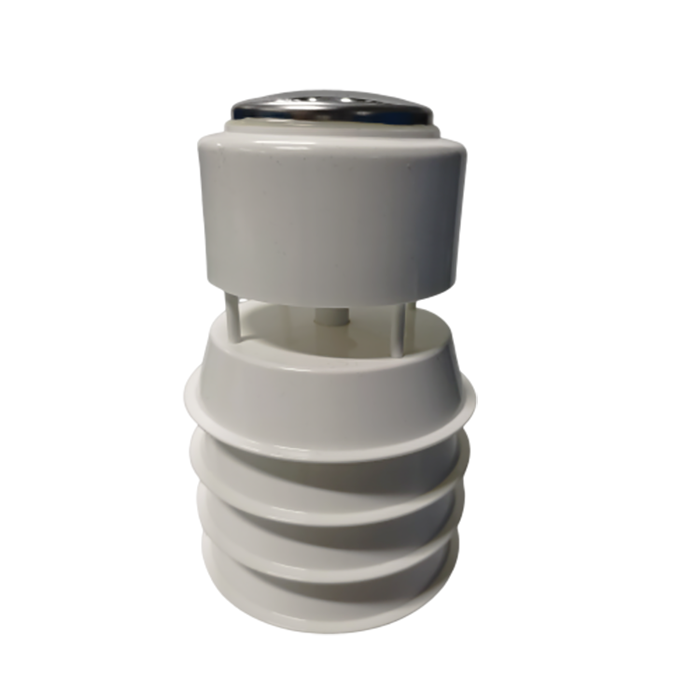
The NiuBoL NBL-W-LBTH combines air temperature, relative humidity and atmospheric pressure in a louvered assembly. Its component specifications below help determine whether it fits the project. They are not specifications for every compact weather sensor pictured on this page, and they do not include exposure or whole-system uncertainty.
| Parameter | NBL-W-LBTH specification | Practical meaning |
|---|---|---|
| Air temperature | -40 to 80 degrees C; accuracy +/-0.5 degrees C; resolution 0.1 degrees C | Suitable range and display increments do not remove solar-heating error. |
| Relative humidity | 0-100% RH; accuracy +/-5% RH; resolution 0.1% RH | A narrow humidity control band needs an uncertainty review. |
| Atmospheric pressure | 10-1200 hPa; accuracy +/-1.5 hPa; resolution 0.1 hPa | Distinguish measured station pressure from a calculated sea-level value. |
| Supply | 12-24 V DC | Check voltage at the sensor with the full cable and other loads connected. |
| Output options | RS485 or 4-20 mA version | Select the delivered interface before assigning logger inputs. |
| Operating temperature | -40 to 80 degrees C | Assess the logger, connectors and power system separately. |
| Digital communication | Modbus RTU; 9600 bit/s; 8 data bits; no parity; 1 or 2 stop bits; at least 1000 ms between communications | Match the host settings and avoid repeated requests faster than the specified interval. |
For example, a required 2% RH control band is narrower than this sensor's +/-5% RH accuracy specification. Displaying 0.1% RH does not solve that mismatch. Either select a more suitable measurement arrangement or reconsider the control requirement. Alarm hysteresis can prevent rapid switching, but it cannot improve measurement accuracy.
Request power consumption, cable construction and ingress-protection details for the selected assembly when they are needed for the installation design. Do not apply an IP rating from a wind sensor or enclosure to an open, ventilated temperature and humidity measuring point. Likewise, a 0-100% RH range is not permission to immerse the sensor or expose it continuously to spray.
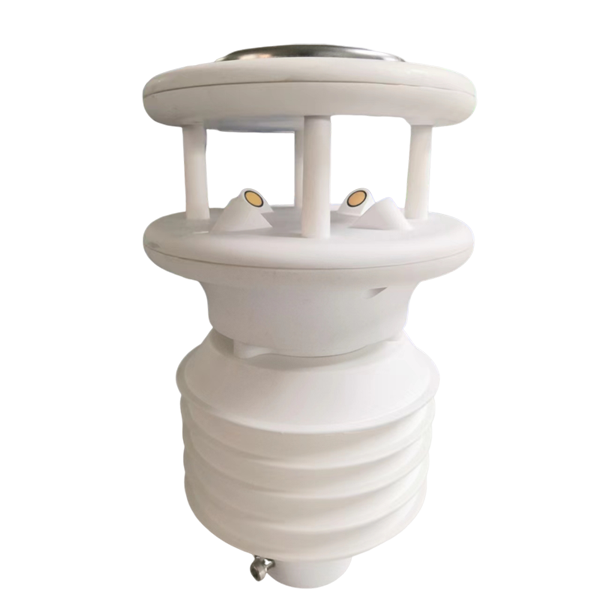
A compact multi-parameter weather sensor reduces separate mounts and connections. It is useful when the shared position suits the required measurements. The compromise is exposure: the location chosen for unobstructed wind may not be the location needed for crop-level humidity. Check the proposed arrangement against the measurement purpose rather than choosing by the number of channels.
A separate shielded sensor can be placed at the relevant air level while wind or radiation instruments remain elsewhere. It also allows that measuring point to be serviced independently. In a greenhouse, several small measurement zones may provide more useful control information than one highly equipped station outside the structure.
During comparison, keep people and warm equipment away from the sensing area. Breathing on a probe tests that it responds to a disturbance, not that its humidity measurement is accurate. A nearby weather station is also an imperfect reference if its elevation, surface or exposure differs.
Define the acceptance tolerance from the installed instrument, reference uncertainty and test conditions. Two instruments each specified at +/-0.5 degrees C can differ by as much as 1.0 degree C under a simple worst-case comparison, even before exposure differences are considered. This is not a calibration rule; it shows why requiring exact agreement is inappropriate.
If a temperature discrepancy increases in sunlight and weak wind, inspect shield ventilation and local heating. If the discrepancy persists through shaded, well-ventilated periods, calibration or electronics deserve closer attention. Record wind conditions from a representative point where available, without assuming mast-level wind equals airflow inside the shield.
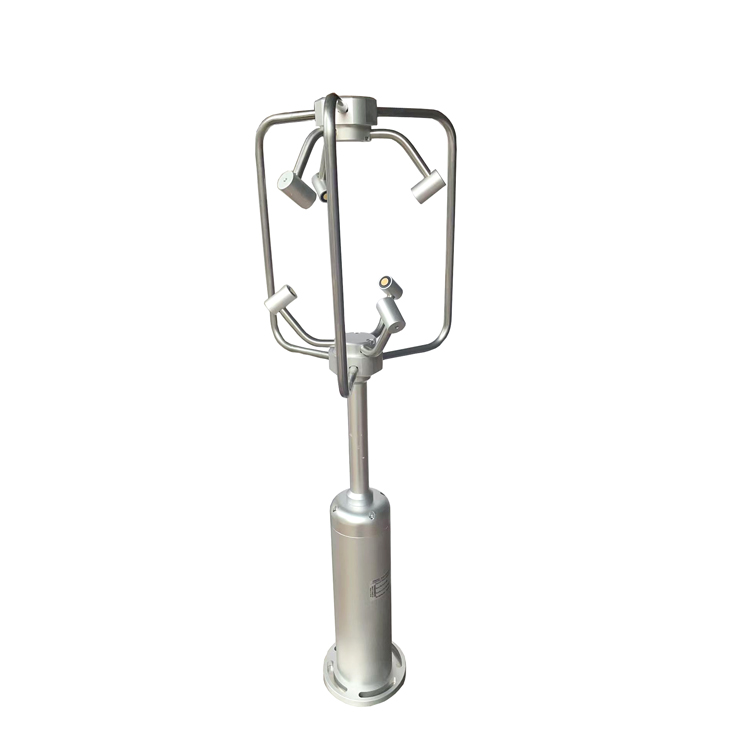
A 3D ultrasonic anemometer can support detailed airflow research, including vertical motion. It is not necessary for every temperature and humidity station and does not measure humidity. For routine installations, the important question is whether air reaches the sensing element without an artificial heat or moisture source.
| Symptom | Likely checks | Action before replacement |
|---|---|---|
| Humidity stays near 100% RH | Fog, dew, direct spray, water ingress and blocked ventilation | Compare local conditions and inspect for wetting; assess recovery after drying. |
| Temperature rises during clear, calm afternoons | Solar exposure, shield cleanliness and nearby hot surfaces | Compare under matched shielding and stronger ventilation. |
| A sudden fixed offset appears | Changed scaling, replacement sensor or moved mounting point | Compare raw readings and configuration before adjusting calibration. |
| Humidity changes much more slowly than expected | Protective filter condition, stagnant air and recent condensation | Check the complete assembly's response, not only the bare sensing element. |
| All values freeze at plausible numbers | Polling failures and last-value retention in the logger | Display data age and fault status instead of presenting old values as current. |
Clean the shield without forcing water or chemicals onto the sensing element. Dust and biological growth can obstruct ventilation or change the shield's thermal behavior. Inspect after pesticide spraying, construction dust or persistent condensation. Do not scrape or solvent-clean a humidity element unless that procedure is approved for the specific sensor.
For RS485 Modbus RTU, test one sensor before connecting the full bus, then assign unique addresses. Confirm temperature decoding below zero as well as at room temperature. Record averaging and upload intervals separately: sending data once per minute does not prove that the value is a one-minute average.
Ventilation control needs a defined response to stale measurements. A frozen humidity reading should not indefinitely command a fan or misting valve. Decide the fallback behavior with the process owner, and test a disconnected sensor. For monitoring-only stations, a visible missing-data flag may be sufficient; automatic control requires a more explicit fault response.
For a NiuBoL quotation, describe the air zone, expected temperature and humidity, required decision threshold, available supply and host inputs. Include exposure photographs and any chemical or spray conditions. These details determine whether a compact station, a separate shielded assembly or a different accuracy class is appropriate.

Only when cabinet air is the intended measurement. Electronics and solar heating can make that air different from the surroundings. Ambient monitoring normally needs an external, ventilated sensing position with suitable radiation protection.
Resolution describes the smallest reported increment, not the uncertainty of the measurement. Evaluate accuracy, drift, response and exposure against the actual control band. For the NBL-W-LBTH, use the +/-5% RH accuracy specification when assessing the control requirement, not the final digit on the display.
No. Saturated air, condensation and direct wetting can produce that reading. Examine temperature, local weather and recovery as conditions change. Persistent disagreement after the assembly dries and stabilizes warrants comparison with a suitable reference.
Only if the measured zone represents the controlled area adequately. Fans, vents, crop density and heating can produce separate zones. Map the differences first and place sensors where they affect the control decision, rather than assuming that one central position is sufficient.
Use a response matched to the process. Short disturbances may justify persistence and hysteresis, while fast processes may require shorter filtering. Excessive averaging can hide real events. Test the alarm using realistic changes and a loss of communication.
Possibly, if its accuracy, range and contamination resistance meet the storage requirements. Select positions representative of the inlet, stored material or room air as needed. Ordinary atmospheric monitoring specifications do not automatically qualify a sensor for regulated storage or chemically aggressive spaces.
An air temperature and humidity monitoring station is useful when its location, shielding and uncertainty match the decision being made. Check exposure before changing calibration, keep resolution separate from accuracy, and verify that the receiving system identifies stale or invalid readings. These checks often resolve misleading data without unnecessary hardware replacement.
Prev:Rainfall and Soil Moisture Monitoring System Selection Strategy
Next:Radar Flow Meter Principle and Application in Open Channels
Related recommendations
Sensors & Weather Stations Catalog
 Agriculture Sensors and Weather Stations Catalog-NiuBoL.pdf
Weather Stations Catalog-NiuBoL.pdf
Agriculture Sensors Catalog-NiuBoL.pdf
Water Quality Sensor Catalog-NiuBoL.pdf
Related products
Combined air temperature and relative humidity sensor TDR Soil Moisture & Temperature Sensor for irrigation| RS485 |4-20mA| NBL-S-THR
 Soil pH sensor RS485 soil Testing instrument soil ph meter for agriculture |NBL-S-PH
 Wind Speed sensor Output Modbus/RS485/Analog/0-5V/4-20mA
 Tipping bucket rain gauge for weather monitoring auto rainfall sensor RS485/Outdoor/stainless steel
 Pyranometer Solar Radiation Sensor 4-20mA/RS485

Screenshot, WhatsApp to identify the QR code
WhatsApp number:+8615367865107
(Click on WhatsApp to copy and add friends)

