





— Blogs —
—Products—
 Consumer hotline +8618073152920
WhatsApp:+8615367865107
Address:Room 102, District D, Houhu Industrial Park, Yuelu District, Changsha City, Hunan Province, China
Product knowledge
Time:2026-08-08 13:42:21 Popularity:326
Quick Answer: An automatic irrigation system using Arduino can read an industrial RS485 soil sensor, but a board's UART pins are not an RS485 port. Use a compatible transceiver or supported RS485 interface, an appropriate sensor supply and the exact Modbus register map. Drive pumps and valves through suitable power hardware, not through a GPIO pin. A portable USB-C soil tester is a different product, not a drop-in substitute.
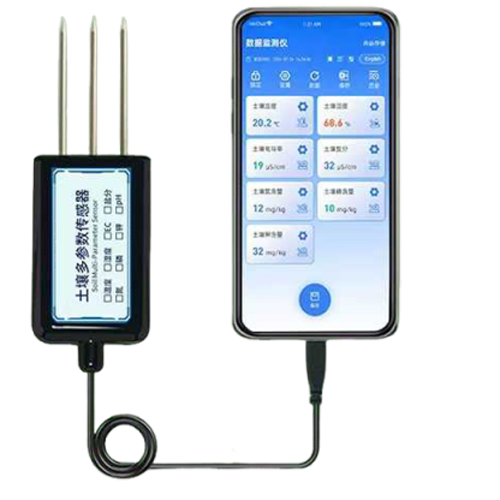
The NiuBoL seven-parameter USB-C soil tester is intended for portable measurements with a compatible phone. Its Type-C connector supplies power and data through the phone interface. That does not establish support for an Arduino USB host or turn the product into an RS485 field probe.
For unattended irrigation, choose a sensor whose documented output can be polled continuously by the installed controller. The NBL-S-TM soil temperature and moisture sensor provides RS485 Modbus RTU output for that role. Moisture informs root-zone water decisions; temperature adds context. EC and nutrient channels are not necessary merely to demonstrate a working moisture-based irrigation loop.
The path is soil probe, RS485 bus, compatible transceiver, controller UART, validated measurement and irrigation logic. Keep the sensor power circuit distinct from the board's logic interface. Some controller hardware already includes RS485; a basic development board generally needs an additional interface.
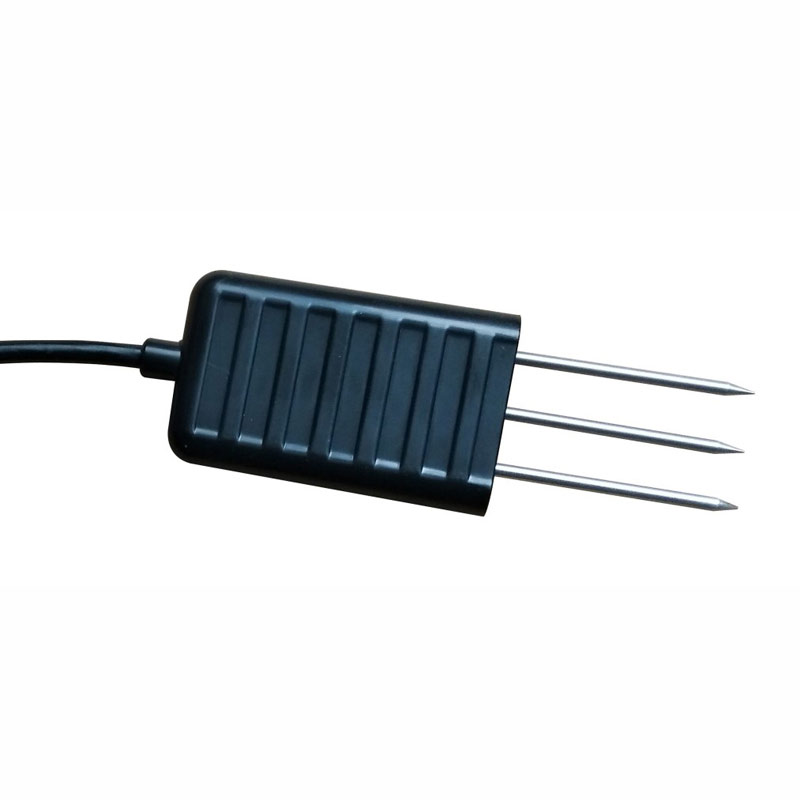
| NBL-S-TM specification | Published value | Integration implication |
|---|---|---|
| Soil moisture | 0-100% volumetric soil moisture; 0.1% resolution; stated accuracy +/-5% | Use volumetric water content, not air relative humidity; confirm accuracy basis for acceptance |
| Soil temperature | -40 to 80 C; 0.1 C resolution; accuracy +/-0.5 C | Check decoding of negative temperatures rather than treating every register as unsigned |
| Sensor supply | 5-24 VDC; some configurations 12-24 VDC | Identify the ordered variant before selecting the supply; do not assume every probe operates from board 5 V |
| Output and protocol | RS485 Modbus RTU; default 9600 bps, eight data bits, no parity | Confirm the remaining serial settings, address, function and register layout for the unit |
| Polling interval | At least 1000 ms | Respect the device interval rather than continuously flooding the bus |
| Protection and cable | IP68 probe; standard 5 m cable; epoxy sealing | Protect above-ground joints and the controller enclosure separately |
Select the transceiver's logic side for the actual board voltage. A 5 V output is not automatically safe for a 3.3 V input. Confirm the module's direction control, isolation and bus-biasing arrangements; generic connection diagrams for another module may differ. The Arduino Modbus documentation distinguishes the protocol from its serial transport, and the RS485 hardware guide illustrates a controller with a built-in interface.
Keep pumping disabled during these checks. A functioning serial link and a stable moisture reading are separate from a tested irrigation controller. Use a maintained Modbus implementation compatible with the hardware rather than inventing a different frame format for the sensor.
Place sensing electrodes in representative root-zone soil with firm contact. Avoid air gaps, large stones and a position immediately beside an emitter unless that wetting zone is the intended measurement. For buried installation, insert horizontally into an undisturbed soil wall at the required depth. Do not hammer the electrodes or rock the probe after insertion.
One probe describes one local volume, not a whole farm. Different soil types, slopes and irrigation zones may need separate points. Compare the chosen location with other points during commissioning; add another depth when the decision requires deeper drainage information rather than assuming the surface reading represents the entire root zone.
Use separate start and stop thresholds to avoid rapid switching near one moisture value. After irrigation, allow an appropriate redistribution period before deciding that more water is needed. Establish those settings from the crop, soil and hydraulic response rather than from the sensor's measuring range.
A weather station can provide rainfall and atmospheric context, but it does not replace root-zone measurement. Conversely, a moisture probe does not verify delivered flow. Where a failed valve or blocked line matters, include suitable flow, pressure or valve feedback in the system design. A remote dashboard can display these records without being required for every local control decision.
Specify a maximum irrigation runtime and test what happens if the probe disconnects, the controller restarts or the network disappears. Select the safe action for the installation: normally closed valves may support a stop-on-fault strategy, but valve hardware, crops and pumping arrangements must be reviewed together. An old valid value must not remain valid indefinitely.
GPIO should command a correctly rated driver, relay interface or contactor circuit, not supply the pump or solenoid load. Inductive-load suppression and electrical protection depend on the selected actuator and driver. Keep mains-powered pump work within the responsibilities of a qualified installer; the sensor interface is not a motor protection circuit.
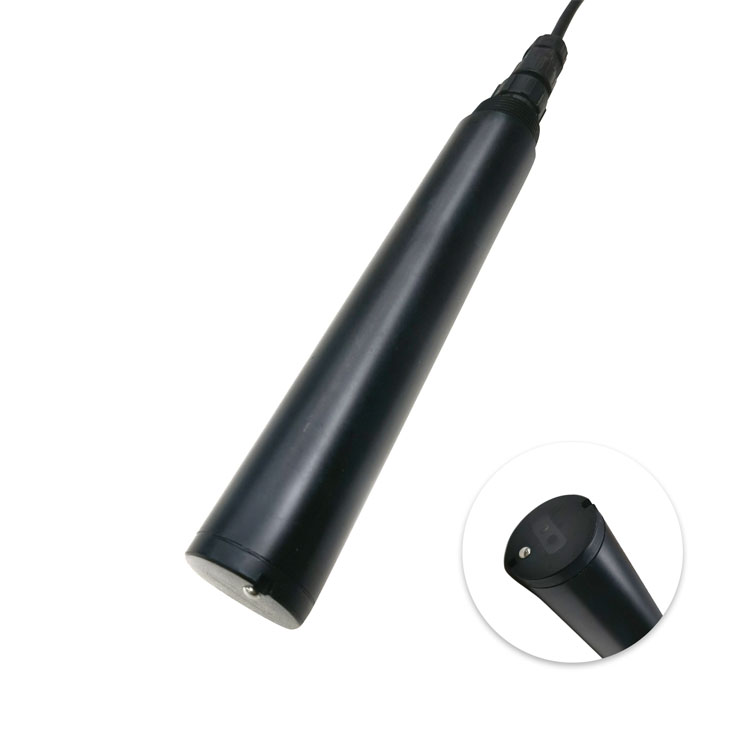
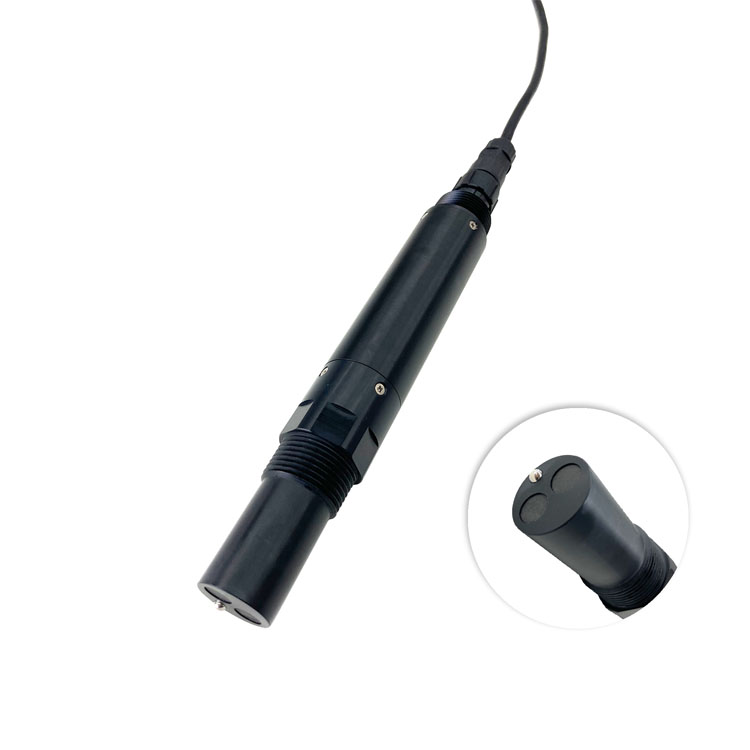
If the broader project also measures irrigation-water turbidity or conductivity, treat those as separate water instruments. A turbidity probe does not report soil moisture, and EC does not replace the moisture input to this controller. Add those channels only when filter or water-quality management requires them.
No. A and B are differential bus connections, while UART pins are logic-level signals. Use a compatible RS485 transceiver or a controller with a documented RS485 interface. Follow that hardware's wiring and voltage limits.
No. The rating applies to the specified probe. Cable splices, power terminals, the RS485 module and the controller need their own environmental protection. Leave serviceable connections accessible rather than burying an unprotected joint.
There is no universal setpoint. Establish thresholds for the crop, soil, root depth and irrigation method, using observations of wetting and drying. Check repeatability and spatial variation before allowing automatic operation.
Only after power recovery, watchdog behavior, actuator faults, enclosure protection and field wiring have been engineered and tested. When documented industrial inputs, service support or project approvals are required, compare an industrial controller or data logger rather than assuming a bench prototype meets them.
Specify NBL-S-TM, supply variant, RS485 Modbus RTU, cable length and connector requirements. Request the matching register map and communication settings. Provide the controller and interface details so the electrical connection can be checked before shipment.
An automatic irrigation system using Arduino needs more than a moisture threshold: correct RS485 hardware, valid data, representative installation and controlled actuator behavior are essential. NiuBoL can help identify a soil sensor configuration for the proposed controller. Commission the measurement and fault responses before enabling unattended watering.
Prev:Anemometer Price: Compare Speed-Only, Two-Axis and Three-Axis Packages
Next:Industrial Turbidity Sensor: Check Chemical, Heat and Abrasion Limits
Related recommendations
Sensors & Weather Stations Catalog
 Agriculture Sensors and Weather Stations Catalog-NiuBoL.pdf
Weather Stations Catalog-NiuBoL.pdf
Agriculture Sensors Catalog-NiuBoL.pdf
Water Quality Sensor Catalog-NiuBoL.pdf
Related products
 Combined air temperature and relative humidity sensor
 TDR Soil Moisture & Temperature Sensor for irrigation| RS485 |4-20mA| NBL-S-THR
 Soil pH sensor RS485 soil Testing instrument soil ph meter for agriculture |NBL-S-PH
 Wind Speed sensor Output Modbus/RS485/Analog/0-5V/4-20mA
 Tipping bucket rain gauge for weather monitoring auto rainfall sensor RS485/Outdoor/stainless steel
 Pyranometer Solar Radiation Sensor 4-20mA/RS485


Screenshot, WhatsApp to identify the QR code
WhatsApp number:+8615367865107
(Click on WhatsApp to copy and add friends)

