





— Blogs —
—Products—
 Consumer hotline +8618073152920
WhatsApp:+8615367865107
Address:Room 102, District D, Houhu Industrial Park, Yuelu District, Changsha City, Hunan Province, China
Product knowledge
Time:2026-08-16 09:06:00 Popularity:279
Quick Answer: Keep a portable DO meter when upgrading to online oxygen monitoring. The fixed probe provides observations between visits; the portable instrument checks other locations and helps investigate disagreement. Remove a manual round only after the new point has demonstrated representative measurement, usable alarms and a workable verification routine.
A portable reading records conditions where and when the operator places the probe. It cannot reconstruct an overnight oxygen decline that ended before the next visit. Conversely, a continuously logging sensor at one tank wall does not describe every depth, pond corner or treatment compartment.
For an aquaculture upgrade, identify which interval currently goes unobserved and who must respond during that interval. For a wastewater tank, identify whether the new reading supports operator review or an aeration-control loop. Those duties determine whether a fixed sensor is justified; continuous data collection alone does not establish a control requirement.
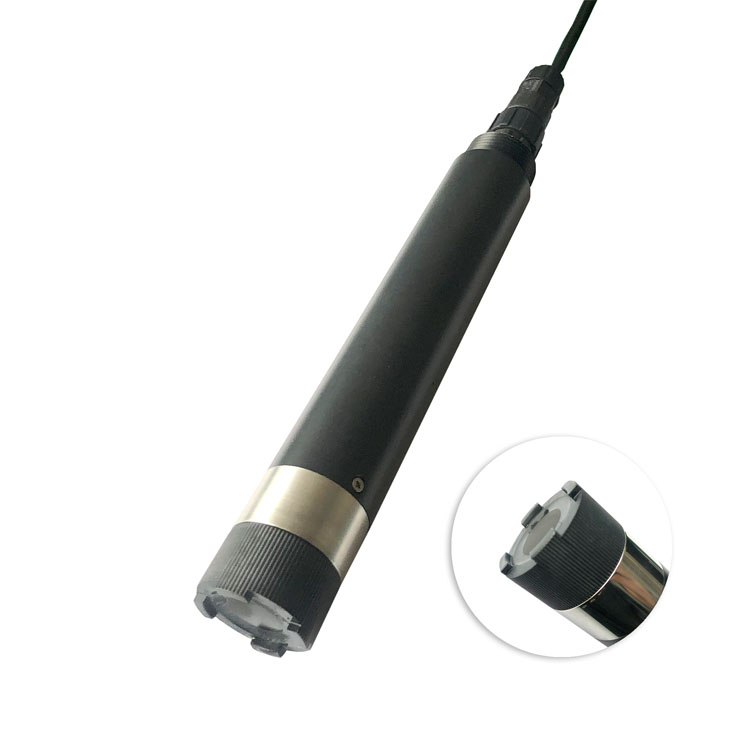
The NiuBoL NBL-WQ-DO is an immersion optical probe, not a handheld meter with its own complete display and alarm system. Its signal needs a compatible controller, PLC, RTU or data logger. Include that receiving equipment when comparing an online upgrade with continued portable testing.
| Task | Keep or change during the upgrade |
|---|---|
| Routine measurement at a fixed point | Online acquisition can provide records between visits after the installation is verified. |
| Depth or location survey | Retain portable checks; one fixed point cannot map the whole water body. |
| Suspected probe drift or fouling | Use an independently checked reference and inspect the installed probe. |
| Overnight alarm | Test the full notification and response path; a logged low value is not itself a delivered alarm. |
| Formal reporting | Retain the applicable approved measurement and verification procedure; an online trend does not establish approval. |
Compare the fixed probe and portable DO meter at the same location and depth, close enough in time to observe the same condition. Avoid placing one in an aerator plume and the other in quiescent water. Record water temperature, aerator or pump state, stabilization and the time of each reading.
Then move the portable probe through the locations that matter to the operating decision. If those observations show a persistent gradient, moving the fixed point or adding a second point may be more useful than adjusting its calibration. A single convenient mounting position should not replace an inspection route that previously detected spatial differences.
The DO-4A probe below is another optical configuration. Compare its own range, accuracy and service requirements when considering a change; probes carrying a dissolved-oxygen label do not necessarily have identical specifications.
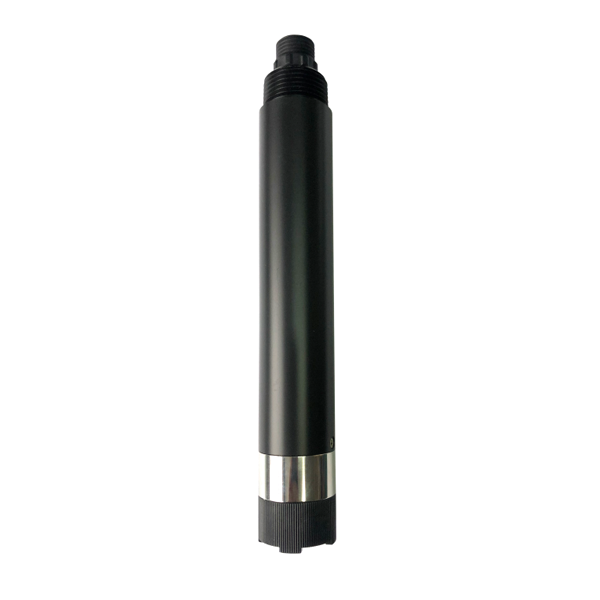
| Selection item | NBL-WQ-DO specification |
|---|---|
| Oxygen range / resolution | 0-20 mg/L; 0.01 mg/L resolution |
| Accuracy | Oxygen +/-2% FS; temperature +/-0.3 degrees C |
| Measurement / compensation | Fluorescence quenching; built-in temperature measurement and salinity-compensation setting |
| Supply / consumption | 12-24 V DC; below 0.3 W at 12 V for the probe |
| Data output | RS485 Modbus RTU; host configuration and register interpretation required |
| Working conditions | 0-45 degrees C; pressure below 0.2 MPa for this configuration |
| Construction / installation | POM and 316L stainless steel; IP68; immersion mounting |
| Cable | Standard 5 m, other lengths configurable; specify jacket suitability for the actual water and exposure |
On a 20 mg/L full-scale range, 2% FS equals 0.4 mg/L. That is not the same as 2% of the current reading. A difference of a few display steps between two instruments is therefore not sufficient reason to recalibrate one of them. Compare both instruments' error specifications and the conditions of the comparison.
Also distinguish mg/L from percent saturation. The USGS oxygen-solubility calculations account for temperature, barometric pressure and salinity. Check the compensation settings and units used by both instruments before diagnosing a hardware fault. Do not replace local pressure with an unrelated sea-level weather value during a calibration calculation.
First establish that the portable reference is ready for use and that both probes have stabilized. Check the sensing surfaces for deposits, attached bubbles or damage. Preserve the installed reading before cleaning so that an apparent improvement can be assessed rather than assumed.
If the instruments agree side by side but not at their usual positions, investigate water movement, depth and time. If they disagree on a suitable check under matched conditions, review compensation, reference condition and calibration. If the local reading agrees but the dashboard differs, investigate the data path before touching the sensing cap.
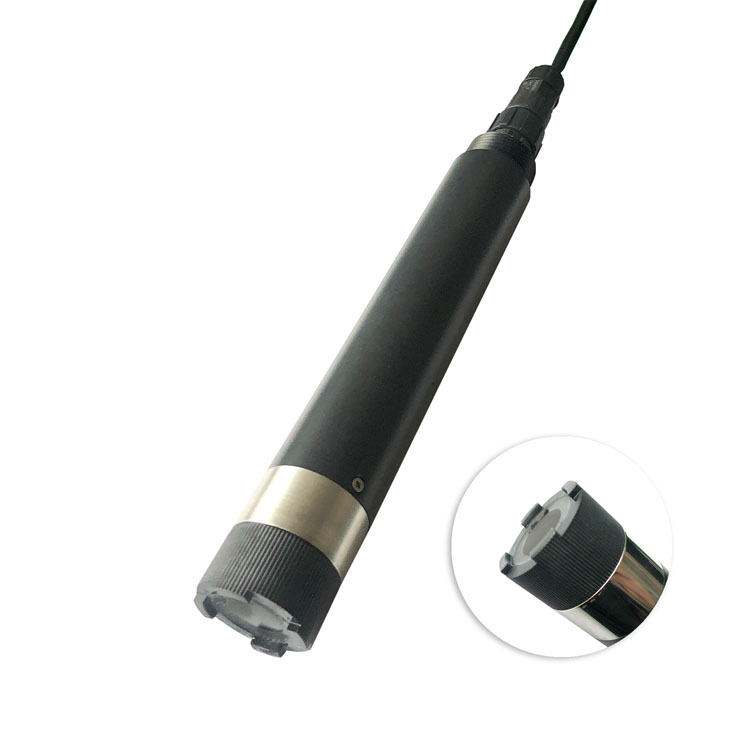
Optical measurement avoids the electrolyte and oxygen-consumption mechanism of an electrochemical probe, but it still needs clean optics and a sound sensing cap. An online installation can foul between visits even when a portable reference remains clean in storage. Set service visits from observed conditions rather than assuming optical means unattended indefinitely.
For RS485 Modbus RTU, verify the sensor address, serial settings, data type, scaling and unit against the delivered version. Compare the decoded host value with an independent indication or configuration tool. Keep the measurement's validity state separate from its numeric value.
A disconnected sensor is not an acceptable oxygen concentration. Test how the PLC or logger identifies missing updates and whether the remote display marks the last value as stale. Do not fill a communication gap with zero or continue displaying an old normal reading without an indication.
Test the alarm threshold, delay, reset behavior and recipient through an approved commissioning method. Include communication loss separately from low oxygen. Where automatic aeration is required, the responsible process engineer must define the response to invalid data and manual override; an extra sensor does not establish that logic by itself.
Before reducing manual rounds, demonstrate that staff can retrieve, clean and reinstall the probe without losing its representative depth. Retain a schedule for portable checks and specify what triggers an extra visit, such as unexpected disagreement, a cap change or a prolonged interruption.
Not solely because the online channel is live. Retain a way to verify the fixed point and inspect other locations. Reduce repetitive rounds only after comparison results, alarm delivery and service access have been demonstrated.
No. Deposits, cap damage and changed compensation settings can still affect results. Follow the selected probe's service procedure and use observed comparison performance to plan checks.
They may be measuring different water, at different depths or at different times. Compare them side by side under stabilized conditions before deciding that the difference is instrument error.
Separate the probe, holder and cable from acquisition, power, local indication and remote alarm delivery. Include suitable verification accessories and sensing-cap service. A probe-only quotation cannot be compared directly with a complete monitoring point.
Provide the existing portable method, water type, operating oxygen region, observed location differences and the interval currently unobserved. Add the proposed mounting depth, host interface and required alarm destination so the upgrade addresses a specific gap.
Keep a labelled record of cable routing, mounting depth and cap replacement with each online point. When a service visit changes the sensor position, repeat the relevant paired check; a clean probe in a different water layer is not a like-for-like comparison.
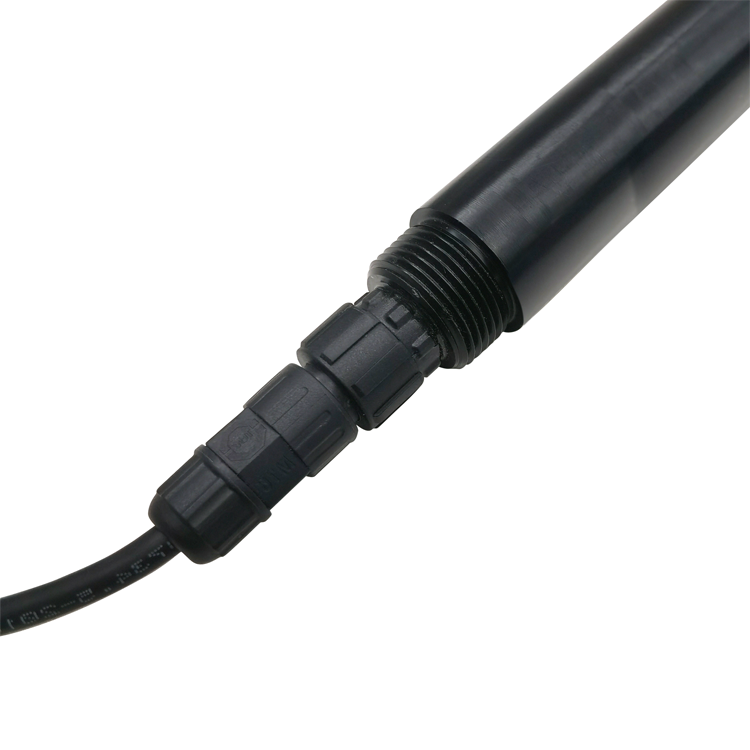
An online upgrade should fill the time gaps in portable inspection while retaining independent verification and location surveys. Establish agreement under matched conditions, then test the entire alarm and maintenance workflow. NiuBoL optical DO configurations can support that change without treating continuous logging as a substitute for every field check.
Prev:Water TDS and pH Meter: EC Range, Conversion and Dosing Checks
Next:IoT Pest Monitoring Dashboard: From Trap Images to Field Checks
Related recommendations
Sensors & Weather Stations Catalog
 Agriculture Sensors and Weather Stations Catalog-NiuBoL.pdf
Weather Stations Catalog-NiuBoL.pdf
Agriculture Sensors Catalog-NiuBoL.pdf
Water Quality Sensor Catalog-NiuBoL.pdf
Related products
 Combined air temperature and relative humidity sensor
 TDR Soil Moisture & Temperature Sensor for irrigation| RS485 |4-20mA| NBL-S-THR
 Soil pH sensor RS485 soil Testing instrument soil ph meter for agriculture |NBL-S-PH
 Wind Speed sensor Output Modbus/RS485/Analog/0-5V/4-20mA
 Tipping bucket rain gauge for weather monitoring auto rainfall sensor RS485/Outdoor/stainless steel
 Pyranometer Solar Radiation Sensor 4-20mA/RS485


Screenshot, WhatsApp to identify the QR code
WhatsApp number:+8615367865107
(Click on WhatsApp to copy and add friends)

