





— Blogs —
—Products—
 Consumer hotline +8618073152920
WhatsApp:+8615367865107
Address:Room 102, District D, Houhu Industrial Park, Yuelu District, Changsha City, Hunan Province, China
Product knowledge
Time:2026-09-14 13:00:00 Popularity:211
Quick Answer: A drainage wastewater monitoring system is useful when it records a discharge event together with water level, flow direction and pump operation. Water-quality readings alone cannot distinguish a new discharge from dilution, backflow or a probe left in stagnant water. Select the measuring point and event-recording method first, then choose the NiuBoL sensor channels that can answer the site's investigation question.
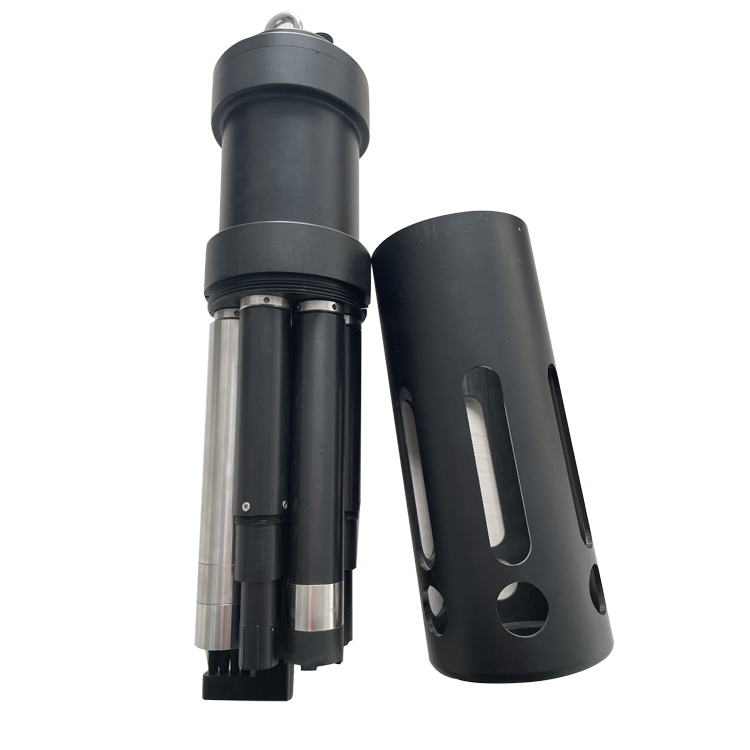
A drainage network can change within one pumping cycle or rain shower. Daily inspection may miss an intermittent industrial discharge, while a daily average can conceal the timing of a short excursion. The useful output is a sequence: when the change started, which branch was flowing, whether a pump or gate operated, and when the water returned toward its previous condition.
Begin with a drainage drawing showing tributary connections, pumping stations and the receiving water. Mark whether the proposed point measures one identifiable outlet or a mixture from several sources. A probe downstream of a junction can detect change but cannot attribute it to one upstream site without additional observations. That distinction determines whether the project needs another measuring point rather than more parameters at the same point.
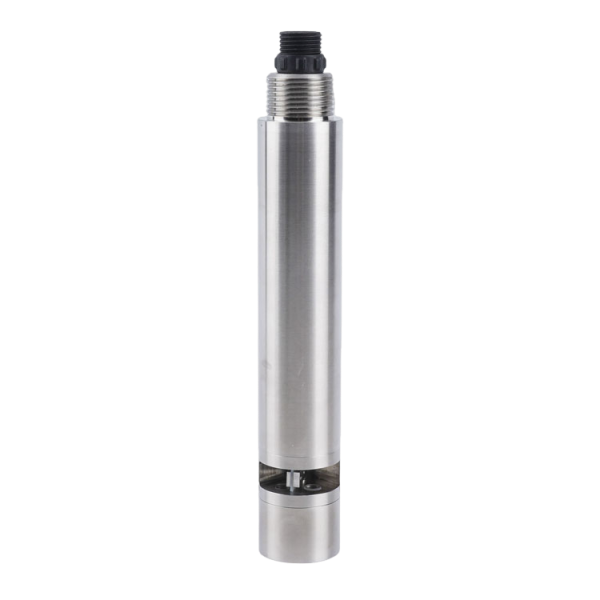
An ammonia channel may help investigate a suspected nitrogen-bearing input. The NBL-WQ-NHN is an ammonium ion-selective probe, so reporting basis, potassium interference and the concentration range matter. It is not a universal sewage detector. Pair an excursion with a timely sample and hydraulic context before assigning its source.
| Location | What can mislead the reading | Installation decision |
|---|---|---|
| Intermittently flowing outfall | The channel becomes dry or leaves a small stagnant pool between discharges | Identify a valid wet measurement condition and flag dry periods separately |
| Pumping-station wet well | Level cycling, grease, debris and local sediment disturbance during pump starts | Keep the sensing point clear of deposits and moving equipment, with safe retrieval from outside the well |
| Tidal or surcharged outlet | Receiving water moves back into the drain | Record level and, where attribution requires it, validated flow direction alongside water quality |
A permanently wet recess can look convenient because it keeps the probe submerged. It may also retain old water after the main discharge has stopped. Check exchange at the sensing point during low flow, normal discharge and pump operation. A low reading in trapped water is not evidence that the flowing outlet has the same concentration.
Direct immersion avoids a sample transport line but exposes the instrument to debris and hydraulic loads. A bypass arrangement improves access only if it reliably receives current discharge water. Provide an indication of sample delivery; communication with a powered probe does not prove that the pump or intake is working. Establish what happens when the drain is empty rather than allowing the bypass to recirculate an old sample indefinitely.
For an optical COD channel, check the actual concentration and particle conditions before choosing the range. An online optical result is a matrix-dependent organic-load indicator, not automatic equivalence to a laboratory COD method. Window fouling, bubbles and changing wastewater composition can alter the relationship. Compare paired samples across the conditions the event monitor must recognize.
Concentration and discharged mass answer different questions. During rain, concentration can fall while total pollutant transport rises because much more water is moving. Estimating a load therefore requires a suitable flow measurement and aligned concentration observations. Water level is not automatically flow: a surcharged pipe or backwater condition can invalidate a simple level-to-flow relationship.
As an arithmetic example, a constant 3 mg/L concentration at 0.1 m3/s for ten minutes represents 0.18 kg of that constituent. The same concentration at twice the flow represents twice the mass. This assumes representative concentration, valid flow and a consistent reporting basis throughout the interval; it is not a measured project result. A varying event requires integration over the changing flow and concentration record.
For source investigation, retain rainfall timing, pump run state and gate position where available. These are separate channels, not functions contained in a water-quality probe. Conductivity can help identify a change in dissolved ionic composition, including mixing or dilution, but it cannot identify an individual pollutant. Compare its timing with the discharge record rather than treating a conductivity threshold as a chemical diagnosis.
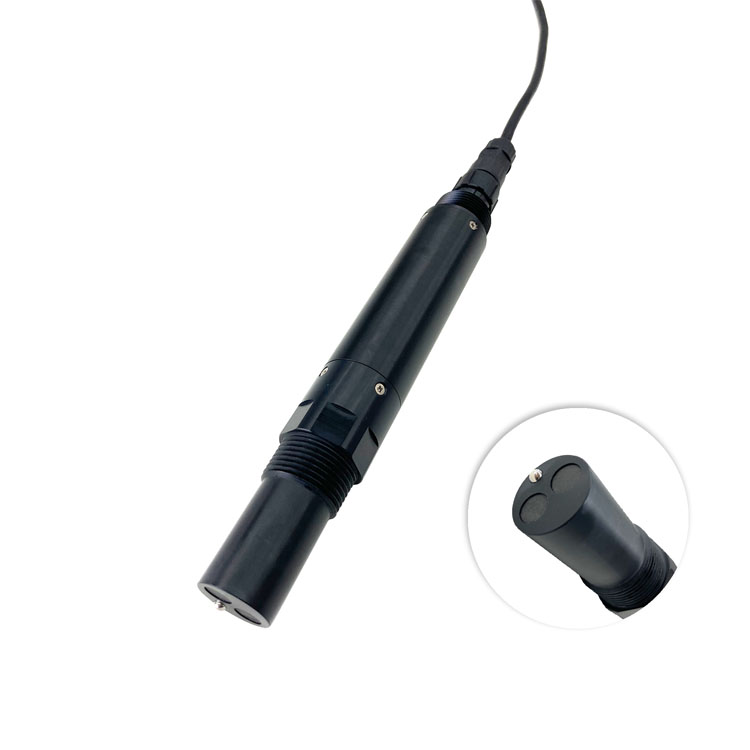
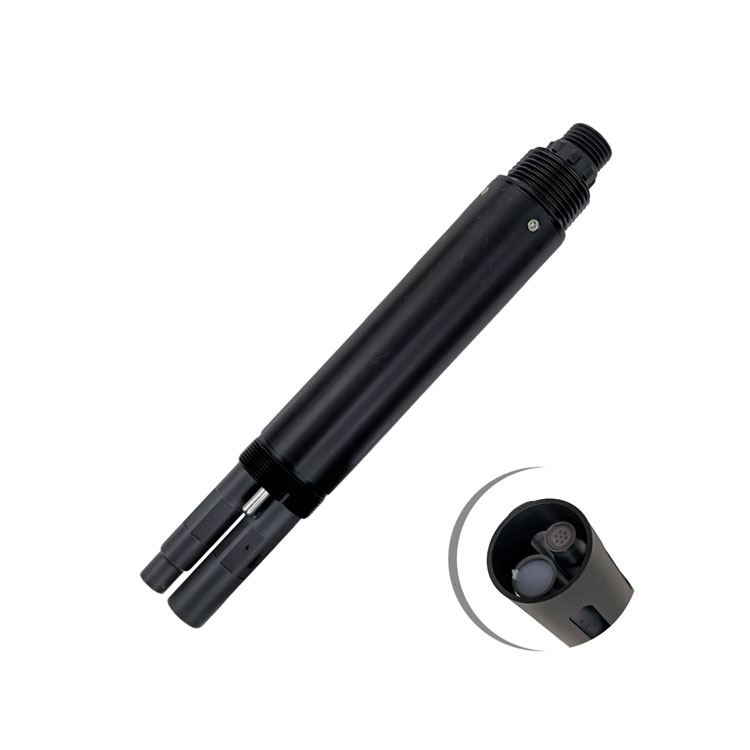
The NiuBoL NBL-WQ-MPS-5A can combine selected water-quality modules at one measuring point. Its configurable channels include pH, ORP, dissolved oxygen, conductivity, turbidity, ammonia and optical organic-load options, with temperature included in the supported parameter count. List the fitted modules and ranges in the order. The maximum available channel count does not mean every option is supplied.
| MPS-5A item | Specification or configuration boundary | Drainage project implication |
|---|---|---|
| Supply | 12 V DC, +/-5% | Maintain 11.4-12.6 V at the assembly; check cable voltage drop |
| Power | 5 W at 12 V | A continuous probe load alone is 120 Wh/day; logger, pump and communications are additional |
| Output | RS485 Modbus RTU; default 9600 baud, 8N1 | Use a compatible master and the register map for the fitted modules |
| pH option | 0-14 pH; +/-0.1 pH; 0.01 pH resolution | Use with representative mixed water, not a concentrated dosing plume |
| Conductivity options | 0-5000 uS/cm or 0-200 mS/cm; +/-1.5% FS | Select for the expected background and excursion range |
| Cable and mounting | 5 m standard shielded cable; lifting ring or 4 NPT support | Support the body mechanically and protect the external connection |
| Cleaning | Adjustable automatic brush cleaning | Allow brush clearance and removal access; it does not clear the drain or a blocked intake |
| Environmental limits | Confirm assembled-unit immersion, temperature, pressure and cable-jacket limits for the order | Individual module measuring ranges are not a complete station rating |
Do not infer explosion protection from an immersion rating or a corrosion-resistant enclosure. A sewer or enclosed pumping location needs the site's hazardous-area assessment and equipment approvals where applicable. Ordinary sensor installation instructions do not authorize entry into a confined space. Design retrieval and routine cleaning around the owner's access procedure.
Optical BOD estimates also need a defined role. They may provide an event trend after a site-specific comparison, but they do not deliver a laboratory BOD5 result immediately. If the purchasing objective is a particular statutory analytical method, establish that requirement before choosing an optical channel.

A ten-minute excursion can occur entirely between fifteen-minute readings. Faster logging may reduce that gap, but the useful response also depends on the sensor, mixing and any sample-line delay. Set the acquisition interval around the event duration of interest and confirm it with the complete measurement arrangement. A fast dashboard refresh cannot recover a change that the sensor never observed.
Keep local records when the uplink is unavailable, and preserve acquisition time when those records are uploaded later. Test storage capacity against the planned sampling interval and the expected outage. Include event start, peak, recovery and the preceding background where the logger supports that recording strategy. An alarm message without the surrounding trend can be difficult to investigate.
For each RS485 channel, verify the unit, decimal scale and installed module identity at the PLC, RTU or data logger. The MPS-5A can return zero for an absent or disconnected module under some conditions. Do not treat every zero as clean water. Distinguish a valid low concentration from unavailable measurement, dry exposure and stale communication.
Observe a normal pump start or discharge cycle without deliberately creating a pollution event. Confirm that level and equipment-state timestamps align with water-quality records. Inspect whether bubbles, vibration or sediment movement produce temporary artifacts, and mark any measurement exclusion period justified by the observed installation behavior.
For paired checks, sample close to the sensing point at a recorded time and follow the selected analytical method. Repeat under more than one operating condition. Check the probe before and after cleaning to distinguish deposits from a water change. A suspended-solids channel needs comparison with the actual particles; a universal NTU-to-mg/L conversion is not an acceptance method.
A useful quotation identifies the outfall layout, dry periods, level variation, suspected event duration, required parameters and existing flow or pump signals. Price the probes, retrieval support, sample equipment if needed, logger, power and remote connection separately. Include the recurring service access cost: a low-cost probe in an inaccessible chamber can be an expensive monitoring point.

They can locate the time and measuring point of an unusual change. Attribution requires the network layout, flow conditions and appropriate follow-up sampling. Several upstream branches or backflow can produce the same downstream observation, so avoid assigning a source from one sensor excursion alone.
No. Select the channels that answer the site's problem. A conductivity and pH point may help investigate a particular industrial connection, while solids or ammonia may be relevant elsewhere. More channels do not compensate for a point that measures stagnant or unrepresentative water.
Record an invalid or dry condition using a tested detection arrangement. Do not store an exposed probe's number as a water concentration. Follow each electrode's storage requirements if prolonged dry periods are expected, and consider a different sampling arrangement where continuous immersion cannot be maintained.
Only through a separately designed control strategy. The process designer must address flooding consequences, signal validity, operator authority and the response to a failed sensor. Adding an alarm channel does not establish that an automatic pump stop is appropriate or safe.
Trial the selected configuration through the actual flow and fouling cycle. Check representative-water comparisons, event timing, network interruption and probe retrieval. Record the time required for maintenance as well as measurement agreement; those results help size the service workload for the wider deployment.
Access and civil works, the number of measuring points, sample pumping, available power and the required communication route can outweigh small probe-price differences. Send NiuBoL a site drawing and the existing equipment list so sensor supply and site installation can be compared on the same scope.
A drainage wastewater monitoring system earns its place by preserving an interpretable event record. Combine appropriate NiuBoL water-quality channels with valid wet exposure, hydraulic context and accurate timestamps. That combination helps the owner investigate short discharges and plan maintenance without mistaking dilution, backflow or an instrument fault for a change at the source.
Prev:Wastewater Dissolved Oxygen Control Factors for Aeration Monitoring Projects
Next:Drainage Sewage Monitoring System Features, Applications and RFQ Checks
Related recommendations
Sensors & Weather Stations Catalog
 Agriculture Sensors and Weather Stations Catalog-NiuBoL.pdf
Weather Stations Catalog-NiuBoL.pdf
Agriculture Sensors Catalog-NiuBoL.pdf
Water Quality Sensor Catalog-NiuBoL.pdf
Related products
 Combined air temperature and relative humidity sensor
 TDR Soil Moisture & Temperature Sensor for irrigation| RS485 |4-20mA| NBL-S-THR
 Soil pH sensor RS485 soil Testing instrument soil ph meter for agriculture |NBL-S-PH
 Wind Speed sensor Output Modbus/RS485/Analog/0-5V/4-20mA
 Tipping bucket rain gauge for weather monitoring auto rainfall sensor RS485/Outdoor/stainless steel
 Pyranometer Solar Radiation Sensor 4-20mA/RS485


Screenshot, WhatsApp to identify the QR code
WhatsApp number:+8615367865107
(Click on WhatsApp to copy and add friends)

