





— Blogs —
—Products—
 Consumer hotline +8618073152920
 WhatsApp:+8615367865107
Address:Room 102, District D, Houhu Industrial Park, Yuelu District, Changsha City, Hunan Province, China
Product knowledge
Time:2026-06-03 14:11:07 Popularity:382
Quick Answer: The pH meter working principle is measurement of a potential difference between a hydrogen-ion-sensitive glass membrane and a reference electrode. The instrument converts that signal to pH using calibration and temperature information. An online digital probe performs this conversion inside the sensor and sends the result to a controller; RS485 does not replace the electrochemical measurement.
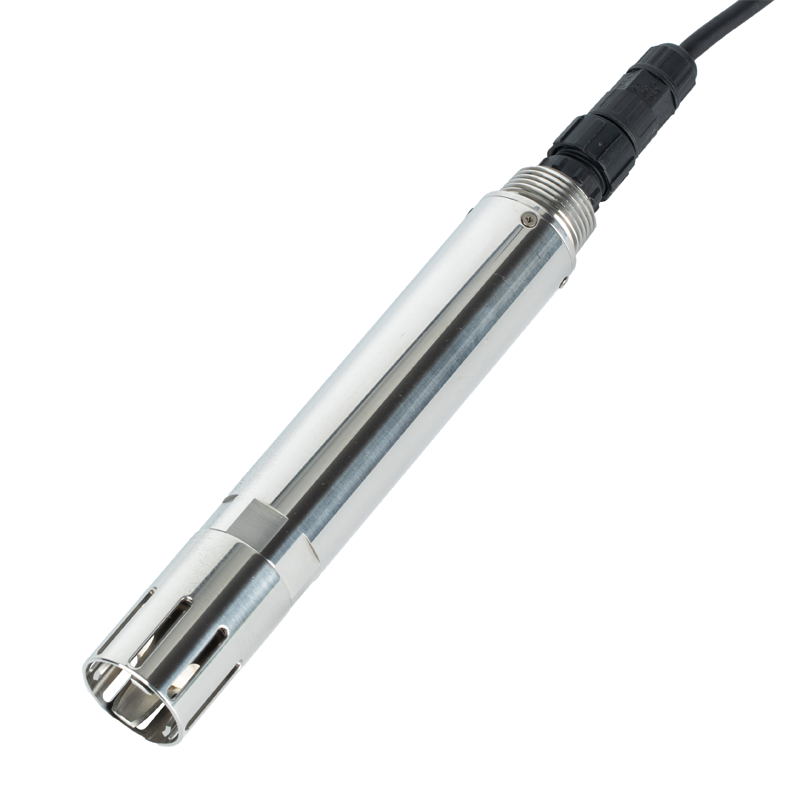
pH describes hydrogen-ion activity on a logarithmic scale. The hydrated surface of a suitable glass membrane develops a potential related to that activity. A reference system provides the other side of the measurement circuit. The instrument measures their potential difference with a high-input-impedance circuit so that measurement does not significantly load the electrode.
This explains why the visible glass tip is not the whole sensor. The reference electrolyte and junction, internal electrical connections and measuring electronics all affect whether the final reading is usable. Replacing a glass element does not necessarily correct a damaged reference system or moisture in an electrical connection.
In the ideal Nernst response, the magnitude of the slope is approximately 59.16 mV per pH unit at 25 degrees C. The USGS guidance on pH measurement explains this relationship and the role of the reference electrode. It is a theoretical relationship, not a guarantee that a particular installed probe always has that slope.
For illustration, a three-pH-unit change corresponds to about 177.5 mV at the ideal 25-degree-C slope. The electrode's offset determines where that relationship sits on the instrument's voltage scale; the slope determines how much the signal changes between two pH values. Both matter when converting voltage into a reported pH value.
A one-point adjustment can make the reading agree at one buffer while leaving the slope wrong elsewhere. Two-point calibration checks the response over a span. Use the buffer family and procedure supported by the actual instrument, with reference values appropriate to the measured buffer temperature. Do not substitute a nominally similar buffer value in the software without checking that setting.
Calibration is also not a repair procedure. If a coated membrane responds too slowly or a blocked junction produces unstable potential, first address the condition of the electrode. A stored calibration value cannot restore physical contact between a fouled measuring assembly and the water.
The junction provides ionic contact between the reference system and the sample. Its condition matters even when the glass looks clean. Deposits, sample chemistry and electrolyte changes can alter the measurement behavior. A probe may therefore drift or respond slowly without visible damage to the bulb.
For an industrial inquiry, describe solids, oils, temperature, pressure and the chemicals that contact the assembly. A metal housing alone does not establish the suitability of the glass, junction, seals or electrolyte. Choose those parts for the actual duty rather than assuming that one construction handles every wastewater stream.
The assembly below illustrates a protected online probe. Its external guard helps identify access to the sensing end, but does not reveal every internal material or prove compatibility with an unknown chemical mixture.
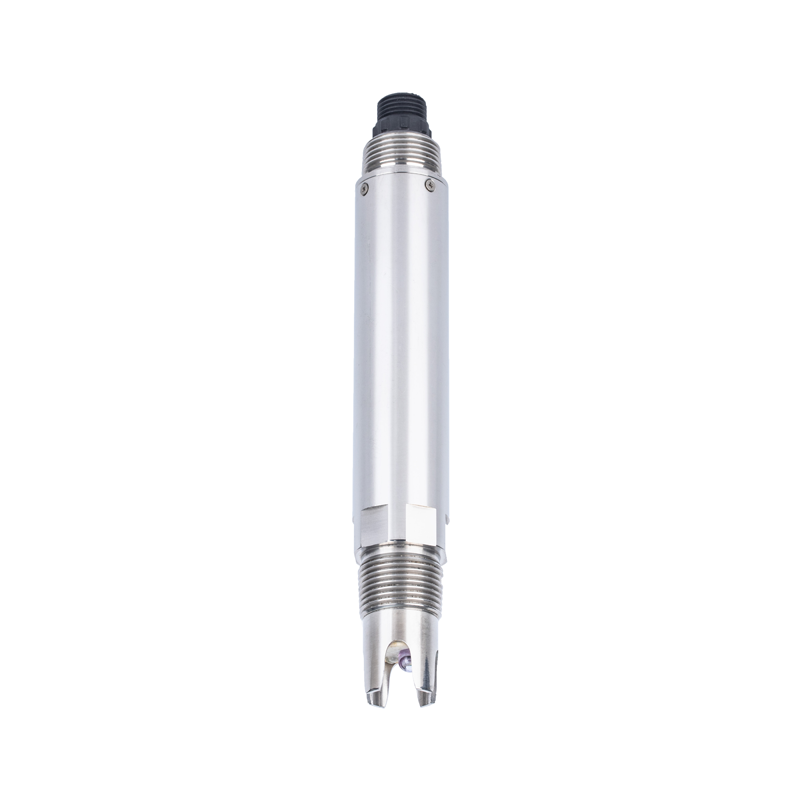
The electrode's theoretical slope changes with absolute temperature. A temperature channel allows the instrument to account for that behavior during conversion. The solution's own pH can also change with temperature because its chemistry changes. Automatic temperature compensation does not generally reconstruct what every sample would measure at 25 degrees C.
This distinction matters when an online sensor is compared with a cooled grab sample. Both instruments may operate correctly and still report different values because they are measuring water at different conditions. Record the temperature of each comparison instead of applying an arbitrary receiver offset.
For a control loop, keep temperature available with pH where the process requires it. Do not infer that every digital pH sensor includes the same temperature element or exposes the same temperature registers.
A bare electrode needs a compatible high-impedance measuring input. A digital sensor includes signal conditioning and conversion before it transmits data. The receiving PLC, RTU or data logger reads the resulting registers rather than directly measuring the glass membrane potential.
These are different interfaces. Do not connect a passive electrode to an ordinary PLC voltage input or treat an RS485 probe as a passive replacement for a panel electrode. For digital integration, identify the actual address, serial settings, data format and scaling. Communication success shows that a value was received, not that calibration or sample contact is satisfactory.
| Characteristic | NBL-WQ-PH-4 configuration |
|---|---|
| Method and measurement | Glass electrode; 0-14.00 pH; 0.01 pH resolution; +/-0.1 pH accuracy |
| Temperature function | Pt1000 automatic temperature compensation; temperature accuracy +/-0.3 degrees C |
| Response and calibration | T90 below 30 s; two-point calibration |
| Power | 12-24 V DC; 0.2 W at 12 V |
| Signal | RS485 Modbus RTU; optional 4-20 mA |
| Water conditions | 0-50 degrees C; pressure at or below 0.2 MPa |
| Housing | PH-4A: POM and ABS; PH-4S: POM and 316L |
| Protection and mounting | IP68; immersion installation; 3/4 NPT |
| Cable | Standard 5 m twisted shielded cable; confirm jacket compatibility and any extension |
The NiuBoL PH-4 series is distinct from the basic PH model. Use the complete model when specifying housing, temperature element and output option. Resolution is the reporting increment, not proof of an equally small measurement error.
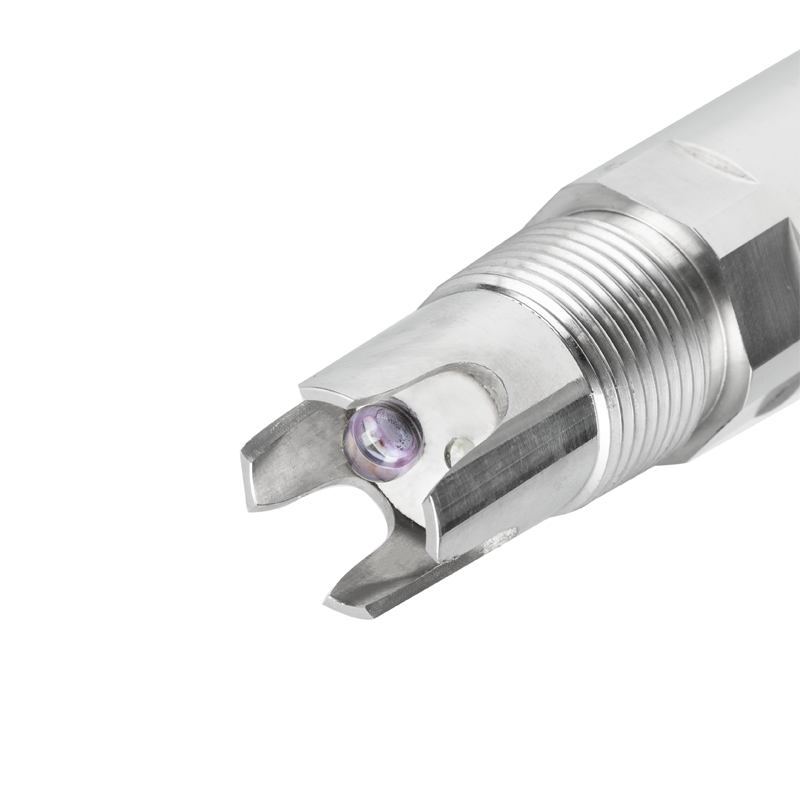
The sensing end below must remain in appropriate contact with the sample. Plan access for inspection without striking the glass or loading the cable. Confirm installation orientation and keep the reference junction wetted as required by the supplied assembly.
No. It responds to hydrogen-ion activity. Buffering and chemical composition prevent a universal conversion from pH into acid concentration or the quantity of neutralizing reagent required.
The reference junction or internal reference system may be affected even when the bulb appears clean. Check the complete measuring assembly and its response in suitable buffers before changing only the displayed offset.
No. It addresses the electrode's temperature-dependent response, not every chemical change in a heated or cooled sample. Compare samples under documented conditions.
No. One point establishes agreement at that point. A supported two-point procedure uses a second suitable buffer to establish the response over a span; proper checks still depend on fresh buffers and temperature.
Identify the digital probe or passive electrode interface, complete model, wetted materials, water conditions, installation and receiver. Include the required calibration access and output option rather than listing only a pH range.
The pH meter working principle connects membrane potential, reference contact and temperature-aware conversion. Understanding that chain helps identify whether a project needs a different electrode, a compatible transmitter or a corrected receiver configuration. For NiuBoL selection, provide the process conditions and receiving interface so the complete measurement path can be reviewed.
Related recommendations
Sensors & Weather Stations Catalog
 Agriculture Sensors and Weather Stations Catalog-NiuBoL.pdf
Weather Stations Catalog-NiuBoL.pdf
Agriculture Sensors Catalog-NiuBoL.pdf
Water Quality Sensor Catalog-NiuBoL.pdf
Related products
 Combined air temperature and relative humidity sensor
 TDR Soil Moisture & Temperature Sensor for irrigation| RS485 |4-20mA| NBL-S-THR
 Soil pH sensor RS485 soil Testing instrument soil ph meter for agriculture |NBL-S-PH
 Wind Speed sensor Output Modbus/RS485/Analog/0-5V/4-20mA
 Tipping bucket rain gauge for weather monitoring auto rainfall sensor RS485/Outdoor/stainless steel
 Pyranometer Solar Radiation Sensor 4-20mA/RS485

Screenshot, WhatsApp to identify the QR code
WhatsApp number:+8615367865107
(Click on WhatsApp to copy and add friends)

