





— Blogs —
—Products—
 Consumer hotline +8618073152920
 WhatsApp:+8615367865107
Address:Room 102, District D, Houhu Industrial Park, Yuelu District, Changsha City, Hunan Province, China
Product knowledge
Time:2026-05-28 16:00:16 Popularity:491
Quick Answer: Residual chlorine is chlorine remaining in water after demand has been exerted. It may be free residual chlorine, combined residual chlorine, or their sum, total residual chlorine. Available chlorine describes oxidizing capacity on a chlorine-equivalent basis, often on a disinfectant product label. Chloride ion is a different substance and is not a substitute measurement for disinfectant residual.
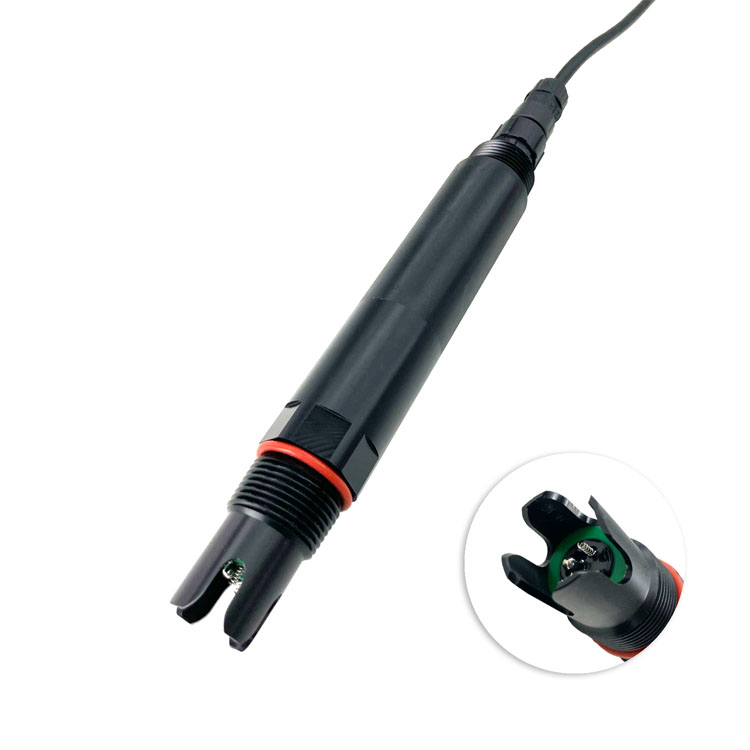
A request for a "chlorine sensor" is incomplete. A free-chlorine process, a chloraminated distribution system and a chloride-monitoring application do not require interchangeable instruments. Even a correct sensor can appear wrong when a field comparison uses total chlorine while the online instrument responds to a free-chlorine species.
Before comparing prices, write the required measured quantity in full. Include the disinfectant, sample pH and temperature, expected concentration and reporting basis. "Residual chlorine, mg/L" is not enough if one bidder interprets it as free chlorine and another as total chlorine.
| Term | Meaning in water treatment | Specification detail |
|---|---|---|
| Free residual chlorine | Free chlorine species, principally hypochlorous acid, HOCl, and hypochlorite ion, OCl-, under typical water-treatment conditions | Free-chlorine measurement method, pH dependence and reporting basis |
| Combined residual chlorine | Chlorine present in combined forms such as chloramines | The relevant disinfectant species and an appropriate combined- or total-chlorine method |
| Total residual chlorine | Free residual chlorine plus combined residual chlorine | A total-chlorine method, not a free-chlorine probe assumed to measure both |
| Available chlorine | Oxidizing capacity expressed relative to an equivalent amount of chlorine | Whether the value refers to chemical-product strength, dosing calculation or a water analysis |
| Chloride ion, Cl- | A dissolved ion, not free disinfectant chlorine | A chloride-specific instrument if chloride concentration is the actual objective |
The EPA chlorine criteria document distinguishes free and combined chlorine and defines their sum for freshwater residual measurements. It also describes why chlorine chemistry becomes more complex in saline water containing bromide. Do not transfer a freshwater method to a seawater application solely because the same concentration unit appears on the display.
Suppose a suitable reference method gives total chlorine of 0.80 mg/L as Cl2 and free chlorine of 0.55 mg/L as Cl2 for the same fresh sample. The calculated combined chlorine is 0.25 mg/L as Cl2. These figures illustrate subtraction, not a recommended treatment target.
The calculation is only useful when both tests have compatible reporting bases, correct timing and acceptable measurement quality. A small negative difference is a reason to review testing and uncertainty, not evidence that combined chlorine has become physically negative. Comparing samples collected at different times in a changing process can also produce a misleading result.
The balance between HOCl and OCl- changes with pH. A sensor that responds primarily to one species may therefore change output when pH changes, even if the total amount of free chlorine is similar. Temperature compensation is not automatically pH compensation, and neither turns a free-chlorine measurement into total chlorine.
At the quotation stage, ask whether the instrument reports HOCl concentration, free chlorine on an as-Cl2 basis, or another defined output. Establish how the reported quantity is produced. If a controller calculates a total free-chlorine value using pH, confirm the pH input, calculation limits and behavior when that input fails.
This distinction is particularly useful when investigating a dosing-loop disagreement. Compare like-for-like results first. Changing calibration to force an HOCl-sensitive signal to match a total-chlorine test can conceal the actual cause and make the dosing response worse.
The NiuBoL NBL-WQ-CL is a constant-voltage residual-chlorine sensor used with a matching flow cell. Its HOCl measurement specification should not be presented as a universal total-chlorine or chloride measurement. The flow arrangement is part of the measurement, not merely a mounting accessory.
| Item | NBL-WQ-CL configuration | Practical implication |
|---|---|---|
| Measurement principle | Constant-voltage electrochemical method | Confirm the chlorine species and comparison method |
| Specified range | 0-2.000 mg/L, labeled for HOCl | Do not assume a total-chlorine or as-Cl2 reporting basis without confirmation |
| Resolution | 0.001 mg/L | Resolution is not the total measurement error |
| Accuracy specification | +/-5% or +/-0.05 mg/L | Obtain the applicable percentage basis and absolute-error rule for the quoted version |
| Sample conditions | 5-50 degrees C; medium pH 4-9 | A permitted pH range does not mean the response is independent of pH |
| Flow-cell sample flow | 30-60 L/h | Provide controlled flow and a way to check it |
| Supply and consumption | 12-24 V DC; 0.2 W at 12 V | Include separate loads for any controller, sampling pump and communications equipment |
| Output | RS485, Modbus RTU | Do not assume that the probe itself has a dosing relay or 4-20 mA output |
| Housing and protection | POM and PTFE; IP68 | Check chemical compatibility and protect external electrical connections |
Arrange the sampling line so that it supplies representative water without an unnecessarily long delay. Stagnant sections, deposits and unsuitable sample-line materials can change the residual before it reaches the sensor. A flow indication and isolation points help distinguish an actual process change from a sampling fault.
Do not feed an uncontrolled pressurized main directly into an installation merely because the probe has an IP68 rating. Confirm the pressure limits of the complete flow-cell assembly and provide the required pressure and flow control. Leave room to remove the electrode and collect a fresh comparison sample near the measurement point.
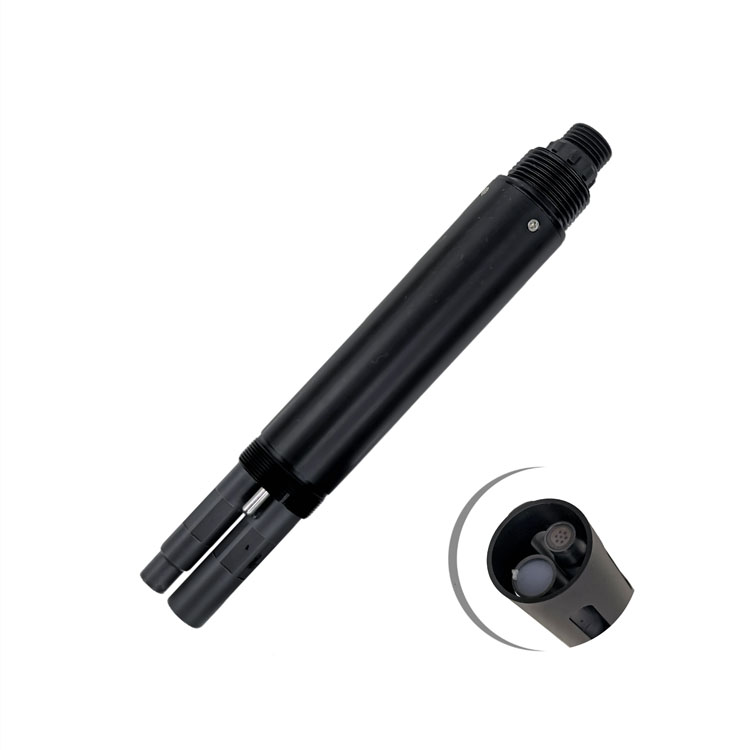
Ammonia affects chlorination chemistry and the formation of combined chlorine. An ammonia nitrogen sensor can therefore provide useful process context where the water and concentration suit the instrument. It does not measure chloramine concentration or total chlorine, and its reading cannot be substituted into a chlorine alarm.
For chloraminated water, choose an analyzer suitable for the intended disinfectant residual. For a free-chlorine outlet, use a compatible free-chlorine reference check. For a saline cooling-water circuit, review the expected oxidants and method interferences before selecting the sensor. These distinctions prevent a technically functioning instrument from answering the wrong process question.
An RS485 Modbus RTU signal can enter a PLC, RTU or data logger that supports the probe's register map. Confirm the concentration unit and decimal scaling using actual readings. Label free, combined and total chlorine separately in the supervisory system; a generic "Cl" label invites later mistakes.
The dosing controller must handle measurement validity as well as concentration. Loss of sample flow, a stale register value or maintenance activity should not silently become a valid low-chlorine demand. Determine the appropriate dosing response with the treatment designer and test it during commissioning. The sensor alone does not provide those process interlocks.
For a comparison test, verify flow, obtain a fresh sample near the sensor, use the matching reference method and observe its specified reaction timing. Record pH, temperature and operating state. If results disagree, investigate the method, sampling delay and electrode condition before changing the calibration.
A useful NiuBoL inquiry states the disinfectant and measured species, reporting basis, normal and maximum residual, pH variation, sample pressure and required host interface. Request a sensor-and-flow-cell configuration rather than a probe-only price if the sampling arrangement has not yet been designed.
Residual chlorine is an incomplete label unless free, combined or total is specified. Total residual chlorine is the sum of free and combined residual chlorine. Use the full measured quantity in the equipment schedule, alarm label and test procedure.
No. Chloride ion is not the free disinfectant residual. A chloride sensor may have a valid role in a different water-chemistry application, but its output cannot replace a free- or total-chlorine measurement.
No. Temperature compensation and pH compensation address different effects. Determine whether the sensor responds to HOCl alone or reports another defined chlorine quantity, and evaluate pH variation against that measurement method.
Its specified signal is RS485 Modbus RTU. A suitable controller is needed to interpret the value, implement control logic and operate the selected pump interface. Do not assume the probe contains a relay, analog control loop or independent dosing safeguards.
One possible reason is that the online sensor measures a free-chlorine species while the reference includes combined chlorine. Sampling delay, flow, pH and instrument condition can also matter. Establish that both methods measure the same quantity before recalibrating.
No. It describes chemical strength on a chlorine-equivalent basis. The residual after dosing depends on dilution, chlorine demand, reactions and contact conditions. Measure the required residual at the intended process point.
No. Disinfection assessment also depends on the applicable process requirements, effective contact conditions and other water-quality factors. A residual sensor provides one measurement; it does not independently establish microbiological compliance.
Choose the chlorine measurement before choosing the hardware. Distinguish free, combined and total residual chlorine from available chlorine and chloride ion. A correctly specified NiuBoL probe, representative controlled-flow sample and compatible reference method provide a useful measurement channel without claiming that one sensor covers every chlorine-related application.
 NBL-WQ-CL Water Quality Sensor Online Residual Chlorine Sensor.pdf
NBL-WQ-DO Online Fluorescence Dissolved Oxygen Sensor.pdf
NBL-WQ-NHN Ammonia Nitrogen Water Quality Sensor.pdf
NBL-WQ-COD Online Water Quality COD Sensor.pdf
NBL-WQ-PH Online pH Water Quality Sensor.pdf
NBL-WQ-EC water quality conductivity sensor.pdf
Prev:Nitrogen Forms in Water: Ammonia, Nitrate and Total Nitrogen
Next:Aquaculture Water Quality Monitor: Pond and RAS Configuration
Related recommendations
Sensors & Weather Stations Catalog
Agriculture Sensors and Weather Stations Catalog-NiuBoL.pdf
Weather Stations Catalog-NiuBoL.pdf
Agriculture Sensors Catalog-NiuBoL.pdf
Water Quality Sensor Catalog-NiuBoL.pdf
Related products
 Combined air temperature and relative humidity sensor
 TDR Soil Moisture & Temperature Sensor for irrigation| RS485 |4-20mA| NBL-S-THR
 Soil pH sensor RS485 soil Testing instrument soil ph meter for agriculture |NBL-S-PH
 Wind Speed sensor Output Modbus/RS485/Analog/0-5V/4-20mA
 Tipping bucket rain gauge for weather monitoring auto rainfall sensor RS485/Outdoor/stainless steel
 Pyranometer Solar Radiation Sensor 4-20mA/RS485

Screenshot, WhatsApp to identify the QR code
WhatsApp number:+8615367865107
(Click on WhatsApp to copy and add friends)

