





— Blogs —
—Products—
 Consumer hotline +8618073152920
WhatsApp:+8615367865107
Address:Room 102, District D, Houhu Industrial Park, Yuelu District, Changsha City, Hunan Province, China
Product knowledge
Time:2026-09-24 13:00:00 Popularity:237
Online water hardness monitoring for a twin-vessel softener should identify which vessel supplies the sample and whether the measuring path has renewed after changeover. One shared probe can otherwise display water from the previous route while the controller labels it as the new outlet. Verify sample transport, valve state and valid measurement before using a result for a release decision.

Mark service, standby, regeneration and changeover states on the sample drawing. Identify whether the probe observes the common treated-water header, each individual vessel outlet or a switched sample manifold. These arrangements answer different questions: a common header describes the combined supply, while an individual outlet can help locate a vessel-specific problem.
For a shared measuring point, record the selected sample route with each result. A selector command is not proof that the expected water reached the probe. Review valve feedback, sample availability and the route downstream of the selector where those are required by the design.
Conductivity can provide a separate ionic-water observation. The EC instrument below is not a hardness probe, and a stable conductivity value does not establish that calcium and magnesium removal remains adequate. Do not use an EC-to-hardness multiplier to avoid verifying the selected hardness method.
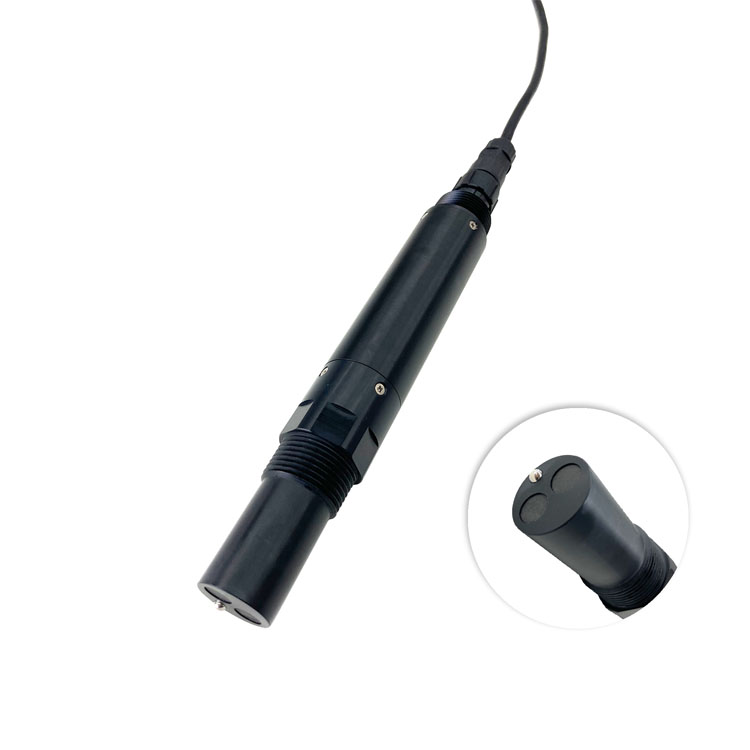
When the sample route changes, water remaining in tubing and the measuring chamber must be displaced before the observation represents the new route. The electrode then needs an appropriate response and stabilization period. Neither delay is shortened simply by polling the Modbus register faster.
For a constructed example, a combined wetted volume of 200 mL at 100 mL/min has a nominal one-volume residence time of 2 minutes. This is not proof that two minutes fully replaces the sample: mixing, dead volume and dispersion can extend carryover. Measure the actual transition in the installed arrangement and define the usable observation interval.
| Changeover check | What to observe | Decision supported |
|---|---|---|
| Sample selection | Command, permitted feedback and actual route | The result is associated with the intended vessel or common header. |
| Sample availability | Suitable flow or water contact after selection | The probe is not reporting stagnant or absent water as the new outlet. |
| Transition and stabilization | Old-water carryover and repeatable new-state response | A defined interval can be excluded from normal acceptance. |
| Return from service or regeneration | Reference comparison under the approved operating procedure | The released point meets the actual monitoring duty. |
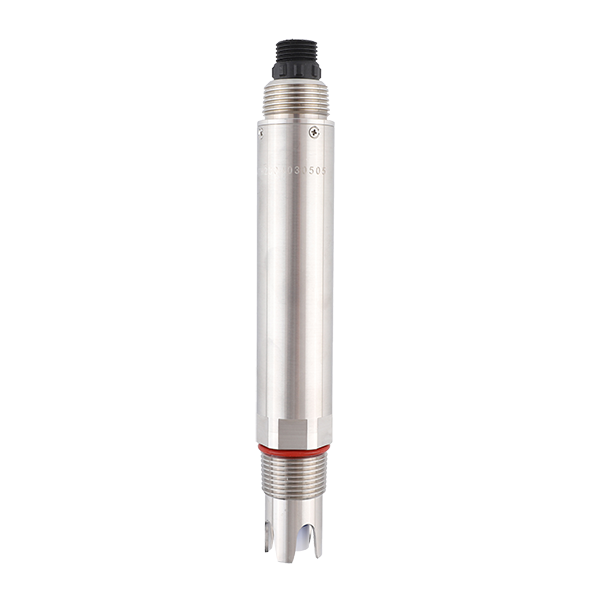
The NiuBoL NBL-WQ-TH-4S uses a calcium/magnesium ion-selective electrode and reports hardness as CaCO3 equivalent. A broad measuring span and a decimal display do not establish performance at every low residual-hardness target. Demonstrate useful response in the water and operating region relevant to the softener.
| TH-4S item | Specification | Changeover implication |
|---|---|---|
| Range and reporting basis | 0–1000 mg/L as CaCO3; resolution 0.1 mg/L | Use the same hardness basis for the probe, reference and host. |
| Accuracy | ±10% of reading; temperature ±0.3 °C | Check the required low region through representative comparison; do not infer a detection limit. |
| Working sample | 0–40 °C; pH 4–10; pressure <0.1 MPa | Condition the sample arrangement to these limits, not to boiler or main-line conditions. |
| Supply and consumption | 12–24 VDC; 0.2 W at 12 V | Budget selector, acquisition and any sample equipment separately. |
| Output | RS485 Modbus RTU; optional 4–20 mA | Keep route and validity information with the concentration channel. |
| Construction and mounting | POM/316L; IP68; 3/4 NPT immersion connection; not horizontal or inverted, minimum 15° inclination | Confirm the installation orientation and suitable service access. |
| Cable and preparation | Standard 5 m cable; preparation includes 24 hours in tap water | Specify jacket, protected joints and conditioning after replacement or storage. |
Automatic temperature compensation does not establish freedom from all sample-matrix effects. A shared point can encounter different chemistry during normal service, abnormal carryover or an incorrect route. Review those conditions before changing calibration to force agreement with one sample.
The dedicated hardness sensor selection guide covers low-region suitability. This changeover test adds the requirement to establish which water is being evaluated and when that result becomes valid.
The TS turbidity probe below is a separate instrument. It can help investigate particle contamination or a disturbed sample route, but clear water is not proof of low hardness. Calcium and magnesium can remain in water that has little visible or measured turbidity.
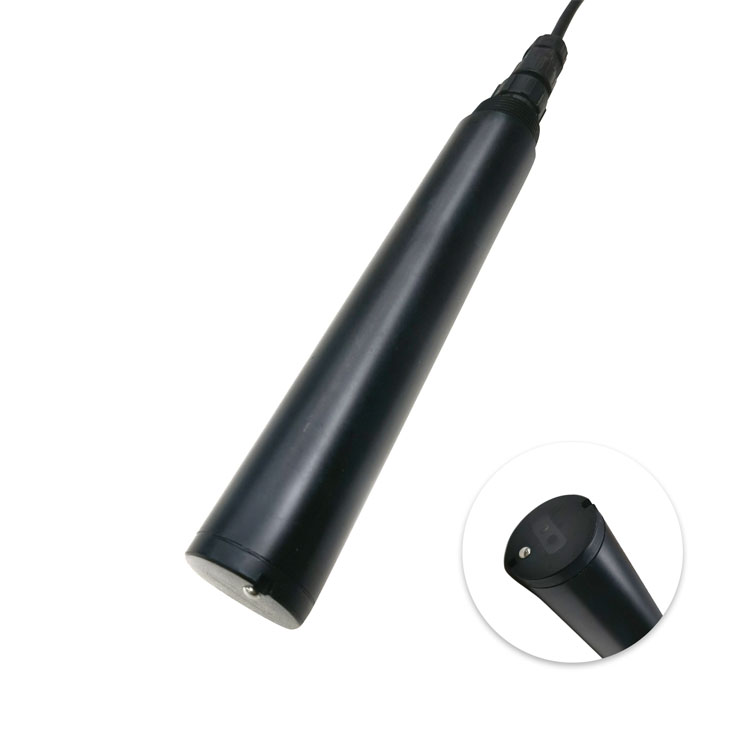
Check the permitted transition from vessel A to B and from B to A. Different tubing lengths, valve leakage or dead legs can produce different renewal times. A successful transition in one direction does not establish the other.
Perform tests through the site's approved commissioning procedure without deliberately releasing unsuitable water to the protected process. Record sample route, changeover time, online transition and representative reference checks. Include a loss of sample or an interrupted selection sequence where the design must handle it.
At the PLC, show transition, unavailable and valid states distinctly. Do not present the previous accepted value as a fresh result for the newly selected vessel. Where the sensor itself does not provide selector state, the acquisition or control application must preserve that information.
A shared probe can reduce instrument count but introduces selection hardware, renewal delay and periods when one route is not observed. Separate probes add equipment and maintenance but avoid sample-switch carryover between vessels. Compare the usable observation duty and required response, not just the number of sensor bodies.
For a NiuBoL inquiry, provide the vessel arrangement, actual sampling drawing, normal and critical hardness region, temperature and pressure, and the permitted operating sequence. State the required output, reference method and access for conditioning or electrode replacement. Specify selector hardware and control work separately from the TH-4S probe.
Only if the sampling arrangement and recorded route support that conclusion. A common-header observation alone may not distinguish individual vessel performance.
No. It is an initial transport estimate. Verify actual carryover and electrode response, then define when the new route produces a usable observation.
No. Conductivity is not selective hardness measurement. Verify hardness with a suitable method at the required decision region.
Yes, where both are used. Sample-line volumes, leakage and flow can differ, so one transition does not prove the other.
Not outside its stated 0–40 °C and pressure below 0.1 MPa limits. Design a suitable representative sampling arrangement for the actual service.
Instrument and maintenance scope increase, while selector carryover and unobserved-route periods can decrease. Recheck identity, reference performance and data quality for each dedicated point.
Online water hardness monitoring across softener changeover must preserve sample identity as well as concentration. Prove water renewal, electrode response and transition handling for the actual arrangement. Select shared or dedicated points by the observation coverage and decision the process requires.
Prev:Online Water Color Measurement: Match the Reference Method
Next:Oil-in-Water Sensor Selection: Oil Type and Sample Validation
Related recommendations
Sensors & Weather Stations Catalog
 Agriculture Sensors and Weather Stations Catalog-NiuBoL.pdf
Weather Stations Catalog-NiuBoL.pdf
Agriculture Sensors Catalog-NiuBoL.pdf
Water Quality Sensor Catalog-NiuBoL.pdf
Related products
 Combined air temperature and relative humidity sensor
 TDR Soil Moisture & Temperature Sensor for irrigation| RS485 |4-20mA| NBL-S-THR
 Soil pH sensor RS485 soil Testing instrument soil ph meter for agriculture |NBL-S-PH
 Wind Speed sensor Output Modbus/RS485/Analog/0-5V/4-20mA
 Tipping bucket rain gauge for weather monitoring auto rainfall sensor RS485/Outdoor/stainless steel
 Pyranometer Solar Radiation Sensor 4-20mA/RS485


Screenshot, WhatsApp to identify the QR code
WhatsApp number:+8615367865107
(Click on WhatsApp to copy and add friends)

