





— Blogs —
—Products—
 Consumer hotline +8618073152920
WhatsApp:+8615367865107
Address:Room 102, District D, Houhu Industrial Park, Yuelu District, Changsha City, Hunan Province, China
Product knowledge
Time:2026-02-16 11:27:53 Popularity:840
Soil moisture monitoring applications differ in the decision they support. An irrigated crop, a park tree, an ecological plot and a slope investigation do not need the same interpretation of a percentage reading. NiuBoL soil sensors can provide local measurements, but the project must specify the quantity, depth and conditions that make those observations useful. A point measurement is not automatically a field water balance, a nutrient test or a landslide warning.
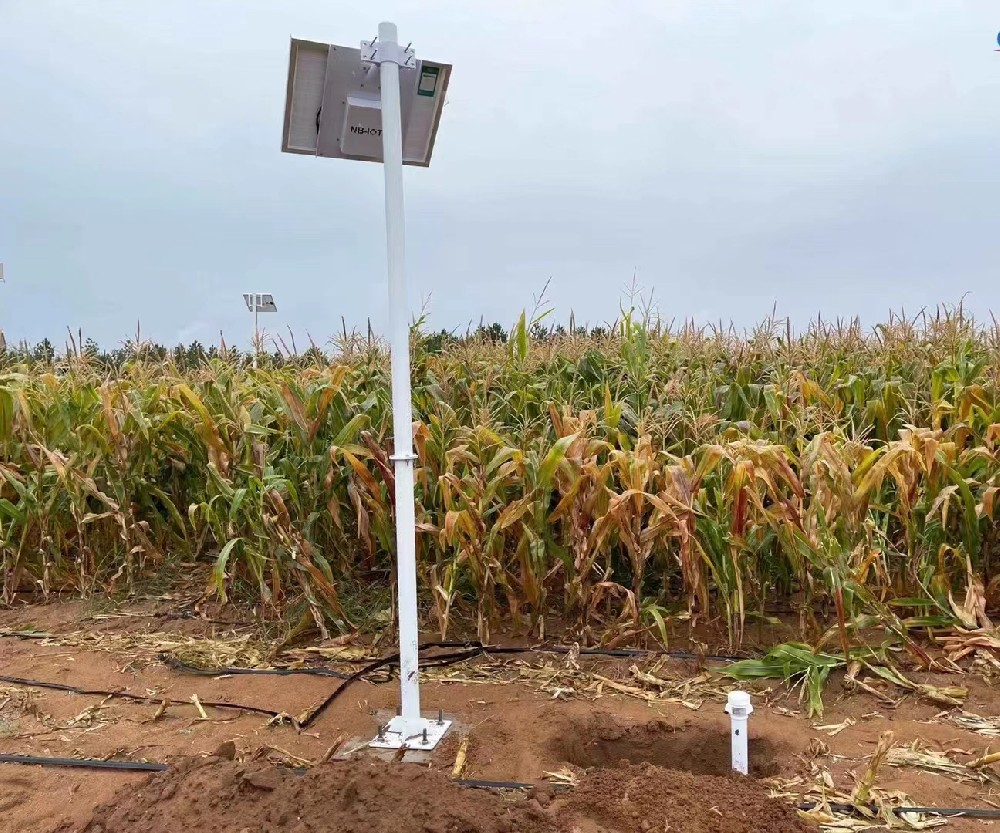
Volumetric water content, or VWC, is the volume of water divided by the bulk soil volume. A value of 0.25 m3/m3 is 25% VWC. It is not air relative humidity, and it is not automatically 25% of the water available to a plant. Water potential and field-capacity ratios describe different aspects of the soil-water condition.
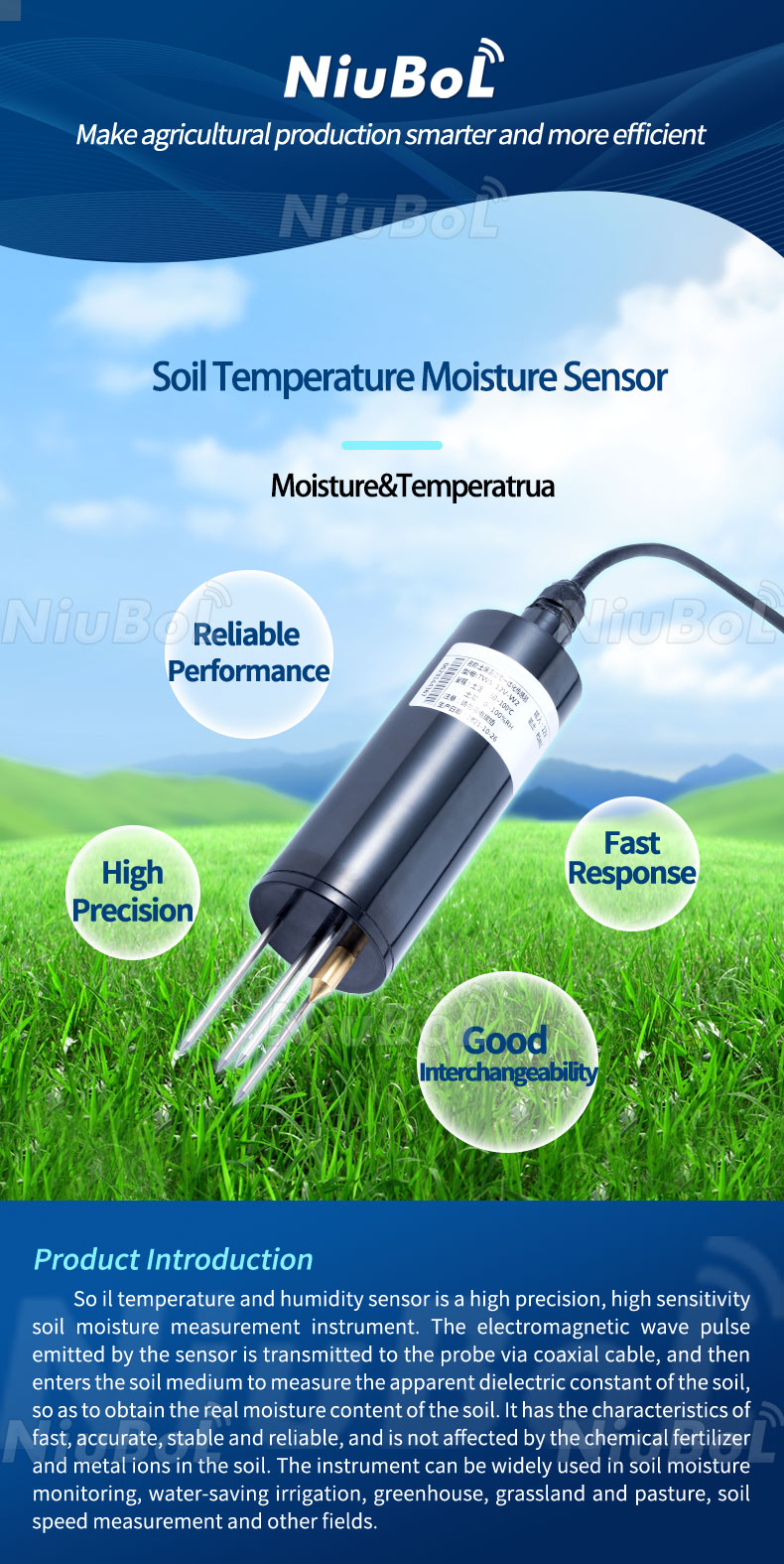
Dielectric probes infer VWC from an electrical response associated with the surrounding medium. Contact, salinity, soil structure and the calibration relationship can affect that inference. Neither FDR nor TDR should be described as unaffected by external conditions. For an unfamiliar soil or substrate, assess the selected probe against an appropriate reference before relying on a management threshold.
| Application | Useful decision | Additional evidence |
|---|---|---|
| Field irrigation | Track depletion and response within a defined root-zone layer | Representative layer readings, soil-water limits, irrigation and rainfall records |
| Greenhouses and containers | Compare wetting and drying within a production zone | Substrate suitability, container geometry and irrigation distribution |
| Urban landscaping | Identify overwatered or drying root zones | Tree establishment stage, rooting volume and local drainage |
| Forestry and ecological research | Compare local soil-water dynamics over time | Plot design, installation history and method consistency |
| Irrigation-district assessment | Observe response at monitored field positions | Delivery volumes and a sampling plan for broader area conclusions |
| Slope investigation | Provide local soil-water context | Geotechnical model and other relevant observations, not a moisture-only warning rule |
A useful monitoring design states what the sensor can establish and what it cannot. A wet point near a pipe does not quantify total leakage, and a dry verge does not describe every tree in a park. Preserve the spatial limits when presenting results to contractors, researchers or irrigation operators.
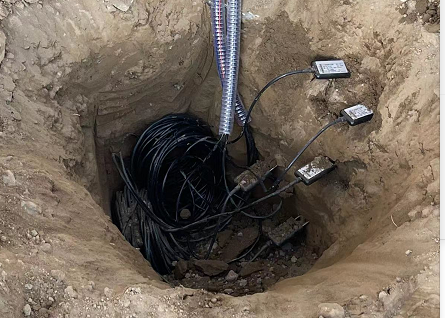
If a 0.30 m soil layer has a representative average VWC of 0.25 m3/m3, the water stored in that layer is 0.30 x 0.25 = 0.075 m, or 75 mm. The calculation requires a layer-representative value. One sensor at one depth does not automatically supply the average for an arbitrary layer thickness.
For a hypothetical target VWC of 0.30 m3/m3 in the same layer, the difference is (0.30 - 0.25) x 0.30 = 0.015 m, or 15 mm. This is a storage difference for the assumed layer, not a direct instruction to apply 15 mm at the irrigation system. Application efficiency, wetted area, root depth, drainage and management limits still require assessment.
University of Minnesota Extension guidance distinguishes water-content sensors from soil-tension methods and illustrates layer-based water-deficit calculations. Use the relevant site values and method rather than transferring a crop or soil threshold from a worked example.
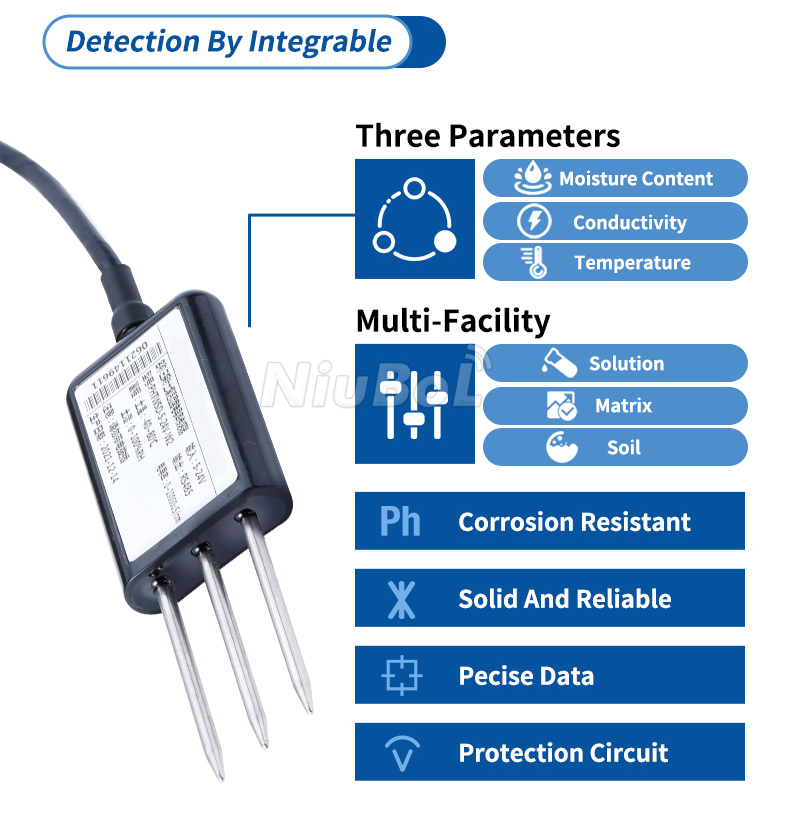
The NBL-S-TM and NBL-S-THR both measure temperature and soil moisture, but their methods and output choices differ. Sensor-family illustrations can show additional channels; the ordered model and its technical schedule determine what is delivered.
| Item | NBL-S-TM | NBL-S-THR |
|---|---|---|
| Moisture method | FDR | TDR |
| VWC range / resolution | 0-100% / 0.1% | 0-100% / 0.1% |
| Specified moisture accuracy | +/-5% | +/-3% |
| Temperature range / accuracy | -40 to 80 C / +/-0.5 C | -50 to 100 C / +/-0.5 C |
| Supply | DC 5-24 V; some configurations 12-24 V | DC 12-24 V |
| Output | RS485 Modbus RTU | Selected RS485 Modbus RTU, 4-20 mA or 0-5 V version |
| Operating environment | -40 to 85 C | -40 to 80 C |
| Protection | IP68 | IP68 |
Measurement span and operating environment are separate limits. A listed temperature measuring range must not override the permitted environment for the assembled sensor. Also obtain the moisture-accuracy definition and reference conditions when an acceptance tolerance depends on them; a small displayed increment is not the same as installed accuracy.
Neither of these two-channel models should be ordered as an EC, salinity, pH or nutrient analyser. Where those quantities matter, select the appropriate additional measurement and verification method. Soil-water data can support an investigation of irrigation or fertilization conditions without directly measuring fertilizer composition.
For an existing PLC with analogue inputs, a selected NBL-S-THR current or voltage version may fit the acquisition arrangement. A 4-20 mA signal is analogue, not a digital protocol. Confirm the channel allocation, scaling and load requirements; do not assume an instrument ordered for analogue output can also provide the desired Modbus feed.
For a digital network, verify RS485 Modbus RTU addressing, register meaning, units and polling constraints for each instrument. Read moisture and temperature as separate quantities. A raw scaled integer can look like a plausible percentage when decoded incorrectly, so test known values and check the engineering-unit conversion.
A data logger, RTU or gateway then provides recording or remote transfer according to its selected capabilities. The buried probe itself is not a cellular endpoint or an irrigation valve controller. Remote storage, alerts and automatic watering should be specified and tested as separate system functions.
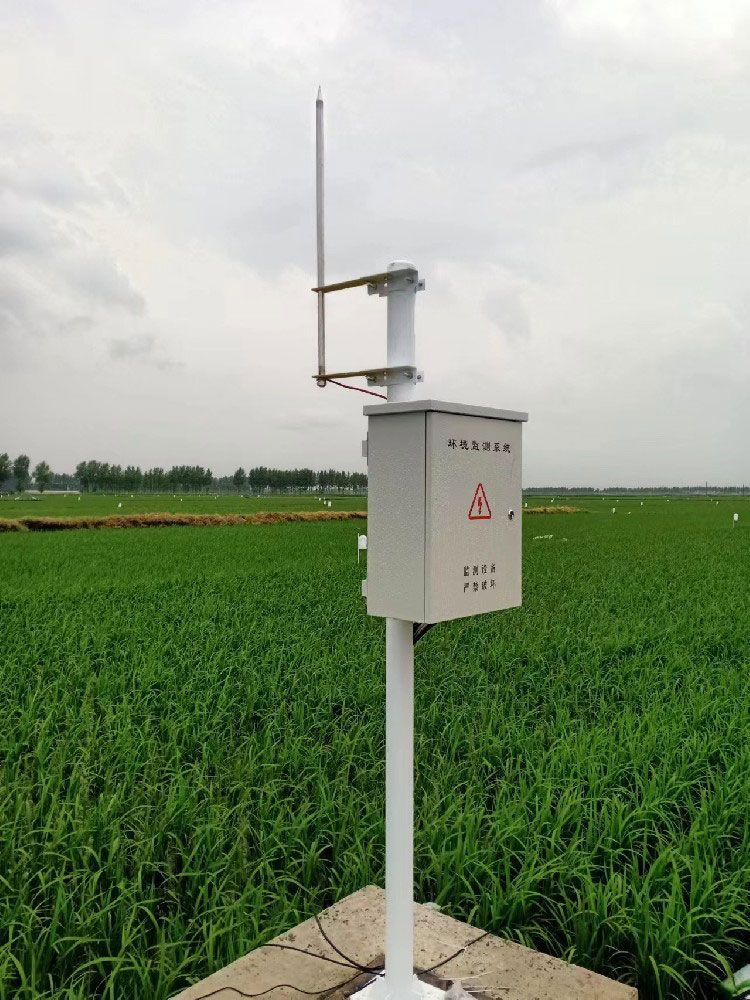
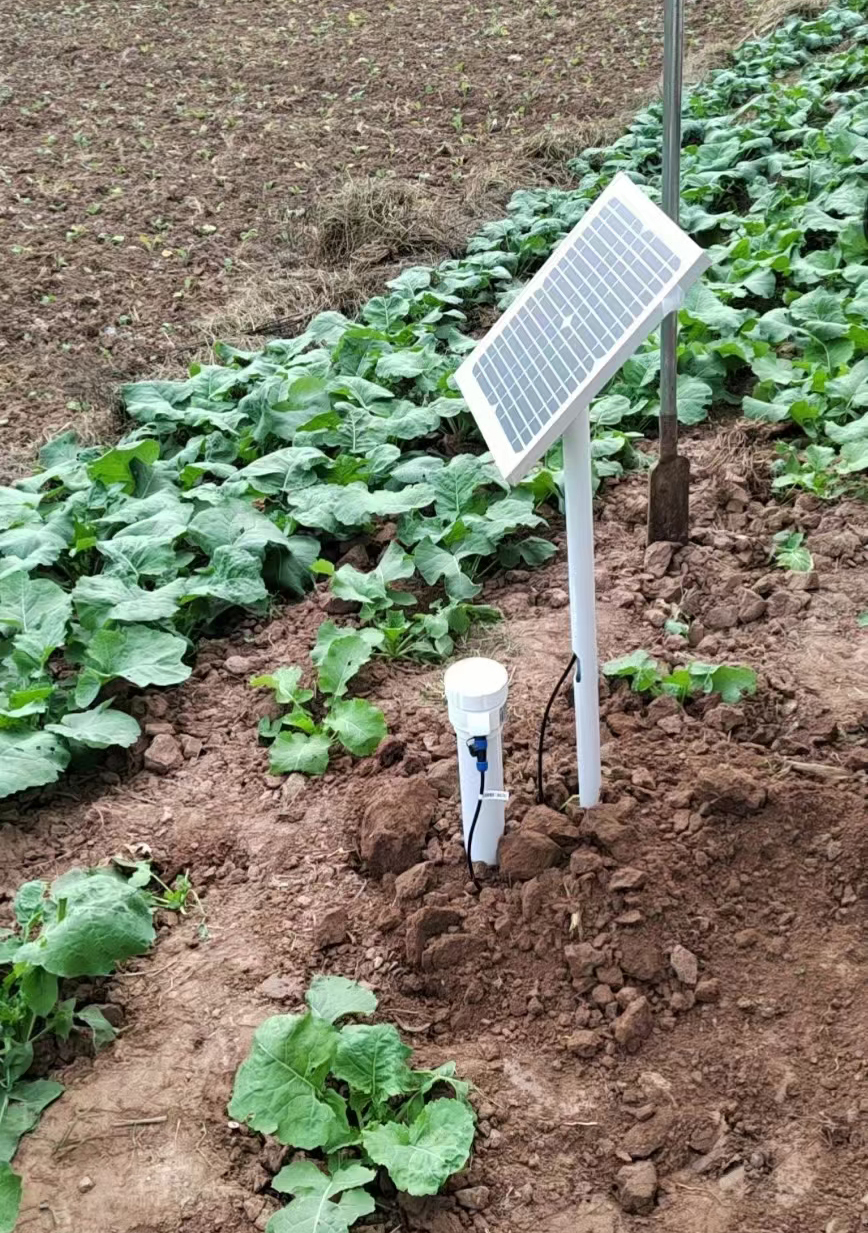
In an irrigation pilot, compare the observed wetting and drying with the known water application and suitable field checks. In an ecological trial, preserve comparable installation and reference methods between plots. In landscaping, assess local drainage and establishment needs rather than translating every dry reading into an automatic watering command.
For geotechnical work, a moisture probe supplies one part of the investigation. Slope stability can depend on geological conditions, pore pressure, movement and other factors. Do not attach a universal alarm to VWC and describe it as a validated landslide warning system. Define the method and responsible engineering assessment separately.
For an enquiry, provide the intended decision, soil or substrate, relevant depths, expected environment and existing acquisition inputs. State whether the requirement is a local probe, a multi-depth profile or a complete monitoring station. Compare these scopes directly without assuming a fixed number of sensors will represent every site.
No. The measured quantity, soil, rooting conditions and intended decision differ. Establish an appropriate interpretation rather than reusing a percentage across unrelated projects.
No. It is a water-volume fraction. Plant-available water requires suitable soil-water limits and root-zone information, not VWC alone.
Only with justified assumptions about the layer and area it represents. A calculated storage difference is still distinct from gross water application at an irrigation system.
No. It provides temperature and moisture channels. Select an appropriate EC or other additional instrument if the project requires that measurement.
No dielectric method should be treated as universally immune. Review the selected instrument's limits, contact and calibration suitability for the intended medium.
Not as a generally valid stand-alone rule. A warning application needs an appropriate geotechnical assessment and supporting observations.
Provide controller input types, supply, cable arrangement and required channels. Specify analogue or RS485 Modbus RTU deliberately and verify the offered configuration.
Soil moisture monitoring applications need a defined measurement-to-decision link. NiuBoL FDR, TDR and profile options can supply different acquisition arrangements, but useful interpretation still depends on soil conditions, representative depth and the intended engineering or management question.
 NBL-S-TMSMS-Tubular-Multi-depth-Soil-Moisture-Sensor-Instruction-Manual.pdf
NBL-S-TM-Soil-temperature-and-moisture-sensor-Instruction-Manual-4.0.pdf
NBL-S-THR-Soil-temperature-and-moisture-sensors-Instruction-Manual-V4.0.pdf
Prev:Solar Insect Lamps in Vineyards: Verify Pest and Crop Outcomes
Next:Portable Soil Moisture Meter in Precision Agriculture Projects
Related recommendations
Sensors & Weather Stations Catalog
Agriculture Sensors and Weather Stations Catalog-NiuBoL.pdf
Weather Stations Catalog-NiuBoL.pdf
Agriculture Sensors Catalog-NiuBoL.pdf
Water Quality Sensor Catalog-NiuBoL.pdf
Related products
 Combined air temperature and relative humidity sensor
 TDR Soil Moisture & Temperature Sensor for irrigation| RS485 |4-20mA| NBL-S-THR
 Soil pH sensor RS485 soil Testing instrument soil ph meter for agriculture |NBL-S-PH
 Wind Speed sensor Output Modbus/RS485/Analog/0-5V/4-20mA
 Tipping bucket rain gauge for weather monitoring auto rainfall sensor RS485/Outdoor/stainless steel
 Pyranometer Solar Radiation Sensor 4-20mA/RS485


Screenshot, WhatsApp to identify the QR code
WhatsApp number:+8615367865107
(Click on WhatsApp to copy and add friends)

