





— Blogs —
—Products—
 Consumer hotline +8618073152920
 WhatsApp:+8615367865107
Address:Room 102, District D, Houhu Industrial Park, Yuelu District, Changsha City, Hunan Province, China
Product knowledge
Time:2026-06-01 11:17:23 Popularity:496
Quick Answer: Online turbidity sensor selection should compare the required decision threshold with the ordered range and stated error limits, not just the displayed decimal places. The basic NiuBoL NBL-WQ-TS offers 0-20, 0-100 or 0-1000 NTU ranges with RS485 Modbus RTU. Its 0.01 NTU resolution on the lowest range does not establish 0.01 NTU accuracy or trace-level suitability.
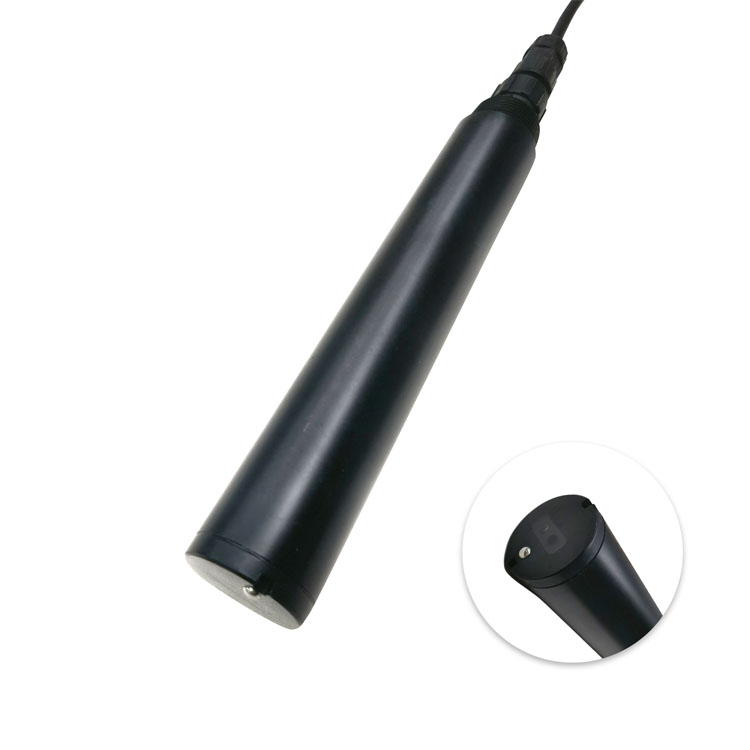
A filtered-water alarm, a raw-water trend and a storm-driven river event need different measurement coverage. Determine the normal band, the abnormal condition that must remain measurable and the smallest change that matters to the operator. Simply assigning the smallest range to every drinking-water project can overlook the uncertainty needed at the intended alarm threshold.
For example, a hypothetical 0.3 NTU decision cannot be justified by a 0.01 NTU display increment if the lowest-range specification also includes an absolute accuracy term of 1.5 NTU. This comparison is not a regulatory limit; it illustrates why resolution alone cannot qualify a monitoring instrument. A project needing low-level reporting should establish a suitable method and uncertainty before purchasing a general immersion probe.
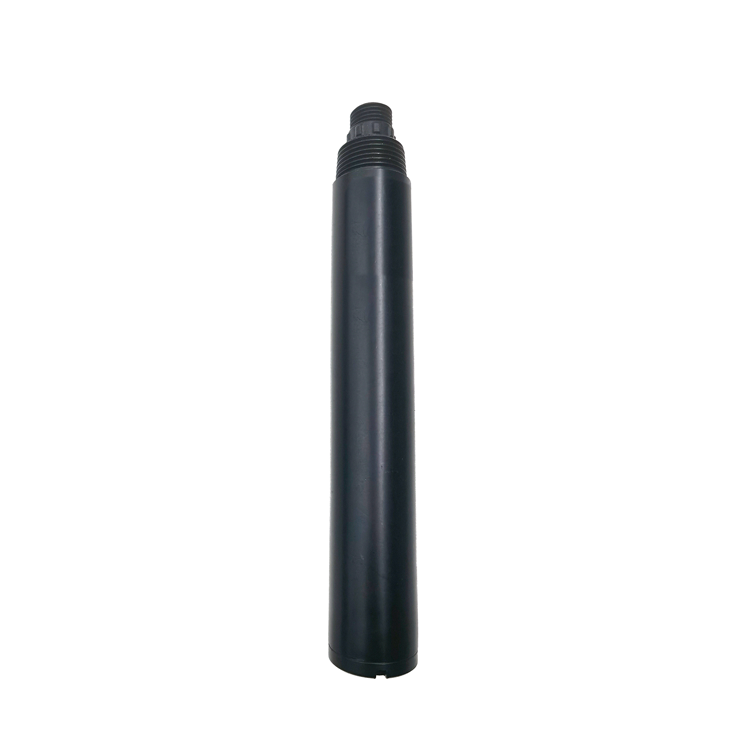
The TS-4A pictured below is a separate configuration. Do not transfer its specifications to the basic TS merely because both measure turbidity. Match the exact product, ordered range and output to the receiving channel.
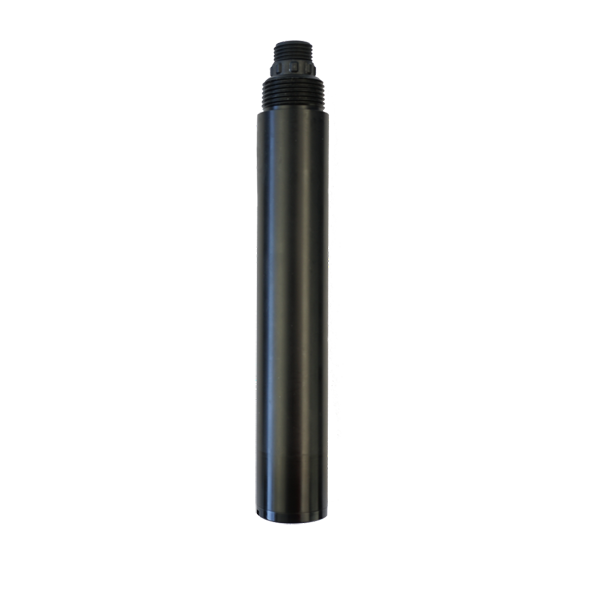
| Parameter | Basic TS specification | Selection implication |
|---|---|---|
| Range / resolution | 0-20.00 NTU / 0.01 NTU; 0-100.0 NTU / 0.1 NTU; 0-1000.0 NTU / 0.1 NTU | Select the ordered range; the basic middle range is 100 NTU, not 200 NTU. |
| Accuracy expression | 20 NTU range: +/-3% or +/-1.5 NTU; 100 NTU range: +/-3% or +/-2 NTU; 1000 NTU range: +/-5% or +/-3 NTU | Establish the percentage basis and how the two terms apply before defining acceptance. |
| Method / compensation | Scattered light; Pt1000 temperature compensation | Optical readings depend on particles; temperature compensation does not remove sample effects. |
| Temperature accuracy | +/-0.3 degrees C | Map temperature as a separate channel. |
| Working conditions | 0-50 degrees C; below 0.2 MPa | Check water temperature and installed pressure. |
| Supply / consumption | 12-24 V DC; 0.2 W at 12 V | Add logger, gateway and any cleaning loads to the station budget. |
| Output | RS485 Modbus RTU; 4-20 mA also listed | Confirm the supplied output, wiring and analog scaling. |
| Housing / protection | POM and ABS; IP68 | Assess chemical exposure and seals separately from enclosure protection. |
| Mounting / cable | Immersion; 3/4 NPT; standard 5 m cable, other lengths customizable | Confirm cable jacket, routing and support for the site. |
The basic TS product has its own range table. A 200 NTU selection in another family, or a response time listed for another assembly, must not be included in the basic model's purchase specification without confirmation.
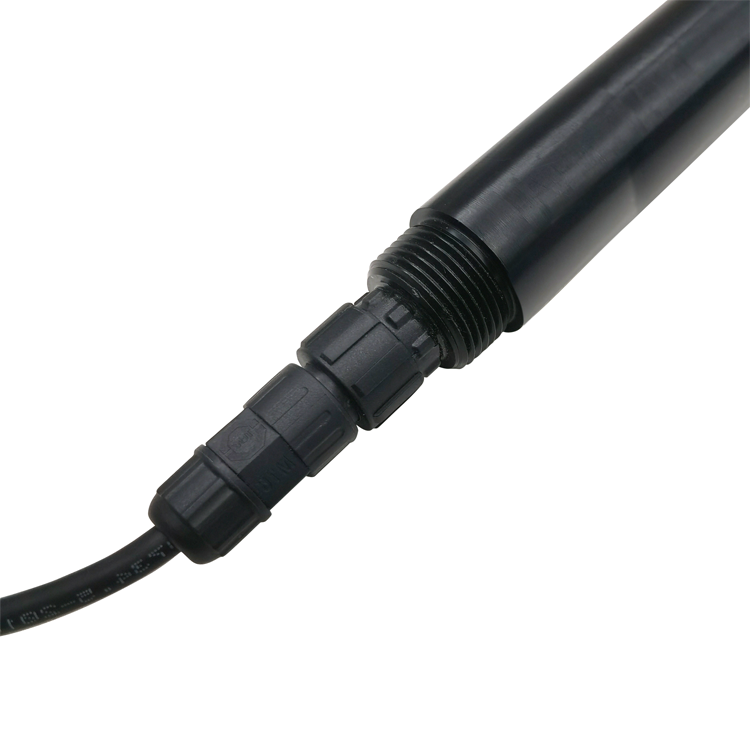
Turbidity describes an optical scattering response. It is not a direct count of microorganisms, a measure of dissolved contamination or a mass concentration of suspended solids. An increase can help identify particle ingress or a treatment change, but it cannot identify the pollutant by itself.
For suspended solids reporting in mg/L, use an appropriate mass-based reference and validate any correlation with the online optical signal. A relationship fitted during one season may change with sediment type or treatment chemistry. Keep raw NTU and calculated concentration in separate historian channels so users can distinguish measurement from estimation.
Comparisons between instruments also need compatible methods. Differences in optical geometry, wavelength and reference standards can produce different results for the same water. See the discussion of turbidity method comparability before using a bench result as a calibration target.
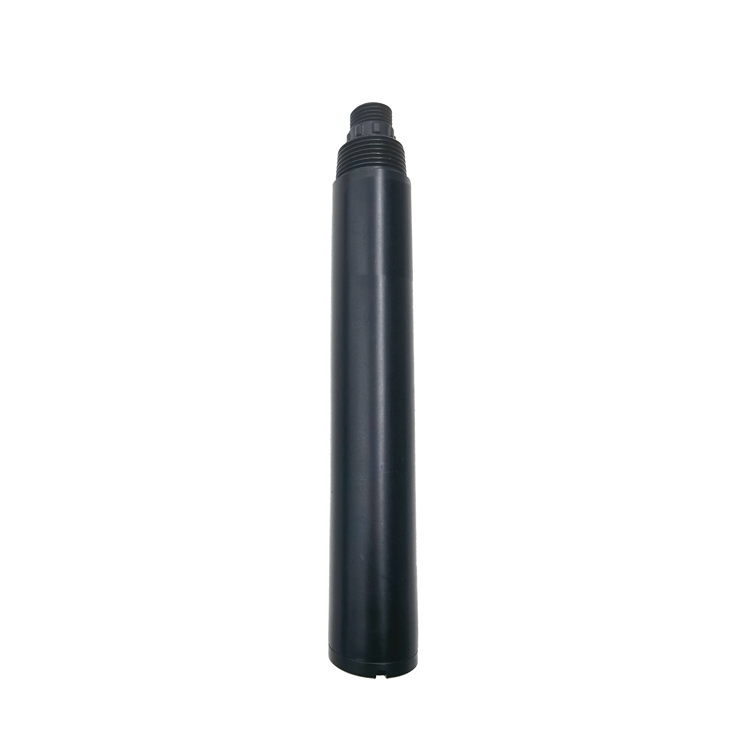
An immersion probe should see moving, representative water rather than a stagnant pocket or settled sediment. Position it away from a direct bubble plume and provide enough access to withdraw it safely. The basic TS installation guidance calls for more than 5 cm from the side wall and more than 10 cm above the bottom; preserve these optical clearances during low water levels as well as normal operation.
In an enclosed process line, evaluate a compatible side-stream arrangement rather than assuming the immersion probe can be inserted through any fitting. Check pressure, sample exchange, drainage and particle settling. A small, slow bypass can yield a tidy trend while losing the heavier particles present in the main stream.
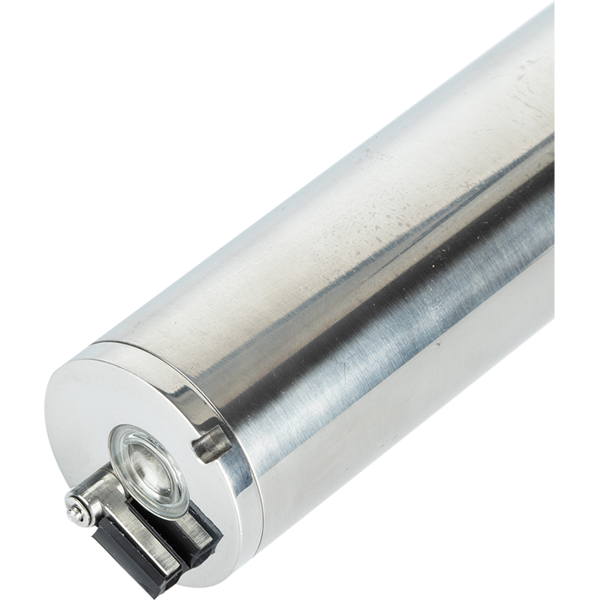
The optical sensing face below needs cleaning access. Protect the window from abrasive contact, do not suspend the probe by its cable, and inspect for trapped bubbles after reinstalling it. A longer cable changes installation reach, not the process-pressure rating.
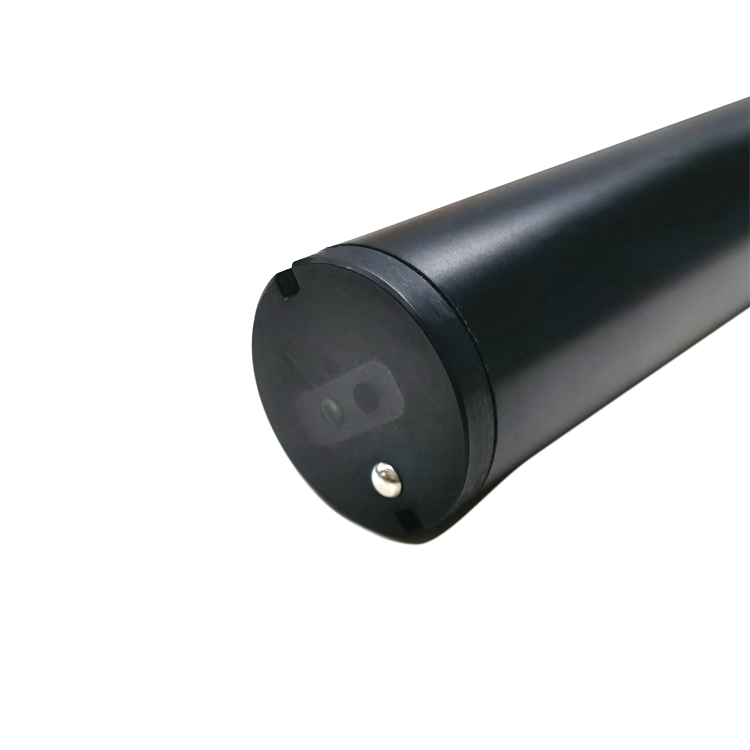
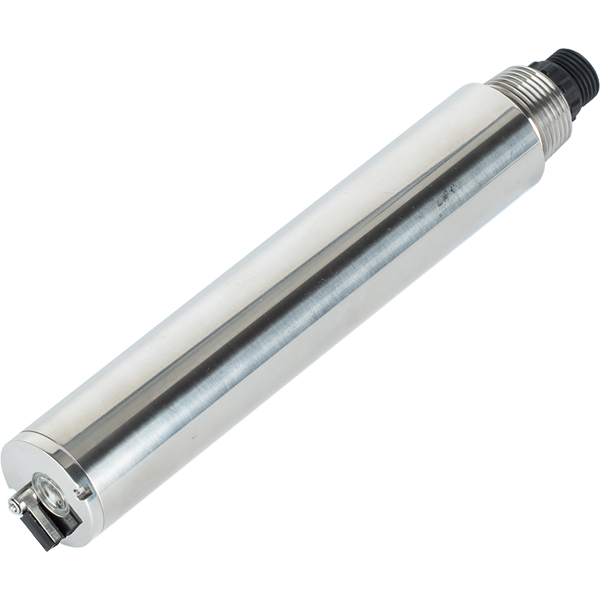
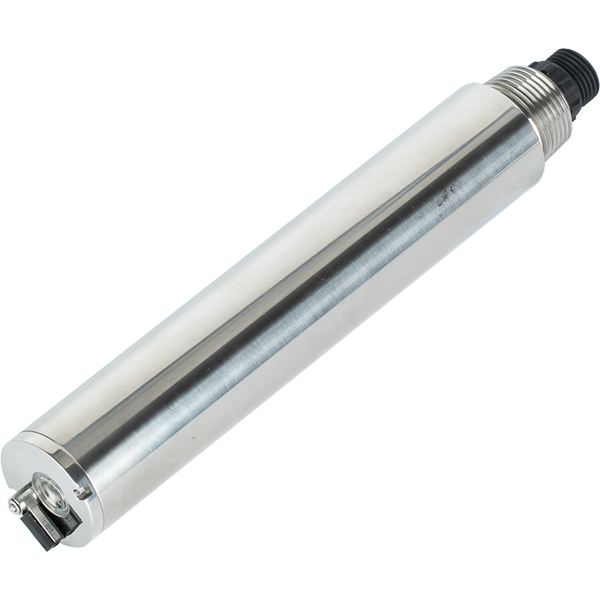
The stainless steel TS-4S configuration lists 20, 200, 1000 and 4000 NTU ordered ranges. Those bands differ from the basic TS. A stainless steel housing does not itself establish higher accuracy, resistance to every chemical or suitability for a low alarm.
Read the accuracy for the selected band. On the TS-4S 4000 NTU range, the listed low portion from 0 to 200 NTU has an absolute error term of +/-20 NTU. That matters if a high-range instrument is expected to provide both a flood-event trend and a low-turbidity decision. Consider whether two distinct monitoring duties require different instruments instead of accepting one broad range by default.
Use the protocol supplied with the exact assembly to verify slave address, serial settings, register address, data type, byte order and unit scaling. Read a stable sample locally and compare it with the PLC and historian. A channel that displays a plausible value can still be wrong by a factor of ten.
If an analog output is ordered, document the selected NTU span at both ends. Test it electrically and compare it with the digital or local reading where available. Keep communication timeout, over-range and maintenance states separate from a high-turbidity process alarm. Never replace missing data with a zero that appears to mean clear water.
For remote stations, a data logger or gateway handles storage and onward transmission. RS485 Modbus RTU does not itself provide cellular access. Size the supply for those devices and any cleaning hardware, not only the probe's 0.2 W figure.
For procurement, send a representative sample description, expected concentration range, required decision level, installation drawing, cleaning access and receiving interface. Ask NiuBoL to identify the exact model and range on the quotation. Installation accessories and a gateway should be itemized rather than assumed to be included with the probe.
During commissioning, record readings before and after cleaning, then repeat under representative flow conditions. A sharp change after wiping may reveal window fouling rather than a process improvement. Compare against a suitable reference without allowing the sample to settle or change between measurements.
Use approved calibration materials and handling instructions for the ordered sensor. Do not create a new zero from an unverified water sample or force agreement between incompatible methods. Establish the first cleaning interval from observed deposits and measurement change; adjust it from inspection records rather than promising unattended operation from IP68 alone.
No. Resolution describes the displayed increment. Assess the range-specific accuracy, reference method and required uncertainty at the decision level before approving trace-level use.
The basic TS lists 20, 100 and 1000 NTU ranges. A 200 NTU band appears on the TS-4S configuration. Identify the complete model and ordered range rather than combining family specifications.
There is no universal conversion. A site-specific relationship requires representative paired optical and laboratory solids measurements and review when particle characteristics change.
No. First assess whether a representative immersion location outside the direct bubble plume is available. A side stream can help in some installations but may also change the particle sample through settling.
Do not assume an automatic brush from the turbidity family name or a photograph. Specify the cleaning mechanism and its power, controls and service requirements for the exact assembly.
Include reference agreement at relevant levels, correct range and scaling, recovery after cleaning, behavior during sample disturbance, over-range and loss of communication. Verify the installed channel, not only a display in a calibration cup.
Online turbidity sensor selection is a range-and-uncertainty decision followed by an installation check. Choose a NiuBoL TS configuration that covers the required event and can support the intended decision, preserve a representative sample and verify the acquired value. More decimal places or a broader range cannot compensate for an unsuitable measurement duty.
 NBL-WQ-CL Water Quality Sensor Online Residual Chlorine Sensor.pdf
NBL-WQ-DO Online Fluorescence Dissolved Oxygen Sensor.pdf
NBL-WQ-NHN Ammonia Nitrogen Water Quality Sensor.pdf
NBL-WQ-COD Online Water Quality COD Sensor.pdf
NBL-WQ-PH Online pH Water Quality Sensor.pdf
NBL-WQ-EC water quality conductivity sensor.pdf
NBL-WQ-BOD-4A Online BOD Sensor.pdf
NBL-WQ-TS Online Turbidity Water Quality Sensor.pdf
Prev:TSS and Sludge Concentration Meter Selection: Range and Mounting
Next:Turbidity Measurement Interference: Aeration, Flow and Sampling Location
Related recommendations
Sensors & Weather Stations Catalog
Agriculture Sensors and Weather Stations Catalog-NiuBoL.pdf
Weather Stations Catalog-NiuBoL.pdf
Agriculture Sensors Catalog-NiuBoL.pdf
Water Quality Sensor Catalog-NiuBoL.pdf
Related products
 Combined air temperature and relative humidity sensor
 TDR Soil Moisture & Temperature Sensor for irrigation| RS485 |4-20mA| NBL-S-THR
 Soil pH sensor RS485 soil Testing instrument soil ph meter for agriculture |NBL-S-PH
 Wind Speed sensor Output Modbus/RS485/Analog/0-5V/4-20mA
 Tipping bucket rain gauge for weather monitoring auto rainfall sensor RS485/Outdoor/stainless steel
 Pyranometer Solar Radiation Sensor 4-20mA/RS485

Screenshot, WhatsApp to identify the QR code
WhatsApp number:+8615367865107
(Click on WhatsApp to copy and add friends)

