





— Blogs —
—Products—
 Consumer hotline +8618073152920
 WhatsApp:+8615367865107
Address:Room 102, District D, Houhu Industrial Park, Yuelu District, Changsha City, Hunan Province, China
Product knowledge
Time:2026-06-01 11:07:02 Popularity:420
Quick Answer: Residual chlorine system design starts with the required chlorine measurement, not the PLC interface. The basic NiuBoL NBL-WQ-CL measures HClO over 0-2.000 mg/L in a matching flow cell at 30-60 L/h and below 0.1 MPa. Select the sample circuit, separate pH measurement and dosing interlocks around those limits; do not substitute a total chlorine requirement or another CL model's specifications.
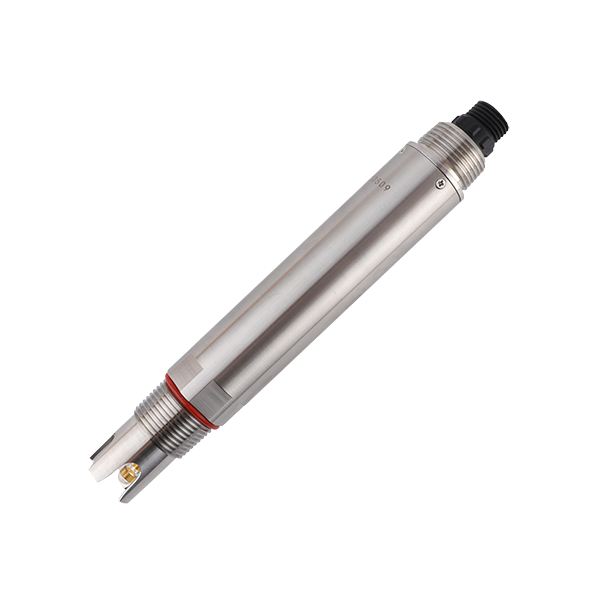
A plant may need a process trend, a dosing feedback signal or a result reported against a prescribed analytical method. These are different duties. Write the required quantity and unit beside each monitoring point: HClO, free chlorine or total chlorine. Chlorine dioxide is another measurement; its use as a disinfectant does not make an HClO probe suitable for measuring it.
The CL-4 assembly pictured above and the basic CL probe below belong to different configurations. The basic probe's HClO response must not simply be labelled total chlorine in SCADA. For a comparison with a free chlorine test, establish the sample pH, temperature and reporting basis first. The article on HClO and free chlorine test differences addresses that comparison separately.
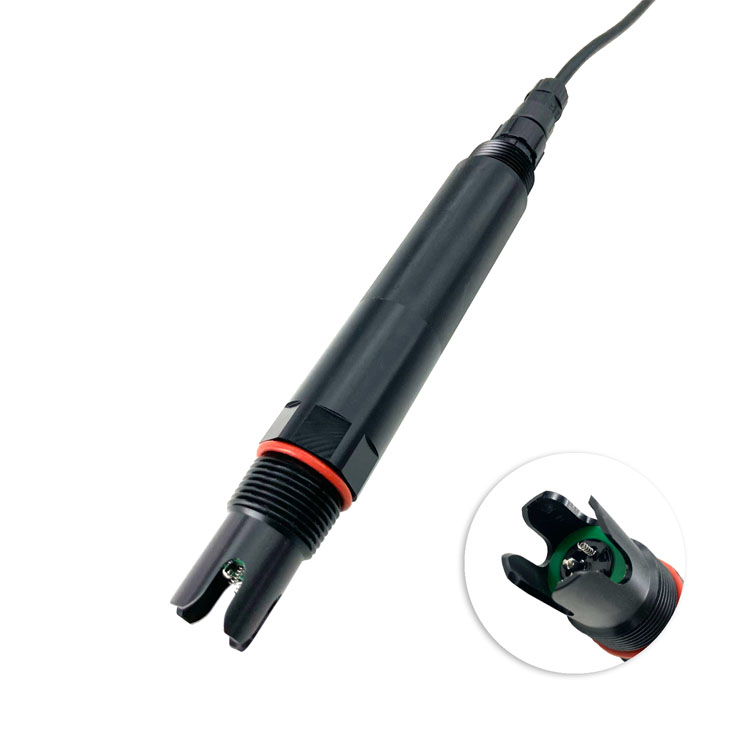
Take the sample from a location that represents treated water after the intended mixing and contact stage. A connection immediately beside a chemical injection point can expose the sensor to a local concentration spike rather than the concentration delivered downstream. Establish the sampling location with the process designer before ordering a mounting kit.
For the basic CL probe, provide the matching flow cell, pressure reduction where necessary, a means of checking flow, isolation for servicing and a suitable discharge route. Maintain 30-60 L/h through the cell and pressure below 0.1 MPa. Check these conditions during pump changes and low-demand operation, not only with the main running at its usual pressure.
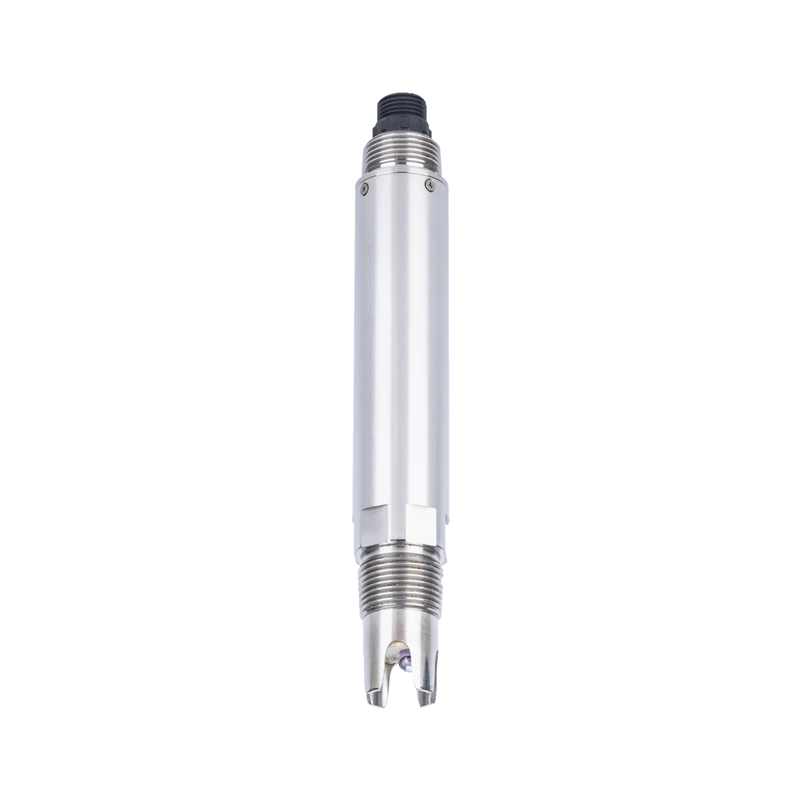
A pH probe is a separate measurement channel, not a function created by the chlorine sensor's Pt1000. Position the pH sample so that it represents the same water condition as the chlorine measurement. The pH assembly shown below requires its own model-specific temperature, pressure and mounting checks.
| Selection item | Basic NBL-WQ-CL | Design consequence |
|---|---|---|
| Measurement / range | Constant-voltage method; 0-2.000 mg/L HClO | Do not use this range for a higher-concentration or total chlorine duty. |
| Resolution / accuracy | 0.001 mg/L; +/-5% or +/-0.05 mg/L; temperature +/-0.5 degrees C | Agree the percentage basis and acceptance interpretation; resolution is not accuracy. |
| Sample conditions | 30-60 L/h; below 0.1 MPa; 5-50 degrees C; pH 4-9 | Check flow, pressure, temperature and pH across operating modes. |
| Response | Below 30 s; sample transport delay is additional | Do not use the sensor figure as the complete control-loop delay. |
| Supply / consumption | 12-24 V DC +/-10%; 0.2 W at 12 V | Size the station supply for every connected device. |
| Output / compensation | RS485 Modbus RTU; Pt1000 temperature compensation | pH measurement and any calculation remain separate requirements. |
| Wetted materials / protection | POM and PTFE; IP68 | Check chemical compatibility; IP68 does not override the pressure limit. |
| Cell / cable | Matching flow cell; standard 5 m cable, other lengths customizable | Confirm fittings and cable jacket for the installation rather than assuming a material. |
The CL-4A and CL-4S models list 0-2.000 or 0-20.00 mg/L HClO ranges, T90 below 90 s, operation at up to 0.2 MPa and optional 4-20 mA. Those values are not upgrades automatically included with the basic CL. Select the exact assembly, output and cell together.
Estimate transport delay from the wetted volume between the take-off and sensing region divided by actual flow. For illustration, a 0.5 L sample volume at 30 L/h takes approximately 60 seconds to exchange one volume. Cell mixing, electrode response and the main process contact time add further delay. This calculation describes an example sampling circuit, not an installed project result.
A longer tube can therefore make a fast probe behave like a slow feedback channel. Shorten unnecessary tubing, avoid stagnant branches and verify the step response with a safe commissioning procedure. Do not increase flow beyond the cell's specified range merely to obtain a faster display change.
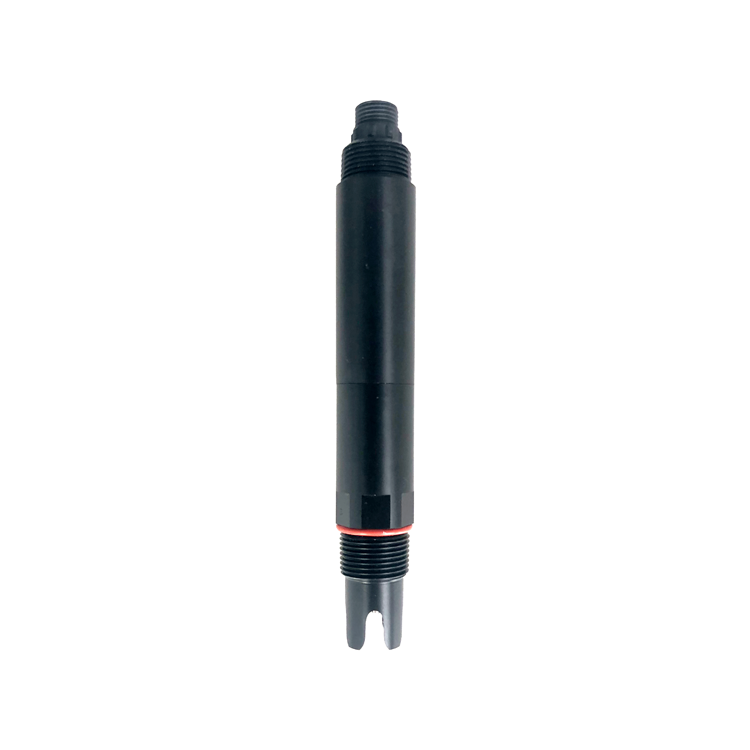
Changing pH can also change HClO response without an equivalent change in the free chlorine test result. Log a representative pH value with the chlorine trend before changing calibration or controller gain. A separate basic pH probe is shown below; its signal should retain its own unit, diagnostics and calibration record.
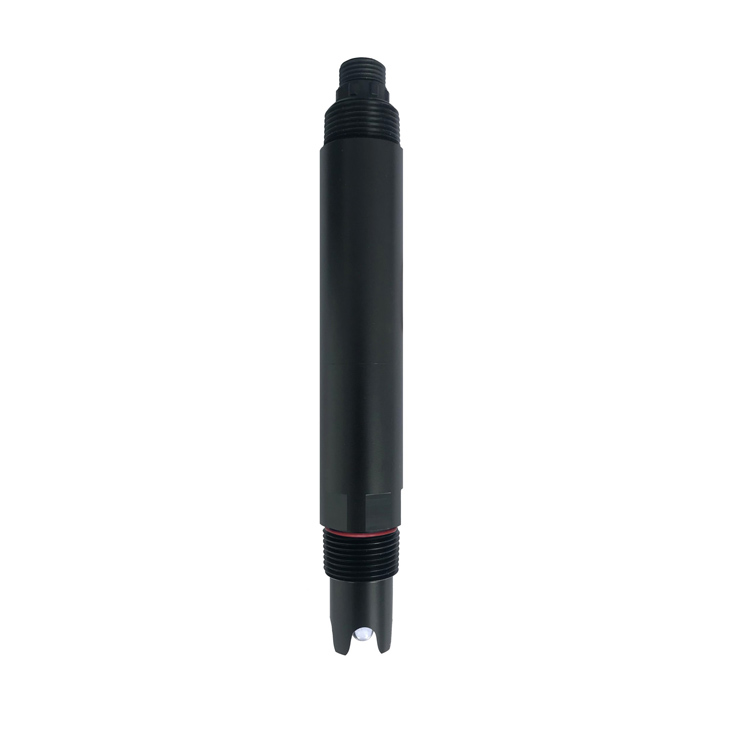
The sensor sends measurements to a PLC, RTU or data logger over RS485 Modbus RTU. Verify address, baud rate, parity, register offsets, data format, scaling and units against the protocol supplied with the ordered sensor. A gateway may then provide Ethernet or cellular transmission; RS485 itself is not a cloud connection.
Test three failure conditions before enabling automatic dosing: loss of sample flow, loss of communication and a value that remains unchanged after the source has failed. A retained numerical value can look plausible. The control program should use a timeout and measurement-validity state, with a site-approved response rather than increasing chemical output on stale data.
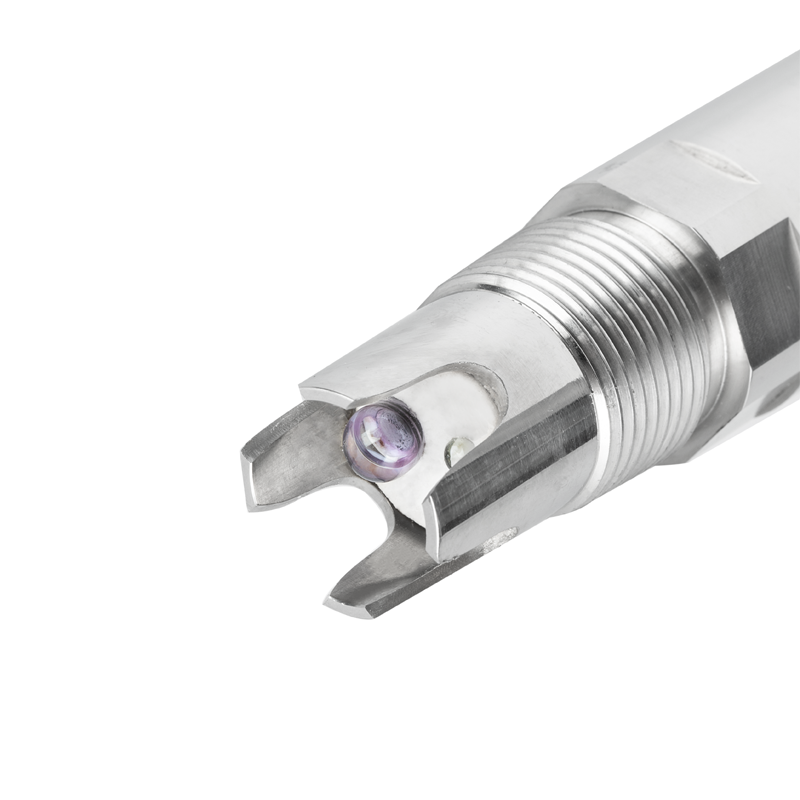
A pH electrode's sensing end is shown below. Its presence in the station does not establish that pH correction is enabled or analytically appropriate. Document whether pH is used for alarms, interpretation or a validated conversion, and retain the measured HClO value separately from a calculated result.
The ammonia nitrogen probe below measures a different parameter. An ammonia channel may help explain changes in chlorine demand, but it does not convert the chlorine channel into a total chlorine analyzer or establish the required contact time.
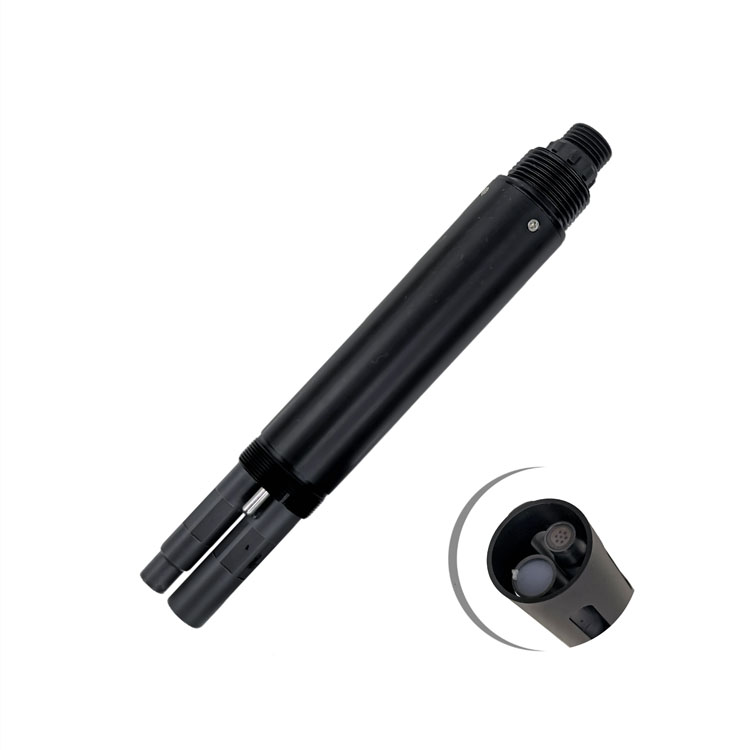
Activate a new basic CL electrode, or one returned after long storage, in tap water for 24 hours. Check the cell flow and sample condition before calibration. Establish zero with chlorine-free water and slope with an appropriate 1-2 mg/L HClO reference whose concentration and reporting basis have been determined by a suitable analytical method. Do not force agreement between different chlorine quantities.
For an enquiry, send the disinfectant, required measurement, normal and abnormal concentrations, pH, temperature, take-off pressure, sample route and receiving interface. Ask for a quote that distinguishes probe, cell, pressure/flow hardware, pH channel and gateway. Prices and delivery depend on that scope; no fixed package price follows from the sensor name alone.
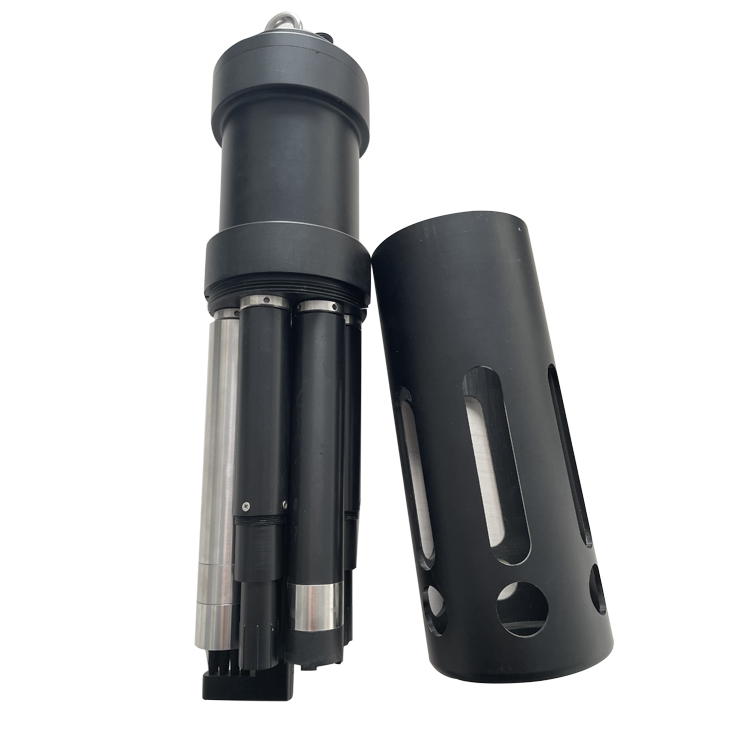
A multiparameter assembly, illustrated below, is an alternative station arrangement. Check its actual channel list rather than assuming that every water quality sensor can be fitted or that one housing provides all disinfection measurements.
No. Its stated range is in HClO. A total chlorine requirement needs an appropriate method and instrument; changing the display label does not change the measurement.
The basic CL has Pt1000 temperature compensation. That is not automatic pH compensation. Specify a separate pH channel and validate any conversion used by the receiving system.
The basic model calls for its matching flow cell at 30-60 L/h and below 0.1 MPa. Design a suitable sample circuit instead of treating IP68 as permission for direct main-line insertion.
No. Verify sample flow, measurement recovery, reference agreement and failure handling first. A valid packet can contain a value that is not yet suitable for control.
No universal replacement instruction applies across chlorine technologies. Use the service procedure for the exact assembly; do not import a membrane or electrolyte schedule from another sensor design.
Use an agreed chlorine quantity, reference method, sample condition, uncertainty allowance and response test. Include sample failure and communication failure tests as well as steady readings.
A usable residual chlorine system combines a suitable measurement with a controlled sample and explicit dosing permissions. For the basic NiuBoL CL, design around HClO, the 0-2.000 mg/L range and its flow-cell limits. Resolve any free or total chlorine reporting requirement before procurement, not after the PLC program is commissioned.
 NBL-WQ-CL Water Quality Sensor Online Residual Chlorine Sensor.pdf
NBL-WQ-CL-4A Industrial-grade Online Residual Chlorine Sensor.pdf
NBL-WQ-CL-4S Series Online Water quality Residual Chlorine Sensor.pdf
Prev:Online pH Meter Acceptance: Resolution, Accuracy and Application Claims
Next:TSS and Sludge Concentration Meter Selection: Range and Mounting
Related recommendations
Sensors & Weather Stations Catalog
Agriculture Sensors and Weather Stations Catalog-NiuBoL.pdf
Weather Stations Catalog-NiuBoL.pdf
Agriculture Sensors Catalog-NiuBoL.pdf
Water Quality Sensor Catalog-NiuBoL.pdf
Related products
 Combined air temperature and relative humidity sensor
 TDR Soil Moisture & Temperature Sensor for irrigation| RS485 |4-20mA| NBL-S-THR
 Soil pH sensor RS485 soil Testing instrument soil ph meter for agriculture |NBL-S-PH
 Wind Speed sensor Output Modbus/RS485/Analog/0-5V/4-20mA
 Tipping bucket rain gauge for weather monitoring auto rainfall sensor RS485/Outdoor/stainless steel
 Pyranometer Solar Radiation Sensor 4-20mA/RS485

Screenshot, WhatsApp to identify the QR code
WhatsApp number:+8615367865107
(Click on WhatsApp to copy and add friends)

