





— Blogs —
—Products—
 Consumer hotline +8618073152920
WhatsApp:+8615367865107
Address:Room 102, District D, Houhu Industrial Park, Yuelu District, Changsha City, Hunan Province, China
Product knowledge
Time:2026-08-18 09:00:00 Popularity:247
Quick Answer: Before you buy a weather station, decide which environment the readings must represent. Open-field weather, conditions above a greenhouse and wind at an exposed work area are different measurements. Choose the sensor locations first, then select an integrated head or separate instruments that can occupy those locations. A taller mast does not correct every exposure problem.
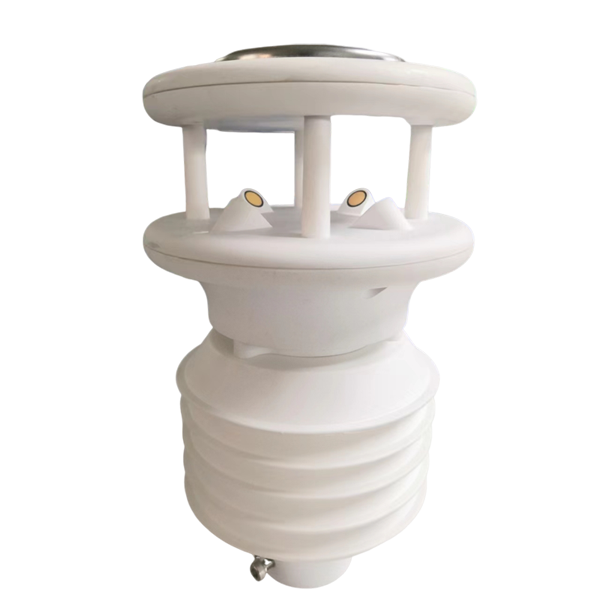
Weather station accuracy starts with siting. Buildings, trees, exhaust outlets and nearby surfaces can distort wind, temperature and rainfall observations even when the instrument itself is functioning correctly. A convenient roof bracket may give dependable communications but an unsuitable sample of the surrounding weather. Moving the same sensor to an open location can change its readings without any calibration change.
For a project buyer, the first drawing should therefore show where each measurement will be made, not just where the enclosure will stand. Mark the ground surface, surrounding obstacles, access route and available cable path. Identify whether the station is intended to describe a wider area or a specific local exposure. Both purposes are legitimate, but they need different installation decisions and should not be compared as equivalent records.
Wind generally needs open exposure above surrounding obstructions. Air temperature and humidity need ventilation and shielding from radiative heating, without contamination by exhausts or warm building surfaces. Rainfall needs an unobstructed collecting area, a level instrument and access for inspection. Raising all these instruments together solves a mounting problem, not necessarily a measurement problem.
| Measurement | Location decision | Purchase consequence |
|---|---|---|
| Wind speed and direction | Open exposure, stated height above ground and clear directional reference | A separate wind sensor may be needed above the temperature measuring point |
| Air temperature and humidity | Representative surface, ventilated radiation shield, separation from heat sources | Allow an independent lower bracket when near-surface conditions matter |
| Rainfall | Clear catch area, level mounting, no roof runoff or irrigation spray | Consider a separately located rain gauge with safe cleaning access |
| Solar irradiance | Unshaded view appropriate to the required horizontal or tilted plane | Specify instrument plane and bracket adjustment rather than a generic mast position |
A 10 m wind observation is a common meteorological reference; it is not a requirement to mount every sensor at 10 m. The NWS siting guide illustrates why wind and near-surface temperature often need different positions. For a formal observation network, use the network's applicable siting specification. For a local operational measurement, document the selected height and explain what it represents.

An integrated weather sensor reduces the number of mounting points and cable connections. It suits a location where the required variables can reasonably share one exposure, such as a compact environmental node. It also reduces the work involved in connecting several digital instruments. Its limitation is physical: all its elements occupy approximately the same location, even when their preferred exposures differ.
Separate instruments allow wind above the local obstructions, temperature closer to the target surface and rainfall at an accessible ground installation. They require more brackets, cable routing and logger inputs. That added installation work is justified when it removes a known exposure conflict. It is not justified merely to increase the number of separate devices in a quotation.
The NiuBoL cup wind speed sensor is one possible component of a split arrangement; its IP65 protection does not make it an immersion device. Pair speed with a compatible direction sensor when directional exposure matters. A cup sensor alone cannot report wind direction, and neither sensor determines the structural suitability of its supporting mast.
A sensor above a paved roof may be appropriate for roof-level equipment monitoring, but its temperature record should not be labelled as an undisturbed ground-level air observation. Similarly, a greenhouse interior sensor measures the managed growing environment, not the outdoor reference weather. Keep these channels separately identified in the data logger, even if both upload to the same dashboard.
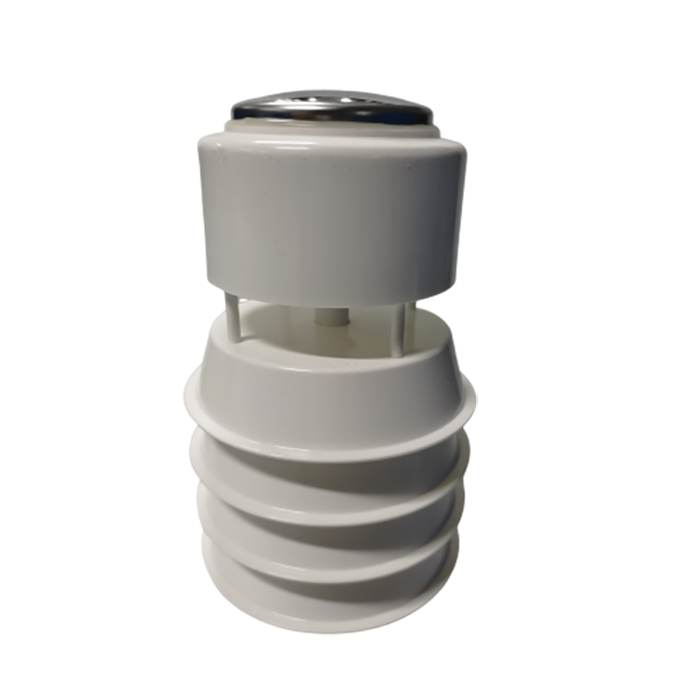
The pictured temperature, humidity, pressure, illumination and CO2 sensor illustrates another configuration choice. Its five parameters do not include wind or rainfall. Compare the actual variable list rather than assuming that every product described as five-in-one measures the same weather elements.
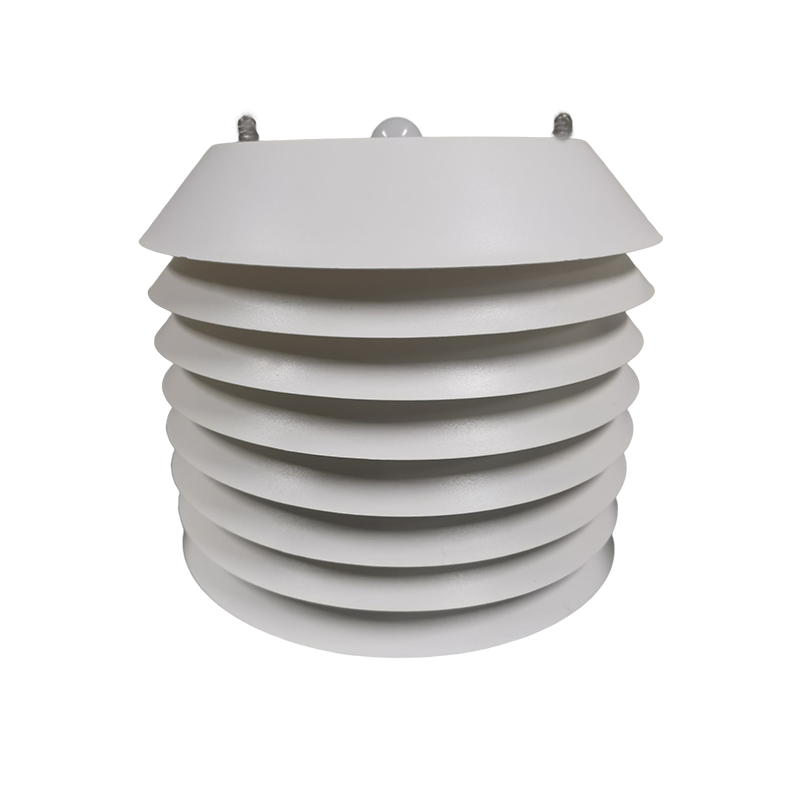
The NBL-W-51MUWS combines wind speed, wind direction, temperature, humidity and pressure. These selected specifications describe the sensor head, not a complete station with mast, power system, logger and communications. They help an integrator assess the electrical connection and operating environment after the site arrangement has been chosen.
| NBL-W-51MUWS item | Specification | Installation implication |
|---|---|---|
| Wind speed range | 0-40 m/s | Check the required observation range; this is not a mast survival rating |
| Wind direction | 0-360 degrees; stated accuracy +/-3 degrees | Survey the directional reference and secure the orientation |
| Supply and stated average power | 12 V DC; 0.3 W | Budget the logger, modem and conversion losses separately |
| Digital interface | RS485, Modbus; stated baud rate 9600 | Match the delivered register map and serial settings to the host |
| Operating environment | -40 to 80 degrees C; 0-95% RH | Do not substitute a measurement range for the operating limit |
| Housing and protection | ABS; IP65 | Provide outdoor cable management and protected terminations |
| Standard cable length | 2.5 m | A taller installation needs a planned extension and connection arrangement |
Detailed channel specifications are available on the NBL-W-51MUWS product page. Specify an observation interval and the required wind statistic as well as the sensor range. An instantaneous speed sample, an averaged speed and a gust statistic are different outputs; a cloud refresh interval alone does not define any of them.
On a farm, inspect seasonal crop height and nearby irrigation before fixing the station location. A sensor initially above bare ground may later sit within a crop canopy. A rain gauge beside a sprinkler can collect irrigation water and rain together. Separate the outdoor weather reference from deliberate canopy or irrigation measurements, and keep access possible during the growing season.
At a photovoltaic site, decide whether irradiance is required on a horizontal plane or in the plane of the modules. Record the selected tilt and azimuth. Avoid shade from the mast, panels and adjacent structures over the relevant solar path. An integrated wind and air sensor can complement the radiation instrument, but it does not replace module-temperature or plane-of-array measurements when those are required.
A wind sensor near a crane, roof edge or ventilation outlet sees a highly local flow. That may be useful for a defined operational task, but should not be presented as regional weather. Where an alarm affects machinery or personnel, use the equipment manufacturer's required measuring position and a separately engineered alarm function. A standard weather logger is not automatically a safety controller.
A weather station quotation changes substantially with the mast arrangement, foundations, cable distance and access method. Compare sensor-only and installed-system prices separately. Ask whether brackets, protected power conversion, enclosure, data logger and communications hardware are included. Civil works and structural calculations should be assigned explicitly; a sensor manufacturer's measuring range says nothing about foundation capacity.
Route RS485 and power cables with strain relief and drip loops. Define bonding, grounding and surge protection with the site electrical design, particularly where cables enter a building from an exposed mast. Keep connectors accessible for inspection without leaving them in standing water. Check voltage at the sensor under normal system load, not only at the cabinet power supply.
At commissioning, compare the sensor value with the PLC, RTU or data logger value, including units, direction convention and timestamps. Record actual sensor heights, orientation and nearby obstacles. These observations explain later differences much more effectively than a photograph of the enclosure alone. Repeat the exposure review if a building, tree line or panel layout changes.
No. Select height from the measurement purpose and the applicable observation specification. Wind may require a higher exposure than temperature or rainfall. A compact local monitoring node can use a different arrangement, provided its records identify the actual height and local surroundings rather than implying a standard reference exposure.
Yes, for a clearly defined roof-level observation. Check turbulence, heat sources, reflected radiation and safe access. Do not assume a roof sensor represents an open ground site, or apply a universal correction to remove all building effects.
No. An integrated head simplifies mounting and wiring, while separate instruments allow different measuring heights and locations. Choose integration when a shared exposure fits the task; choose separation when the location requirements conflict.
Not necessarily. NBL-W-51MUWS measures wind speed, wind direction, temperature, humidity and pressure. Other five-parameter products have different combinations. Read the channel list, and select a rain-equipped model or separate rain gauge if precipitation is required.
Send a site sketch, required variables, intended sensor heights, obstacle photographs, cable route and receiving-system details. State whether the price should include the mast, foundation design, power system and commissioning. This allows NiuBoL to quote an appropriate configuration without assuming that one pole location serves every channel.
Buy a weather station after resolving its exposure, not before. Integrated sensors simplify installation where one location suits the required observations; separate instruments are more appropriate when wind, temperature, rainfall or radiation need different positions. NiuBoL can match the sensor and data acquisition arrangement to a site drawing, while the project team verifies the mast, electrical protection and actual measuring environment.
Prev:Industrial Wastewater COD Sensor: Validate Batch and Cleaning Events
Next:Multiparameter Sonde for Variable Water Levels: Keep Channels Submerged
Related recommendations
Sensors & Weather Stations Catalog
 Agriculture Sensors and Weather Stations Catalog-NiuBoL.pdf
Weather Stations Catalog-NiuBoL.pdf
Agriculture Sensors Catalog-NiuBoL.pdf
Water Quality Sensor Catalog-NiuBoL.pdf
Related products
 Combined air temperature and relative humidity sensor
 TDR Soil Moisture & Temperature Sensor for irrigation| RS485 |4-20mA| NBL-S-THR
 Soil pH sensor RS485 soil Testing instrument soil ph meter for agriculture |NBL-S-PH Wind Speed sensor Output Modbus/RS485/Analog/0-5V/4-20mA
 Tipping bucket rain gauge for weather monitoring auto rainfall sensor RS485/Outdoor/stainless steel
 Pyranometer Solar Radiation Sensor 4-20mA/RS485


Screenshot, WhatsApp to identify the QR code
WhatsApp number:+8615367865107
(Click on WhatsApp to copy and add friends)

