





— Blogs —
—Products—
 Consumer hotline +8618073152920
WhatsApp:+8615367865107
Address:Room 102, District D, Houhu Industrial Park, Yuelu District, Changsha City, Hunan Province, China
Product knowledge
Time:2026-08-18 09:01:00 Popularity:238
A multiparameter sonde can lose a complete monitoring point when falling water exposes its sensing elements. In a river, reservoir margin or intermittently filled channel, minimum water level can be more important than the number of available parameters. Choose a mounting arrangement that keeps the selected channels immersed without burying them in sediment or placing them outside the water body the project intends to monitor.

Survey the expected low-water surface, bed elevation and sediment accumulation at the proposed location. Identify where every sensing face sits within the assembly, not just the bottom of the outer guard. A partly submerged housing does not demonstrate that its pH, oxygen, conductivity and turbidity channels are all operating in water.
The NiuBoL NBL-WQ-MPS-5B is a submerged, configurable assembly with a cleaning brush and up to six parameters including temperature. Optional channels include dissolved oxygen, pH, ORP, conductivity/salinity and turbidity. The ordered module combination determines the actual output; a product-family list does not mean every indicator is installed.
Co-located channels are useful when the project needs water-quality context from one point. They are less suitable when oxygen must be measured in an occupied pond layer while another parameter is required at a separate inlet. A sonde at one depth cannot establish a vertical profile or represent several hydraulically separated zones.
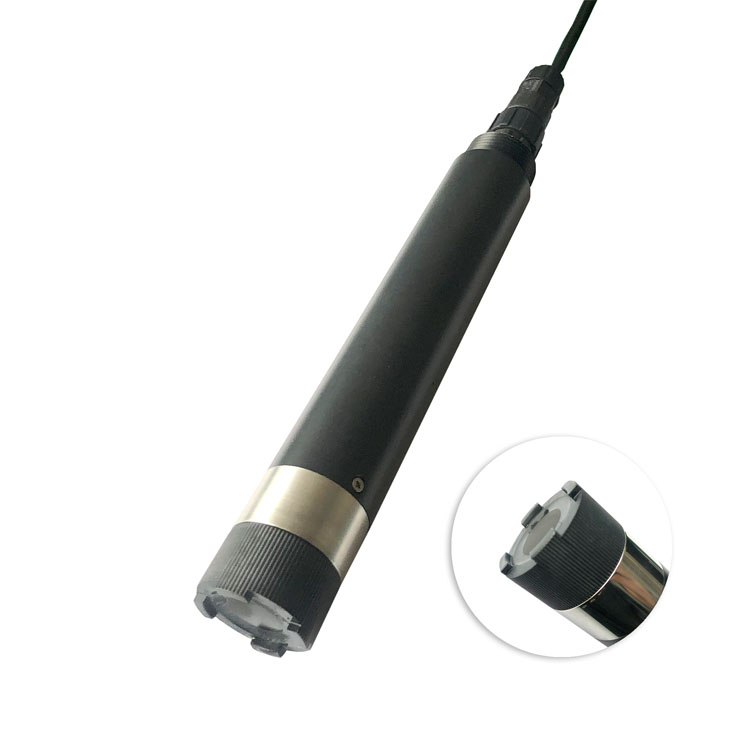
Additional chemistry may require independent instruments. For example, the ammonia-nitrogen probe below is a separate device, not evidence that ammonia measurement is included in MPS-5B. Locate it according to its own immersion, interference and service requirements rather than assuming a shared bracket solves those questions.
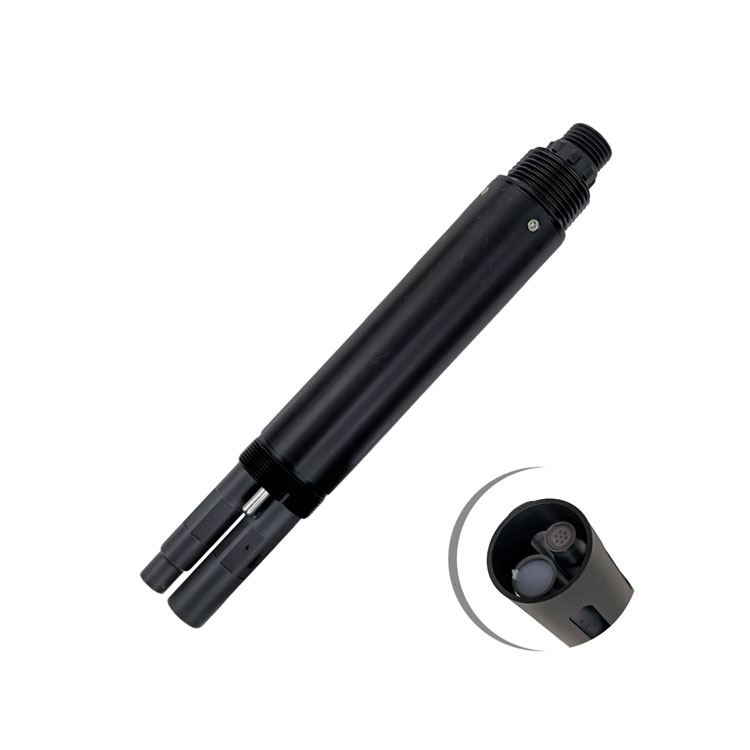
| Item | MPS-5B specification | Installation implication |
|---|---|---|
| Working conditions | 0-50 degrees C; pressure at or below 0.2 MPa; IP68 | Check the complete water-level and temperature range. IP68 is not permission to exceed the pressure limit. |
| Supply and load | 12 V DC; 2 W at 12 V | Do not assume a general 24 V sensor supply is suitable. Size the station supply for the assembled system. |
| Digital output | RS485 Modbus RTU | Map the ordered channels and their units in the PLC, RTU or data logger. |
| Housing and cable | POM + 316L; standard 5 m shielded cable | Review water chemistry, retrieval travel and route length. The cable shield does not replace waterproof joints. |
| pH and temperature options | pH 0-14.00, accuracy +/-0.1; temperature 0-50.0 degrees C, accuracy +/-0.3 degrees C | Select each required channel explicitly. Verify calibration and stabilization separately after re-immersion. |
| Mounting and cleaning | Submerged mounting using lifting ring or top-cover M8 fixing; built-in timed cleaning brush | Support the body mechanically and leave access for brush inspection. Do not suspend it by its cable. |
Do not choose a retrieval cable route from normal water level alone. Allow for the travel needed to raise the full assembly onto a safe service surface. Check that the support does not trap the head against the bed when water falls or strike structures when flow increases.
A fixed mount suits an observation tied to a surveyed elevation, provided all sensing elements remain submerged at low water and clear of deposited solids. Record depth below the surface as well as the fixed elevation if seasonal comparisons depend on depth.
A floating support can maintain an approximately constant immersion below the moving surface. However, the sample then changes elevation as water rises and falls. Evaluate mooring movement, access, debris and cable travel. This is a support-system design choice, not a supplied feature of the sonde.
Separate probes may be preferable where channels need different depths or independent retrieval. The standalone oxygen probe below illustrates this alternative. Compare the additional cables and brackets with the loss of all co-located channels whenever a complete sonde is lifted for service.
If the project needs automatic dry-exposure detection, specify a suitable level signal or another demonstrated method in the station design. Do not infer an internal dry-detection feature from Modbus connectivity. A plausible pH or temperature value does not prove that an exposed sensing head is immersed.
Record removal, exposure, cleaning and re-immersion periods separately from valid water measurements. After return to water, let each channel stabilize and perform the appropriate checks before restoring automatic use. Do not convert a period without representative water into zero concentration or interpolate it into an apparently complete environmental record.
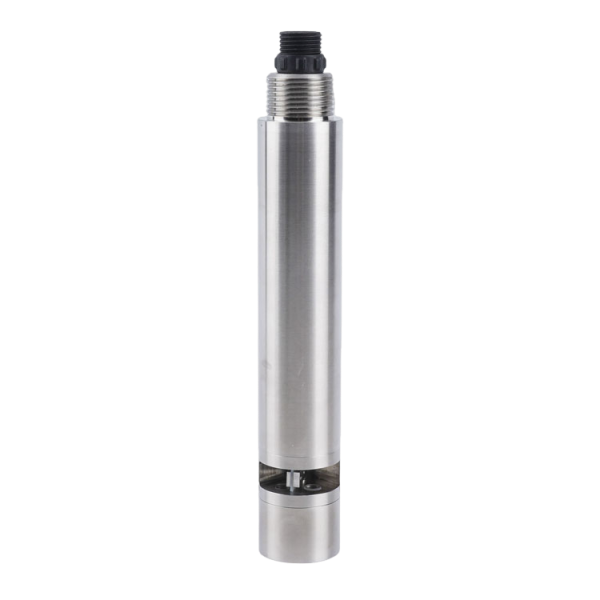
A separate COD probe also needs a representative optical path. Moving it into a sheltered pocket to avoid low water may leave it sampling stagnant water rather than the passing river. That location change can undermine the result even if the instrument continues communicating.
At the lowest expected level, inspect immersion, sediment clearance and any air trapped around the guard. At higher flow, examine support movement, debris loading and cable strain. Do not create hazardous flow conditions for testing; use accessible observations and the installation engineer's assessment where direct testing is unsafe.
Compare channel responses after retrieval and replacement at the recorded depth. A sudden step in conductivity can reflect a new water layer, while a turbidity spike can reflect disturbed sediment. Keep the location and service record before deciding that calibration has changed. A brush reduces some surface fouling but does not remove buried sediment or make an exposed probe valid.
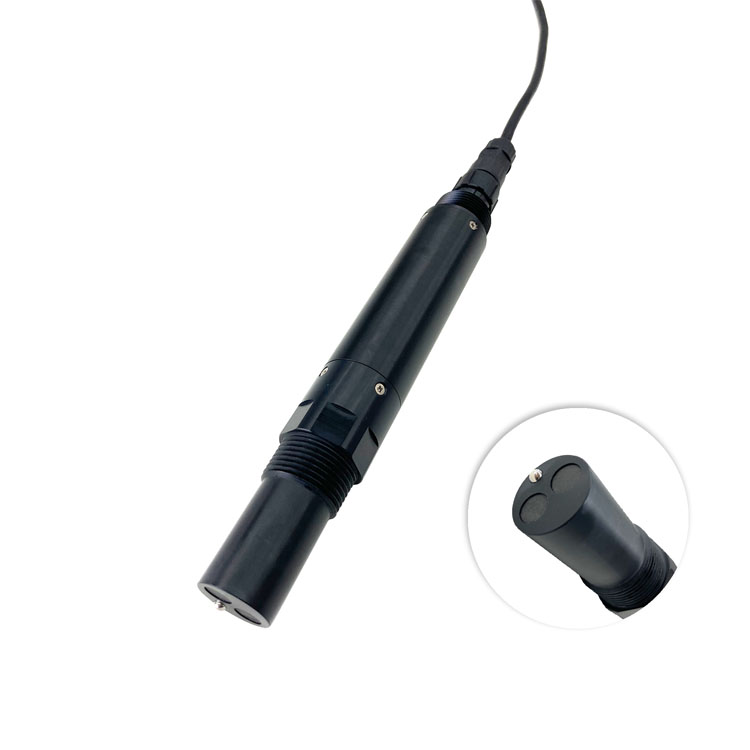
Do not assume so. Verify the positions and immersion requirements of every installed sensing element. Select the mounting depth from the highest element that requires water contact, with clearance for expected level movement and sediment.
No. It follows surface level rather than a fixed elevation and introduces mooring and movement constraints. Use it when the required observation is tied to depth below the surface and the support can be safely maintained.
Do not infer bypass suitability from its pressure limit alone. It is specified for submerged installation. Obtain approval for the proposed chamber, seals, flow path, pressure and service arrangement before ordering a different installation.
Provide the water-level range, bed and access photographs, expected sediment or debris, selected channels, cable route and receiving controller. State whether observations must represent a fixed elevation or a constant depth below the surface.
No. Recheck each affected channel by its own procedure after inspection and stabilization. A valid conductivity result does not validate a pH electrode, optical window or oxygen cap.
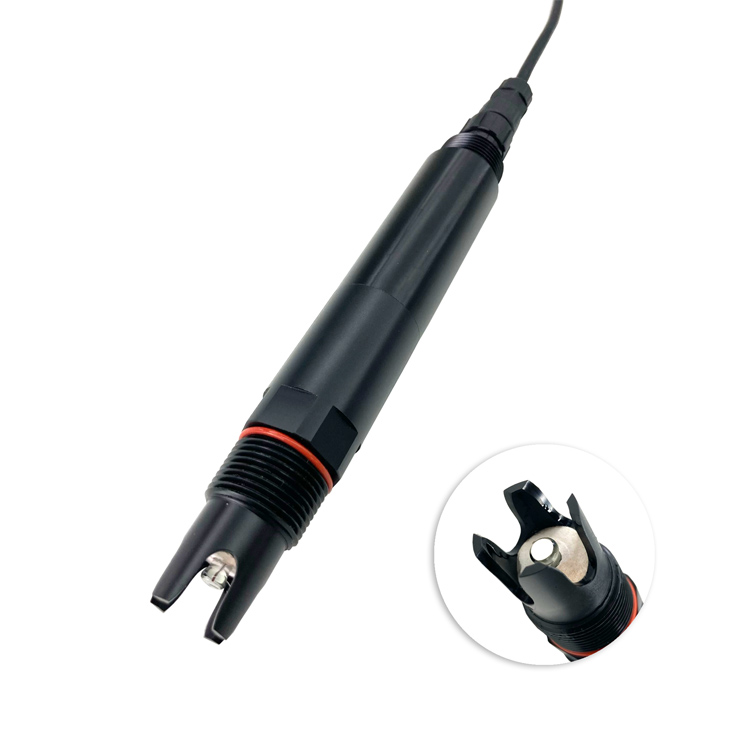
Choose a multiparameter sonde only where one maintainable immersion point suits the required observations. For variable water levels, compare fixed and floating supports against the actual sample definition. NiuBoL can review the MPS-5B channel combination and installation limits from the site's low-water, sediment and access conditions.
Prev:Buy a Weather Station: Choose Sensor Locations Before Mast Height
Next:Analog Anemometer: Scale and Test a PLC Wind-Speed Input
Related recommendations
Sensors & Weather Stations Catalog
 Agriculture Sensors and Weather Stations Catalog-NiuBoL.pdf
Weather Stations Catalog-NiuBoL.pdf
Agriculture Sensors Catalog-NiuBoL.pdf
Water Quality Sensor Catalog-NiuBoL.pdf
Related products
 Combined air temperature and relative humidity sensor
 TDR Soil Moisture & Temperature Sensor for irrigation| RS485 |4-20mA| NBL-S-THR
 Soil pH sensor RS485 soil Testing instrument soil ph meter for agriculture |NBL-S-PH
 Wind Speed sensor Output Modbus/RS485/Analog/0-5V/4-20mA
 Tipping bucket rain gauge for weather monitoring auto rainfall sensor RS485/Outdoor/stainless steel
 Pyranometer Solar Radiation Sensor 4-20mA/RS485


Screenshot, WhatsApp to identify the QR code
WhatsApp number:+8615367865107
(Click on WhatsApp to copy and add friends)

