





— Blogs —
—Products—
 Consumer hotline +8618073152920
 WhatsApp:+8615367865107
Address:Room 102, District D, Houhu Industrial Park, Yuelu District, Changsha City, Hunan Province, China
Product knowledge
Time:2026-06-10 10:00:42 Popularity:1068
Quick Answer: Multi-pond dissolved oxygen monitoring must keep each probe, pond record and operating response correctly associated. More sensors do not help if one pond's value appears under another pond's name or a replacement probe inherits the wrong settings. Preserve pond identity, fresh timestamps and model-specific compensation through installation, maintenance and replacement.
On a farm with several ponds or tanks, the operator needs to know which water the displayed DO describes. An RS485 address identifies a device on a bus, not a permanent geographical location. A technician can replace or relocate that device while the platform continues using an old pond label.
Use a point record that joins the pond or tank identity, probe model and identifier, physical location, depth reference, logger channel and intended alarm recipient. Keep any actuator association separate and explicit. A label typed once at commissioning is not enough if later service changes are not recorded.
Keep the measuring point's identity through routine cleaning and cap replacement. A correct position can still produce a misleading farm record if its label or response mapping changes unnoticed.
An average can conceal a local condition. For an illustrative pair of 6 mg/L and 2 mg/L, the average is 4 mg/L, but neither pond contains that averaged water. Review pond-level values and their validity before using any summary indicator.
A low or unavailable pond channel must remain visible. Do not average a failed channel as zero, and do not silently omit it while presenting the farm summary as complete. Identify which points contributed to any calculated display.
When comparing ponds, retain temperature, salinity setting, observation depth and relevant farm events. Differences between water bodies may be real. A common gateway does not make their oxygen demand, mixing or compensation settings identical.
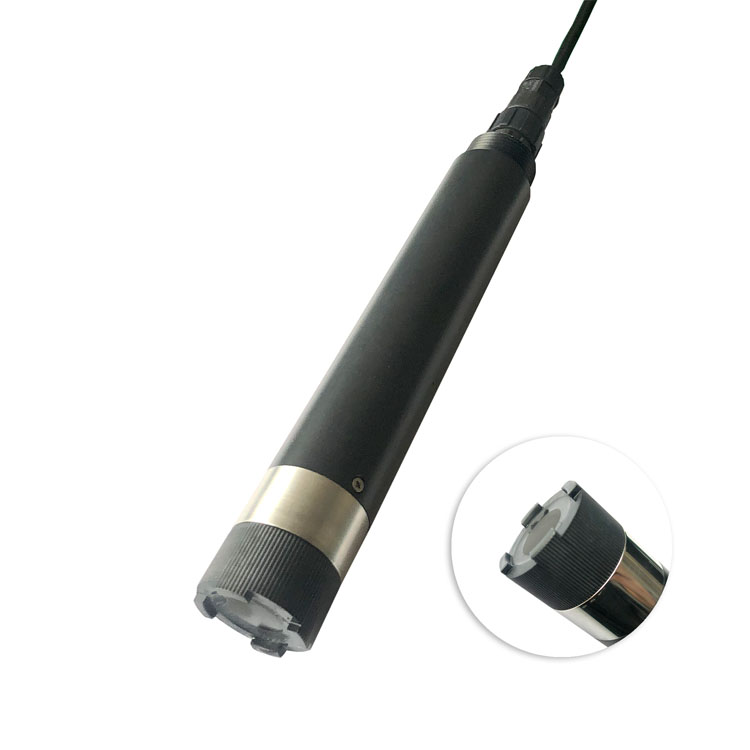
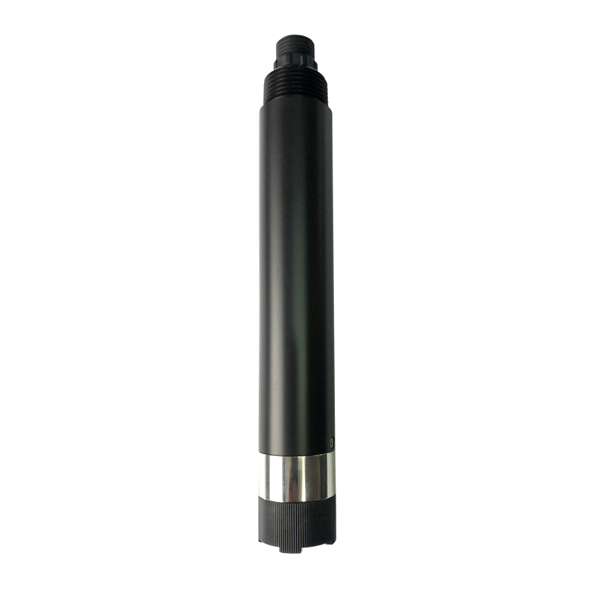
The basic NiuBoL DO probe and DO-4A are different configurations. The first two pictures illustrate these separate assemblies; use their actual identities rather than treating all optical DO probes as one specification.
| Characteristic | NBL-WQ-DO | NBL-WQ-DO-4A |
|---|---|---|
| Range | 0-20.00 mg/L | 0-20.00 mg/L |
| DO accuracy | +/-2% FS; equivalent to +/-0.4 mg/L over the span | +/-2% of reading |
| Water conditions | 0-45 degrees C; below 0.2 MPa | 0-50 degrees C; at or below 0.2 MPa |
| Supply / consumption | 12-24 V DC; below 0.3 W at 12 V | 12-24 V DC; 0.2 W at 12 V |
| Interface | RS485 Modbus RTU | RS485 Modbus RTU; optional 4-20 mA |
| Common review items | IP68; Pt1000 temperature compensation; configured salinity input; verify cable, wetted parts and mounting for the ordered version | |
A salinity setting is not an independently measured salinity result. Confirm the appropriate value for each water body and retain its change history. Do not copy freshwater settings to a brackish pond just because the probe communicates successfully.
Do not deliberately reduce pond oxygen to test a low alarm. A signal simulation can test the data and control path; a suitable reference comparison tests the water measurement. Record which part was tested so a simulated value is not presented as a physical oxygen observation.
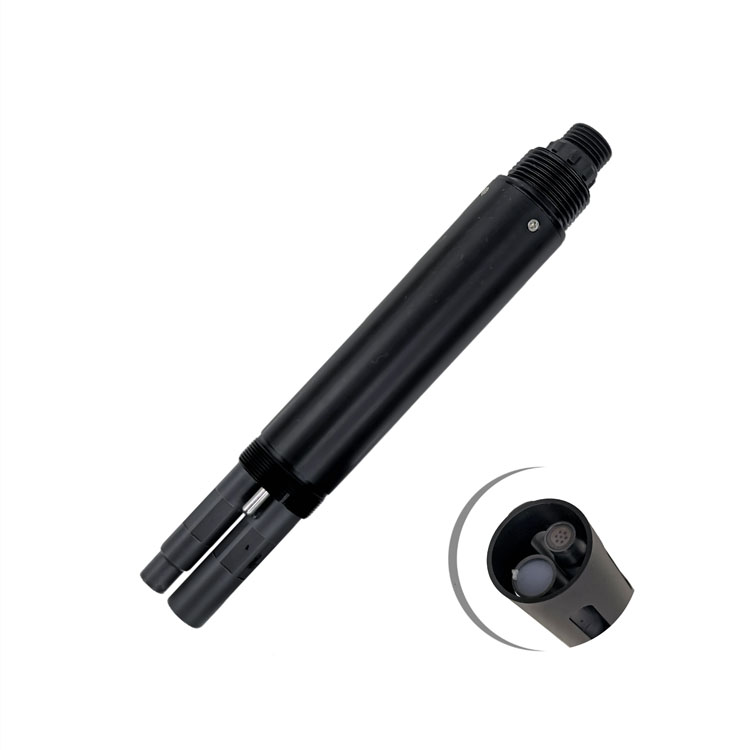
The separate probe body below illustrates the need to identify the fitted sensor, not merely recognize a connector. A stored configuration for another parameter must not be reused without checking its units and register definition.
A modem or platform outage is different from low DO. Specify which functions remain available locally, which depend on the network and how staff are informed when the record is stale. Do not assume that a visible historical curve means the current value is being acquired.
For a shared RS485 network, design the cable route, supply and addressing for the actual farm layout. Separate electrically remote groups where the interface design requires it rather than connecting unlimited branches to one gateway. Include logger and transmission demand in the power calculation.
If DO observations support aeration, retain the pond's equipment state separately from the oxygen measurement. A command to run an aerator does not establish that it ran, and a running machine does not prove oxygen has recovered at the monitoring location. The farm's operating procedure should define the appropriate confirmation and response.
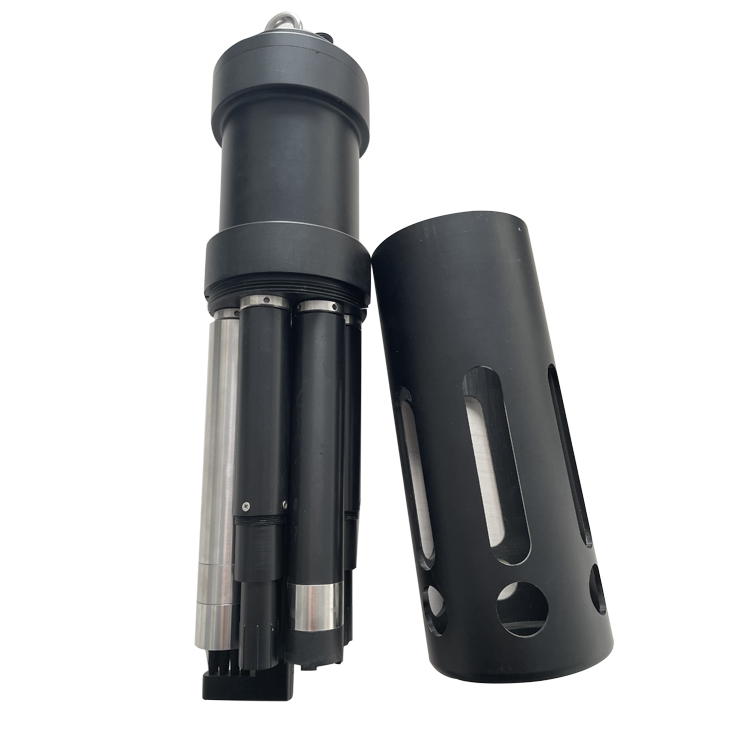
A multiparameter assembly can add context to a particular pond, as shown below. Its channels and electrical requirements must be identified independently; they do not inherit every standalone DO specification.
No. It is a communication identifier. Maintain a separate physical point record and verify the mapping after a probe is replaced or moved.
No. A summary can hide a local low value or missing channel. Preserve pond-level observations and identify incomplete summaries.
Only after checking model compatibility, register mapping, calibration and the actual water's compensation inputs. Similar appearance or successful communication is insufficient.
No. Confirm the installed local control architecture and its network-loss behavior. A gateway and a cloud display do not inherently provide an independent operating function.
Provide pond and tank identities, measuring locations, freshwater or saline conditions, cable routes, power access, required local functions and alarm recipients. State how equipment replacement and location changes will be recorded.
Multi-pond dissolved oxygen monitoring depends on keeping each observation attached to the correct pond, configuration and response. Select NiuBoL DO models by their actual specifications, verify mapping after service and retain local operating responsibilities separately from the remote dashboard.
Prev:Municipal Residual Chlorine Monitoring: Supply-Zone Comparisons
Next:Heavy Metal Water Monitoring: Direct Analysis and Supporting Sensors
Related recommendations
Sensors & Weather Stations Catalog
 Agriculture Sensors and Weather Stations Catalog-NiuBoL.pdf
Weather Stations Catalog-NiuBoL.pdf
Agriculture Sensors Catalog-NiuBoL.pdf
Water Quality Sensor Catalog-NiuBoL.pdf
Related products
 Combined air temperature and relative humidity sensor
 TDR Soil Moisture & Temperature Sensor for irrigation| RS485 |4-20mA| NBL-S-THR
 Soil pH sensor RS485 soil Testing instrument soil ph meter for agriculture |NBL-S-PH
 Wind Speed sensor Output Modbus/RS485/Analog/0-5V/4-20mA
 Tipping bucket rain gauge for weather monitoring auto rainfall sensor RS485/Outdoor/stainless steel
 Pyranometer Solar Radiation Sensor 4-20mA/RS485

Screenshot, WhatsApp to identify the QR code
WhatsApp number:+8615367865107
(Click on WhatsApp to copy and add friends)

