





— Blogs —
—Products—
 Consumer hotline +8618073152920
 WhatsApp:+8615367865107
Address:Room 102, District D, Houhu Industrial Park, Yuelu District, Changsha City, Hunan Province, China
Product knowledge
Time:2026-06-10 10:00:37 Popularity:1018
Quick Answer: Chloramine monitoring requires a measurement appropriate to the combined residual or particular chloramine species of interest. A low HClO reading can coexist with a total-chlorine residual in water containing chloramines. Do not increase chlorine feed or reject an analyzer solely because a free-chlorine-related probe does not reproduce the total-chlorine result.
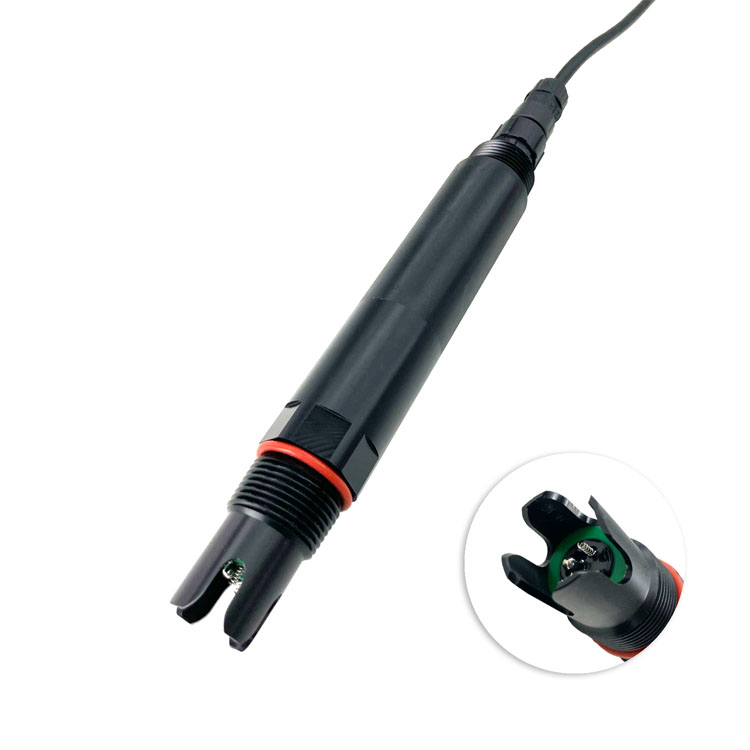
Chlorine can react with ammonia to form chloramines. This changes the distribution of residual chlorine rather than simply changing the number displayed by an unchanged measurement. An intentionally chloraminated supply and a nominal free-chlorine process affected by ammonia therefore require different interpretation.
Before procurement, state whether the system uses free-chlorine disinfection, intentional chloramination or an industrial process with variable nitrogen chemistry. Identify the desired result: free chlorine, total chlorine, a derived combined residual or a species-specific determination. The term "chlorine sensor" does not select among them.
The official Health Canada chlorine technical discussion distinguishes free and total determinations. That chemistry distinction is useful for specifying a measurement; it does not establish the local operating limit for a particular project.
| Project question | Measurement needed | Inappropriate shortcut |
|---|---|---|
| Is free residual present? | A suitable free-chlorine determination under the actual water conditions | Assuming every HClO response includes all required free forms |
| What total residual remains? | A suitable total-chlorine determination | Adding a fixed offset to the HClO channel |
| How much combined residual is indicated? | Comparable total and free results with suitable uncertainty | Subtracting values from different samples or times |
| What monochloramine concentration is present? | A method appropriate to that species | Equating all total or combined chlorine with monochloramine |
For a project using two residual channels, the separate free and total chlorine verification guide covers paired checks and data identity. The selection issue here is whether those measurements answer the chloramine-related operating question in the first place.
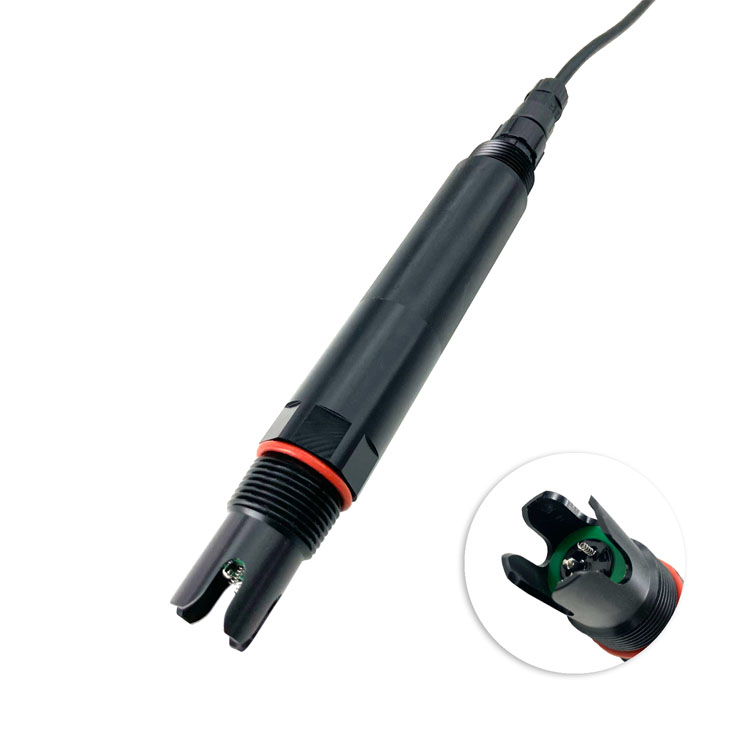
The NiuBoL NBL-WQ-CL uses a constant-voltage HClO basis. It is not a direct total-chlorine or monochloramine analyzer. If either is the specified result, do not recommend this probe alone as a complete solution.
| Basic CL boundary | Specified configuration |
|---|---|
| Range | 0-2.000 mg/L HClO; 0.001 mg/L resolution |
| Accuracy expression | +/-5% or +/-0.05 mg/L; confirm the applicable basis |
| Sample conditions | 5-50 degrees C; below 0.1 MPa; pH 4-9 |
| Installation | Matching flow cell at steady 30-60 L/h |
| Electrical | 12-24 V DC; 0.2 W at 12 V; RS485 Modbus RTU |
| Construction / cable | POM and PTFE; IP68; standard 5 m cable. Confirm jacket and fitting compatibility. |
These limits describe the basic CL probe. They are not a specification for a chloramine analyzer. pH affects chlorine chemistry, and temperature compensation does not supply every correction or missing chemical measurement.
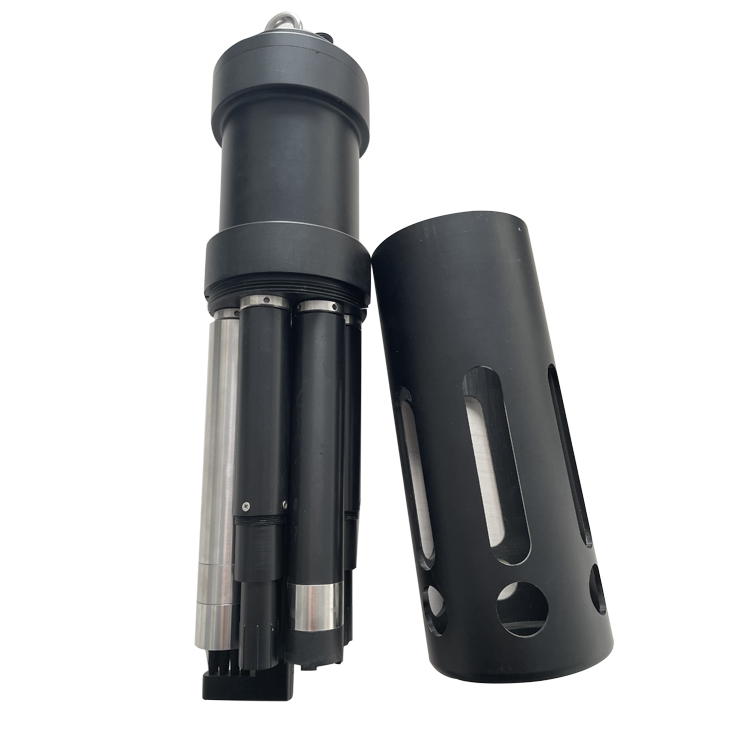
A multiparameter assembly can add related observations, as illustrated below, but the fitted channels must be confirmed. A pH or ammonia-related channel does not automatically provide monochloramine concentration or validate a missing total-chlorine determination.
First verify fresh sample flow, instrument condition and the intended chemical result. Compare appropriate free and total reference determinations from equivalent water. Review pH, source-water changes, ammonia-related observations and recent dosing events under the site's operating procedure.
If total residual remains while the free-related signal falls, investigate the change in residual distribution rather than forcing the two displays to agree. Do not infer the concentration of each chloramine species from that pattern alone. Different analytical methods can have their own interferences and timing requirements.
For intentional chloramination, chlorine-to-ammonia feed relationships and process controls require the responsible water-treatment design. An HClO probe is not a substitute for that design or for any specified nitrogen or chloramine measurement. This discussion does not provide a dose ratio or a breakpoint-chlorination procedure.
At the PLC, RTU or data logger, label each channel with its actual determination. Store the method, unit, acquisition time and validity where the project requires them. Do not copy one Modbus register into both a free and total tag or convert a missing value to zero.
Keep measured values separate from a calculated combined residual. If one input is unavailable, the derived value must not continue appearing as a current measurement. A gateway can transport the available data; it cannot derive a missing chemical fraction from an unrelated sensor.
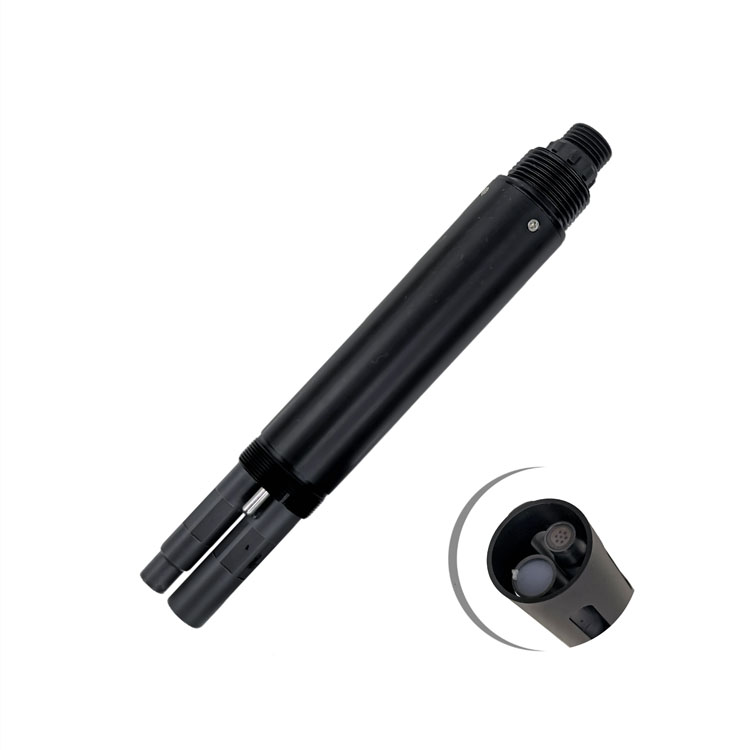
The other probe body below illustrates why model identity matters. Similar housings do not establish shared chlorine sensitivity or analytical selectivity. Request the actual method and interference information rather than approving equipment from the connector or outer shape.
Yes. Combined forms can contribute to total chlorine. Use the appropriate determination and investigate the intended process before treating the difference as an instrument fault.
It is specified on an HClO basis, not as a direct monochloramine analyzer. A monochloramine requirement needs a suitable method and configuration.
No. Total chlorine is an aggregate determination and does not identify every contributing species. Use a species-specific method when that identity drives the decision.
No. A correction cannot create the missing total or species-specific measurement. Confirm the instrument's actual correction functions and analytical basis.
Describe the disinfectant regime, ammonia context, required residual or species, reference method, range and sample conditions. NiuBoL can then distinguish a suitable HClO duty from a requirement that needs another analytical arrangement.
Chloramine monitoring begins by naming the chemical result the operator needs. Keep free, total, combined and species-specific determinations distinct, and do not present an HClO probe as a universal chlorine analyzer. Correct measurement selection avoids compensating for a missing channel with an unsafe interpretation.
Prev:Online Residual Chlorine Analyzer Selection: CL or CL-4A?
Next:Fishery Water Quality Monitoring: Reference Stations and Event Response
Related recommendations
Sensors & Weather Stations Catalog
 Agriculture Sensors and Weather Stations Catalog-NiuBoL.pdf
Weather Stations Catalog-NiuBoL.pdf
Agriculture Sensors Catalog-NiuBoL.pdf
Water Quality Sensor Catalog-NiuBoL.pdf
Related products
 Combined air temperature and relative humidity sensor
 TDR Soil Moisture & Temperature Sensor for irrigation| RS485 |4-20mA| NBL-S-THR
 Soil pH sensor RS485 soil Testing instrument soil ph meter for agriculture |NBL-S-PH
 Wind Speed sensor Output Modbus/RS485/Analog/0-5V/4-20mA
 Tipping bucket rain gauge for weather monitoring auto rainfall sensor RS485/Outdoor/stainless steel
 Pyranometer Solar Radiation Sensor 4-20mA/RS485

Screenshot, WhatsApp to identify the QR code
WhatsApp number:+8615367865107
(Click on WhatsApp to copy and add friends)

