





— Blogs —
—Products—
 Consumer hotline +8618073152920
WhatsApp:+8615367865107
Address:Room 102, District D, Houhu Industrial Park, Yuelu District, Changsha City, Hunan Province, China
Product knowledge
Time:2026-09-16 12:00:00 Popularity:236
Micro automatic water quality monitoring equipment should be evaluated as an installed station, not just a compact box containing sensors. The supplier must show how representative water reaches the probes, how an operator removes them for service, how the station remains powered, and what happens to records when communication fails. A small footprint is useful only if it preserves those functions at the intended site.

A narrow riverside platform, reservoir access point or treatment-plant walkway can justify a compact monitoring station. The enclosure dimensions alone do not define the space requirement. Include the probe lifting path, open cabinet door, technician access, sample tubing, drain outlet, solar panel and antenna. A cabinet that fits against a railing may still prevent safe removal of a long probe assembly.
Ask for a layout showing the station in its proposed position, with the minimum and maximum water levels. For an immersion installation, show where the sensor remains submerged and how it is recovered without pulling on its cable. For a pumped installation, show the intake, pump, sample chamber and discharge. These details reveal installation problems that a front-view product photograph cannot.
Define which events the station must detect before choosing channels. A river trend station might prioritize temperature, conductivity, pH, dissolved oxygen and turbidity. A wastewater investigation may need an additional ammonia channel. A compact station cannot infer ammonia concentration from pH and conductivity; the measuring principle and required electrode arrangement must be included explicitly.
| Arrangement | Where it can work | What to resolve before ordering |
|---|---|---|
| Direct immersion | Accessible water with enough depth and a representative location | Changing level, debris loading, fouling, retrieval and protection against mechanical damage |
| Pumped sample chamber | A sheltered cabinet is preferable or water cannot be reached safely for routine service | Sample transport delay, pumping power, bubbles, chamber turnover and a reliable drain |
| Process bypass | A plant provides a controlled takeoff and an acceptable return or drain point | Pressure reduction, flow interruption, backpressure and whether the branch represents the main stream |
Direct immersion avoids a sample pump and its tubing, but places sensor maintenance at the water. A pumped chamber brings service to the cabinet while creating another process to maintain. Pump selection cannot be separated from the measurement: suction leaks can introduce bubbles, long tubing delays event detection, and deposits can change the sample reaching the instrument.
For a pumped station, request a water-volume and flow calculation. As an illustrative example, a 2 L sample path flowing at 1 L/min has a nominal displacement time of 2 minutes. Actual event response can take longer because of chamber mixing and sensor response. That delay matters if the station is expected to identify a short discharge; a fast transmission interval cannot recover an event that never reaches the probe intact.
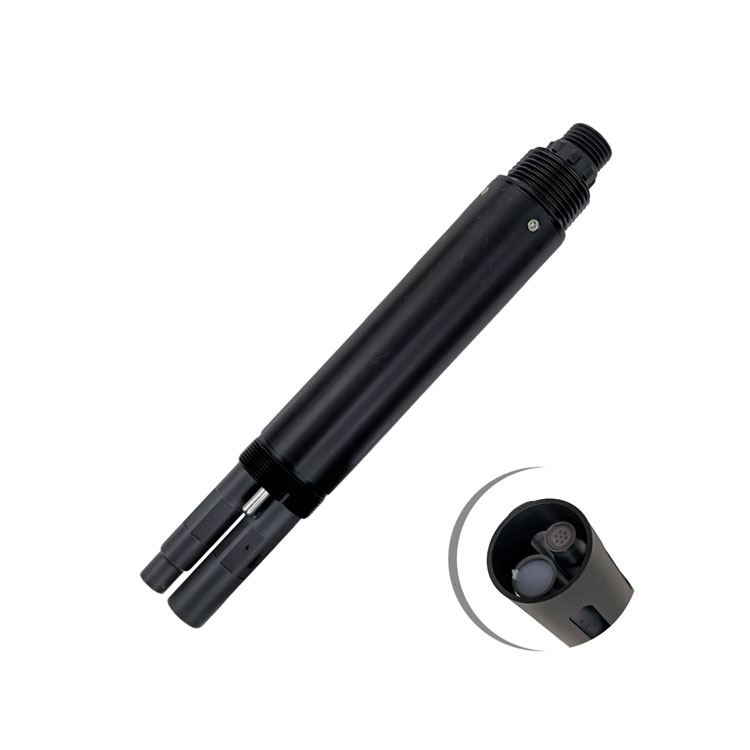
Optical COD monitoring adds a separate constraint. The sample must suit the optical method and its validated relationship to the site's laboratory results. A small cabinet does not remove matrix interference. The COD channel pictured below is an additional instrument choice, not a claim that every multi-parameter probe includes COD.
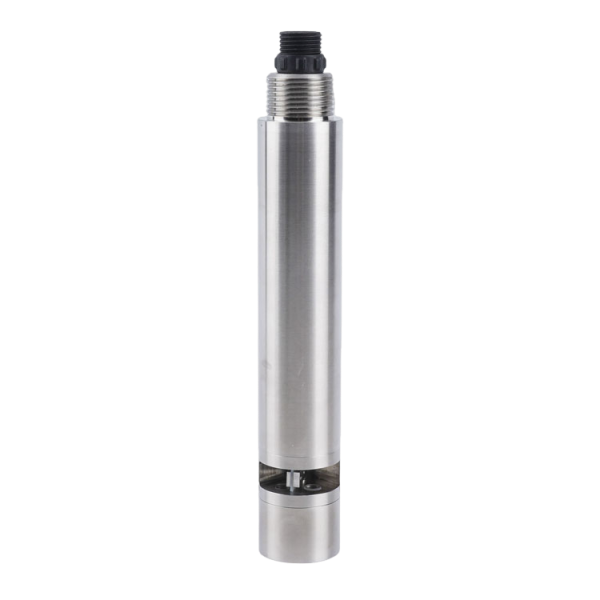
The NiuBoL NBL-WQ-MPS-5B can group selected water measurements at one location. Its value in a small station is reduced mounting complexity and a digital interface for the configured channels. It does not itself provide a station enclosure, a sample pump, solar autonomy or a cellular data service. Those items need their own specification and an identified supplier responsibility.
| NBL-WQ-MPS-5B item | Technical detail | Effect on station design |
|---|---|---|
| Parameter configuration | Up to six parameters including temperature, with selected pH, ORP, dissolved oxygen, conductivity/salinity and turbidity functions | List the actual fitted channels; do not assume COD or ammonia is included |
| pH option | 0-14 pH; accuracy +/-0.1 pH; resolution 0.01 pH | Include calibration access and electrode service space |
| ORP option | -1500 to +1500 mV; accuracy +/-6 mV | Use as a separate redox measurement, not a substitute for dissolved oxygen |
| Supply and power | 12 V DC; 2 W at 12 V | Add the logger, modem and other station loads separately |
| Water conditions | 0-50 C; pressure no greater than 0.2 MPa | Check immersion conditions or sample-chamber pressure |
| Protection and wetted construction | IP68; POM and 316L | Probe protection does not determine the cabinet or cable-joint rating |
| Communication | RS485, Modbus RTU; default 9600 baud, 8N1 | Commission the actual logger map and configured channel list |
| Cable | Standard 5 m, four-core twisted-pair shielded cable | Plan the route and termination; verify jacket suitability for the installation |
Conductivity can also be supplied as a separate probe when the point needs a different range or physical position. This can be more practical than forcing every measurement into one assembly. A station with several independent sensors is still compact if the layout remains accessible; compactness should not require measuring every parameter at an unsuitable location.
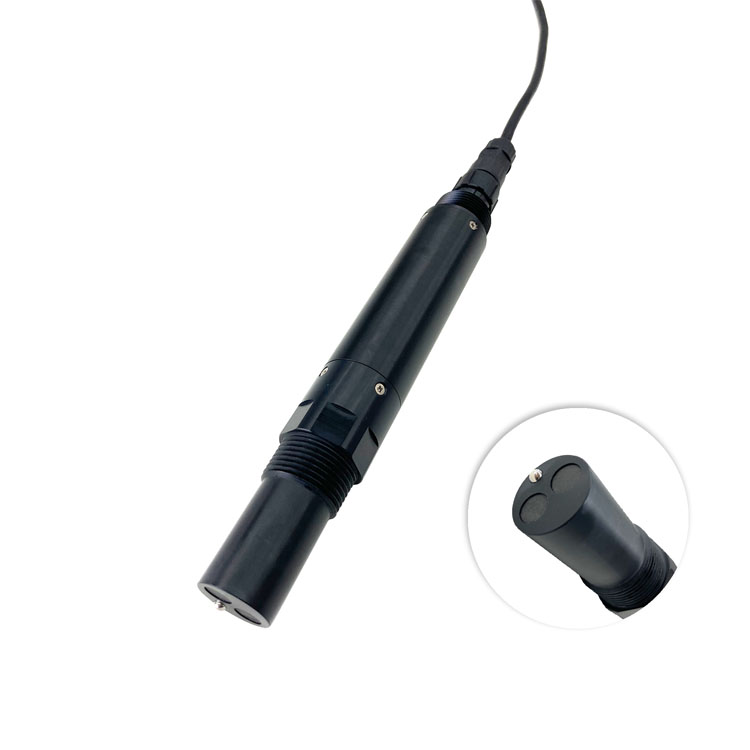
The difficulty is maintaining a representative, submerged measuring point without burying it in sediment or exposing it during low water. Compare the mounting elevation with observed levels, not just the survey-day level. A protected, retrievable installation gives the maintenance team access after a debris event. Where one fixed position cannot cover the level range, resolve the mounting or sampling arrangement before selecting the electronics.
Power and service access often dominate the design. A 2 W probe operated continuously consumes 48 Wh per day before adding the data logger, modem, losses or other devices. Battery and solar sizing must use the whole load and the required operating period without charging. A station that fits the budget only by ignoring transmission peaks or additional sensors is not a complete remote-site design.
The useful integration may be a wired connection to a nearby PLC rather than a second independent cloud platform. Check the available power, serial-port arrangement and maintenance ownership. A bypass can offer convenient service, but its sample flow and pressure need monitoring where a stagnant chamber would otherwise continue to produce plausible numbers.
A portable arrangement can establish suitable locations and seasonal variability before civil works. Keep the deployment date, depth and sampling arrangement with the data so relocation is distinguishable from a real change. Permanent installation should then address anchoring, cable protection and repeatable servicing; the temporary mount is not automatically suitable for year-round operation.
Measurement validity: compare each installed channel against its appropriate field check or reference method. Test the real sample arrangement, including the pump where fitted. A sensor demonstration in a beaker verifies much less than an operating station with its intake, chamber and drain connected.
Stop sample flow during the acceptance test where a pump or bypass is used. Determine how the station detects that condition and marks affected readings. A current timestamp can accompany a measurement of old water in a stagnant chamber; successful polling alone is not evidence that the sample is fresh.
Data continuity: interrupt the uplink deliberately and determine what the proposed logger actually stores. Check timestamps and whether records can be retrieved after reconnection. Local buffering, automatic backfill and remote access are configuration-dependent capabilities, not consequences of selecting an RS485 sensor.
Power recovery: remove and restore power under an agreed test procedure. Confirm that the station returns to the correct sensor addresses, interval and units, and that the monitoring platform distinguishes restart conditions from a water-quality event. Verify time synchronization after recovery rather than assuming the clock remained correct.
Serviceability: have the operator remove, clean and reinstall the probe using the proposed bracket and cable route. Check that the enclosure can be opened without blocking a walkway and that tools can reach the terminals. This physical exercise often exposes a compact-layout problem faster than another drawing review.
When a station includes an optical BOD channel, define its method-specific purpose and comparison procedure separately. An optical trend estimate does not become a laboratory BOD5 result because it appears in the same dashboard. Add the channel where organic-load interpretation is required, with sampling and validation appropriate to that question.

Not necessarily. The term describes a compact arrangement, not a standardized channel count. Ask for the fitted probes, sample-handling equipment and complete installation dimensions. Two equally small cabinets can have different analytical capabilities and maintenance requirements.
A compatible Modbus RTU connection may carry the configured sensor data, but verify addresses, register types, scaling, serial settings and cable conditions. Sensors, a logger and a PLC cannot all act as competing masters on the same serial bus. Define which device polls and how any second system receives the results.
No. The probe rating excludes the data logger, communications equipment and pumps. Ask for a load schedule and an autonomy calculation using local conditions. Confirm battery capacity, charging arrangement and the behavior at low voltage before accepting the off-grid configuration.
It depends on access. An immersed probe avoids a pump but must be safely retrieved from the water. A sample chamber is easier to reach yet adds tubing, flow checks and drainage. Choose the arrangement that the actual maintenance team can inspect and service at that site.
The main differences are fitted channels, sample handling, power supply, enclosure, telemetry and installation work. Ask suppliers to quote the same station functions and exclusions. A probe-only price cannot be compared directly with an installed, powered and commissioned monitoring point.
Finalize the measuring point, mounting drawing, power source, communications route and site acceptance procedure. Lead time depends on the selected equipment and customization, so obtain a project-specific schedule. Missing civil works or an unresolved sample drain can delay commissioning even when the instruments arrive on time.
A compact water-quality station succeeds when its small footprint still allows representative measurement, reliable recording and practical maintenance. For a NiuBoL configuration review, provide a site photograph, water-level range, required parameters and the available power and data connection. These inputs allow the probe package and station arrangement to be evaluated together before installation.
Prev:Chloride Ion in Water Monitoring for Corrosion and Source-Water Projects
Next:Sludge Concentration vs MLSS: Measurement Difference and Sensor Selection
Related recommendations
Sensors & Weather Stations Catalog
 Agriculture Sensors and Weather Stations Catalog-NiuBoL.pdf
Weather Stations Catalog-NiuBoL.pdf
Agriculture Sensors Catalog-NiuBoL.pdf
Water Quality Sensor Catalog-NiuBoL.pdf
Related products
 Combined air temperature and relative humidity sensor
 TDR Soil Moisture & Temperature Sensor for irrigation| RS485 |4-20mA| NBL-S-THR
 Soil pH sensor RS485 soil Testing instrument soil ph meter for agriculture |NBL-S-PH
 Wind Speed sensor Output Modbus/RS485/Analog/0-5V/4-20mA
 Tipping bucket rain gauge for weather monitoring auto rainfall sensor RS485/Outdoor/stainless steel
 Pyranometer Solar Radiation Sensor 4-20mA/RS485


Screenshot, WhatsApp to identify the QR code
WhatsApp number:+8615367865107
(Click on WhatsApp to copy and add friends)

