





— Blogs —
—Products—
 Consumer hotline +8618073152920
WhatsApp:+8615367865107
Address:Room 102, District D, Houhu Industrial Park, Yuelu District, Changsha City, Hunan Province, China
Product knowledge
Time:2026-09-13 09:00:00 Popularity:185
Quick Answer: The portable water quality meter vs online monitor decision depends on where and when a reading is needed. Choose a portable arrangement for surveys and attended checks across several locations. Choose an online system when an unattended point must produce trends or alarms between visits. Many sites need both: continuous observation at critical points and an independent instrument for investigation.
A portable meter taken to ten sampling locations answers a spatial question: how do conditions differ across the site? A fixed sensor at one location answers a time question: how does that point change through the day? These are different measurements even when the parameter, range and nominal accuracy are identical. Neither instrument automatically replaces the other.
Consider a hypothetical discharge event lasting twenty minutes between two daily inspection rounds. A portable reading before and after it may show normal conditions. An online station with a suitable measurement interval could record the event, provided its sensor response, data storage and availability are adequate. Conversely, a fixed station near an inlet may miss a localized problem on the opposite side of a pond that a portable survey would find.
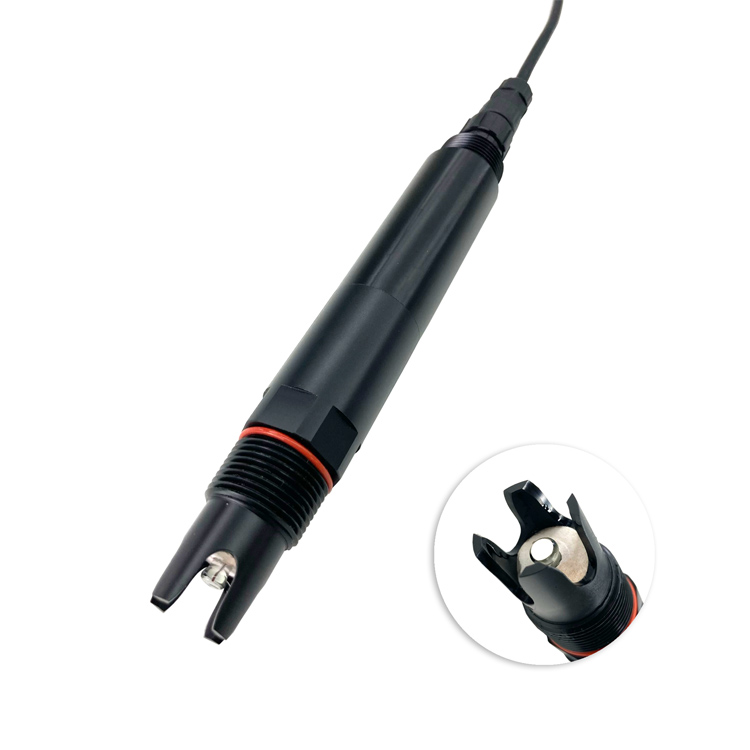
A fixed online pH sensor requires a compatible readout and an installation suitable for its duty. Distinguish the sensing probe from the complete equipment package when comparing offers. A loose digital probe becomes neither a portable kit nor an operating station until its power, readout and deployment arrangements are defined.
| Required task | Portable arrangement | Online arrangement |
|---|---|---|
| Survey many temporary points | One attended instrument can move between points | Needs relocation or additional fixed points |
| Investigate a night-time excursion | Requires an operator at the relevant time | Can record unattended if powered and logging correctly |
| Check a fixed sensor | Provides a comparison when independently maintained | Supplies the trend and event context around the check |
| Provide a control input | Usually unsuitable as the sole permanent input unless specifically designed for it | Requires tested controller integration and a defined fault response |
| Produce formal compliance results | Depends on method and reporting requirements | Also depends on method and reporting requirements; continuity alone is insufficient |
Portable work concentrates the measurement process into a visit: calibrate or verify, transport the instrument, locate the point, allow stabilization and save the result. The online installation spreads those duties across the equipment and maintenance team. The probe stays exposed to fouling, the logger keeps time, and the communication system must distinguish a current observation from a stale value.
A fluorescence dissolved oxygen sensor illustrates the difference between probe specifications and system specifications. The NiuBoL NBL-WQ-DO is an online sensing element with RS485 Modbus RTU. A compatible readout can be part of a field-testing arrangement, but portability, battery runtime and export functions belong to the complete package and cannot be inferred from the probe alone.
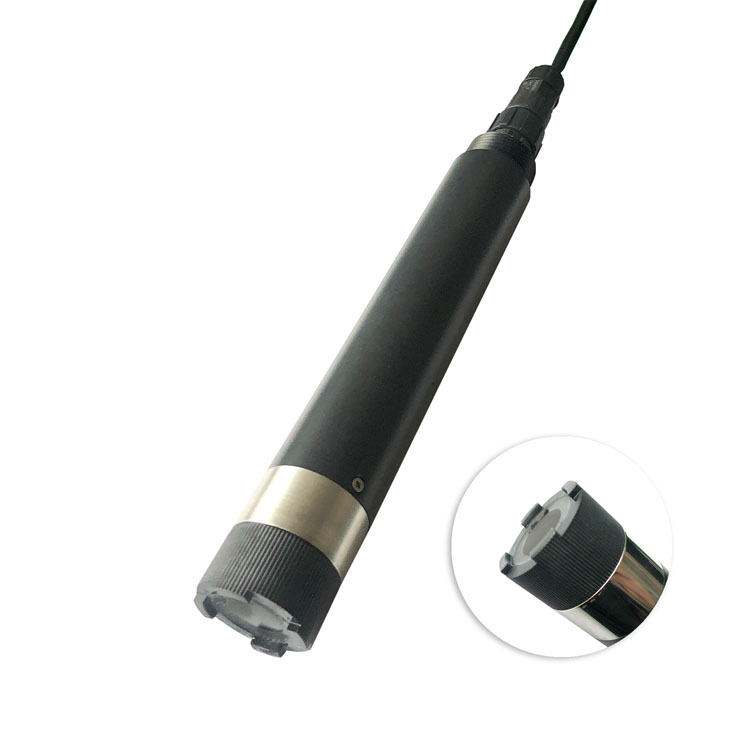
| NBL-WQ-DO probe parameter | Value | What it does not establish |
|---|---|---|
| Measurement principle and range | Fluorescence; 0-20 mg/L dissolved oxygen | The complete station's alarm or control suitability |
| Resolution and accuracy | 0.01 mg/L; +/-2% of full scale | Accuracy of 0.01 mg/L merely because the display shows that increment |
| Temperature accuracy | +/-0.3 deg C; automatic temperature compensation | Automatic knowledge of the site's salinity |
| Power and consumption | 12-24 V DC; below 0.3 W at 12 V | Battery life for a meter, modem and display added to the probe |
| Output | RS485 Modbus RTU | Direct compatibility with every handheld connector or cloud service |
| Working conditions | 0-45 deg C; pressure below 0.2 MPa | Use in a hotter or higher-pressure process without a suitable arrangement |
| Construction | IP68 probe; POM and 316L stainless steel housing; 5 m standard cable | Weatherproofing of the readout, exposed terminals or cable extension |
On a 0-20 mg/L range, 2% of full scale is 0.4 mg/L. That is different from 2% of the displayed reading. Compare specifications on the same basis before attributing a disagreement to one instrument. Cable-jacket material, additional cable length and readout protection must be checked separately for the selected package.
Dissolved oxygen and pH may vary with depth, circulation, feeding and time of day. A fixed point supports unattended trends, while a portable survey checks whether that point represents the wider pond or tank. Place the online probe where it measures relevant water rather than an unusually aerated pocket. Use a portable instrument to investigate differences, not to dismiss an overnight alarm based on a later daytime reading.
Where the objective is to compare several tributaries or investigate a suspected source, attended measurements can establish spatial variation before choosing a fixed site. Record location, depth, time and flow conditions consistently. A permanent station becomes useful once a recurring point needs a time series; it does not replace upstream and downstream checks when locating a source.
Online measurements can support process supervision where a short excursion matters between operator rounds. Portable checks remain useful during troubleshooting, probe cleaning and commissioning. They should be made near the installed probe at a matching time. A sample carried from a mixed tank to a distant bench is not automatically equivalent to an in-situ reading.
A short-duration study may need a portable logger or temporary deployment rather than a permanent cabinet and telemetry contract. However, leaving a handheld display beside water does not make it weatherproof or suitable for unattended service. Define the study duration, required sampling interval and protection of the complete assembly before selecting it.
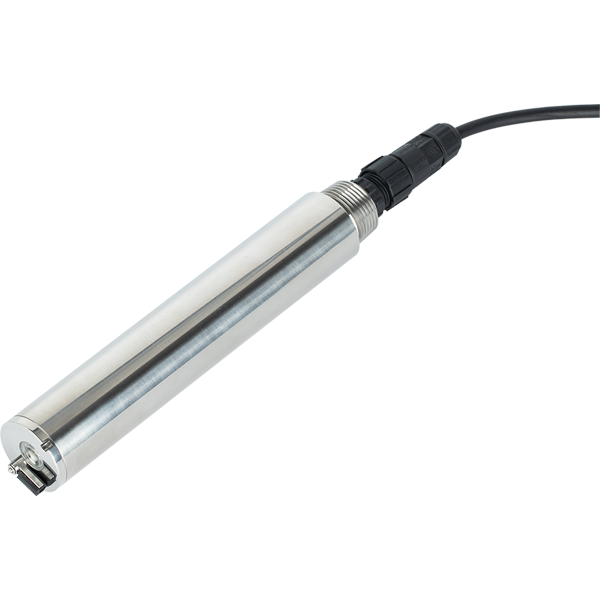
Turbidity measurements particularly require consistent sampling geometry and handling. Different optical arrangements or disturbed sediment can produce differences even with the same displayed unit. The online turbidity sensor below is an option for a fixed point; comparison with a portable meter should include both instruments' measurement methods and the condition of the water sample.
Sample handling matters. Aerating a collected sample can alter dissolved oxygen; cooling or warming can change temperature-dependent results; particles may settle before turbidity is measured. When the objective is to assess an in-situ sensor, an immediately comparable in-situ reading is often more informative than an uncontrolled transported sample. Laboratory comparisons should follow the applicable method rather than an improvised field procedure.
A portable meter is not an independent reference merely because it is portable. If both readings use the same electrode, they mainly test the readout and data path. If both instruments were adjusted against the same unsuitable standard, their agreement may preserve a common bias. Keep the reference method and instrument condition visible in the comparison record.
For portable work, inspect a real exported record before ordering. It should retain the parameter, unit, time and measurement location or a reliable way to associate the location afterward. Some instruments provide manual records, some local storage and some digital export; do not assume Bluetooth, USB, RS485 or a cloud connection from the word portable.
For an online system, the probe normally connects to a controller, PLC, RTU or data logger, with a gateway used where remote transfer is needed. Confirm the model's register map and scaling, then test sensor disconnection and communication loss. The platform should flag missing data. It should not fill a gap with zeros or repeatedly present an old measurement as fresh.
Maintenance also changes with deployment. A portable probe needs cleaning between locations, appropriate storage and enough battery capacity for the inspection route. An online probe needs safe removal, fouling inspection and access to replacement parts without disrupting the installation. A self-cleaning multi-parameter assembly can reduce some cleaning work, but it does not remove calibration checks or guarantee that every fitted sensor is cleaned by the same mechanism.

The relevant comparison is not handheld price versus probe price. Portable costs include the instrument, compatible probes, standards, storage supplies, travel and operator time. Online costs include the sensing points, mounting, controller, power, data service and recurring maintenance visits. Existing plant infrastructure can change the balance substantially.
For a simple workload example, ten inspection points requiring twelve minutes each take two hours per round before travel, preparation and documentation. At one round on each of twenty-two working days, that is forty-four hours of measurement time per month. This is not a labor-saving promise for online monitoring: fixed probes still need service, and the project may require portable verification regardless.
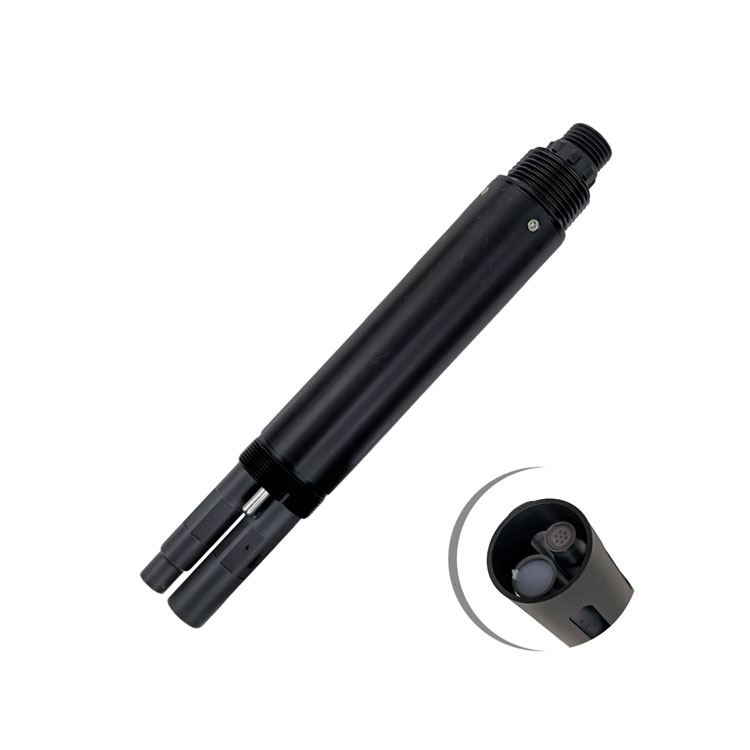
Ammonia monitoring adds a further distinction. A portable ammonia test may use a different analytical principle from an online ammonium ion-selective electrode. The NHN probe below is an online option. Compare reporting basis, water-matrix interference and acceptable uncertainty before deciding that it can replace a particular field or laboratory method.
For a NiuBoL quotation, separate the fixed sensing package from any attended test equipment. Provide the parameter list, concentrations, water type, number of locations, unattended recording requirement and existing controller. Ask for the exact compatible portable readout where one is needed; do not substitute an unrelated handheld soil tester because it has a similar connector or display.
Not inherently. Accuracy depends on the measurement method, range, calibration, sample conditions and instrument condition. Online equipment adds time coverage, while portable equipment adds mobility. Compare the same accuracy basis and use paired measurements rather than ranking the two categories by name.
Only if the complete arrangement supports the required logging duration, power, environmental protection and mounting. Confirm whether data are saved after a power interruption and whether the probe remains suitably positioned. A battery and a display do not establish unattended outdoor suitability.
No. A compatible local PLC or data logger can collect readings without a cloud service. Remote access requires an additional communication path and suitable software. Specify where data must be stored and who receives alarms before buying a gateway or subscription.
The cleaning process may have changed sensor condition, disturbed nearby sediment or temporarily changed sample temperature. Allow stabilization and inspect both instruments before adjusting calibration. If disagreement persists, check compensation settings, measurement basis and independent verification results.
No. Portable inspections can identify spatial differences and support checks after maintenance. Their frequency should reflect process risk, fouling and observed stability. Continuous data reduces gaps between visits only when the installed point remains representative and its readings are valid.
For portable equipment, demonstrate a complete field reading, saved record and usable export with the intended probes. For online equipment, demonstrate the sensor-to-platform value, timestamps, interruption handling and maintenance access. For either option, agree a parameter-specific comparison method instead of accepting a display screenshot as proof of measurement performance.
Choose a portable water quality meter for attended coverage across locations and an online monitor for continuous observation at selected points. Use both when spatial checks and unattended trends are necessary. NiuBoL online pH, dissolved oxygen, turbidity and ammonia sensors can be assessed against the fixed monitoring duty; the readout, data connection and maintenance arrangement should be selected around that duty rather than assumed from the probe name.
Prev:Online Ammonia Nitrogen Sensor Probe Supplier: Selection Checks for Water Projects
Next:Aquaculture Pond Water Quality Parameters: Monitoring Scope for DO, pH and Ammonia
Related recommendations
Sensors & Weather Stations Catalog
 Agriculture Sensors and Weather Stations Catalog-NiuBoL.pdf
Weather Stations Catalog-NiuBoL.pdf
Agriculture Sensors Catalog-NiuBoL.pdf
Water Quality Sensor Catalog-NiuBoL.pdf
Related products
 Combined air temperature and relative humidity sensor
 TDR Soil Moisture & Temperature Sensor for irrigation| RS485 |4-20mA| NBL-S-THR
 Soil pH sensor RS485 soil Testing instrument soil ph meter for agriculture |NBL-S-PH
 Wind Speed sensor Output Modbus/RS485/Analog/0-5V/4-20mA
 Tipping bucket rain gauge for weather monitoring auto rainfall sensor RS485/Outdoor/stainless steel
 Pyranometer Solar Radiation Sensor 4-20mA/RS485


Screenshot, WhatsApp to identify the QR code
WhatsApp number:+8615367865107
(Click on WhatsApp to copy and add friends)

