





— Blogs —
—Products—
 Consumer hotline +8618073152920
WhatsApp:+8615367865107
Address:Room 102, District D, Houhu Industrial Park, Yuelu District, Changsha City, Hunan Province, China
Product knowledge
Time:2026-08-10 08:05:27 Popularity:223
Quick Answer: A smart irrigation control sensor set needs a soil measurement that suits the crop and an output the irrigation controller can actually receive. Match RS485 Modbus RTU, current or voltage versions explicitly. A soil probe provides measurements; automatic valve or pump control additionally requires the controller, suitable output hardware and tested control logic.
The purchase decision should start from field size, crop, water source, valve control method and the data interface required by the irrigation controller. A useful soil measurement cannot operate the irrigation system if the controller has no compatible input or if the necessary valve interface is missing.
For NiuBoL project buyers, the main question is whether soil moisture data can support irrigation scheduling, pump control, greenhouse operation or remote farm management. A practical system may include soil moisture sensors, soil temperature sensors, valve controllers, data logger, gateway, solar power and mounting accessories.
Manual irrigation decisions often depend on fixed schedules or visual crop observation. That is risky in greenhouses, orchards and open-field projects where soil texture, root depth, rainfall and crop stage change water demand. Soil sensor data gives the operator a measurable basis for irrigation timing.
The soil sensor is the field measurement point. It sends moisture or temperature data to a controller, RTU, data logger or gateway. The controller then displays the value, uploads records or drives irrigation logic according to the project design.
The quotation should clearly separate sensors, cable length, controller, enclosure, valve interface, gateway, solar power, mounting accessories and after-sales support. Without this boundary, two quotations with the same product name may represent very different systems.
Check the installed controller before choosing the output. An RS485 probe cannot be connected directly to an analog-only moisture input. Likewise, a controller's sensor input is not a valve power output. Confirm the valve type, electrical load and switching arrangement separately. A gateway that uploads readings does not necessarily execute local irrigation logic when remote communication is unavailable.

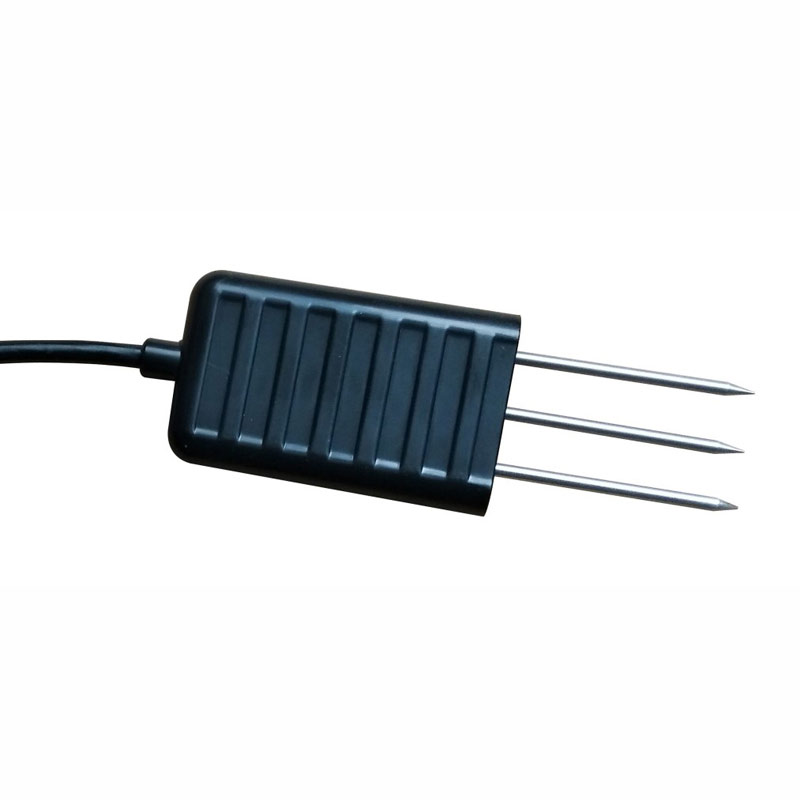
The NBL-S-TM soil temperature and moisture sensor uses FDR sensing and RS485 Modbus RTU. The NBL-S-THR soil sensor uses TDR sensing and is offered with digital or analog output versions. Select a delivered version; do not assume that all listed outputs are available simultaneously.
| Selection item | NBL-S-TM | NBL-S-THR |
|---|---|---|
| Soil moisture measurement | 0-100% volumetric water content; 0.1% resolution; listed accuracy +/-5% | 0-100% volumetric water content; 0.1% resolution; listed accuracy +/-3% |
| Soil temperature | -40 to 80 C; +/-0.5 C | -50 to 100 C; +/-0.5 C |
| Supply | 5-24 VDC; confirm configurations requiring 12-24 V | 12-24 VDC |
| Output | RS485 Modbus RTU | RS485 Modbus RTU, 4-20 mA or 0-5 V by version |
| Protection | IP68 | IP68 |
| Operating temperature | -40 to 85 C | -40 to 80 C |
Confirm the accuracy basis and applicable soil conditions when comparing offers. A stated percentage is not automatically a percentage of reading or an absolute percentage-point error. The temperature measurement range also does not replace the complete assembly's operating-temperature limit.
Neither of these two-channel probes should be ordered as an EC, pH or nutrient instrument. Where fertigation decisions require conductivity, include an appropriate additional channel rather than attempting to infer salinity from the moisture reading. Confirm cable length and jacket material for burial and machinery exposure.
Volumetric water content describes the water volume within the measured soil volume. Water potential describes the soil water's energy state, which is relevant to how readily roots can obtain it. These measurements support different control strategies and cannot share an unchanged alarm threshold.
The NBL-S-WPS soil water potential sensor reports -1500 to -10 kPa through RS485 Modbus RTU. More negative values indicate drier conditions. Its porous sensing material must equilibrate with the surrounding soil; intimate soil contact and site interpretation matter.
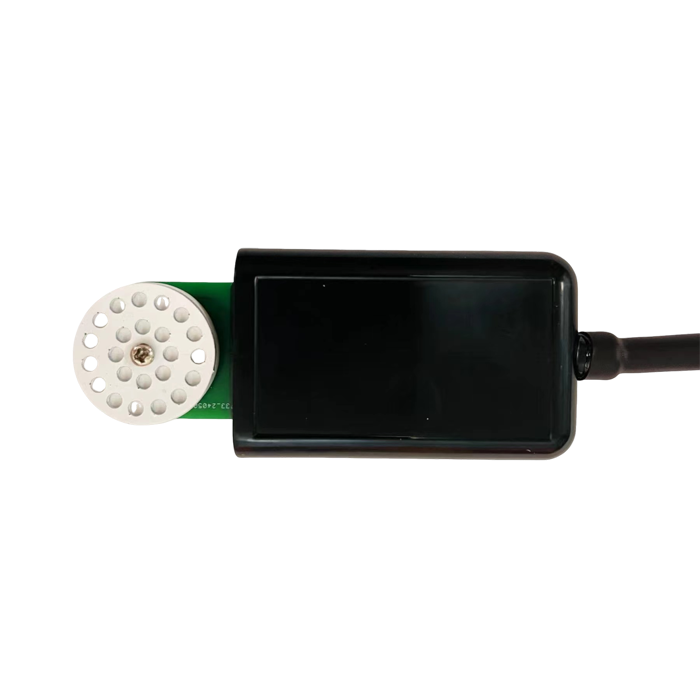
A controller expecting moisture percentage cannot accept kPa by simply changing the display label. Check that it supports the measurement range, sign and chosen control logic. Set irrigation criteria for the crop, soil and growth stage using field observations; there is no single kPa or moisture-percentage trigger suitable for every project.
For greenhouse irrigation, choose a package that supports short data intervals, protected cable routing and controller access near the irrigation valves. For orchards, focus on root-zone depth, field block layout, wireless distance and solar power margin. For open-field irrigation, sensor placement should represent soil type and crop block instead of the easiest installation point.
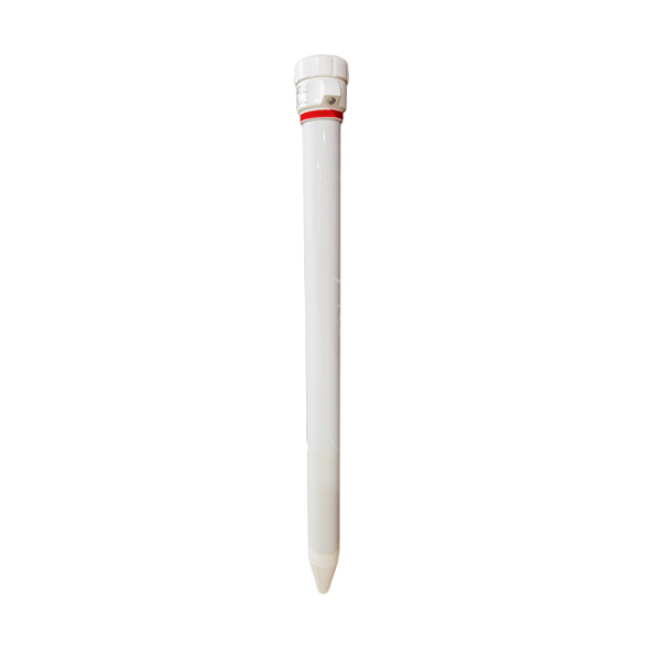
A tubular multi-depth probe is useful when the question is whether irrigation reaches the intended root zone or drains below it. Compare measurements at the configured depths rather than averaging away the profile. It is a different installation from placing a single short probe at one depth; specify the required depths and accessible installation method before ordering.
For automatic operation, define separate start and stop conditions and an appropriate maximum run time. Simulate missing or stale readings to confirm the controller's response. Soil moisture alone does not prove water flow or protect a pump from dry running; those requirements need the appropriate inputs and protection arrangement.
If the project only needs occasional inspection, a handheld meter may be sufficient. Where records, alarms or automatic irrigation logic are required, an online package can be justified by those functions, provided the selected controller and communications actually support them.
Quantity depends on soil variation, root depth and independently managed irrigation zones. A pilot point can test installation and communications, but it should not be treated as representative of several unlike soil blocks without field comparison.
Only if its inputs support the ordered output and data format. TM uses RS485 Modbus RTU; THR offers specified digital or analog versions. Obtain the controller input documentation before ordering the probe version.
Not as an unchanged substitution. WPS reports negative kPa rather than volumetric water content. The receiver, display and irrigation criteria must support that measurement, and thresholds must be established for the crop and soil.
Yes, when the ordered scope includes a compatible controller and suitable switching or valve interface. Test the control logic, load compatibility and sensor-failure response. Do not connect a valve directly to a soil probe's data terminals.
Provide crop and soil type, field blocks, required depths, irrigation method, controller inputs, valve type, power and cable layout. Ask for separate prices for probes, acquisition, communications and actuation so the offers cover the same functions.
It should demonstrate correct units and point identity, stable communications, credible wetting and drying response, and the agreed alarm or valve behavior. Where remote records are required, verify that the stored data belongs to the correct sensor location and depth.

A smart irrigation control sensor set is useful when its measurement, field position and controller interface support a specific irrigation decision. NiuBoL can match the soil probe and acquisition arrangement to the crop, required depths and existing controller. Define those details first, then decide which valve, gateway and power components the installation still needs.
Prev:Solar Irradiance Meter Calibration: Use the Supplied Sensitivity
Next:CO2 Sensor Price: Compare the Range and Installed Equipment
Related recommendations
Sensors & Weather Stations Catalog
 Agriculture Sensors and Weather Stations Catalog-NiuBoL.pdf
Weather Stations Catalog-NiuBoL.pdf
Agriculture Sensors Catalog-NiuBoL.pdf
Water Quality Sensor Catalog-NiuBoL.pdf
Related products
 Combined air temperature and relative humidity sensor TDR Soil Moisture & Temperature Sensor for irrigation| RS485 |4-20mA| NBL-S-THR
 Soil pH sensor RS485 soil Testing instrument soil ph meter for agriculture |NBL-S-PH
 Wind Speed sensor Output Modbus/RS485/Analog/0-5V/4-20mA
 Tipping bucket rain gauge for weather monitoring auto rainfall sensor RS485/Outdoor/stainless steel
 Pyranometer Solar Radiation Sensor 4-20mA/RS485


Screenshot, WhatsApp to identify the QR code
WhatsApp number:+8615367865107
(Click on WhatsApp to copy and add friends)

