





— Blogs —
—Products—
 Consumer hotline +8618073152920
WhatsApp:+8615367865107
Address:Room 102, District D, Houhu Industrial Park, Yuelu District, Changsha City, Hunan Province, China
Product knowledge
Time:2026-08-13 09:09:00 Popularity:345
Quick Answer: A TSS portable meter is suitable for planned spot measurements and field comparisons, while an online suspended-solids sensor is intended for repeated observation at an installed point. Neither an optical TSS estimate nor a turbidity value is automatically equivalent to a laboratory gravimetric result. Choose the sampling workflow and required measurement before choosing the display, logger or communication interface.

A portable arrangement lets an operator compare selected locations during a survey. Its usefulness depends on consistent depth, timing, sample handling and instrument configuration. An online point can reveal changes between visits, provided installation, cleaning and acquisition remain adequate. The two approaches can complement each other without producing identical observations.
The BOD probe above measures a different property related to organic matter; it is not a portable suspended-solids meter. Likewise, oxygen demand and physical solids concentration should not be interchanged in an equipment schedule. A monitoring project may require both, but each channel needs its own measurement definition.
| Required task | Suitable approach | Important limitation |
|---|---|---|
| Survey several process locations | A suitable portable solids instrument and repeatable route | Sequential readings combine spatial differences with changes during the survey. |
| Observe an event between operator visits | Installed optical suspended-solids sensor and acquisition | Fouling, bubbles and unrepresentative placement can distort the trend. |
| Obtain a specified reference TSS result | Appropriate representative sampling and gravimetric laboratory method | The method and sampling requirements must match the intended use. |
| Follow optical clarity | Turbidity measurement with a defined optical method and unit | NTU cannot be relabeled as mg/L without a validated relationship. |
When asking NiuBoL for equipment, state whether a portable instrument, an online probe or a complete acquisition package is required. The NBL-WQ-TSS specifications discussed below describe an online option. Confirm a separate portable package's actual availability and characteristics rather than assuming the online probe includes a handheld display and battery.
An optical suspended-solids instrument estimates concentration from light interacting with particles and the applied calibration. Particle size, shape, composition and color can affect the relationship. Water with the same suspended mass can produce a different optical response when the material changes.
A gravimetric method determines retained solids from a filtered and dried sample under its specified procedure. EPA Method 160.2, for example, describes non-filterable residue using a well-mixed sample and a glass-fiber filter. That measurement process is different from an in-situ optical reading; use the method required by the actual project.
For a site relationship, collect paired observations over representative conditions and inspect how well the optical estimate follows the reference. Do not create a universal conversion from one grab sample. Reassess the relationship when the process or particle population changes materially.
For an illustrative mass-to-volume calculation, 20 mg of correctly determined retained dry residue from a 0.5 L sample corresponds to 40 mg/L. The example explains the concentration unit; it is not a complete laboratory procedure. Filter preparation, sample handling, drying and other method requirements still apply, and a probe's optical response is not a weighing measurement.
Retain the actual paired sample results used for an optical relationship. A fitted line can look convincing while describing only a narrow concentration band or one particle type. Evaluate the conditions the project expects to encounter and keep independent checks rather than accepting the fit solely because the displayed coefficient is close to one.
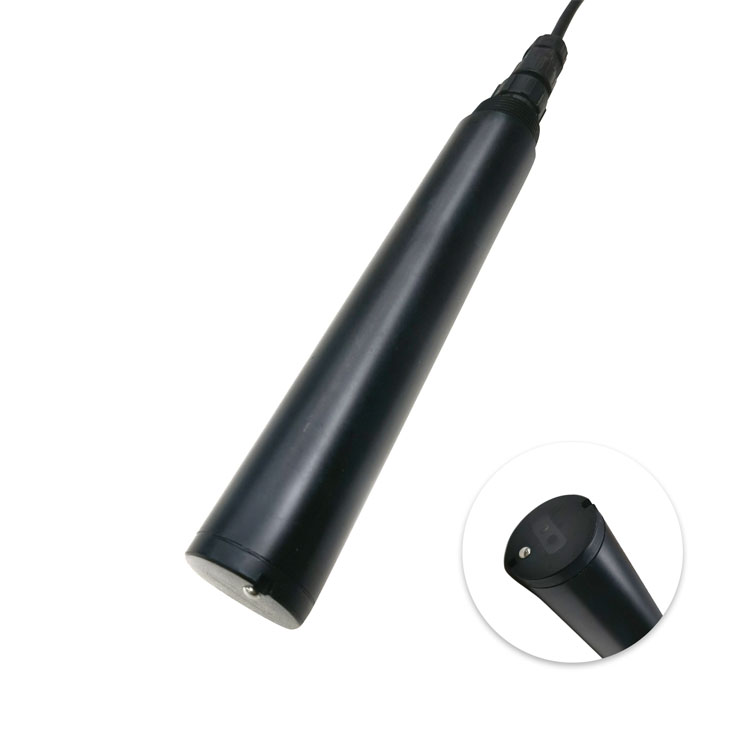
The turbidity probe represents an optical measurement useful for water-treatment and source-water trends. Its result depends on the instrument method and calibration. A turbidity channel reported in NTU is not a solids mass concentration simply because the platform allows a custom unit label.
A portable comparison needs the same caution. If one instrument reports turbidity and another reports estimated TSS, establish the relationship being evaluated. A disagreement between their numbers alone says little when the quantities differ.
For wastewater with changing sludge or for runoff carrying different sediment during a storm, review representativeness through the event. A relationship derived during quiet operation may not explain a transient with different particles. Keep the actual optical observation and any estimated concentration identifiable in exported records.
| NBL-WQ-TSS characteristic | Value | Selection consequence |
|---|---|---|
| Principle and range | Scattered-light measurement; 0-2000 mg/L | Confirm that the expected normal and upset conditions fit the offered range. |
| Stated accuracy | +/-5%, depending on sludge homogeneity; temperature +/-0.3 degrees C | Do not omit the homogeneity condition or assume agreement with every laboratory sample. |
| Calibration | Two-point calibration | Define the intended reference and field comparison procedure. |
| Supply and consumption | 12-24 V DC; 0.2 W at 12 V | The controller, display and remote communications add separate loads. |
| Output | RS485 Modbus RTU | Verify the delivered channel definitions, concentration unit and scale. |
| Process conditions | 0-50 degrees C; pressure below 0.2 MPa | Check the actual process, not only cabinet conditions. |
| Construction | POM and ABS; IP68; immersion mounting, 3/4 NPT thread | Assess chemical compatibility, retrieval and protection of field connections. |
| Cable and resolution | Standard cable 5 m; jacket and delivered mg/L resolution to be confirmed | Do not substitute an NTU increment for a concentration-channel specification. |
For this option, allow more than 5 cm from the side wall and at least 10 cm from the bottom. Also check the sensing direction, nearby structures and representative flow. Those clearances do not eliminate the need to inspect deposits, reflections or bubbles at the actual installation.
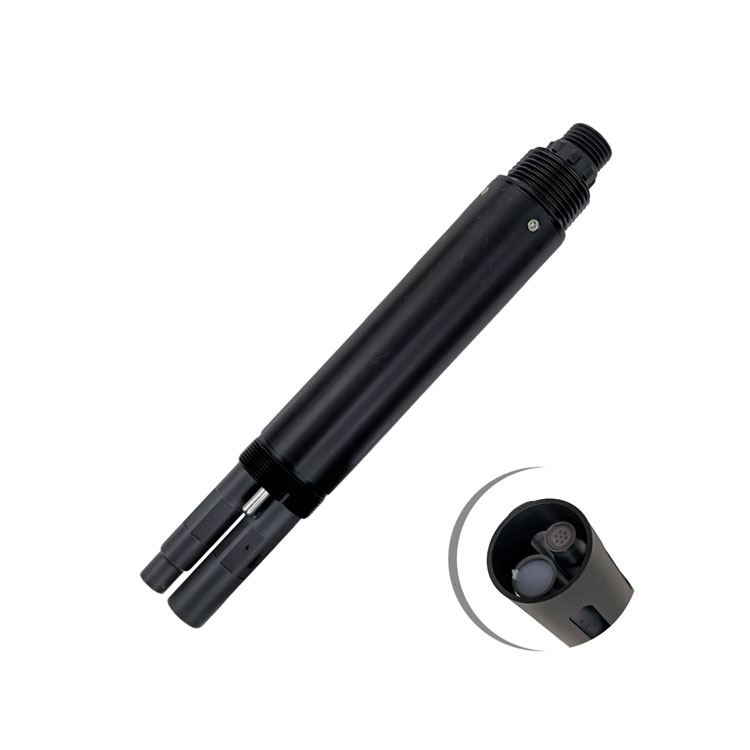
The ammonia-nitrogen probe shown here supplies a different chemical channel; it does not replace physical solids measurement. In a multi-parameter project, separate those observations before evaluating agreement between portable and online TSS readings.
A sample can change after collection as particles settle or become unevenly distributed. Do not compare a settled bottle reading with an online point in moving mixed water and assume the difference is drift. Likewise, excessive mixing can introduce bubbles that alter an optical reading.
Agree a comparison procedure that the site can repeat. If the operator must travel between distant points, record the sequence and times. A difference along that route may include changing process conditions, not only location or sensor performance.
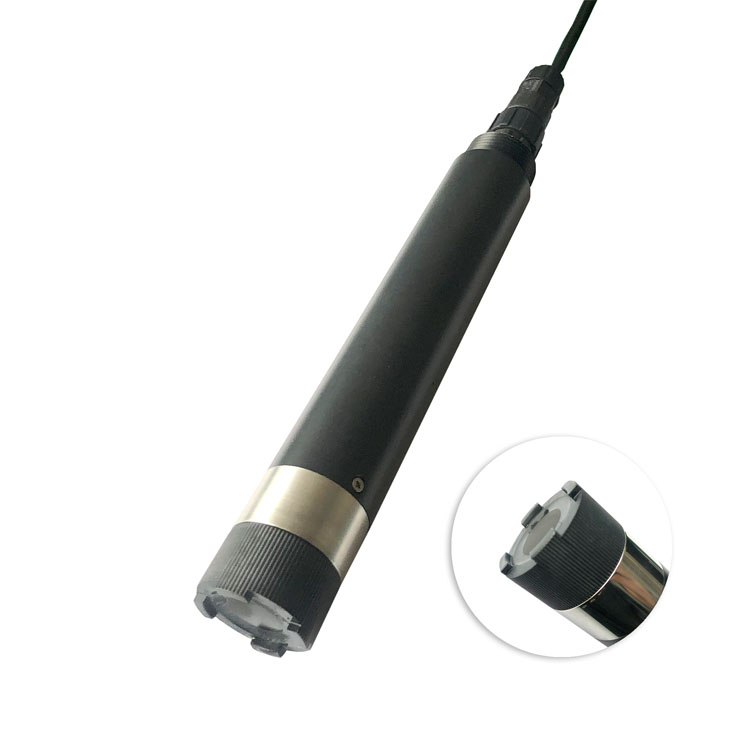
A fluorescence dissolved-oxygen sensor can help explain oxygen conditions during a process change. An ammonia channel, BOD-related optical observation or COD sensor may provide other context. None measures the mass of suspended solids by substitution, and one should not be ordered in place of a TSS instrument because the housings look similar.
For an installed solids point, use acquisition that preserves measurement time and validity. Test RS485 mapping with the delivered probe; a portable meter may instead use local storage or an export function. Check each device's actual interface rather than requiring every portable arrangement to behave like a fixed Modbus transmitter.
Maintenance matters in both workflows. Inspect windows, cable and mounting, and compare before-and-after-cleaning behavior where useful. A clean portable instrument does not prove a fouled online point is representative, while calibrating either instrument during unstable sample conditions can introduce a new error.
For a quotation, provide the water matrix, expected solids range, survey or continuous-monitoring requirement, sample access and desired data output. Include whether the project requires a handheld power/display package, a fixed probe or a receiving logger. A clear request avoids buying a chemically different sensor or an incomplete measurement assembly.
No. An optical estimate and a gravimetric reference use different measurement processes. Validate the intended relationship and use the reference method required by the project.
No. Particle properties and water conditions affect the relationship. A site-specific conversion needs representative paired data and periodic reassessment when the process changes.
Check quantity, method, timing, depth, settling, bubbles, cleaning and any conversion settings. The two instruments may not be observing the same sample condition even when used close together.
No. Compare normal and credible upset concentrations with the actual range. A different range or instrument arrangement may be needed, and its specifications must be checked separately.
No. They describe different properties. They may support process interpretation alongside solids data but are not interchangeable measurements.
Confirm the exact measured quantity, instrument and probe, range, local power, display, storage or export, cleaning requirements and intended reference comparison. Do not assume an online sensor includes those portable functions.
Select portable or online TSS equipment from the required observation and sampling procedure. Keep optical estimates, turbidity and gravimetric reference results distinct, and compare representative conditions. NiuBoL can assess an online solids configuration against the water matrix and acquisition requirements without implying that a different water-quality probe is a TSS meter.
Prev:Ambient Air Temperature Sensor Selection Guide
Next:TDS Sensor for Raspberry Pi: Recover Valid Records After a Restart
Related recommendations
Sensors & Weather Stations Catalog
 Agriculture Sensors and Weather Stations Catalog-NiuBoL.pdf
Weather Stations Catalog-NiuBoL.pdf
Agriculture Sensors Catalog-NiuBoL.pdf
Water Quality Sensor Catalog-NiuBoL.pdf
Related products
 Combined air temperature and relative humidity sensor
 TDR Soil Moisture & Temperature Sensor for irrigation| RS485 |4-20mA| NBL-S-THR
 Soil pH sensor RS485 soil Testing instrument soil ph meter for agriculture |NBL-S-PH
 Wind Speed sensor Output Modbus/RS485/Analog/0-5V/4-20mA
 Tipping bucket rain gauge for weather monitoring auto rainfall sensor RS485/Outdoor/stainless steel
 Pyranometer Solar Radiation Sensor 4-20mA/RS485


Screenshot, WhatsApp to identify the QR code
WhatsApp number:+8615367865107
(Click on WhatsApp to copy and add friends)

