





— Blogs —
—Products—
 Consumer hotline +8618073152920
WhatsApp:+8615367865107
Address:Room 102, District D, Houhu Industrial Park, Yuelu District, Changsha City, Hunan Province, China
Product knowledge
Time:2026-08-14 09:00:00 Popularity:234
Quick Answer: An RS485 TDS sensor for Raspberry Pi needs a suitable serial interface, separate sensor power and software that distinguishes fresh readings from cached values. After a restart or cable interruption, restore the sensor identity, scaling and time basis before accepting new records. A recovered connection alone does not establish a valid measurement.
The NiuBoL NBL-WQ-EC conductivity sensor provides conductivity, temperature and supported calculated TDS through RS485 Modbus RTU. It is not a bare analog TDS board. A USB-to-RS485 adapter is one integration route; the receiving computer still needs a compatible driver and Modbus application.
The Raspberry Pi hardware documentation describes USB peripheral connections and GPIO interfaces. An RS485 A/B pair is not a direct GPIO connection. Keep the probe's specified supply separate from the computer's power input, and choose interface isolation and field protection for the installation.
A monitoring application may retain the last displayed value even when the acquisition process has stopped. Store the last successful acquisition time separately from the screen refresh time. On restart, label any retained value as historical until a new response has passed the instrument and decoding checks.
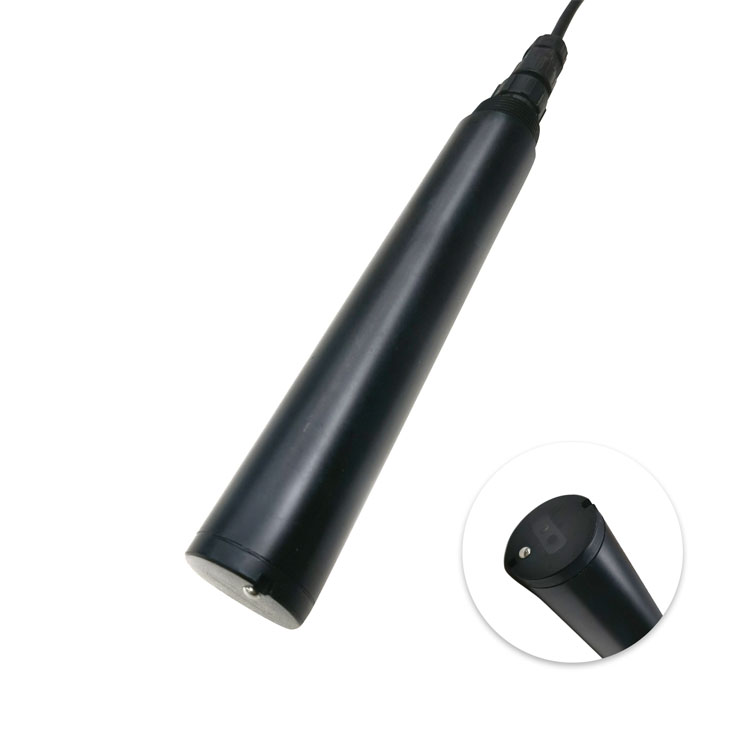
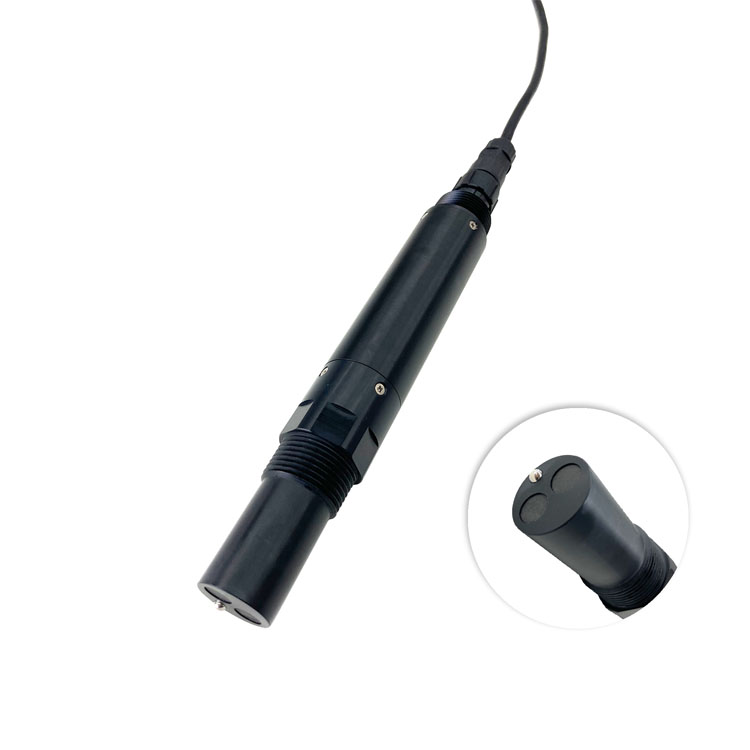
This matters even more in a station containing the turbidity probe pictured below. Its last valid value is not the last valid EC value. Each channel needs its own acquisition status, timestamp and mapping; one responding instrument cannot make the whole station healthy.
| NBL-WQ-EC item | Product specification | Software or installation implication |
|---|---|---|
| EC ranges | 0-20.00 / 0-200.0 / 0-5000 uS/cm, or 0-200.0 mS/cm | Identify the ordered range and decimal position; do not apply one scale to every version |
| Conductivity accuracy | +/-1% FS | Full-scale accuracy is not +/-1% of every reading |
| Temperature / compensation | +/-0.3 C; Pt1000 automatic temperature compensation | Record the reporting basis used for EC comparisons |
| TDS | Calculated from conductivity where supported; configurable coefficient, default 0.64 | Keep the coefficient with configuration history; it is not laboratory identification of dissolved constituents |
| Supply / power | 12-24 VDC +/-10%; 0.2 W at 12 V | Size the probe supply separately from the computer and interface |
| Output / serial defaults | RS485 Modbus RTU; 9600, N, 8, 1 | Match port settings and use the ordered register map |
| Operating limits | 0-50 C; pressure below 0.6 MPa | Check actual sample conditions, not just cabinet temperature |
| Protection / mounting / cable | IP68; immersion or 3/4 NPT; standard 5 m cable | The probe rating does not cover the computer; confirm cable jacket and wetted materials |
Choose the measurement range from expected water conditions before writing alarm logic. The product lists TDS ranges of 0-10, 0-100 and 0-3000 mg/L for the three lower EC configurations; TDS support for the high-conductivity version needs confirmation. A configurable coefficient does not make unsupported ranges valid.
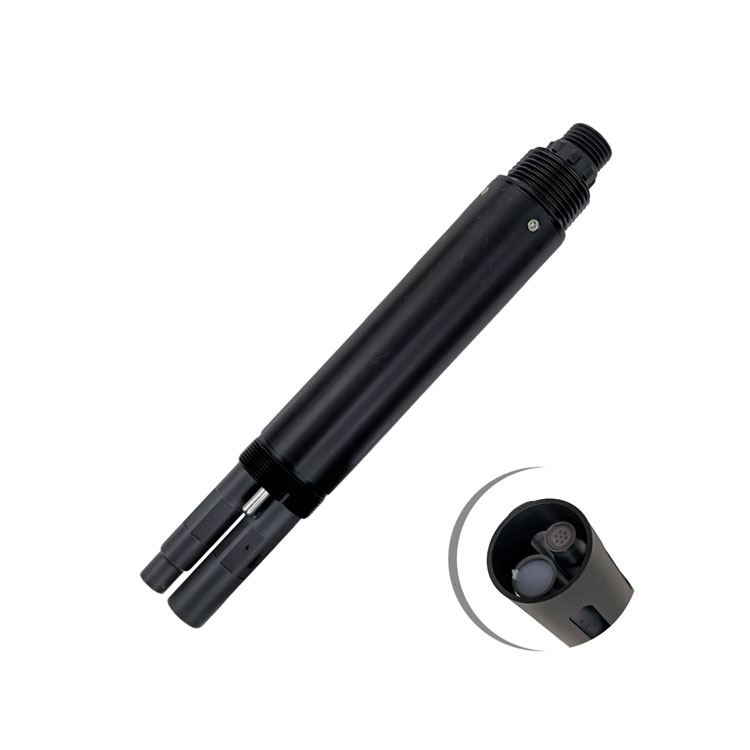
The ammonia-nitrogen instrument below is another separate measurement channel. Its units, calibration and response interpretation differ from EC-derived TDS. Preserve that distinction when extending the same computer to a multi-probe station.
The documented measurement block starts at 0x0000 and contains six 16-bit registers: EC value and decimal position, temperature value and decimal position, then TDS value and decimal position. Use the ordered protocol for signed temperature handling and other decoding details. A successful function-03 response with the wrong interpretation can still produce plausible but incorrect numbers.
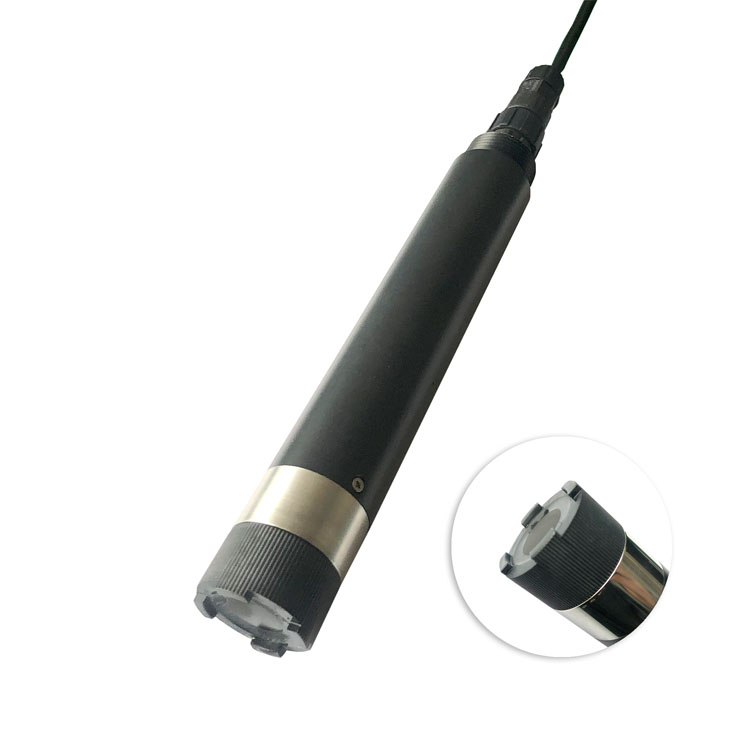
For an optical dissolved-oxygen channel, restarting the host similarly does not prove that the probe has a representative, stable sample. Keep acquisition readiness separate from physical measurement readiness. Record cleaning, calibration or removal from the water as service events rather than apparent process changes.
Run four controlled checks: restart the application, restart the computer, disconnect the serial adapter, and interrupt sensor power. Perform them in a safe test setup. For each, verify that the interface recovers to the correct probe, missing data stay visibly missing, and the first accepted value has a valid timestamp and scale.
Then interrupt only the network. Local acquisition and remote upload are separate functions; whether records survive depends on the application's storage design, not the RS485 label. Check that reconnection does not duplicate buffered samples or overwrite historical times. If alarms operate equipment, test communication-failure behavior independently of water-quality thresholds.
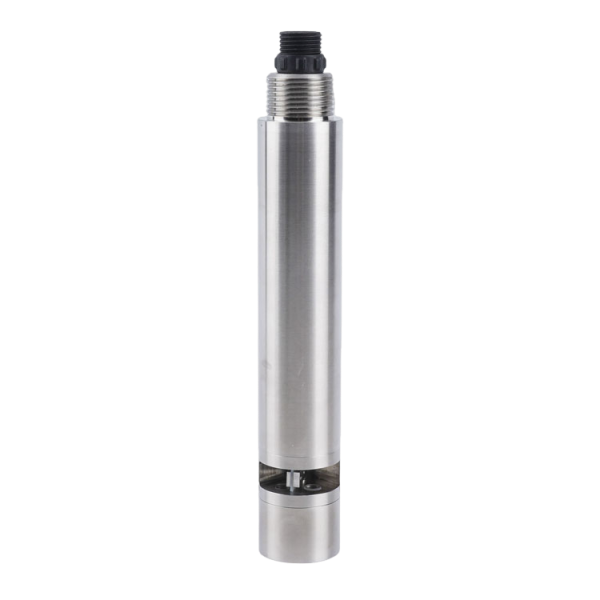
A COD probe, such as the separate instrument shown below, needs its own acceptance checks. Reusing the EC decoder for an optical channel can produce wrong units even when the same serial bus is electrically functional.
The NBL-WQ-EC provides RS485, not a GPIO-level signal. Use a suitable RS485 interface and the specified external sensor supply. Verify the exact wiring before applying power.
Routine acquisition should not depend on uncontrolled configuration writes. Keep approved address, scaling and coefficient settings traceable; perform intentional changes through a separate commissioning procedure and verify the result.
The display may be showing a cached last value. Show its acquisition time and mark it stale. A new display refresh is not a new sensor measurement, and a timeout must not be recorded as zero TDS.
No. Track each instrument separately. An EC response does not verify a turbidity, ammonia, dissolved-oxygen or COD probe, even when all devices share the same host.
No. Conductivity-derived TDS estimates dissolved-solids concentration using a coefficient. It cannot identify individual chemicals, and similar conductivity values can occur with different dissolved compositions.
Send the expected EC/TDS range, liquid conditions, interface type, required record interval, restart tests and local-storage requirement. Ask NiuBoL to confirm the probe configuration and protocol; computer software, remote services and enclosure provision must be defined separately.
A TDS sensor for Raspberry Pi becomes useful for unattended monitoring when recovery is as trustworthy as the first successful reading. Choose the right NBL-WQ-EC range, keep configuration changes controlled, and test freshness, timestamps and missing-data handling through realistic interruptions before relying on the records.
Prev:Portable TSS Meter and Online Sensor: Selection and Field Comparison
Next:Professional pH and TDS Meter: Why the Two Trends Can Disagree
Related recommendations
Sensors & Weather Stations Catalog
 Agriculture Sensors and Weather Stations Catalog-NiuBoL.pdf
Weather Stations Catalog-NiuBoL.pdf
Agriculture Sensors Catalog-NiuBoL.pdf
Water Quality Sensor Catalog-NiuBoL.pdf
Related products
 Combined air temperature and relative humidity sensor
 TDR Soil Moisture & Temperature Sensor for irrigation| RS485 |4-20mA| NBL-S-THR
 Soil pH sensor RS485 soil Testing instrument soil ph meter for agriculture |NBL-S-PH
 Wind Speed sensor Output Modbus/RS485/Analog/0-5V/4-20mA
 Tipping bucket rain gauge for weather monitoring auto rainfall sensor RS485/Outdoor/stainless steel
 Pyranometer Solar Radiation Sensor 4-20mA/RS485


Screenshot, WhatsApp to identify the QR code
WhatsApp number:+8615367865107
(Click on WhatsApp to copy and add friends)

