





— Blogs —
—Products—
 Consumer hotline +8618073152920
 WhatsApp:+8615367865107
Address:Room 102, District D, Houhu Industrial Park, Yuelu District, Changsha City, Hunan Province, China
Product knowledge
Time:2026-06-11 11:24:29 Popularity:1046
Quick Answer: Turbidity monitoring for changing source water should cover both the normal operating band and credible high-NTU events. Select the actual range using historical or pilot observations, then check its accuracy near the decision point. A wide-range probe can capture an excursion while being unsuitable for a tight low-turbidity criterion; one instrument need not serve both duties.
An intake that is usually clear can receive sediment during rain, reservoir disturbance or changes in abstraction depth. A range chosen from a quiet commissioning day may saturate during the event the project most needs to observe. Conversely, selecting the largest range simply to avoid saturation can sacrifice useful discrimination in the normal band.
Build a water-condition record before ordering. Include routine NTU observations, known high events, changes in source blend, treatment operating states and the reference method. If event data are missing, use a supervised pilot or discuss the uncertainty explicitly rather than presenting the normal value as the maximum.
The decision may concern intake investigation, treatment adjustment or downstream water quality. Keep these duties separate. A source-water probe intended to capture high sediment events is not automatically suitable for final filtered-water release, even when both report NTU.
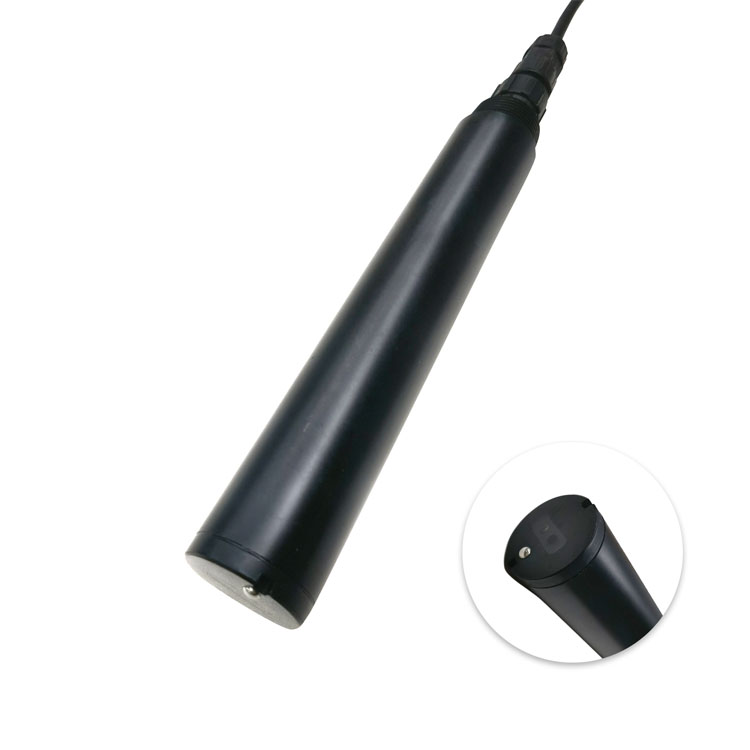
NiuBoL offers different turbidity configurations. The basic TS has a 0-100 NTU middle range; the TS-4S has a 0-200 NTU option and a separate 0-4000 NTU option. Those are not interchangeable catalogue entries.
| Configuration | Range and resolution | Accuracy expression |
|---|---|---|
| Basic NBL-WQ-TS | 0-20 NTU; 0.01 NTU | +/-3% or +/-1.5 NTU; confirm percentage basis and application rule. |
| Basic NBL-WQ-TS | 0-100 NTU; 0.1 NTU | +/-3% or +/-2 NTU; confirm percentage basis and application rule. |
| Basic NBL-WQ-TS | 0-1000 NTU; 0.1 NTU | +/-5% or +/-3 NTU; confirm percentage basis and application rule. |
| NBL-WQ-TS-4S | 0-200 NTU; 0.1 NTU | +/-3% of reading or +/-2 NTU, whichever is greater. |
| NBL-WQ-TS-4S | 0-4000 NTU; 0.1 NTU | Within 0-200 NTU: +/-20 NTU; within 200-4000 NTU: +/-5%, with percentage basis to confirm. |
For illustration, a source normally around 10 NTU but occasionally above 1000 NTU presents two requirements. The TS-4S 4000 NTU option may cover more of that event, but its stated +/-20 NTU term in the lower band does not establish tight accuracy around 10 NTU. Assess separate monitoring duties or another suitable instrument if both low-level discrimination and high-event coverage are essential.
This example is a selection calculation, not a measured profile or a claim that one NiuBoL configuration fits every intake. The ordered range, reference comparisons and water characteristics determine suitability. For the two related models, use the basic TS and TS-4S specifications separately.
An upper-range plateau is not proof that the water stayed exactly at the displayed value. Review whether the sensor, analog scaling or receiving software has reached a limit. Keep over-range or other available status information and distinguish it from a valid observation at the upper endpoint.
A recording interval that captures routine stability may miss short source-water events. Choose acquisition and storage intervals around the changes being investigated, allowing for sensor and sample delay. Retain raw observations where practical; a daily average can conceal a short excursion important to plant operation.
After an event, inspect the optical region and mounting. Deposited sediment or a coated window can persist after the water clears. Compare before-and-after cleaning values so an apparent long event is not automatically attributed to continuing source-water contamination.
Particle size, composition and optical properties can change between baseflow, sediment events and biological growth. The same dry solids mass need not produce the same turbidity. Do not convert NTU to mg/L with one universal factor or interpret an NTU reduction as a quantified mass removal without a suitable site-specific method.
Check reference agreement under the important water conditions, not only after cleaning in a standard. Match sample time and location and minimize settling or bubbles introduced by handling. Different optical methods can respond differently to the same particles, so method identity belongs with the comparison record.
For event investigations, retain source blend, water level, pumping and relevant treatment changes alongside turbidity. These observations support interpretation without making a rain record, a conductivity value or a photograph a substitute for the actual optical measurement.
| Installation item | Basic TS | TS-4S |
|---|---|---|
| Working conditions | 0-50 degrees C; pressure <0.2 MPa | 0-50 degrees C; pressure <0.2 MPa |
| Supply and power | 12-24 V DC; 0.2 W at 12 V | 12-24 V DC; 0.2 W at 12 V, with separate cleaning load to confirm |
| Output | RS485 Modbus RTU; 4-20 mA configuration to confirm | RS485 Modbus RTU; optional 4-20 mA |
| Housing and protection | POM and ABS; IP68 | ABS and 316L; IP68 |
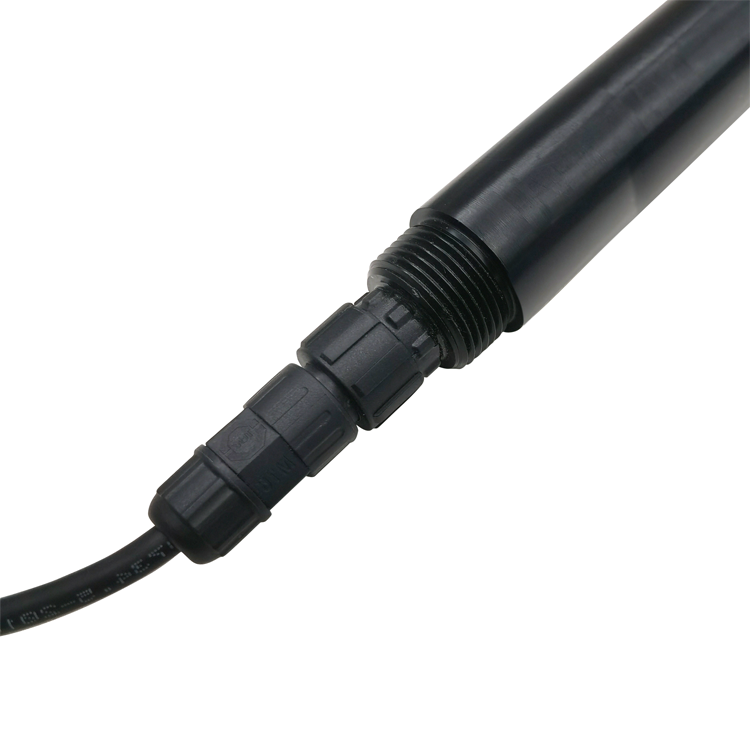
| Mounting and cable | 3/4 NPT immersion mounting; standard 5 m cable | 3/4 NPT immersion mounting; standard 5 m cable |
Specify cable-jacket compatibility, retrieval access and any cleaning assembly separately. Keep the optics more than 5 cm from side walls and more than 10 cm from the bottom, with representative water exchange. Confirm the support remains suitable as water level and debris exposure change; an IP rating does not establish flood-resistant mounting or unlimited depth.
At the PLC, RTU or data logger, verify the actual range, decimals and units. Changing a sensor range without updating an analog input or software scale can make historical comparisons misleading. Document the change date and preserve the earlier configuration rather than presenting the whole trend as one unchanged instrument.
No. Use expected peaks and the required normal-band discrimination. The widest range can be useful for high events but its low-band accuracy may not support the project's other decisions.
Not necessarily. Check the sensor and receiving-system limits and any available range status. If the actual water exceeds the range, the display cannot quantify the unseen peak.
Only if evidence shows it remains suitable across relevant particle populations and water conditions. A relationship established during one event should not be assumed valid after a source or seasonal change.
Send routine and event NTU records, the reference method, required decision band, water conditions and installation details. Identify missing peak data and any downstream low-turbidity duty so these are not hidden inside one range request.
Only if the complete measurement and receiving-system configuration remains correctly interpreted. Record the change, verify digital scaling or analog range and review any altered uncertainty. Do not silently merge differently configured observations into one unchanged channel.
Turbidity monitoring for changing source water requires a range that captures useful events without overstating low-end performance. Review the full operating record, preserve over-range information and recheck representative water after changes. NiuBoL model-specific range selection can then address the actual intake duty rather than a generic maximum NTU value.
Prev:Heavy Metal Water Monitoring: Direct Analysis and Supporting Sensors
Next:Dissolved Oxygen Measurement Method Selection: Run a Site Comparison
Related recommendations
Sensors & Weather Stations Catalog
 Agriculture Sensors and Weather Stations Catalog-NiuBoL.pdf
Weather Stations Catalog-NiuBoL.pdf
Agriculture Sensors Catalog-NiuBoL.pdf
Water Quality Sensor Catalog-NiuBoL.pdf
Related products
 Combined air temperature and relative humidity sensor
 TDR Soil Moisture & Temperature Sensor for irrigation| RS485 |4-20mA| NBL-S-THR
 Soil pH sensor RS485 soil Testing instrument soil ph meter for agriculture |NBL-S-PH
 Wind Speed sensor Output Modbus/RS485/Analog/0-5V/4-20mA
 Tipping bucket rain gauge for weather monitoring auto rainfall sensor RS485/Outdoor/stainless steel
 Pyranometer Solar Radiation Sensor 4-20mA/RS485

Screenshot, WhatsApp to identify the QR code
WhatsApp number:+8615367865107
(Click on WhatsApp to copy and add friends)

