





— Blogs —
—Products—
 Consumer hotline +8618073152920
WhatsApp:+8615367865107
Address:Room 102, District D, Houhu Industrial Park, Yuelu District, Changsha City, Hunan Province, China
Product knowledge
Time:2026-09-15 09:00:00 Popularity:218
Quick Answer: Water quality meter product features are worth specifying when they solve a measurable operating problem. A cleaner can help manage surface fouling; a replaceable sensing element can reduce the work required during service; a digital interface can carry multiple channels. None of these features compensates for an unsuitable measurement range, poor location or inaccessible installation.
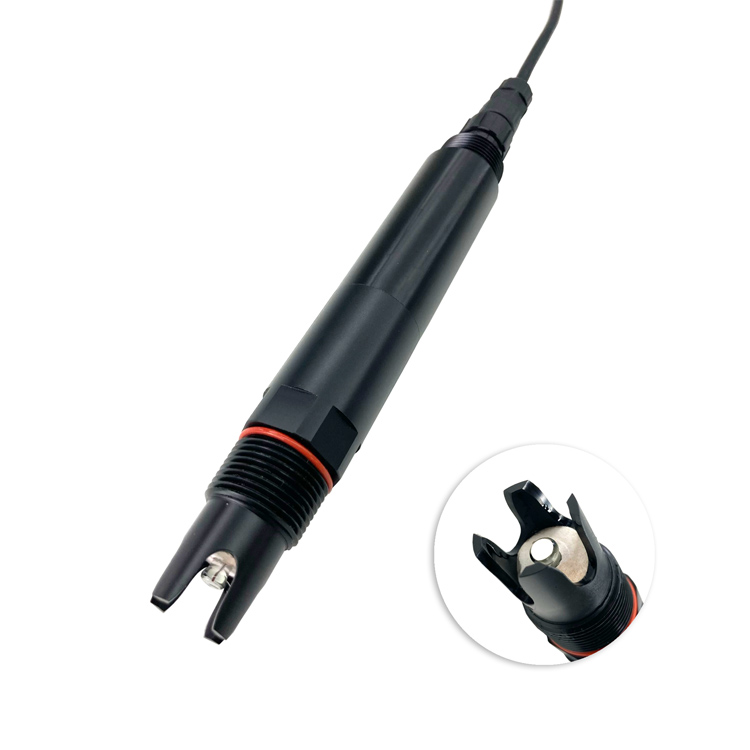
A feature list can make two water-quality instruments look interchangeable even when they create very different workloads. An engineer maintaining a pond probe from a bank needs a retrievable assembly. A treatment-plant technician may need an electrode that can be isolated and serviced without interrupting an entire monitoring panel. A remote station needs power and communications that remain practical throughout the service interval.
Separate essential capabilities from conveniences before comparing prices. A required measurement range, compatible wetted material and usable output are essential. An extra display, additional unused channels or remote configuration may be convenient, but should earn their place through a specific operating need. This prevents a project from buying more electronics while leaving its difficult maintenance task unresolved.
| Feature | Worth considering when | Limitation to examine |
|---|---|---|
| Automatic surface cleaning | Deposits or biological growth repeatedly affect exposed sensing surfaces | Brush reach, wear, obstruction and access for manual cleaning |
| Replaceable sensing element | The sensing surface needs service before the rest of the electronics | Exact spare identity, replacement procedure and post-replacement calibration |
| Multi-parameter body | Several channels must observe the same water at one location | Shared power, cable and retrieval create common interruption points |
| Digital multi-channel output | A PLC, RTU or data logger needs several measurements | Register support, scaling and behaviour when a channel is unavailable |
| Local display | Technicians need to inspect a value without a laptop or working network | Whether the display is included, separately powered and accessible |
| Remote access | Travel is difficult and the operator can act on remote information | Network coverage, access control and the functions actually exposed by the device |
A useful comparison includes the feature's operating cost. Automatic cleaning requires energy and a serviceable mechanism. A local display needs enclosure space and protection. Additional channels require calibration materials and staff time even when their values are rarely used. Ask what work disappears, what work remains and what new work the feature introduces.
An optical dissolved oxygen cap illustrates the distinction between replacing a consumable and replacing an entire instrument. The NiuBoL NBL-WQ-DO uses a fluorescence sensing cap. Cap condition matters to the measurement, so a replacement must be the appropriate part and must be followed by the applicable checks. A mechanically similar cap is not automatically an equivalent optical component.
Service access deserves attention before the mounting bracket is fabricated. The technician should be able to retrieve the probe, clean it and inspect the cap without pulling on the signal cable. Where a plant cannot tolerate a long measurement interruption, a compatible spare probe may be more practical than carrying a spare component that requires careful work beside the process.
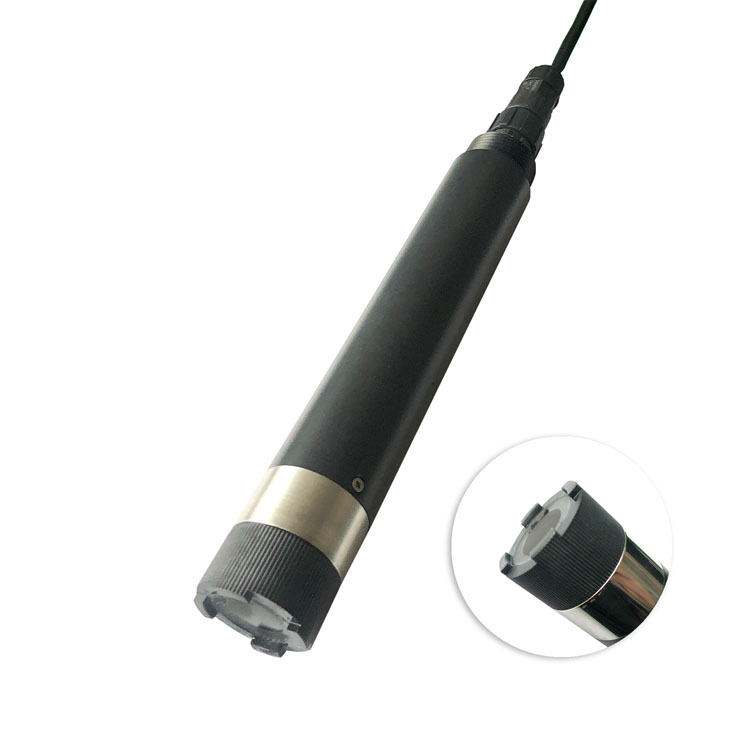
The NBL-WQ-MPS-5A multi-parameter sensor has an automatic cleaning mechanism with adjustable cleaning intervals and cycles. This is relevant when exposed surfaces accumulate fouling between visits. It does not mean that the assembly can be left indefinitely without inspection, and it does not establish that every type of deposit can be removed by brushing.
Distinguish soft biological growth from mineral scale, oily films and fibrous material. A cleaning schedule that helps with one may not resolve another. Inspect the assembly after an initial deployment period and compare readings before and after manual cleaning. If the difference keeps growing, shortening the interval alone may not solve the underlying deposition or mounting problem.
Cleaning also changes how a trend should be interpreted. Water disturbed around the sensing surfaces can cause temporary changes. Establish how the host records the cleaning period and recovery rather than discarding unexplained spikes after the event. Do not assume the sensor provides a cleaning-status register unless that function is documented for its firmware.
| NBL-WQ-MPS-5A item | Specification | Configuration consequence |
|---|---|---|
| Channel capacity | Up to eight parameters including temperature | Select the actual module combination; capacity is not a list of included modules |
| Supply | 12 V DC +/-5% | Required input range is 11.4-12.6 V at the assembly |
| Power consumption | 5 W at 12 V | Obtain cleaning peak and duty information for final supply sizing |
| Output | RS485, Modbus RTU | A compatible host must read and interpret the selected channels |
| Cable | 5 m standard; four-core twisted-pair shielded construction | Specify extension length, sealing and jacket suitability separately |
| pH module | 0-14 pH; +/-0.1 pH; resolution 0.01 pH | Do not use display resolution as the allowable control error |
| ORP module | -1500 to +1500 mV; +/-6 mV; resolution 1 mV | Host processing must accommodate negative readings |
| Temperature measurement | 0-50 C; +/-0.3 C; resolution 0.1 C | This is a measurement specification, not a substitute for complete assembly environmental limits |
For example, a regulated supply set to 12.0 V with a measured 0.8 V drop at the probe delivers only 11.2 V. That is below the 11.4 V lower limit. This is an illustrative wiring calculation, not a measurement from a customer site. Increasing battery capacity would not correct that voltage drop; cable resistance, connections and power distribution need attention.
The quoted 5 W corresponds to about 0.42 A at 12 V. Use that only as a reference operating calculation, not as the cleaner's verified peak demand. A solar station also needs the logger, modem, conversion losses and local energy conditions included in its design. A low-power label by itself is not a battery-autonomy specification.
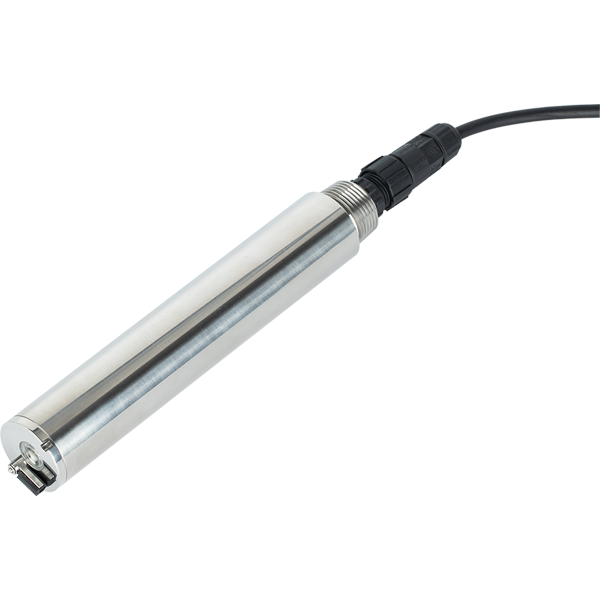
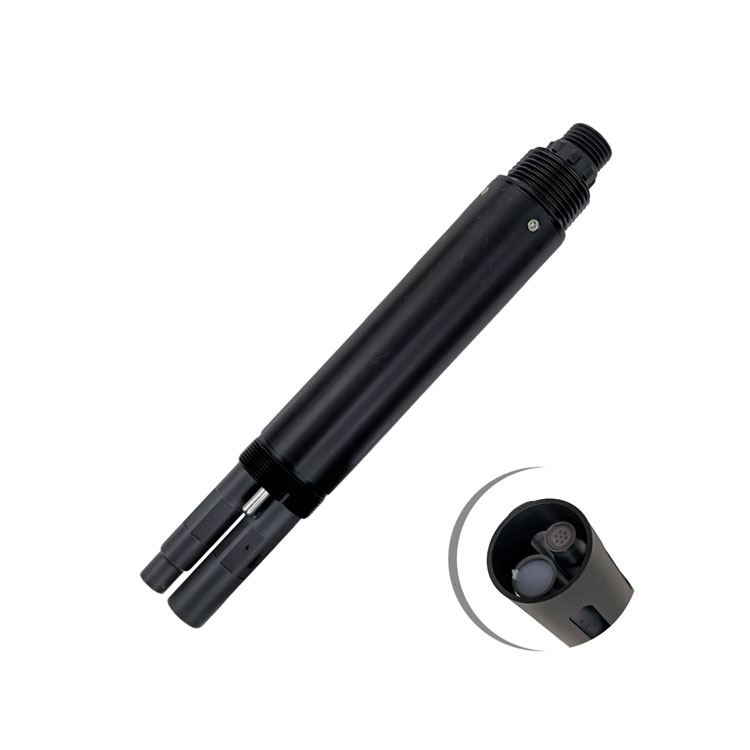
A shared body is attractive when turbidity, pH, oxygen and conductivity belong at the same location. It can reduce the number of mounting points and make retrieval straightforward. However, lifting the assembly for one channel's maintenance may interrupt several measurements. For a process that depends continuously on one value, a separate sensor or an independent comparison point may be more suitable.
The same reasoning applies to measuring conditions. An immersion turbidity probe and a low-range flow-through instrument may both report NTU, yet they require different hydraulic arrangements. A multi-parameter body cannot replace a controlled sample cell simply because it has a turbidity module. Choose the measurement arrangement first, then decide whether shared packaging makes the installation easier.
For a fish-production site, oxygen response and serviceability may dominate the decision. For a river station, retrievability, debris exposure and station power may be more important. For wastewater, surface deposits and access around tanks may determine whether a feature remains usable after commissioning. These priorities are different; a single feature ranking is not suitable for all three settings.
A sensor's RS485 Modbus RTU output provides a local communication path. A gateway can then transfer data to a remote application, but the sensor itself does not thereby acquire cellular communication, local storage or cloud functions. Price and specify the sensor, host and remote connection according to the capabilities each device actually provides.
For an existing installation, check whether the controller can support the added registers without changing the entire application. Reading a value is only part of the job: the operator also needs to distinguish a fresh reading from an old one retained after a timeout. Define that behaviour in the host instead of assuming every probe supplies identical diagnostics.

For each proposed option, write the site problem and the observable benefit. If the problem is frequent cap fouling, ask about the cleaning arrangement and retrieval method. If the problem is incompatible PLC inputs, resolve the interface before adding more channels. If the problem is travel for routine checks, identify which checks can genuinely be performed remotely and which still require hands at the probe.
Send NiuBoL the required parameters, normal and exceptional water conditions, available supply, controller type and expected maintenance access. A configuration discussion can then identify whether a multi-parameter assembly, separate digital probes or additional station hardware is appropriate. There is little value in pricing unused options before the difficult installation conditions have been resolved.
No. It is useful when surface fouling is a significant cause of measurement degradation and the cleaning mechanism can address that fouling. In relatively clean water with easy access, the additional mechanism and power demand may offer less benefit. Evaluate deposits and service travel together.
Not necessarily. Capacity describes what the platform can accommodate, while the supplied configuration identifies installed modules. For NBL-WQ-MPS-5A, the eight-parameter capacity includes temperature. Request the actual channel list rather than assuming eight independent chemical sensors are fitted.
NBL-WQ-MPS-5A requires 12 V DC +/-5%, so it should not be connected directly to a 24 V supply. A suitable regulated supply arrangement is needed, with voltage checked at the probe under load. Other NiuBoL sensor models may have different input ranges.
No. Enclosure ingress protection does not establish resistance to every solvent, cleaning chemical or process liquid. Check wetted materials, seals, connectors, pressure and temperature for the complete selected assembly. Do not transfer an individual module's rating to the whole station.
No. A remote command cannot clean an electrode, place it in a reference solution or inspect a damaged cap. Remote functions can assist a supported procedure, but the physical work and reference conditions still need to be provided at the instrument.
Request an itemized configuration and compare the costs associated with the actual problem: cleaner, mounting, spares, power supply and host changes. A feature is economically useful when it reduces relevant service or integration work, not merely because it appears in a longer specification list.
Select water quality meter product features around maintenance access, measurement duty and the existing electrical system. NiuBoL multi-parameter and individual sensor options support different arrangements; the appropriate choice is the one whose useful functions remain practical to power, install and service at the intended site.
Prev:Types of Water Quality Meters: Field, Bench and Online Instruments
Next:Water Quality Testing Instrument Brand Evaluation for Industrial Procurement
Related recommendations
Sensors & Weather Stations Catalog
 Agriculture Sensors and Weather Stations Catalog-NiuBoL.pdf
Weather Stations Catalog-NiuBoL.pdf
Agriculture Sensors Catalog-NiuBoL.pdf
Water Quality Sensor Catalog-NiuBoL.pdf
Related products
 Combined air temperature and relative humidity sensor
 TDR Soil Moisture & Temperature Sensor for irrigation| RS485 |4-20mA| NBL-S-THR
 Soil pH sensor RS485 soil Testing instrument soil ph meter for agriculture |NBL-S-PH
 Wind Speed sensor Output Modbus/RS485/Analog/0-5V/4-20mA
 Tipping bucket rain gauge for weather monitoring auto rainfall sensor RS485/Outdoor/stainless steel
 Pyranometer Solar Radiation Sensor 4-20mA/RS485


Screenshot, WhatsApp to identify the QR code
WhatsApp number:+8615367865107
(Click on WhatsApp to copy and add friends)

