





— Blogs —
—Products—
 Consumer hotline +8618073152920
WhatsApp:+8615367865107
Address:Room 102, District D, Houhu Industrial Park, Yuelu District, Changsha City, Hunan Province, China
Product knowledge
Time:2026-09-15 08:00:00 Popularity:207
Quick Answer: The main types of water quality meters include portable field meters, bench instruments and permanently installed online instruments. Within online monitoring, immersion probes and flow-through instruments have different sample and maintenance requirements. Choose the format by where the measurement must occur, whether an operator is present and whether the required method needs sample preparation. A shared parameter name does not make these arrangements interchangeable.
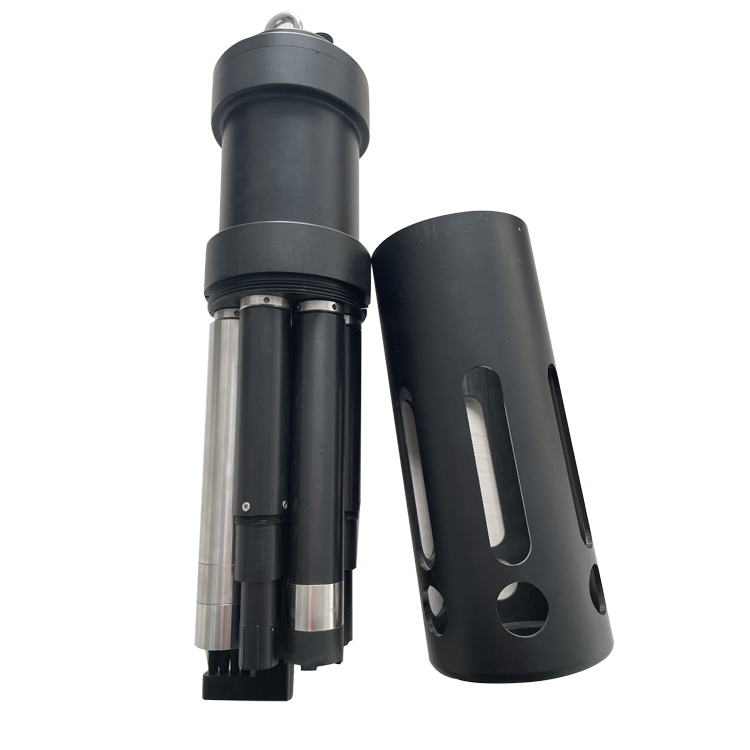
The first axis is the measurement method: an electrode, optical sensing surface or analytical reaction produces the result. The second is the deployment format: a technician carries the equipment, a sample goes to a bench, or installed equipment measures continuously. Confusing these axes leads to specifications such as an online laboratory meter without a clear description of how water reaches the instrument.
A pH electrode, for example, can operate with a handheld readout, a bench meter or a fixed transmitter. The underlying measurement does not establish battery runtime, outdoor protection or permanent logging. Conversely, two online COD instruments may use different methods even though both are installed in cabinets. The purchase description must identify both the method and the complete measurement arrangement.
| Instrument format | What reaches the instrument | Suitable task | Main constraint |
|---|---|---|---|
| Portable field meter | An operator places a probe in water or tests a collected sample | Surveys, troubleshooting and attended checks | Coverage depends on the visit and the operator's procedure |
| Bench instrument | A prepared or unprepared sample is brought to a controlled work area | Repeatable sample analysis and specified laboratory methods | Transport and preparation can change the sample or delay the result |
| Online immersion probe | The surrounding process or environmental water contacts the sensor | Unattended observation at a defined point and depth | Exposure, representative placement and retrieval access |
| Online flow-through instrument | A controlled sample stream passes through a measuring cell | Measurements requiring a defined hydraulic arrangement | Sample delivery, flow, pressure and drainage |
| Automatic analytical instrument | A sample is admitted into a programmed analytical cycle | A specified reaction or preparation-based measurement | Cycle time, consumables, waste and method suitability |
Choose a portable arrangement when the technician needs to compare several locations or investigate a fixed installation. Check the complete kit: compatible probe, readout, calibration materials, transport protection and usable records. A digital probe supplied without a readout is not a complete portable meter. An IP68 sensing body also does not establish that a connected handheld display can be left outdoors.
A bench arrangement is useful when the work needs controlled preparation, a stable work surface or a prescribed analytical sequence. It is not automatically a more representative observation of the process. Water taken from an aerated basin can change before it reaches the bench; suspended particles can settle, and temperature can change. The sampling and handling procedure belongs in the method selection.
For pH verification, decide whether the objective is to compare instruments or examine a transported sample. In the first case, matched water, time and temperature are important. In the second, record what happened between collection and measurement. An unexplained difference should not be resolved by adjusting the installed electrode to every later bench result.
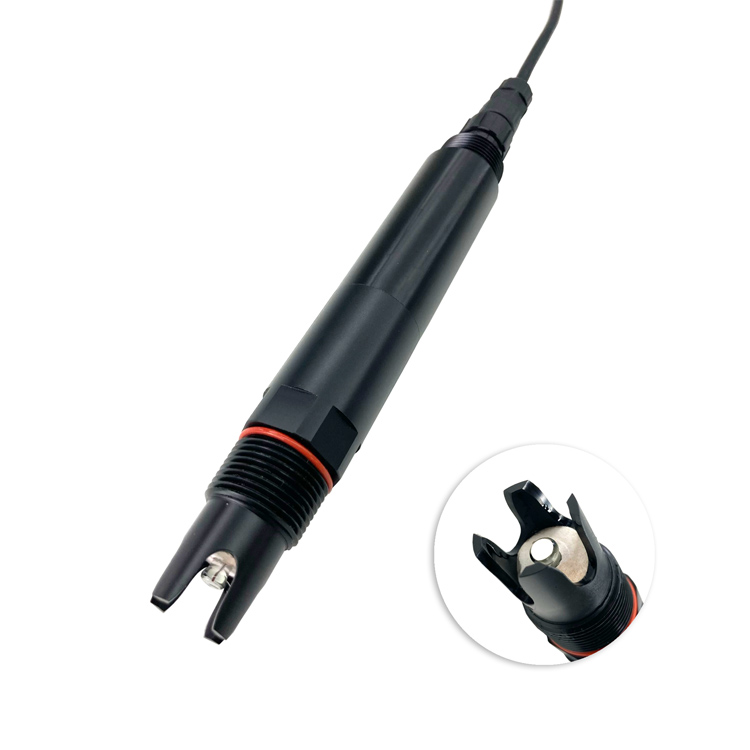
An immersion probe suits a tank, pond, river or channel when it can contact representative water and be serviced safely. It removes the need for a long sample transport line but retains the risks at the measuring point: deposits, changing depth, debris and local mixing. A convenient railing is not a sufficient reason to choose the location.
Optical dissolved oxygen is one example. A sensor at a poorly mixed corner may disagree with one beside an aerator because the water differs, not because one instrument type is defective. First define the zone that the measurement should represent. A portable survey can help establish that location before a permanent support is fabricated.
For a combined probe, check whether the chosen channels genuinely need the same water and service schedule. Lifting one assembly can interrupt every fitted channel. Separate probes may be more practical when one electrode needs frequent attention or one measurement belongs at another depth. Combined packaging reduces hardware at one point; it does not remove spatial differences.
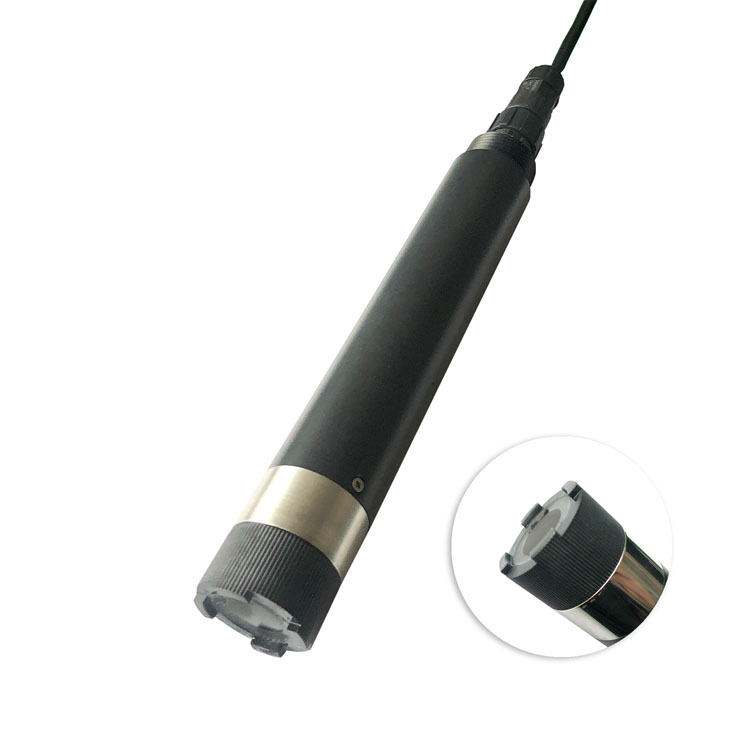
A flow-through cell brings water to a defined measuring space. This can improve service access and provide the conditions required by a particular method. It adds a sample inlet, flow control and discharge route. If the intake blocks, the instrument may continue measuring retained water while returning valid-looking digital responses.
The NiuBoL NBL-WQ-CL residual chlorine probe uses a matching circulation cell with a recommended 30-60 L/h flow. Its specified concentration range is expressed as HClO. Selecting it therefore requires both a hydraulic arrangement and agreement on the chlorine reporting basis. A water sample in an arbitrary beaker does not reproduce the intended continuous-flow duty.
Turbidity illustrates another selection boundary. A wide-range immersion probe and a low-range flow-through instrument may both report NTU but have different usable low-level performance and sample requirements. Inspect accuracy near the decision level, bubble handling and permitted flow. Do not choose between them using maximum range alone or transfer one model's detection limit to another.
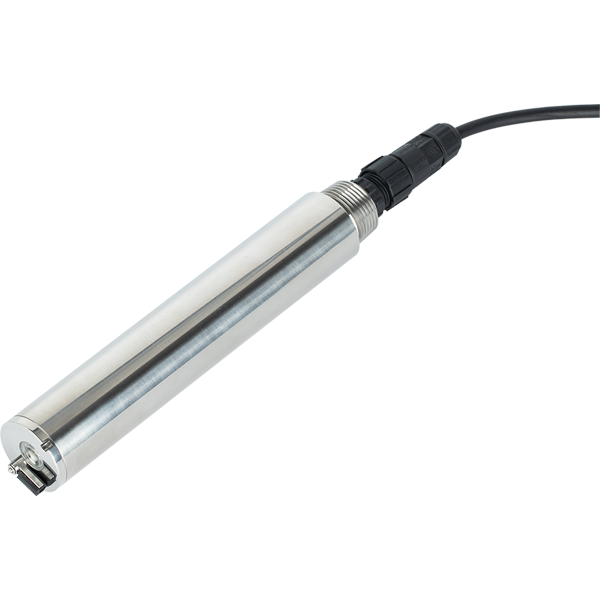
The following NiuBoL examples show why online is not one electrical or mechanical specification. The MPS-5A is a configurable immersion assembly; the CL is a particular electrochemical channel used with its circulation cell. Neither example establishes a universal specification for portable or bench equipment.
| Selection item | NBL-WQ-MPS-5A | NBL-WQ-CL |
|---|---|---|
| Measurement arrangement | Selected modules in a shared immersion assembly | Residual chlorine electrode in a matching circulation cell |
| Range and accuracy example | Optional pH module: 0-14 pH, +/-0.1 pH | 0-2.000 mg/L as HClO; +/-5% or +/-0.05 mg/L, with the acceptance rule agreed for the configuration |
| Supply and consumption | 12 V DC +/-5%; 5 W at 12 V | 12-24 V DC; 0.2 W at 12 V |
| Output | RS485 Modbus RTU for the installed channels | RS485 Modbus RTU |
| Cleaning and access | Adjustable automatic brush; provide retrieval access | Provide electrode and circulation-cell access for the specified maintenance procedure |
| Water exposure | Confirm assembly immersion, temperature and pressure limits for the selected modules | 5-50 C; medium pH 4-9; recommended flow 30-60 L/h |
| Protection boundary | Confirm the assembled configuration; do not infer a cabinet rating from a fitted module | IP68 probe rating does not protect the station's external terminals |
| Cable | 5 m standard shielded cable | 5 m standard cable; confirm extensions and jacket construction |
For the MPS-5A, a 24 V panel needs a suitable regulated supply rather than a direct connection to the assembly. For the CL, probe power is only one station load; any sample pump and communication equipment require their own allowance. Small sensor consumption does not establish the power requirement of a complete sample station.
Some measurements require sample preparation or a reaction before the instrument can report a result. For example, EPA Method 410.4 determines COD through digestion followed by colorimetric measurement. This is a different analytical route from a UV-absorption probe that reports a calibrated COD estimate without that digestion step.
Choose according to the required result and its intended use. An optical probe can provide frequent operational trends after matrix evaluation, while a specified analytical procedure may be required for another duty. A shared mg/L label does not prove method equivalence. Do not assume that NiuBoL supplies every laboratory instrument category simply because it supplies online water-quality sensors.
Similarly, an automatic sampler collects water for subsequent examination; it does not by itself measure the selected pollutant. If the event requires both a rapid warning and a retained sample, identify the sensing and sampling functions separately. Record the time relationship between the alarm, sample collection and later analysis.
Ask the site technician to describe one complete measurement or service cycle. For a portable kit, follow the route and record handling. For an immersion probe, demonstrate retrieval. For a flow-through panel, inspect isolation, flow verification and drainage. For an analyzer, identify the preparation work and waste route. This reveals constraints that a parameter list misses.
Then compare costs for the same duty. A bare probe, a complete field kit and an installed sampling panel are different purchases. Request the specific combination of instrument, readout, mounting or hydraulics and service items. Additional background is available in the portable versus online monitoring comparison; measurement response is covered in the water quality meter working principle guide.

No. It combines channels that may use different principles. The MPS-5A supports configurations of up to eight parameters including temperature, but the order must identify the installed modules. Each channel retains its own range, interpretation and maintenance needs.
Only with a compatible arrangement validated for that probe. Cell dimensions, exchange, bubbles and wall effects may matter. A container that physically holds the sensor does not establish that it reproduces the intended measurement conditions.
Not merely because it can store readings. The complete installation would need appropriate sample delivery, unattended operation, protection and recovery behavior. Specify those capabilities explicitly rather than treating a bench power adapter as an online conversion.
Any proposed type needs a verified interface on the exact model. For NiuBoL digital probes, the PLC or intermediary must support RS485 Modbus RTU and the correct register decoding. A USB socket or a serial connector alone does not establish the required integration.
Test the complete arrangement at a representative site, including sample handling or retrieval and one interruption-recovery cycle. Confirm that operators can maintain it with the available access and equipment. A successful measurement in a clean vessel does not test these installation duties.
Identify the parameter and required method, water conditions, measuring location and whether readings are attended or continuous. Include the available power and receiving controller. State whether the request covers a probe or a complete measuring point so the proposed format and quotation match.
Compare types of water quality meters by both measurement method and deployment format. Portable, bench, immersion and flow-through equipment place different demands on operators and sample handling. NiuBoL online probes should be selected where their actual measurement and installation requirements fit the duty, with analytical and attended measurements retained where those tasks require them.
Prev:Water Quality Meter Working Principle and Application in Industrial Projects
Next:Water Quality Meter Product Features That Matter in Engineering Procurement
Related recommendations
Sensors & Weather Stations Catalog
 Agriculture Sensors and Weather Stations Catalog-NiuBoL.pdf
Weather Stations Catalog-NiuBoL.pdf
Agriculture Sensors Catalog-NiuBoL.pdf
Water Quality Sensor Catalog-NiuBoL.pdf
Related products
 Combined air temperature and relative humidity sensor
 TDR Soil Moisture & Temperature Sensor for irrigation| RS485 |4-20mA| NBL-S-THR
 Soil pH sensor RS485 soil Testing instrument soil ph meter for agriculture |NBL-S-PH
 Wind Speed sensor Output Modbus/RS485/Analog/0-5V/4-20mA
 Tipping bucket rain gauge for weather monitoring auto rainfall sensor RS485/Outdoor/stainless steel
 Pyranometer Solar Radiation Sensor 4-20mA/RS485


Screenshot, WhatsApp to identify the QR code
WhatsApp number:+8615367865107
(Click on WhatsApp to copy and add friends)

