





— Blogs —
—Products—
 Consumer hotline +8618073152920
 WhatsApp:+8615367865107
Address:Room 102, District D, Houhu Industrial Park, Yuelu District, Changsha City, Hunan Province, China
Product knowledge
Time:2026-02-05 11:41:44 Popularity:660
A forward scattering visibility sensor estimates meteorological optical range from light scattered within a small sample of air. It is useful when a project needs an electronic visibility input without a long transmitter-to-receiver baseline. It does not measure how far every driver, vessel operator or pilot can see. Choosing it requires agreement on the optical quantity, the conditions it must represent and the way the receiving system will use the result.
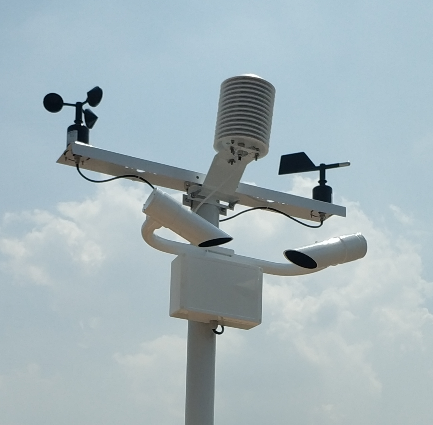
The first decision is whether the project needs a local atmospheric observation, attenuation along a defined path, or interpretation of a camera scene. These are different tasks. A road operator may need local fog measurements at several exposed sections; a process engineer may need a measurement across a particular optical path. Buying the same instrument for both can leave a gap even when its measuring range appears adequate.
| Method | Measurement basis | Selection consequence |
|---|---|---|
| Forward scatter | Scattered light in a localized sampling volume, converted to MOR | Compact monitoring point; local air must represent the area of interest |
| Optical transmission | Light attenuation between separated optical units | Requires a defined baseline, alignment and suitable foundations |
| Camera analysis | Image contrast or scene features processed by software | Depends on the scene, lighting and validated interpretation method |
No method should be ranked by a blanket claim that it is always more accurate or less expensive. Compare the required range, environmental conditions, maintenance access and acceptance method. A camera already present at the site may provide useful context, but that does not make its image-derived distance interchangeable with an optical MOR measurement.
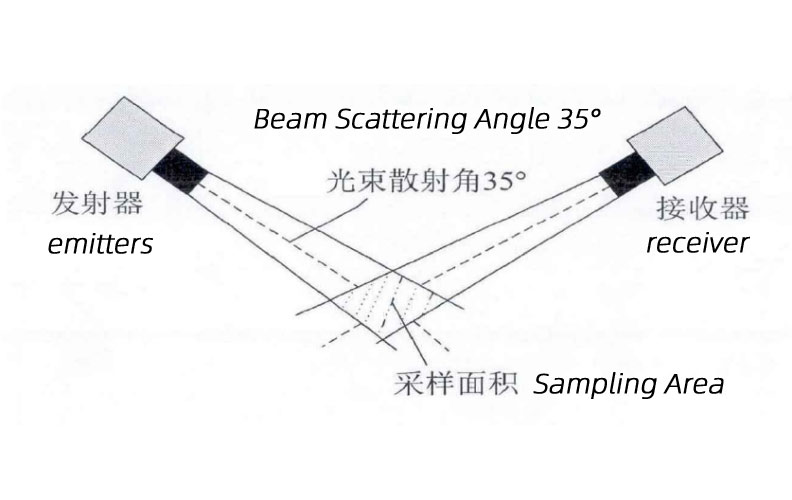
The diagram illustrates the scattering principle, not the specific optical geometry of NBL-W-VS. Use the model's 39-51 degree scattering angle in the specification table below rather than the illustrative angle in the diagram.
Meteorological optical range describes atmospheric light attenuation using a defined transmission criterion. The Met Office explanation of visibility measurement uses transmission reduced to 5% of its original value. Under the corresponding homogeneous-path model, MOR is approximately 3 divided by the extinction coefficient, when the coefficient is expressed per metre.
For example, an extinction coefficient of 0.003 per metre corresponds to approximately 1,000 m MOR. This is an illustration of the optical relationship, not an NBL-W-VS register conversion or a site alarm setting. The sensor provides a calculated distance; the PLC or data logger should decode that output using the instrument's actual data definition.
Forward scatter observes only a small part of the scattering pattern and uses a conversion model. Particle characteristics and the relationship between scattering and total extinction matter. Avoid assuming that one conversion is equally representative of every mixture of fog, smoke, dust and precipitation. A specification for measurement accuracy also does not include every error introduced by an unsuitable location or dirty optics.
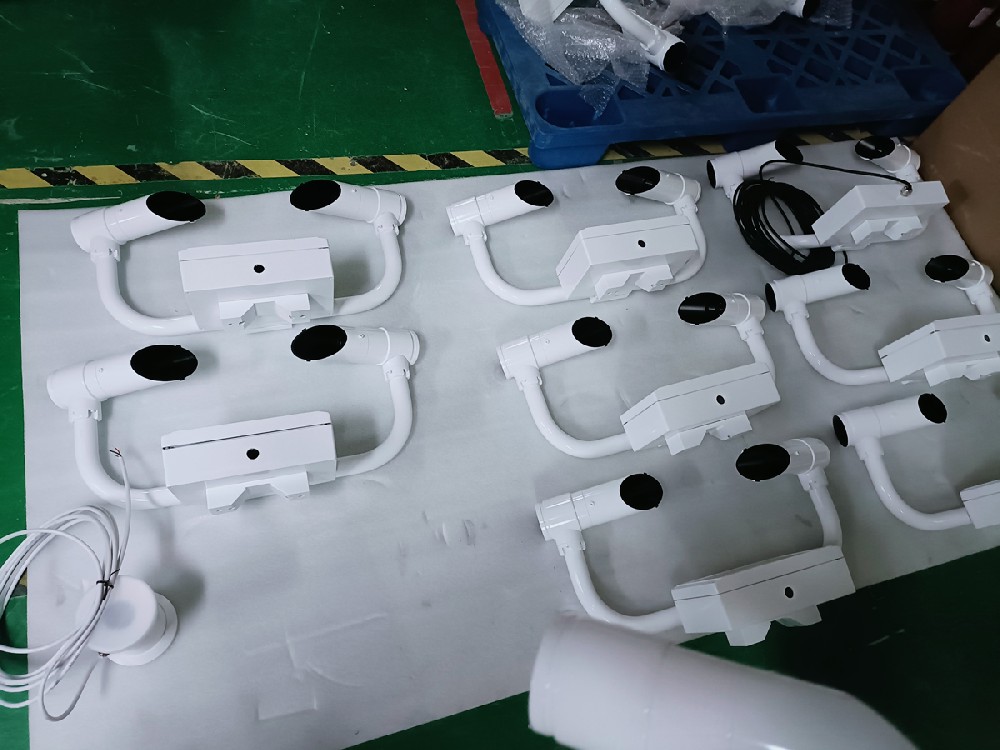
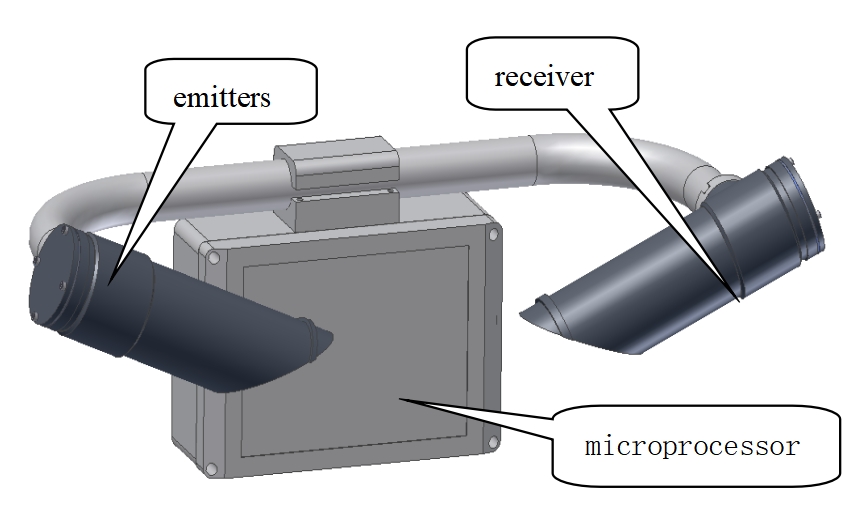
The NiuBoL NBL-W-VS is a forward-scattering MOR sensor with RS485 Modbus RTU communication. Its 5 m to 10 km range can cover reduced-visibility observations in transport and outdoor monitoring. It is not a dust mass-concentration instrument, a precipitation classifier or a complete runway visual range system.
| Parameter | NBL-W-VS |
|---|---|
| Measured quantity | Meteorological optical range, 5-10,000 m |
| Accuracy | 2% at distances up to 2 km; +/-10% from 2 to 10 km |
| Optical arrangement | 39-51 degree forward scattering; 875 nm peak wavelength |
| Supply and average power | 12 V DC; approximately 0.8 W |
| Data interface | RS485 Modbus RTU; default 9600 bps |
| Operating environment | -40 to +80 C; 0-95% RH |
| Protection and cable | IP65; standard 10 m instrument cable |
| Construction | Protected anodized aluminum housing and stainless steel structural components |
Check performance around the decision boundary, not just at the upper range limit. A hypothetical warning transition at 500 m requires useful discrimination near 500 m and a suitable temporal rule. The value 500 m here is not a recommended traffic threshold. The responsible operator must define warning and recovery conditions for the actual application.
A 10,000 m value also needs a defined display interpretation. It may be the highest reportable value rather than proof that the atmosphere has exactly that range. Do not extend the instrument's specification by extrapolating a clear-weather reading beyond 10 km.
A sensor in clear air cannot describe a fog bank farther along the road. The engineering task is to identify separate low-visibility sections and determine whether each needs its own observation point. Use local MOR alongside site context and the operator's traffic procedure. A visibility value alone does not calculate stopping distance or authorize a particular speed limit.
Sea fog, spray and salt deposits can affect both the atmosphere and the optical surfaces. Separate an atmospheric event from contamination of the instrument window through inspection and available status information. A shore-side observation does not automatically represent an entire channel, and IP65 does not make the device suitable for immersion or unrestricted seawater exposure.
Place the sensor according to the question being asked. A location beside an exhaust outlet may describe that plume, not general site visibility. If the project also needs PM2.5 or PM10 mass concentration, select a separate suitable particle instrument. MOR in metres cannot be converted to a universal dust concentration without additional assumptions and validation.
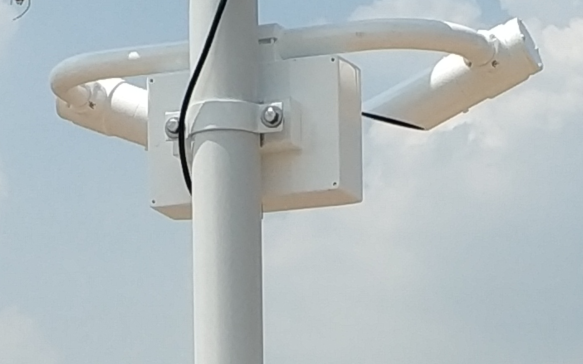
The integration chain is NBL-W-VS, then a compatible PLC, RTU or data logger, then the display or supervisory platform. RS485 describes the electrical interface and Modbus RTU the serial messaging. Neither provides a complete warning policy, network security design or certified aviation function. Match device address, serial settings, data unit and polling interval before testing higher-level actions.
Read at intervals of at least 1,000 ms for the documented communication arrangement. Confirm the supplied register map instead of copying a map from another environmental sensor. Log timestamps and communication validity with the MOR value. An unchanged screen after a cable fault must not look like a fresh observation.
For an alarm demonstration, use a clearly identified test input to the supervisory logic and verify notification, persistence and recovery. Do not assume that covering a receiver produces a calibrated fog condition. Test the actual optical instrument separately with an appropriate verification procedure and equipment.
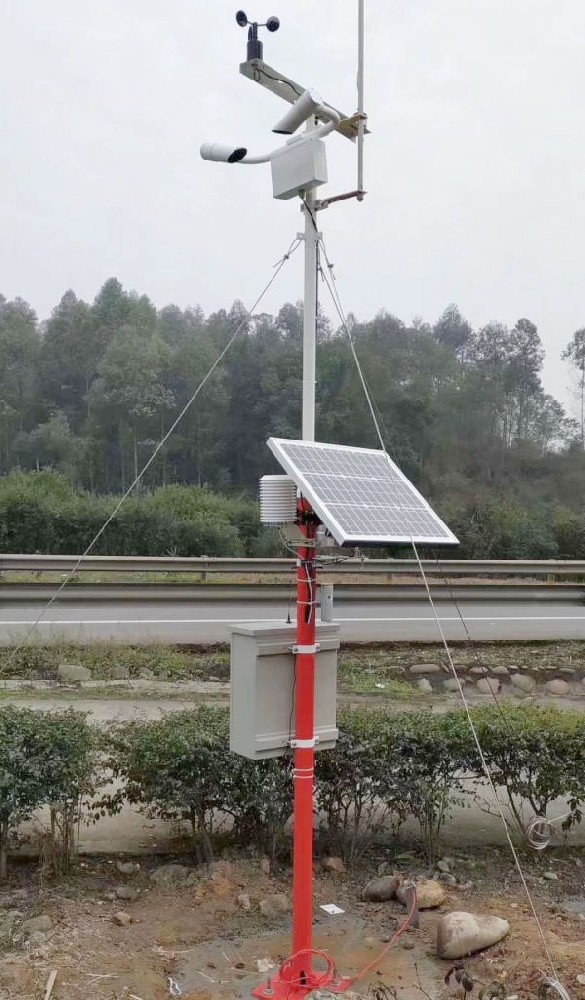
A forward scattering visibility sensor quotation should identify the instrument, cable and mounting hardware, power arrangement, acquisition equipment and any verification accessories. Add access costs where cleaning requires road closures, a lift or port permits. These items can change the installed cost substantially without changing the sensor model.
The 0.8 W average load corresponds to approximately 19.2 Wh per day for continuous sensor operation alone. A solar design must also supply the logger, modem, conversion losses and any separately specified heater. A low operating-temperature rating is not evidence that an optical window cannot ice, and an optional function should not be included in the power budget until it is defined.
Cleaning about every three months is a starting inspection interval, not a reason to skip checks between visits. Dust and salt may require earlier attention. Specify who performs cleaning, how the optical condition is checked and how questionable records are marked. For an aviation project, request separate confirmation of the required approvals and RVR system scope rather than accepting a generic airport application statement.
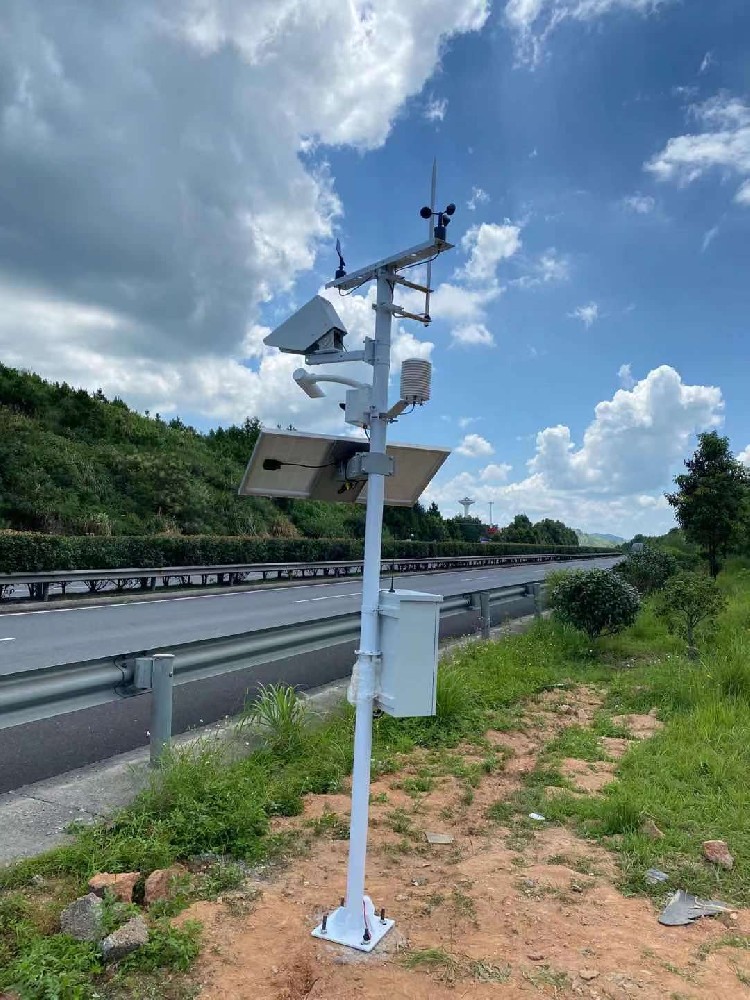
When a representative local MOR observation and compact mounting arrangement fit the project. A transmissometer may be appropriate when a defined optical baseline is part of the measurement requirement. Compare the complete measurement and maintenance arrangements, not only the number of optical units.
Not by itself. MOR and RVR are distinct quantities, and an operational aviation system has additional requirements. Confirm the required measurement, approved configuration and acceptance process before specifying this sensor for that purpose.
No. The camera may observe a different path and use different contrast criteria. Compare matched conditions and understand both methods before treating disagreement as a sensor fault.
MOR describes reduced optical range, not a definitive particle classification. Use additional suitable observations where the cause changes the operating response. Do not label an event solely from its visibility distance.
Provide the monitored area, decision distances, installation locations, power source, acquisition interface and maintenance access. Identify whether the project requires routine MOR monitoring or a separately regulated operational system so that the offered scope can be evaluated correctly.
Select a forward scattering visibility sensor for a defined local optical measurement. For NBL-W-VS, evaluate the 5 m to 10 km MOR range, representative sampling, RS485 integration and optical maintenance together. The useful purchase is a measurement that the receiving system can interpret correctly, with operational actions assigned to the responsible application rather than inferred from the sensor specification.
Prev:Roadside Visibility Sensor Placement and Fault Checks: NBL-W-VS
Next:Distributed PV Environmental Monitoring: Diagnose Low Output
Related recommendations
Sensors & Weather Stations Catalog
 Agriculture Sensors and Weather Stations Catalog-NiuBoL.pdf
Weather Stations Catalog-NiuBoL.pdf
Agriculture Sensors Catalog-NiuBoL.pdf
Water Quality Sensor Catalog-NiuBoL.pdf
Related products
 Combined air temperature and relative humidity sensor
 TDR Soil Moisture & Temperature Sensor for irrigation| RS485 |4-20mA| NBL-S-THR
 Soil pH sensor RS485 soil Testing instrument soil ph meter for agriculture |NBL-S-PH
 Wind Speed sensor Output Modbus/RS485/Analog/0-5V/4-20mA
 Tipping bucket rain gauge for weather monitoring auto rainfall sensor RS485/Outdoor/stainless steel
 Pyranometer Solar Radiation Sensor 4-20mA/RS485

Screenshot, WhatsApp to identify the QR code
WhatsApp number:+8615367865107
(Click on WhatsApp to copy and add friends)

