





— Blogs —
—Products—
 Consumer hotline +8618073152920
WhatsApp:+8615367865107
Address:Room 102, District D, Houhu Industrial Park, Yuelu District, Changsha City, Hunan Province, China
Product knowledge
Time:2026-08-03 09:36:56 Popularity:270
Quick Answer: Use an ammonia nitrogen sensor across a RAS biofilter or nitrification stage only after confirming what each channel reports and whether the instruments can resolve the expected difference. Match inlet and outlet water, timing and flow. A lower outlet concentration alone does not prove a nitrification rate, total nitrogen removal or a safe un-ionized ammonia level.
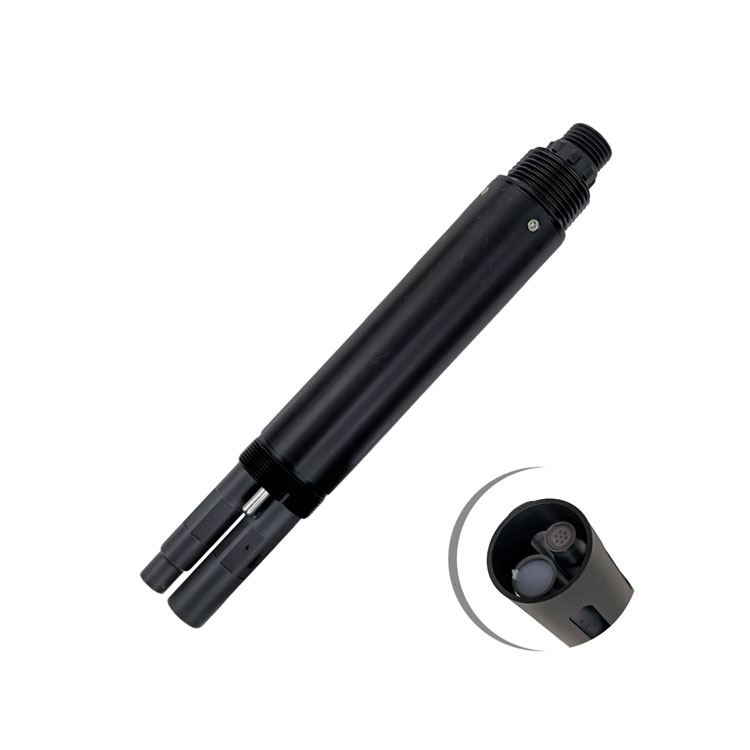
Ammonia monitoring can help investigate feed-load changes, biofilter stress and nitrification imbalance. The NiuBoL NHN probes use an ammonium ion-selective electrode. That principle does not directly measure every ammonia species or total nitrogen.
Confirm whether each delivered channel is reported as ammonium ion mass, ammonium as nitrogen, total ammonia nitrogen through a supported calculation, or another defined result. The laboratory comparison and both online points must use the same basis before their values are subtracted.
For species and alarm interpretation, see the aquaculture ammonia measurement guide. Here the engineering question is whether a pair of observations can support a useful conclusion about the treatment stage.
The opening image shows the base NiuBoL NHN. The NHN-4S below is a separate configuration; its available ranges must not inherit the base model's 0-10 mg/L option.
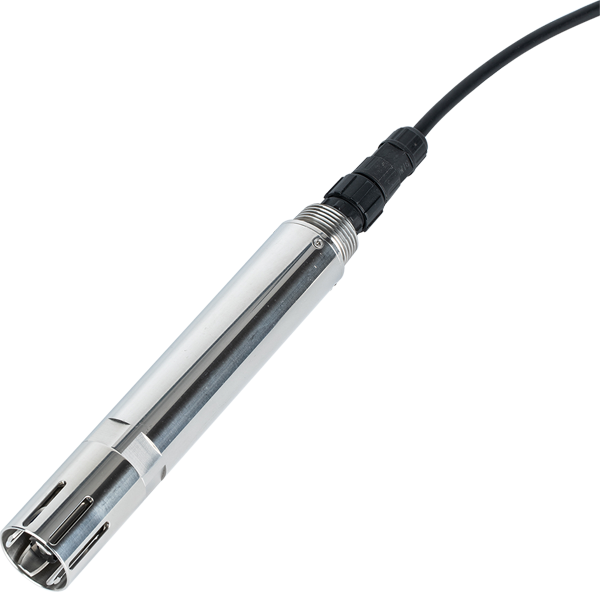
| NHN-4S item | Specification | Meaning for paired measurements |
|---|---|---|
| Range; resolution | 0-100.00 or 0-1000.0 mg/L; 0.01 or 0.1 mg/L | Use the ordered span and correct units |
| Accuracy | +/-10% or +/-1 mg/L, whichever is greater; confirm percentage basis for the ordered unit | A small displayed inlet/outlet difference is not automatically resolved |
| Water conditions | 0-40 degrees C; pressure below 0.1 MPa; pH 4-10 | Check both actual locations and the water matrix |
| Temperature compensation | Pt1000; temperature accuracy +/-0.5 degrees C | Not proof of a complete TAN or NH3 calculation |
| Supply; consumption | 12-24 VDC; 0.2 W at 12 V | Add logger and network loads |
| Output | RS485 Modbus RTU; optional 4-20 mA | Confirm each channel's reporting basis and scale |
| Construction; mounting | POM/316L; IP68; 3/4 NPT immersion | Provide representative water and repeatable service access |
| Cable | Standard 5 m shielded; custom length available | Specify jacket, support and protected terminations |
Consider an illustrative inlet reading of 2.4 mg/L and outlet reading of 2.0 mg/L on the same basis. The apparent difference is 0.4 mg/L, or 16.7% of the inlet value. It is smaller than the stated 1 mg/L error term of either NHN-4S alone. Those numbers cannot establish a precise removal percentage from the display increments.
This is not a measured NiuBoL result or a complete uncertainty calculation. If the expected treatment difference is small, obtain demonstrated suitability for that decision or choose an appropriate alternative measurement arrangement before specifying two broad-range probes.
Mark the inlet and outlet relative to bypasses, dilution, recirculation and chemical addition. A change between points can reflect mixing rather than conversion in the biofilter. Record flow and operating state, and account for hydraulic and sample-line delays when load is changing.
Do not automatically subtract same-clock readings from a rapidly changing inlet and outlet. Those readings may describe different water passing the two points. Equally, do not assume a single fixed delay represents every flow or mixing state.
Check both instruments together in representative water before attributing their disagreement to treatment. Verify their permitted reference checks and conditioning first. An imposed offset that merely forces agreement can hide a real instrument or matrix problem.
For a suitably defined stage with approximately steady, equal inlet and outlet flow, an apparent mass-rate difference can be calculated as Q x (Cin - Cout) / 1000 when Q is in m3/day and both concentrations are in mg N/L. The result is kg N/day. If flows differ or side streams exist, use the separate inlet and outlet mass flows instead.
As an arithmetic example, 100 m3/day and a validated 2 mg N/L concentration difference give 0.2 kg N/day. This is not a biofilter rating or a measured project outcome. In a recirculating system, filter-loop flow is not the same as fresh feed or makeup flow, and repeated circulation must not be counted as independent new nitrogen input.
A decrease in ammonium does not establish total nitrogen removal. Appropriate nitrite, nitrate, alkalinity and process observations may be needed to investigate the mechanism. Do not calculate a biological capacity from an unresolved concentration difference.
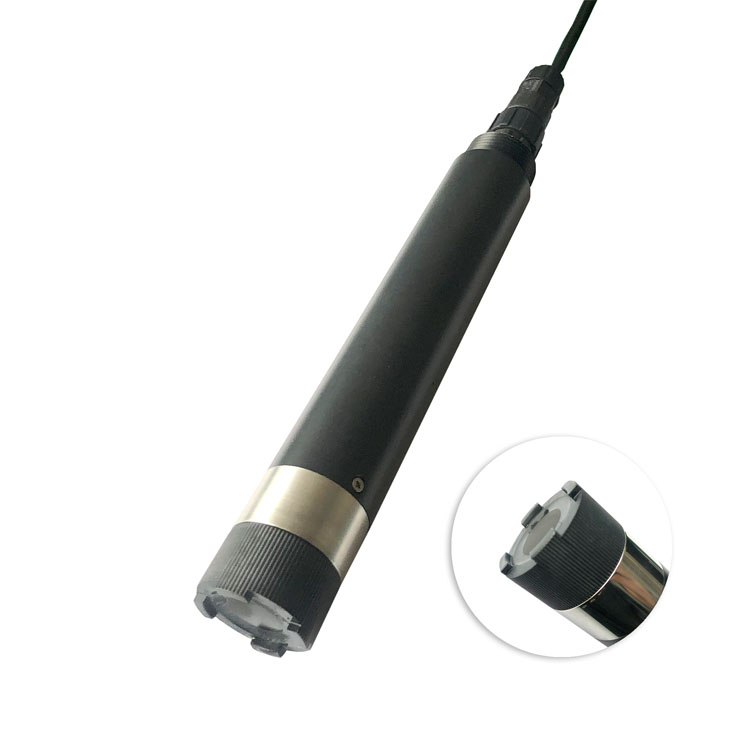
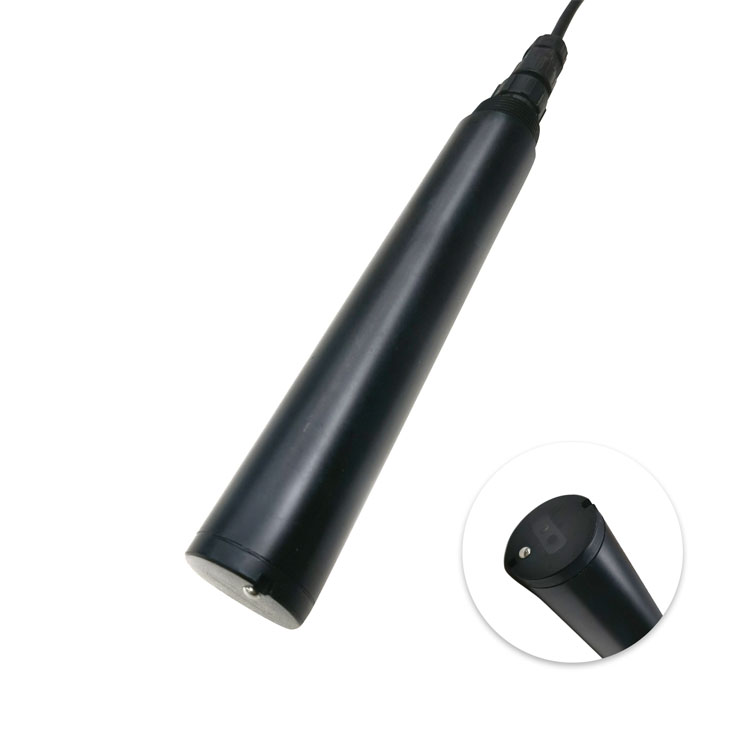
The separate DO instrument above can help assess oxygen conditions at the relevant location. A normal DO value alone does not prove adequate nitrification, and raising aeration is not the answer to every apparent ammonia change.
Record pH and temperature with the ammonia observations. They matter to process interpretation and ammonia-species risk, but the probe's temperature compensation is not a universal toxicity calculation. Use current representative inputs and the project's applicable calculation and operating plan.
The NHN-4S guidance identifies potassium as an interfering ion for the ammonium electrode. Changes in ionic background should therefore be investigated alongside deposits, conditioning and reference comparisons. Avoid diagnosing a biological failure solely from an unverified sensor excursion.
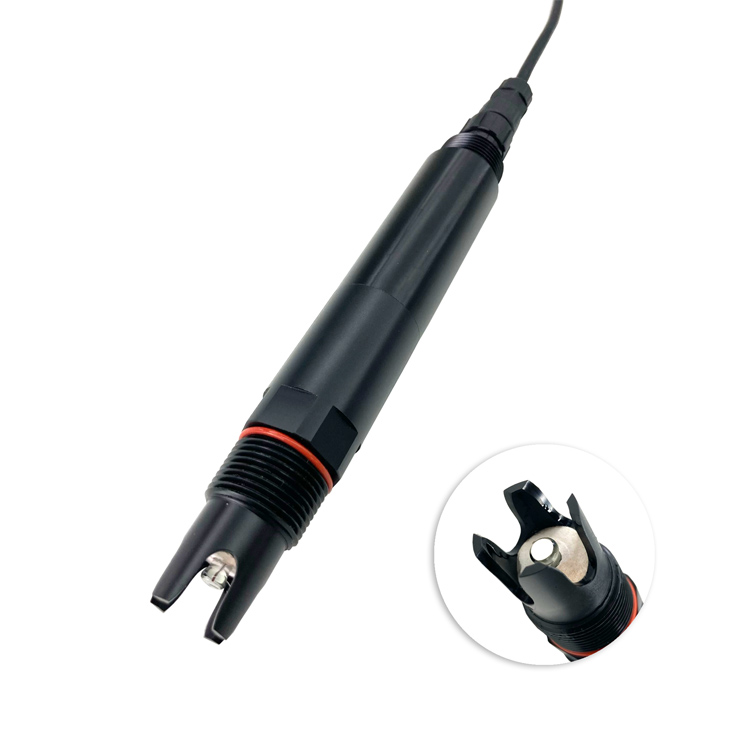
For a NiuBoL configuration enquiry, provide a flow diagram, normal and changed-flow conditions, expected inlet/outlet bands, reference results and the decision to be supported. Include matrix information, access and output requirements. A multiparameter assembly needs its actual ammonia-related module confirmed; other channels do not create that measurement.
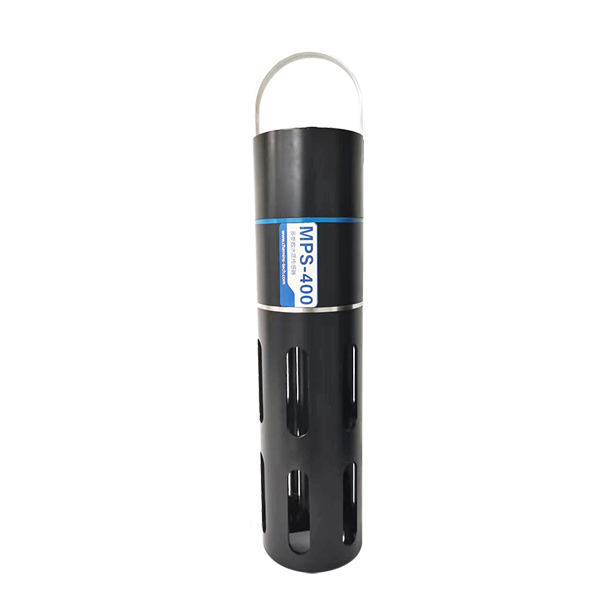
No. Their basis, uncertainty, sample locations and timing must support the comparison. A displayed difference smaller than the measurement capability is not a reliable efficiency result.
No. Nitrogen can change form without leaving the water. Use the relevant nitrogen-species and mass-balance observations for a total-removal assessment.
No. NHN-4S lists 0-100 or 0-1000 mg/L options. Confirm the exact model and demonstrated performance needed at the low operating band.
It helps identify disagreement attributable to the instruments or their setup before assigning every inlet/outlet difference to the treatment stage. It does not replace separate reference checks.
No. Recirculation repeatedly moves existing water. Define fresh inputs, side streams and the intended stage boundary before calculating nitrogen loads.
No. It can support investigation of solids or sampling changes, but it is not a reference for the ammonium electrode or a measure of nitrification performance.
An ammonia nitrogen sensor pair adds value when the expected treatment difference can actually be measured and interpreted. Confirm species and units, match water and timing, review uncertainty and use flow correctly. This prevents a precise-looking dashboard from making an unsupported biofilter-performance claim.
Prev:Residual Chlorine Sensor for Dosing: Restart After Sample-Flow Loss
Next:Turbidity Sensor for Filter Backwash: Separate Trigger, Wash and Recovery
Related recommendations
Sensors & Weather Stations Catalog
 Agriculture Sensors and Weather Stations Catalog-NiuBoL.pdf
Weather Stations Catalog-NiuBoL.pdf
Agriculture Sensors Catalog-NiuBoL.pdf
Water Quality Sensor Catalog-NiuBoL.pdf
Related products
 Combined air temperature and relative humidity sensor
 TDR Soil Moisture & Temperature Sensor for irrigation| RS485 |4-20mA| NBL-S-THR
 Soil pH sensor RS485 soil Testing instrument soil ph meter for agriculture |NBL-S-PH
 Wind Speed sensor Output Modbus/RS485/Analog/0-5V/4-20mA
 Tipping bucket rain gauge for weather monitoring auto rainfall sensor RS485/Outdoor/stainless steel
 Pyranometer Solar Radiation Sensor 4-20mA/RS485


Screenshot, WhatsApp to identify the QR code
WhatsApp number:+8615367865107
(Click on WhatsApp to copy and add friends)

