





— Blogs —
—Products—
 Consumer hotline +8618073152920
WhatsApp:+8615367865107
Address:Room 102, District D, Houhu Industrial Park, Yuelu District, Changsha City, Hunan Province, China
Product knowledge
Time:2026-09-17 14:00:00 Popularity:213
Fish pond ammonia nitrogen monitoring needs more than an ammonia number. Establish whether the instrument reports ammonium, total ammonia nitrogen or a calculated un-ionized ammonia value, then match its usable accuracy to the intended warning level. Measure pH and temperature at the same place and time. A wide range and fine display resolution do not prove that a sensor can reliably distinguish a low-level pond alarm.
Total ammonia nitrogen, or TAN, includes ammonium nitrogen and un-ionized ammonia nitrogen. Their proportions depend on water conditions. UF/IFAS guidance on ammonia in aquatic systems explains that higher pH and temperature increase the un-ionized fraction; salinity also affects the relationship. The same TAN reading therefore does not always represent the same ammonia exposure.
The NiuBoL NBL-WQ-NHN uses an ammonium ion-selective electrode with Pt1000 temperature compensation. Its communication description identifies an ammonium measurement. Before naming the PLC tag TAN or NH3-N, obtain the output's chemical and mass basis and establish whether any conversion is performed. Temperature compensation of an electrode is not, by itself, a calculation of the un-ionized ammonia fraction.
Keep the units explicit. A result expressed as mg/L of nitrogen is not numerically interchangeable with mg/L of the complete ammonia molecule. If a reference test and a sensor use different reporting bases, a consistent disagreement may be a conversion problem rather than drift. Resolve that issue before adjusting the electrode or setting alarms.
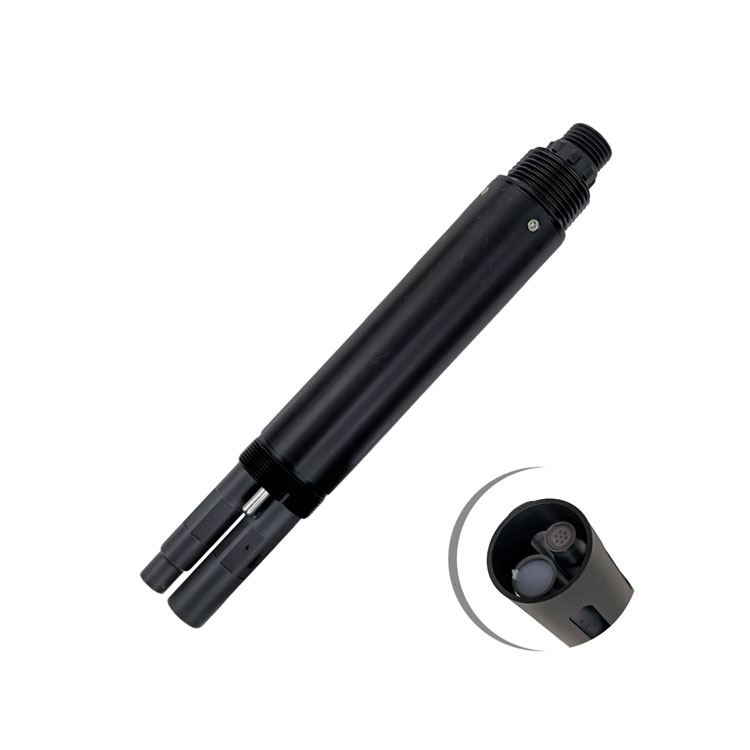
COD provides different information about organic loading. The probe below may be relevant to a separately validated investigation of pond inflows or treatment water, but COD cannot be converted directly into TAN. An ammonia alarm should use a method-matched nitrogen measurement, not an estimate derived from an unrelated organic-load channel.
Begin with historical pond results and the farm's action plan. Identify the normal band, the smallest increase worth investigating and a plausible upset concentration. Only then select the range. A 0-1000 mg/L option may cover a severe process stream but offers no automatic advantage for a pond that needs to distinguish much smaller changes.
| NBL-WQ-NHN item | Specification | Meaning for pond selection |
|---|---|---|
| Range options and resolution | 0-10.00 or 0-100.00 mg/L: 0.01 mg/L; 0-1000.0 mg/L: 0.1 mg/L | Select an ordered range; do not assume automatic switching |
| Measurement accuracy | +/-10% or +/-0.5 mg/L | Clarify percentage basis and how the two terms apply; require evidence near the proposed alarm |
| Temperature | 0-40 C operation; temperature accuracy +/-0.5 C; Pt1000 compensation | Check shallow-water heating and the separate requirements of any ammonia calculation |
| Water conditions | pH 4-10; pressure below 0.1 MPa | These operating limits are not fish-health limits |
| Power | 12-24 V DC; 0.2 W at 12 V | Add the logger, pH and oxygen instruments, and telemetry loads separately |
| Output | RS485, Modbus RTU; default 9600 baud, 8N1 | Check register values and decimal positions in the receiving system |
| Construction | PVC and POM wetted materials; IP68 | Protect cable joints and confirm compatibility with pond treatments |
| Mounting and cable | 3/4 NPT immersion installation; 5 m standard cable | Support the probe mechanically; specify extension and jacket requirements |
The 0.01 mg/L display step is much smaller than the stated 0.5 mg/L absolute error term. For example, a proposed investigation band only 0.10 mg/L wide cannot be justified by the display resolution alone. Ask for a comparison study at the required concentrations, including actual pond water. If the acceptance tolerance cannot be met, use a more suitable analytical method for that alarm.
Do not hide out-of-range readings by clipping them to the maximum scale. The operator needs to know that the result exceeds the instrument's capability. Similarly, a near-zero display should not be treated as proof that ammonia is absent; interpret it against the method's demonstrated low-level performance and the reference test.
Acquire pH and temperature from the ammonia measuring location, with timestamps close enough to represent the same conditions. Using an afternoon ammonia reading with a morning pH value can give a misleading calculated result. For a site-approved TAN calculation, retain the original TAN, pH and temperature alongside the derived un-ionized ammonia value so an engineer can reproduce it.
As a mathematical example, a validated TAN result of 1.00 mg/L as N and an applicable un-ionized fraction of 0.05 give 0.050 mg/L NH3-N. The fraction in this example is an assumed input, not a pond alarm recommendation. Do not apply the multiplication directly to an unqualified ammonium-electrode reading, or reuse a freshwater relationship for saline water without checking its applicability.
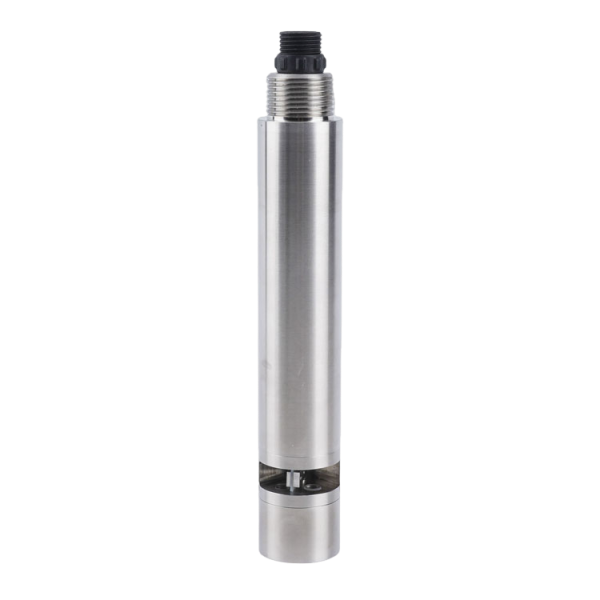
Conductivity can help identify a change in the pond's dissolved-ion background or incoming water. The probe below is useful for that context, but conductivity alone does not identify potassium concentration or prove that ion-selective interference has been corrected. Where salinity varies, include representative low- and high-salinity samples in the sensor evaluation.
For an earthen pond, compare candidate locations at the fish-holding depth rather than choosing the nearest convenient bank position. Avoid a stagnant pocket, a concentrated feed deposition area or direct contact with bottom sediment unless that local condition is deliberately being investigated. Leave enough access to remove the electrode without dragging it through mud.
In a lined intensive pond, compare readings with circulation equipment running and stopped under controlled operating conditions. A point beside an aerator may differ from a poorly mixed area. Decide whether the fixed station represents typical exposure or a known vulnerable zone, and identify that location on the display. One probe cannot establish uniform conditions across a large pond.
For a farm supplied by a shared inlet, an inlet station can identify incoming-water changes but cannot replace measurements in the production ponds. Where resources are limited, use a fixed station at a high-priority location and a defined manual survey of the remaining ponds. Revisit that priority when stocking, feeding or circulation arrangements change.
An optical BOD channel, shown below, can be considered for a separate organic-load study after comparison with an appropriate reference method. It does not replace dissolved oxygen measurement or diagnose the cause of a nitrogen excursion. Keep the basic ammonia, pH, temperature and oxygen records usable before adding further channels.

Activate and calibrate the electrode using the procedure and standards for the supplied range. Then compare simultaneous samples from the installed depth using a suitable independent method. Repeat across different concentrations and water conditions. A single agreement point cannot establish slope, low-level discrimination or resistance to interference.
Potassium and sodium can interfere with ammonium ion-selective measurement. The basic NBL-WQ-NHN should not be assumed to include the compensation functions of a differently designated model. Ask for a representative-water evaluation when feed, salt additions or source changes alter the ionic background. Record those changes during the trial so disagreement can be investigated rather than averaged away.
Check the receiving software with a known register example. The NHN measurement block uses separate integers for the value and its decimal places. A raw value of 85 with two decimal places represents 0.85 mg/L; a raw temperature value of 280 with one decimal place represents 28.0 C. Reading these fields as a single floating-point number will produce incorrect data even when communication succeeds.
Distinguish a high valid reading from stale data, electrode service and an invalid calculation input. A missing pH value should not silently become pH 7 in an ammonia calculation. Preserve the last valid result with its age, flag the derived result as unavailable and notify the operator according to the farm's monitoring procedure.
Set warning and action levels with the farm's aquaculture specialist for the species, life stage and measurement basis. Establish who checks the result and how quickly. A confirmed ammonia excursion should prompt the approved review of feeding, oxygen, incoming water and treatment performance; this article does not prescribe chemical dosing or a universal water-exchange response.
Use recorded or simulated values to test threshold crossing, persistence, acknowledgement and recovery. The delay should reject brief measurement disturbances without hiding an event that requires action. Test loss of pH, temperature and communications separately. Where a control action is proposed, prove its effect and failure behavior before allowing an ammonia tag to trigger it automatically.
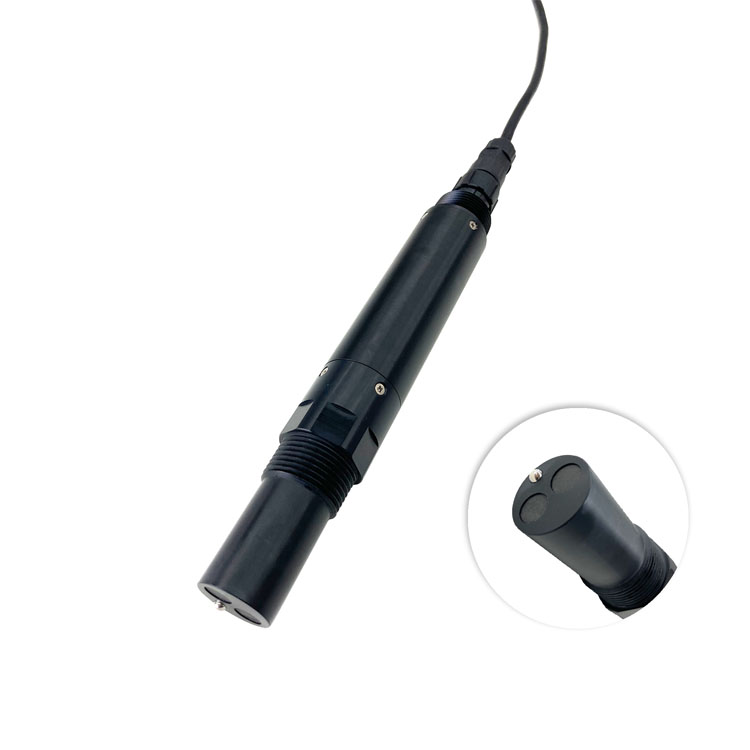
Fouling can distort the trend gradually. Compare before and after cleaning, and retain the pre-cleaning values rather than deleting inconvenient points. A suspended-solids channel can help investigate particulate conditions, but it does not quantify dissolved ammonia. The TSS instrument below belongs to that separate task and should not be used to validate the ammonia concentration.

Choose from measured normal and upset concentrations, then verify performance at the proposed warning level. For a low-concentration pond, the narrower option may be the starting candidate, but range alone is insufficient. The stated accuracy and actual-water comparison must support the required decision; otherwise a different method is needed.
No. Interpretation depends on the reporting basis, water conditions and the cultured stock's requirements. Keep thresholds specific to the farm's approved procedure. When a calculated ammonia value is used, verify that the input really is TAN on the correct mass basis and that pH and temperature are current.
Do not assume that function on the basic NBL-WQ-NHN. Temperature compensation is specified, while potassium interference requires a separate evaluation. If compensation is necessary, review the exact alternative model, its required channels and its validation in the pond water before substituting it.
First check sampling time, depth and nitrogen reporting basis. Then review sample handling, electrode condition, reference-method interference and the ionic composition of the water. Compare a time-matched sample at the probe. Do not apply a constant offset until the reason for the difference is understood.
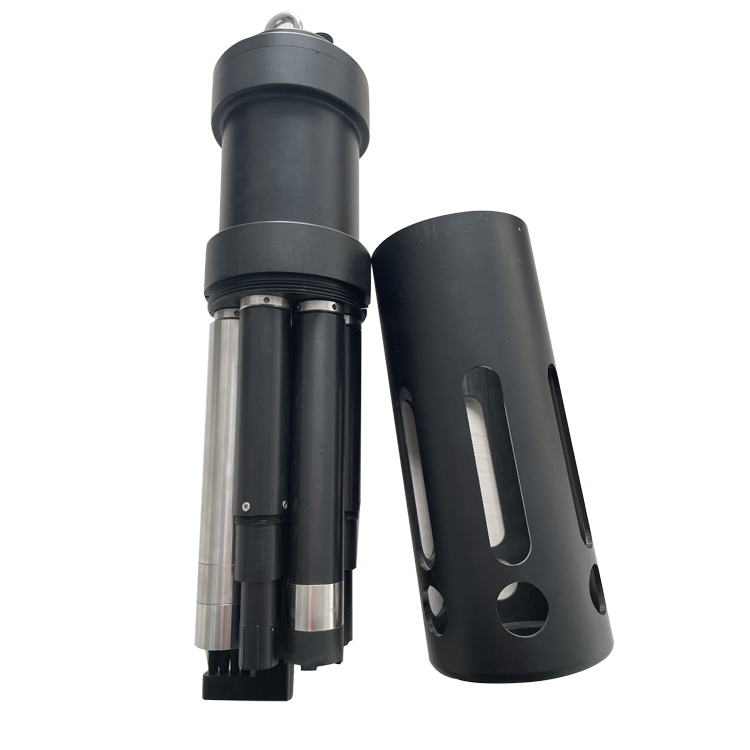
Yes, if the chosen assembly's ammonia performance meets the pond requirement and all channels represent the same water. The MPS-5A below has ammonia options that differ from the standalone NHN. Do not transfer the standalone range or accuracy to the assembly; compare its actual channel specification before consolidating instruments.
Send NiuBoL historical ammonia results with their units, pH and temperature ranges, salinity information and the intended warning level. Request the selected range, calibration standards and a defined real-water comparison. Price the trial and required companion measurements explicitly so suitability is established before wider deployment across the farm.
Fish pond ammonia nitrogen monitoring is dependable only when the reported nitrogen form, low-level performance and pond conditions are understood. Select the range around a real decision, validate the electrode in representative water and test alarms with synchronized pH and temperature. NiuBoL configuration discussions should begin with those requirements, not with the largest range or the most decimal places.
Prev:Swimming Pool Water Quality Online Monitoring Advantages and Selection Notes
Next:Online Water Quality Monitoring System Structure from Sensor to Platform
Related recommendations
Sensors & Weather Stations Catalog
 Agriculture Sensors and Weather Stations Catalog-NiuBoL.pdf
Weather Stations Catalog-NiuBoL.pdf
Agriculture Sensors Catalog-NiuBoL.pdf
Water Quality Sensor Catalog-NiuBoL.pdf
Related products
 Combined air temperature and relative humidity sensor
 TDR Soil Moisture & Temperature Sensor for irrigation| RS485 |4-20mA| NBL-S-THR
 Soil pH sensor RS485 soil Testing instrument soil ph meter for agriculture |NBL-S-PH
 Wind Speed sensor Output Modbus/RS485/Analog/0-5V/4-20mA
 Tipping bucket rain gauge for weather monitoring auto rainfall sensor RS485/Outdoor/stainless steel
 Pyranometer Solar Radiation Sensor 4-20mA/RS485


Screenshot, WhatsApp to identify the QR code
WhatsApp number:+8615367865107
(Click on WhatsApp to copy and add friends)

