





— Blogs —
—Products—
 Consumer hotline +8618073152920
 WhatsApp:+8615367865107
Address:Room 102, District D, Houhu Industrial Park, Yuelu District, Changsha City, Hunan Province, China
Product knowledge
Time:2026-06-10 10:00:40 Popularity:339
Quick Answer: Water quality station cabling must deliver the required voltage at each instrument and a correctly designed RS485 signal path. Specify the bus route, power conductors, device connections and protection together. A communication-distance claim does not establish acceptable DC voltage drop, and a probe's IP68 rating does not protect an ordinary field splice.
A cable may carry both power and data, but the two functions have different design constraints. The signal pair needs suitable electrical characteristics and routing; the power conductors must carry the required current while keeping the field supply within the instrument's limit.
Begin with a route drawing showing the controller, each field junction, sensor tail and supply connection. Mark which sections share a bus and which use an isolated interface or repeater. A collection of long branches connected at one cabinet is not automatically equivalent to a properly designed multidrop trunk.
The Modbus Organization's serial-line implementation guide provides the protocol's physical-layer guidance. Apply it alongside the actual controller and sensor requirements, including termination, polarization and signal-common arrangements. Do not copy settings from an unrelated installation merely because both use Modbus RTU.
For a DC cable, voltage drop equals load current multiplied by the total outgoing-and-return resistance. Include connectors and joints where relevant. The sensor must receive its allowed voltage during the operating conditions being assessed, not just when disconnected from the load.
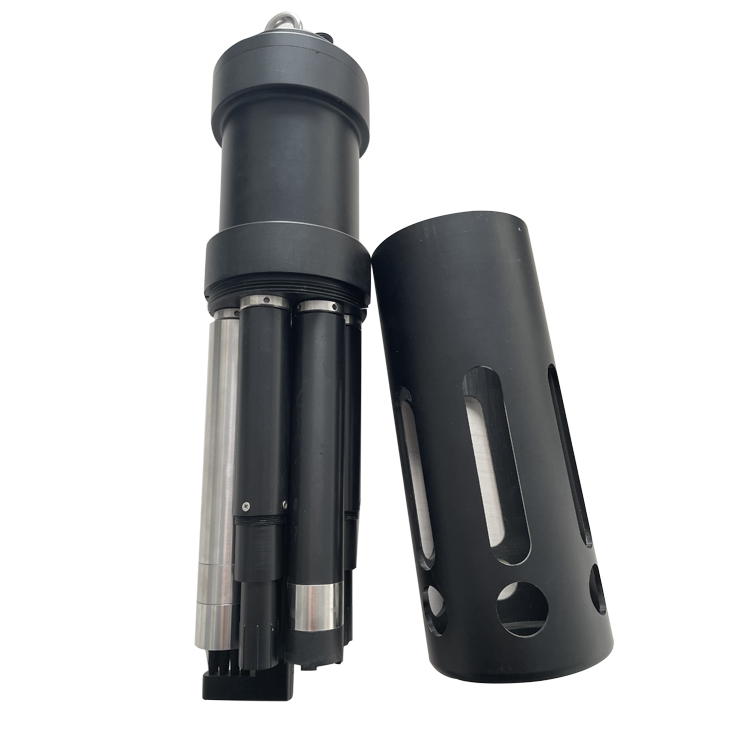
As an illustration, the NiuBoL MPS-5A platform specifies 5 W at 12 V, corresponding to approximately 0.42 A at that operating point. If the supply loop has 4 ohms total resistance, the approximate drop is 1.68 V. A 12 V source would then deliver about 10.32 V, below the platform's 12 V +/-5% supply band. These resistance and current values illustrate the calculation; they are not a cable-length allowance or startup-current specification.
Possible corrections include an appropriate conductor size, a shorter supply route or a suitable local regulated supply. Have the electrical designer check the complete arrangement. Do not raise the source voltage beyond the connected equipment's limits to compensate blindly for cable losses.
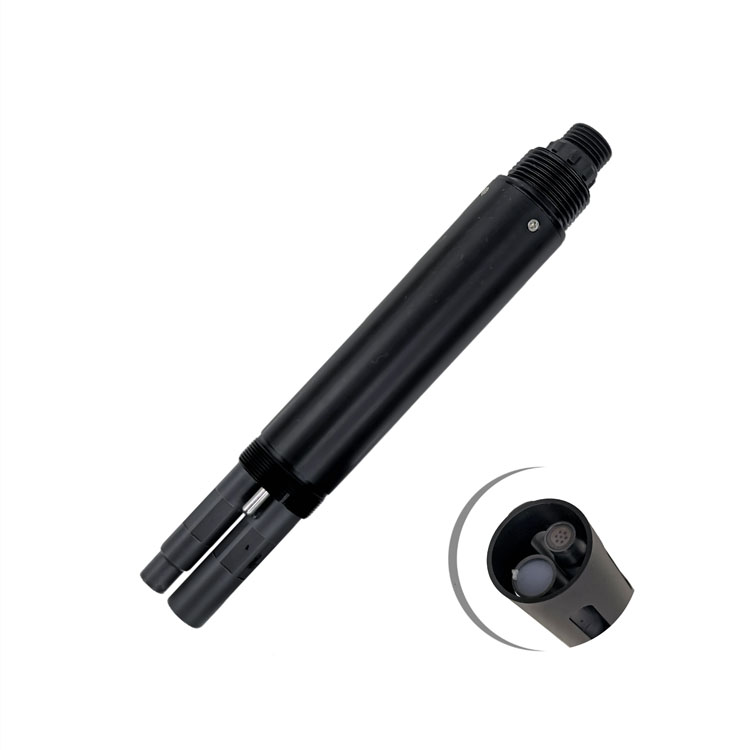
| Instrument example | Supply and consumption | Wiring consequence |
|---|---|---|
| MPS-5A multiparameter platform | 12 V DC +/-5%; 5 W at 12 V | Do not assign the wider supply band of a standalone probe |
| Basic NBL-WQ-CL | 12-24 V DC; 0.2 W at 12 V | Identify its own conductor definition and load |
| NBL-WQ-TS | 12-24 V DC; 0.2 W at 12 V | A matching voltage does not imply identical cable connections |
| Shared field requirements | RS485 Modbus RTU; standard 5 m instrument leads in these examples | Specify extension, jacket, pair characteristics and wet joints separately |
Use the MPS-5A electrical details for that complete assembly. Confirm maximum operating demand, including any cleaning cycle, before selecting the supply and protection. Do not multiply a generic 0.2 W probe figure by the number of displayed channels.
Maintain the intended signal pair and the device's specified reference arrangement. Shield, signal common, DC return and protective earth have different functions; they should not be joined or substituted casually. Follow the project's bonding and interface design rather than assuming one universal ground connection suits every site.
Check built-in termination and polarization before adding external components. Excessive or misplaced termination can load the bus. The A/B letters and wire colors used by different manufacturers may not match; identify functions from the delivered connection definitions.
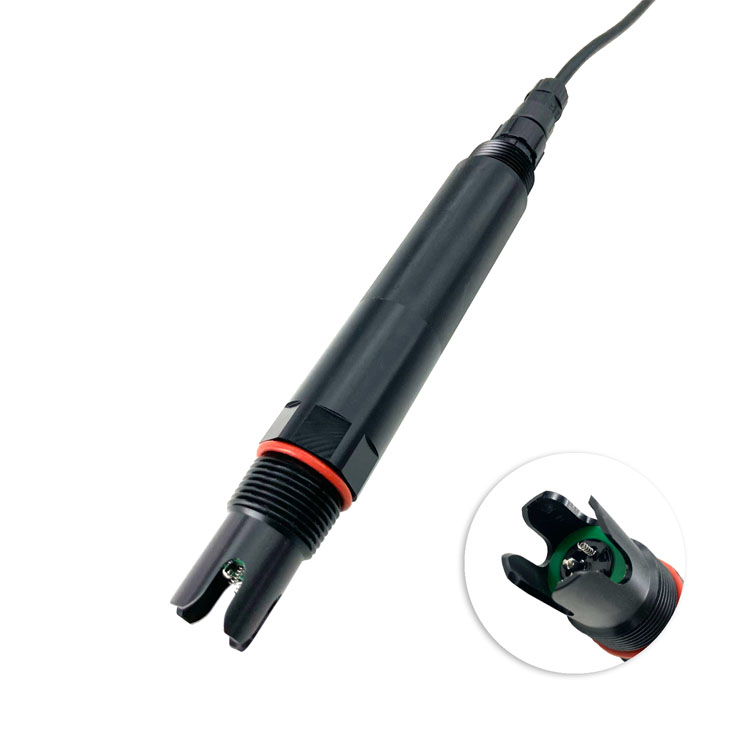
The chlorine probe below is one example of a field device with its own lead assignment. Do not infer the connection of a turbidity instrument or a multiparameter platform from that cable alone.
Separate instrumentation from motor feeders, variable-frequency-drive outputs and switching power circuits according to the approved site design. Avoid long parallel exposure where practical. If the route cannot be changed, review appropriate shielding, containment and isolation rather than assuming that metallic conduit fixes every interference problem.
Outdoor runs also need a coordinated surge and bonding assessment. Select protection appropriate to both the signal and supply, and confirm how it is connected. No general ground-resistance number proves adequate lightning protection for every station. Required values and testing belong to the applicable electrical design and site conditions.
For wet locations, specify glands and joints for the actual cable diameter and exposure. Provide strain relief and a drip arrangement where appropriate. A submerged sensor body can remain intact while water enters through an unsuitable extension joint.
A timeout is not a reason to recalibrate the wet measurement. If the bus fails only when equipment starts, investigate the electrical path as well as changes in the water. Keep the original observation, supply check and communication results so the fault remains traceable.
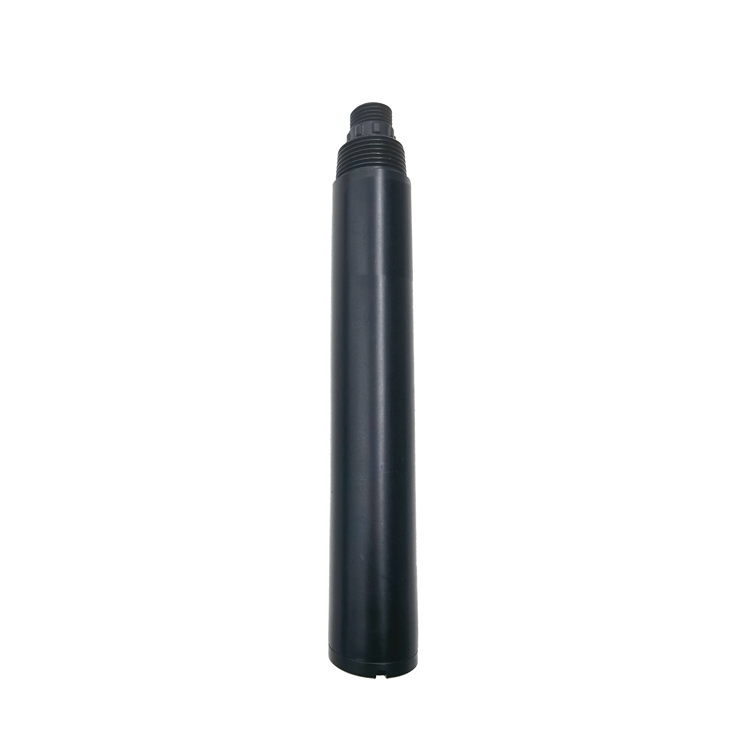
The optical probe below needs the same disciplined cable identification, even though its measuring principle differs. Request terminal schedules and route information with the installation scope rather than treating cabling as an unspecified accessory.
No. Check DC voltage drop and required current separately from the data path. The instrument's allowed field voltage is the relevant limit.
No. Termination follows the bus topology and equipment design. Check existing components and the serial-line guidance rather than adding one at every probe.
Do not assume that substitution is allowed. Follow the specified interface and bonding arrangement; these conductors have different purposes.
Only the actual rated assembly and its installation conditions are covered. An improvised joint does not inherit the sensor body's protection.
Provide the route, lengths, connected models, supply arrangement, nearby electrical equipment and wet exposure. Include junctions, protection, terminal identification and the required field tests.
Water quality station cabling is a design task for both power and communication. Check model-specific supply limits, keep the RS485 topology and conductor functions clear, and verify the complete wet-site connection. Those checks make a NiuBoL measurement channel maintainable without relying on unsupported distance or grounding claims.
Prev:Fishery Water Quality Monitoring: Reference Stations and Event Response
Next:Municipal Residual Chlorine Monitoring: Supply-Zone Comparisons
Related recommendations
Sensors & Weather Stations Catalog
 Agriculture Sensors and Weather Stations Catalog-NiuBoL.pdf
Weather Stations Catalog-NiuBoL.pdf
Agriculture Sensors Catalog-NiuBoL.pdf
Water Quality Sensor Catalog-NiuBoL.pdf
Related products
 Combined air temperature and relative humidity sensor
 TDR Soil Moisture & Temperature Sensor for irrigation| RS485 |4-20mA| NBL-S-THR
 Soil pH sensor RS485 soil Testing instrument soil ph meter for agriculture |NBL-S-PH
 Wind Speed sensor Output Modbus/RS485/Analog/0-5V/4-20mA
 Tipping bucket rain gauge for weather monitoring auto rainfall sensor RS485/Outdoor/stainless steel
 Pyranometer Solar Radiation Sensor 4-20mA/RS485

Screenshot, WhatsApp to identify the QR code
WhatsApp number:+8615367865107
(Click on WhatsApp to copy and add friends)

