





— Blogs —
—Products—
 Consumer hotline +8618073152920
WhatsApp:+8615367865107
Address:Room 102, District D, Houhu Industrial Park, Yuelu District, Changsha City, Hunan Province, China
Product knowledge
Time:2026-09-24 08:00:00 Popularity:195
Quick Answer: Pure water and RO monitoring should distinguish feedwater protection, membrane performance and finished-water acceptance. Conductivity is useful on both feed and permeate, but the required ranges differ. Turbidity and chlorine-related measurements mainly address pretreatment risks, while dissolved oxygen is needed only where the downstream process specifies it. A sensor that reads a low value is not necessarily accurate enough to release that water for use.
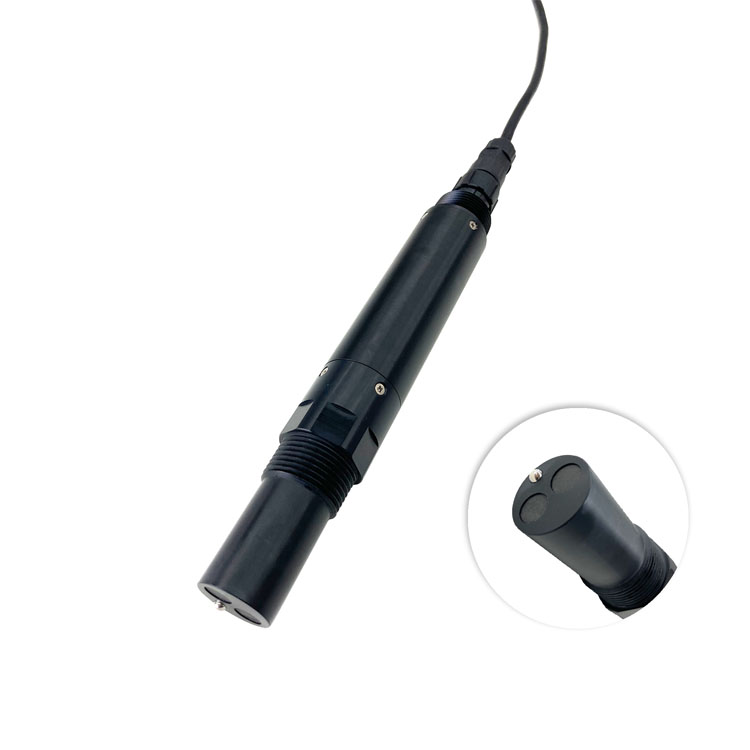
A reverse-osmosis skid does not have one universal water-quality condition. Its raw-water inlet may contain suspended matter and oxidants; its membrane feed has passed through pretreatment; its permeate has much lower ionic content; and its final distribution loop may receive additional polishing. Installing the same range and sampling arrangement at all four locations obscures these differences.
The monitoring plan should identify which result protects equipment, which diagnoses membrane performance and which authorizes product-water use. An online measurement can support more than one purpose, but the acceptance tolerance, response requirement and action must be stated separately. A useful process trend does not automatically qualify as a finished-water release test.
| Water stage | Measurement task | Important boundary |
|---|---|---|
| Raw water and pretreatment inlet | Characterize variable conductivity, suspended matter and source-specific contaminants | A feedwater channel need not have the sensitivity or hygienic construction required downstream |
| After filtration and dechlorination, before RO | Check pretreatment performance and the oxidant conditions relevant to the selected membrane | Turbidity does not replace every fouling assessment; a chlorine result must match the required chlorine species and detection capability |
| RO permeate | Track ionic quality and support startup diversion or investigation | Compare feed and permeate on a consistent temperature basis; do not infer all contaminants from conductivity |
| Polished water and distribution return | Verify the downstream process's water specification | Trace oxygen, particles, organic carbon or microbiological requirements may require dedicated instruments |
For an industrial washing line, the final specification may be considerably different from a laboratory or semiconductor utility. Start with the consuming process, including what happens if unsuitable water reaches it. The term pure water is not a complete purchasing specification, and a standard multiparameter package should not be represented as an ultrapure-water qualification system.
The NiuBoL NBL-WQ-EC family offers separate range options for different water conditions. Select the feedwater range from expected normal and abnormal inlet values, then assess the permeate instrument against the much narrower decision region downstream. Do not choose a broad range for both locations merely because it simplifies spare-part identification.
State whether the displayed value is actual-temperature conductivity or temperature-compensated conductivity, and use the same convention when comparing instruments. In low-conductivity water, the compensation method itself matters. An exposed grab sample can also change during handling, so a disagreement should lead to a controlled comparison before adjusting the online channel.
A change in permeate conductivity deserves investigation, but it does not identify membrane damage on its own. Review feed conductivity, operating temperature, pressure, flow and startup state. Compare equivalent operating conditions. A trend taken immediately after an idle period should not be mixed indiscriminately with stable production data or used by itself to decide membrane replacement.
If the process diverts startup water, the controller needs a current, valid result and a defined period of acceptable operation before releasing water. Establish that period from the actual plant response and downstream risk; there is no universal waiting time. Verify the route of diverted water and the valve feedback. A screen that says acceptable does not prove the product-water valve moved to the intended position.
Where finished-water conductivity approaches the measurement uncertainty of the proposed sensor, select a more suitable analyzer rather than adding decimal places in the PLC. Specify the allowable error near the release limit, not just the overall span. Procurement should resolve this before the skid is built, since a different instrument may require a different flow cell or sampling arrangement.
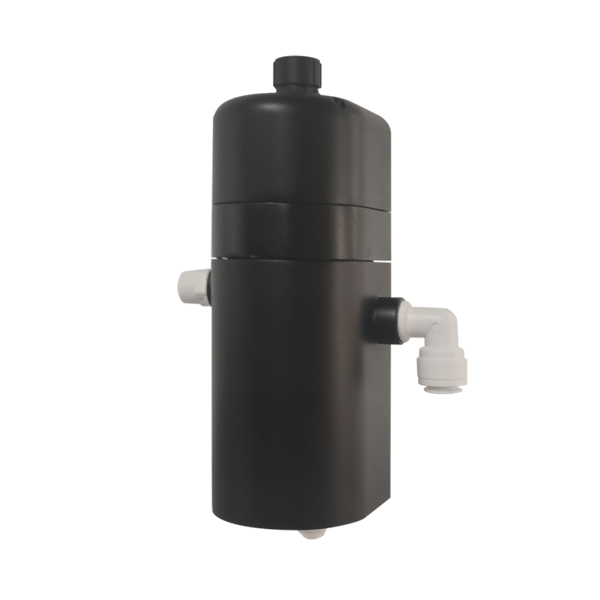
The NBL-WQ-TSA-4 is a flow-through turbidity sensor for low-range water measurements. It can support a pretreatment or filtered-water clarity check when the required range and uncertainty are suitable. It is a wall-mounted assembly, not an immersion probe to lower into a tank. Its optical reading must not be relabeled as a particle count or a silt density index result.
| NBL-WQ-TSA-4 parameter | Specification | Meaning for the installation |
|---|---|---|
| Range and resolution | 0-10.000 NTU; 0.001 NTU resolution | Resolution describes the displayed increment, not the ability to distinguish every 0.001 NTU change |
| Accuracy expression | +/-5% or +/-0.02 NTU, whichever is greater | Specify the percentage basis and required acceptance tolerance in the order; do not infer ultra-low-level qualification from resolution |
| Supply and consumption | 12-24 VDC; 0.2 W at 12 V | Include the separate controller and any sample equipment in the panel power budget |
| Output | RS485 Modbus RTU; optional 4-20 mA | Order the required interface and verify its range scaling |
| Working conditions | 0-60 C; pressure at or below 0.2 MPa | Use a conditioned sample branch where the process exceeds these limits |
| Mounting and enclosure | Wall-mounted; IP65; composite housing | Protect the installation from immersion and arrange service access |
| Sample flow and cabling | Recommended flow below 300 mL/min; five-core shielded cable | Provide a stable flow and unobstructed discharge; verify the cable length required for the panel |
Keep the sample path short enough to follow the process and free from components that unintentionally settle out particles. Air release after a pressure reduction can disturb the optical reading. Examine bubble formation, drain restriction and flow changes before treating a brief spike as filter failure. A comparison sample must come from the same water path, not from a different tank outlet.
For oxidation-sensitive RO membranes, dechlorination performance must meet the membrane's feed requirements. Those requirements depend on the installed membrane and water chemistry. The RO/NF membrane technical reference describes oxidant exposure as a membrane-protection issue; it should not be reduced to a generic online alarm value shared by every RO installation.
The NBL-WQ-CL range is 0-2.000 mg/L on an HClO basis. Before selecting it for a dechlorination interlock, establish whether the project requires hypochlorous acid, free chlorine or total chlorine, and whether the analyzer can resolve the required decision level. These names are not interchangeable tags. pH, sample conditions and the chosen comparison method affect how a chlorine-related result is interpreted.
Its sample arrangement calls for 30-60 L/h, equivalent to 0.5-1 L/min, with a 5-50 C operating temperature and pressure below 0.1 MPa. This flow is higher than the TSA-4's recommended flow below 0.3 L/min. Do not connect both instruments in a single unregulated series path and assume they share one acceptable flow setting. Separately regulated branches may be needed.
A displayed zero is not proof that an oxidant is absent. Evaluate measurement uncertainty and low-level capability against the required protection threshold. If that capability is insufficient, select a dedicated analyzer suitable for the duty. An ORP channel may add operational context, but it cannot universally replace a specified chlorine measurement.
Some source waters or reuse feeds create a separate need for ammonia-related monitoring. In that case, a NBL-WQ-NHN channel is evaluated against the feedwater chemistry, expected concentration and required ammonia or ammonium reporting basis. It is an additional feedwater measurement, not a substitute for turbidity and not a default product-water acceptance channel. Do not purchase it merely because a panel has room for another probe.
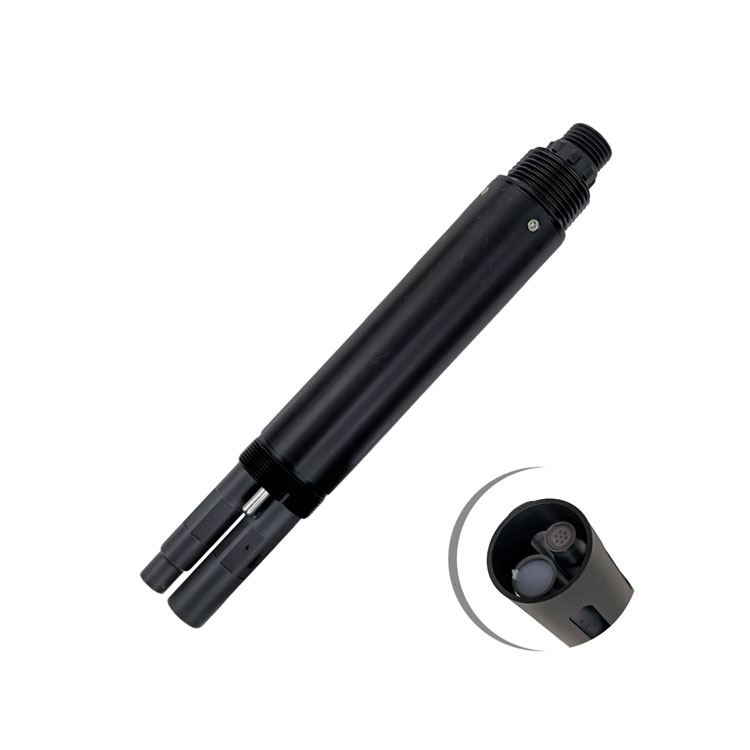
Dissolved oxygen likewise belongs to a specific downstream requirement. The NBL-WQ-DO has a 0-20 mg/L range and an accuracy of +/-2% of full scale. On that span, the full-scale term is +/-0.4 mg/L, equivalent to +/-400 ug/L. It is therefore not evidence of suitability for a trace-oxygen requirement simply because the display can show a small number. A low-oxygen polishing or deoxygenation duty needs an analyzer specified for that decision level.
For an oxygen measurement, also consider the sample's contact with air and the permeability and length of sample tubing. The objective is to measure the process water, not oxygen acquired on its way to the analyzer. Decide where oxygen matters: ahead of a downstream process, after deoxygenation or at a distribution return. Those locations can answer different questions.
Use separate PLC or data logger tags for raw feed, membrane feed, permeate and distribution return. With RS485 Modbus RTU, check each instrument's address, register type, unit and decimal scaling. For EC, explicitly distinguish uS/cm from mS/cm; a factor-of-1,000 unit mistake can appear plausible on an auto-scaled trend. Retain temperature and compensation settings with the conductivity record.
Record production, startup, flushing and cleaning modes alongside the measurements. A sensor removed from service for cleaning or calibration must not authorize water release. Likewise, low sample flow should be visible as an instrument condition rather than interpreted as excellent water quality. Confirm that the cabinet logic deals with a lost sensor independently from a genuine out-of-range result.
Acceptance should include comparison around the actual decision levels, sample-flow checks, unit verification and demonstration of any diversion or stop action. Take no credit for a successful digital read until the process meaning is correct. For a quotation, send the process flow drawing and a table of limits at each location, including the methods required for final-water acceptance.
It supports an ionic-quality assessment, not a complete assessment of particles, organic contamination or microbiological condition. Suitability depends on the downstream specification. Identify any additional tests required by that process before treating the conductivity signal as a release permission.
Only if its error and resolution are acceptable at both operating levels, which should be demonstrated rather than assumed. A wide feedwater range can be inadequate near a low permeate limit. Separate range options are often necessary even when the probes connect to the same controller.
No. It measures turbidity over its specified NTU range. Particle-count, particle-size or ultra-low turbidity acceptance needs must be assessed separately. Its 0.001 NTU resolution should not be read as a 0.001 NTU accuracy specification.
Not for the CL and TSA-4 conditions described here. The CL calls for 0.5-1 L/min, whereas TSA-4 recommends below 0.3 L/min. Design suitable branches and verify flow at each instrument rather than regulating only the combined supply.
Its 0-20 mg/L span and +/-2% full-scale accuracy do not establish trace-oxygen capability. Compare the required limit with the instrument's uncertainty and low-level performance. Select a dedicated trace analyzer when the downstream requirement lies beyond the standard probe's demonstrated capability.
Provide the measurement locations, normal and alarm values, feed chemistry, sample pressure and temperature, and the required controller interface. Identify any water-release or membrane-protection function. This allows unsuitable standard options to be excluded before quotation and prevents a general monitoring sensor from being assigned an acceptance duty it cannot meet.
Pure water and RO monitoring works when the measurement matches the water stage and the decision level. Use conductivity to investigate ionic quality, low-range turbidity for an appropriate clarity task, and chlorine or oxygen instruments only with the required species, sensitivity and sampling conditions. NiuBoL options should be assessed against those duties individually, with specialist analyzers retained wherever the finished-water specification demands them.
Prev:Cooling Water Monitoring: Conductivity, pH, ORP and Scaling Risk Control
Next:Emergency River Pollution Monitoring: Can the Warning Arrive in Time?
Related recommendations
Sensors & Weather Stations Catalog
 Agriculture Sensors and Weather Stations Catalog-NiuBoL.pdf
Weather Stations Catalog-NiuBoL.pdf
Agriculture Sensors Catalog-NiuBoL.pdf
Water Quality Sensor Catalog-NiuBoL.pdf
Related products
 Combined air temperature and relative humidity sensor
 TDR Soil Moisture & Temperature Sensor for irrigation| RS485 |4-20mA| NBL-S-THR
 Soil pH sensor RS485 soil Testing instrument soil ph meter for agriculture |NBL-S-PH
 Wind Speed sensor Output Modbus/RS485/Analog/0-5V/4-20mA
 Tipping bucket rain gauge for weather monitoring auto rainfall sensor RS485/Outdoor/stainless steel
 Pyranometer Solar Radiation Sensor 4-20mA/RS485


Screenshot, WhatsApp to identify the QR code
WhatsApp number:+8615367865107
(Click on WhatsApp to copy and add friends)

