





— Blogs —
—Products—
 Consumer hotline +8618073152920
WhatsApp:+8615367865107
Address:Room 102, District D, Houhu Industrial Park, Yuelu District, Changsha City, Hunan Province, China
Product knowledge
Time:2026-09-24 10:00:00 Popularity:224
A nitrate sensor for agricultural runoff should capture the event the project intends to assess, not merely report a concentration while the drain is flowing. Select a suitable range and matrix, synchronize the nitrate observation with flow and reference sampling, and retain gaps. A storm-load estimate is unreliable if concentration and discharge describe different water or different times.

A concentration warning, comparison of drainage treatments and estimate of nitrogen export are different tasks. The first needs an interpretable change near the decision region. An event-mass calculation also needs representative discharge and observations covering the event duration. A nitrate instrument supplies neither a flow measurement nor an automatic total-nitrogen result.
For a storm study, define when the event starts and ends and how rising flow, the peak and recession will be observed. A fixed daily grab sample may miss the conditions of interest. Faster acquisition is useful only if the sample reaching the electrode also represents the drainage stream and the returned values are suitable for that matrix.
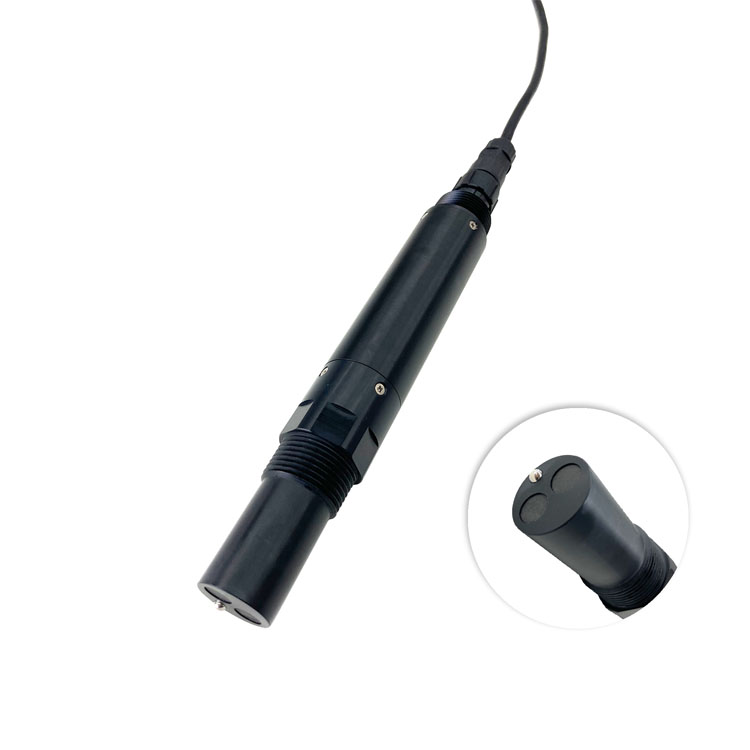
The opening photograph shows the NON-4S nitrate family. The NBL-WQ-NON-4A configuration described below has its own specification. Related nitrate versions should be approved by their delivered range, construction and measurement basis, not treated as interchangeable from appearance alone.
| Event condition | Risk to interpretation | Design choice to review |
|---|---|---|
| Drain dry before rainfall | The electrode may be exposed or require preparation before valid measurement. | Choose a supported wet installation or sampling arrangement and identify invalid periods. |
| Rapidly rising discharge | A long sample line or slow acquisition can miss the rising limb. | Assess sample renewal and the complete observation interval. |
| Sediment and debris during peak flow | Burial or obstruction can remove contact with representative water. | Provide protection, inspection and retrieval without creating a stagnant pocket. |
| Recession and shallow water | A point representative at the peak may be exposed later. | Check the complete operating level range and flag loss of suitable immersion. |
| Changing ionic background | Electrode response may change independently of the target concentration. | Trial representative runoff conditions, not just clean standards. |
Conductivity can provide context for changing ionic water, but it is not a nitrate measurement. The EC probe below cannot substitute for the NON electrode or determine nitrate concentration from a generic conversion. Retain its own units and measuring-point identity if the project includes that supporting channel.
| NON-4A item | Specification | Runoff-monitoring implication |
|---|---|---|
| Method and range | PVC-membrane nitrate ion-selective electrode; 0–100.00 or 0–1000.0 mg/L | Confirm the selected span and whether the delivered result is expressed as NO3-N. |
| Accuracy and resolution | ±10% or ±2 mg/L, whichever is greater; resolution 0.01 or 0.1 mg/L by range | Clarify the percentage basis and prove that relevant event changes can be distinguished. |
| Sample envelope | 0–40 °C; pH 2.5–11; pressure <0.1 MPa | Check runoff extremes and the actual installation, not storage conditions. |
| Supply and output | 12–24 VDC; 0.2 W at 12 V; RS485 Modbus RTU; optional 4–20 mA | Include flow acquisition and station communication as separate functions. |
| Construction and mounting | PVC/POM; IP68; 3/4 NPT immersion connection; permitted tilt at least 15° from horizontal, not inverted | Protect the membrane and confirm the installed orientation. |
| Cable and preparation | Standard 5 m cable; replaceable membrane head; activation required before use | Specify jacket, joints and preparation for an intermittently operated station. |
The absolute ±2 mg/L term matters if the required event contrast is small. Output increments do not establish low-level accuracy, and a successful wet-standard check does not prove performance in changing runoff chemistry. Approve the duty through representative comparisons before purchasing several stations.
The separate nitrate units, error limits and trial guide covers NO3-N versus NO3 interpretation. Use one agreed basis throughout the sensor output, reference results, flow calculation and exported records.
Use acquisition time rather than server receipt time when pairing nitrate with discharge. If a pumped sample reaches the electrode after transport, account for that delay. A concentration read at the cabinet can correspond to earlier water at the drain than the simultaneous field-flow record.
For an instantaneous calculation example, 3 mg/L as nitrogen at 0.2 m3/s corresponds to 0.6 g N/s, or 2.16 kg N/h. These are constructed values illustrating units, not field results or an event total. Estimate event mass by combining representative concentration and discharge over the event duration, with an explicit treatment of missing or invalid intervals.
Do not multiply the highest observed concentration by the whole event flow and label it measured export. Likewise, a simple mean concentration times total volume can misrepresent an event where concentration and flow change together. State the calculation and coverage so the result can be reviewed.
Take reference samples at a location and time representing the sensor's water. Record any sample-line delay and preparation. Compare rising and falling conditions where they differ; agreement at the quiet end of a storm does not independently approve the peak-flow observations.
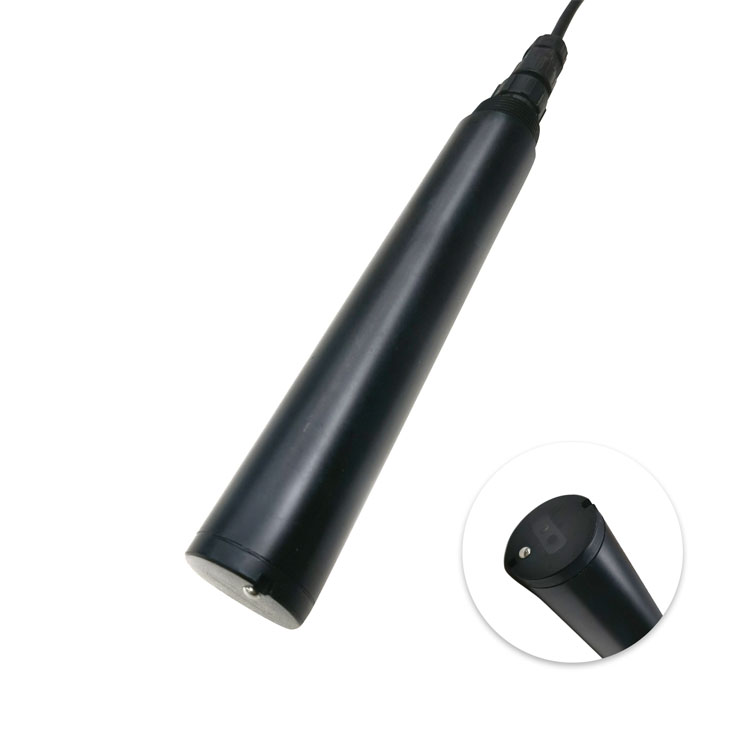
The following TS turbidity probe provides a separate optical observation. A sediment event may help explain sample obstruction, fouling or a change in the drain, but NTU cannot establish nitrate or nitrate-nitrogen concentration. Do not relabel the turbidity channel as another nitrogen parameter.
Record whether the electrode was submerged, prepared and producing a valid observation during the event. Identify retrieval, calibration and communication interruption. Retained last values should not silently fill dry or failed periods as though fresh concentration measurements continued.
At the RTU or data logger, preserve the nitrate basis, engineering value, acquisition time and quality alongside the corresponding flow. Verify the selected range and actual Modbus conversion at startup. Where the optional current output is used, check the ordered analog span independently.
For a NiuBoL inquiry, provide the drain geometry, wet/dry behavior, expected concentration and flow range, sediment conditions and reference method. State whether the result is a warning, a comparative study or an event-mass estimate. These details determine the measuring arrangement and integration work more usefully than requesting an unspecified nutrient-monitoring package.

No. Use a suitable independent discharge measurement or an approved site flow relationship. A nitrate concentration alone is insufficient for an event-mass calculation.
Do not assume that arrangement is suitable. Review exposure, preparation and the permitted installation with NiuBoL, and identify periods when valid wet measurement is unavailable.
Only if sampling, electrode response and acquisition captured the peak first. Uploading more frequently cannot recover an observation that was never measured or stored.
Water composition and sampling conditions can differ during the event. Paired observations across both periods test whether the measurement remains useful rather than relying on one convenient sample.
No. They observe different properties. Use them as supporting context where relevant, not as universal nitrate conversion inputs.
Provide the nitrogen basis, time-aligned concentration and discharge, event boundaries, calculation method and coverage of valid observations. Identify estimates or gaps instead of presenting incomplete data as a fully measured total.
Select a nitrate sensor for agricultural runoff around the event and intended result. Verify the NON configuration in representative water, keep the electrode in a suitable measuring condition and pair its observations with the corresponding discharge. Preserve timing and gaps so the reported event has a defensible measurement basis.
Prev:Emergency River Pollution Monitoring: Can the Warning Arrive in Time?
Next:Total Nitrogen and Total Phosphorus Monitoring: Sample Time and Result Age
Related recommendations
Sensors & Weather Stations Catalog
 Agriculture Sensors and Weather Stations Catalog-NiuBoL.pdf
Weather Stations Catalog-NiuBoL.pdf
Agriculture Sensors Catalog-NiuBoL.pdf
Water Quality Sensor Catalog-NiuBoL.pdf
Related products
 Combined air temperature and relative humidity sensor
 TDR Soil Moisture & Temperature Sensor for irrigation| RS485 |4-20mA| NBL-S-THR
 Soil pH sensor RS485 soil Testing instrument soil ph meter for agriculture |NBL-S-PH
 Wind Speed sensor Output Modbus/RS485/Analog/0-5V/4-20mA
 Tipping bucket rain gauge for weather monitoring auto rainfall sensor RS485/Outdoor/stainless steel
 Pyranometer Solar Radiation Sensor 4-20mA/RS485


Screenshot, WhatsApp to identify the QR code
WhatsApp number:+8615367865107
(Click on WhatsApp to copy and add friends)

