





— Blogs —
—Products—
 Consumer hotline +8618073152920
WhatsApp:+8615367865107
Address:Room 102, District D, Houhu Industrial Park, Yuelu District, Changsha City, Hunan Province, China
Product knowledge
Time:2022-05-09 20:43:37 Popularity:2485
Selecting the right soil sensor starts with identifying which soil parameters need to be measured. Agricultural monitoring projects may require soil temperature, volumetric water content, electrical conductivity (EC), salinity, pH, nutrient indicators or measurements at several soil depths.
Different soil sensors use different measurement principles. FDR and TDR sensors estimate soil moisture from dielectric properties, EC sensors measure electrical conductivity, and electrochemical pH sensors respond to the acidity or alkalinity of the soil environment. Multi-depth probes provide measurements from several soil layers at one installation location.
This soil sensor selection guide explains how to compare measurement parameters, sensor technologies, accuracy, output interfaces, installation methods and system integration requirements for agriculture, greenhouses, orchards and environmental research.

The first selection decision is determining which measurements are required. A single-parameter or two-parameter sensor may be sufficient for irrigation monitoring, while more complex projects may require additional conductivity, salinity, pH or soil-profile information.
| Soil Parameter | Typical Unit | Monitoring Purpose |
| Soil Moisture | VWC (%) | Root-zone water monitoring and irrigation management |
| Soil Temperature | °C | Root-zone temperature and seasonal soil-condition monitoring |
| Soil EC | µS/cm or mS/cm | Electrical conductivity and salt-related trend monitoring |
| Soil Salinity | Model-Specified Unit | Monitoring estimated salt-related conditions |
| Soil pH | pH | Soil acidity and alkalinity monitoring |
| Soil NPK Indicators | mg/kg | Empirical field nutrient indication and trend comparison |
A soil moisture sensor does not automatically measure soil EC, pH or NPK. Similarly, electrical conductivity does not directly identify individual nutrient concentrations. Select the appropriate instrument according to the actual measurement requirement.
NiuBoL provides several soil sensing technologies and parameter combinations for agricultural monitoring. The following representative instruments can be selected according to the monitoring objective.
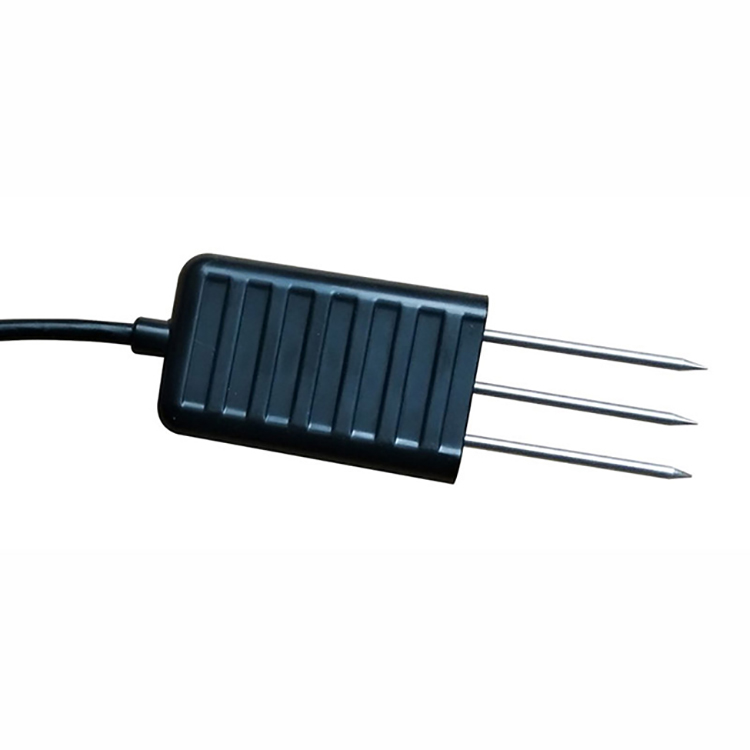 NBL-S-TM FDR Soil Sensor Temperature + Moisture RS485 Modbus RTU |  NBL-S-THR TDR Soil Sensor Temperature + Moisture RS485 / Analog Versions |
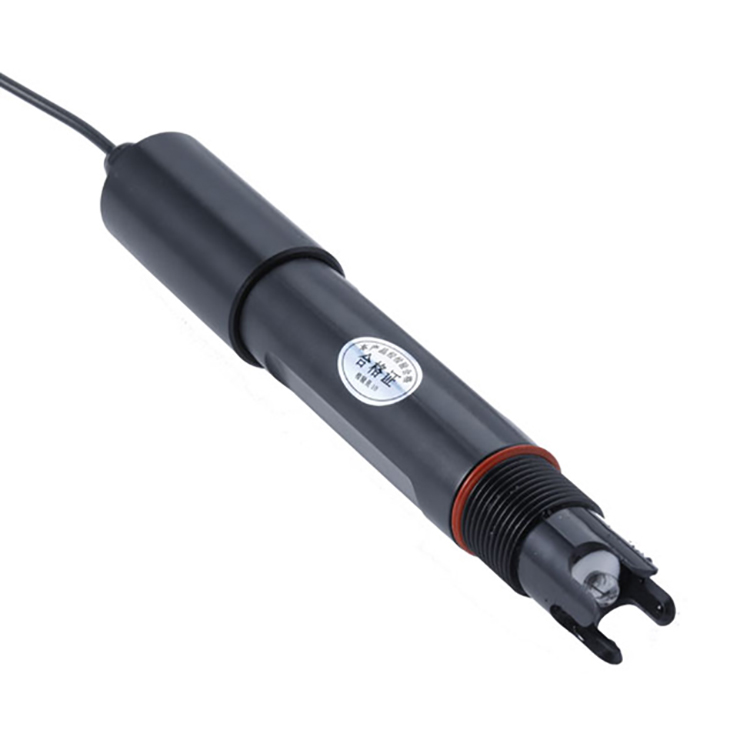 NBL-S-PH Soil pH Sensor Soil pH RS485 / Analog Versions | 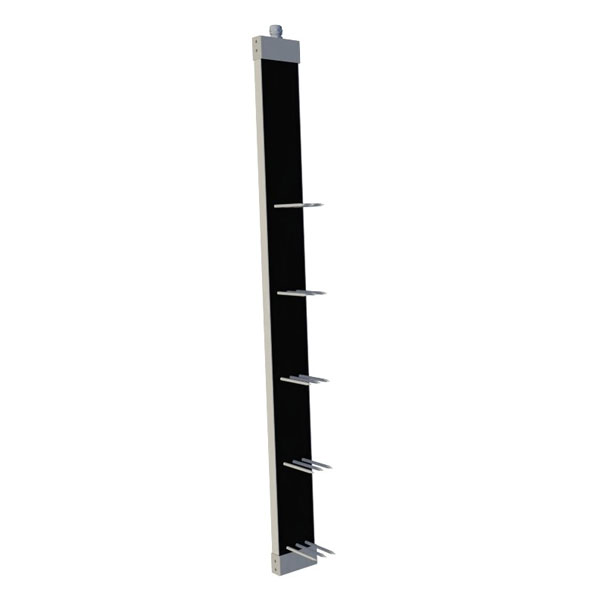 NBL-S-TM-MD Multi-Depth Sensor Multi-Layer Temperature, Moisture & Salinity Modbus Communication |
For integrated temperature, moisture and EC measurement, see the NBL-S-TMC 3-in-1 Soil Sensor. For additional salinity monitoring, the NBL-S-TMCS 4-in-1 Soil Sensor provides temperature, moisture, EC and salinity outputs.
FDR and TDR are two commonly used dielectric measurement technologies for soil moisture monitoring.
FDR (Frequency Domain Reflectometry) sensors evaluate the frequency-domain dielectric response of the surrounding soil. The sensor electronics convert the measured response into an estimated volumetric water content value.
TDR (Time Domain Reflectometry) sensors analyze electromagnetic pulse propagation and reflection along a sensing structure. The response is related to the apparent dielectric properties of the soil.
| Comparison | FDR | TDR |
| Measurement Method | Frequency-domain dielectric response | Electromagnetic pulse propagation and reflection |
| Main Measurement | Volumetric Soil Moisture | Volumetric Soil Moisture |
| Representative Model | NBL-S-TM | NBL-S-THR |
| Published Moisture Accuracy | ±5% for NBL-S-TM | ±3% for NBL-S-THR |
| Output Options | RS485 Modbus | RS485, 4–20mA or 0–5V by configuration |
Neither technology should be considered universally unaffected by soil texture, density, salinity or installation conditions. Field accuracy depends on sensor design, calibration and the measurement environment.
Soil electrical conductivity sensors measure the conductivity of the surrounding soil environment. EC is affected by dissolved ions, moisture, temperature and soil characteristics.
For irrigation and greenhouse projects, EC measurements can help monitor changes in salt-related root-zone conditions. The measurement should be interpreted together with soil moisture, irrigation-water quality and fertilizer application.
The NBL-S-TMC combines temperature, moisture and EC. The NBL-S-TMCS adds a model-derived salinity output. These configurations are useful when several related parameters must be measured at the same monitoring point.
Soil EC is not the same as individual nutrient concentration. A field EC sensor cannot determine nitrogen, phosphorus or potassium concentrations from conductivity alone.
Soil pH describes the acidity or alkalinity of the soil environment. It is relevant to nutrient availability, crop growth and soil management.
For field pH monitoring, select a sensor according to the required measurement range, electrode technology, accuracy, calibration procedure, soil moisture conditions and output interface.
The NBL-S-PH Soil pH Sensor uses an electrochemical sensing electrode and is available with RS485 Modbus RTU and selected analog output configurations.
Field measurements and standardized laboratory soil pH results may differ because of sampling, moisture conditions, extraction procedures and electrode characteristics. Laboratory verification is recommended when standardized analytical results are required.
Some integrated soil sensors provide nitrogen (N), phosphorus (P) and potassium (K) reference-value outputs for field monitoring.
For NiuBoL integrated EC-related soil NPK probes, the displayed NPK values are based on empirical relationships with soil electrical characteristics. They are primarily intended for comparative field screening and trend observation.
These values should not be treated as direct laboratory chemical determinations of available nitrogen, phosphorus or potassium.
For fertilizer formulation, detailed soil nutrient analysis or projects requiring standardized chemical results, use a suitable laboratory method. For field reference monitoring, see the NBL-S-NPK Soil Sensor.
A conventional soil sensor measures conditions near one installation location and depth. Soil moisture, temperature and salt conditions may vary significantly throughout the root zone.
When several depths must be monitored, a project can use multiple single-point sensors or a dedicated multi-depth soil sensor.
The NBL-S-TM-MD provides multi-layer temperature, moisture and salinity measurement with configurable measurement layers and spacing. It is suitable for root-zone monitoring, orchards, irrigation research and long-term soil-profile observation.
| Requirement | Typical Selection |
| One Monitoring Depth | Single-point temperature and moisture sensor |
| Several Independent Depths | Multiple single-point sensors |
| Continuous Root-Zone Profile | Multi-depth soil monitoring instrument |
| Water and Salt Distribution | Multi-depth temperature, moisture and salinity monitoring |
Correct installation is essential for representative soil measurements. Probe contact, installation depth, soil texture, root distribution, stones and irrigation patterns should be considered.
For temporary measurements, insert the sensing electrodes into representative soil without excessive movement. Avoid creating air gaps around the sensing area.
For long-term monitoring, an appropriate probe can be inserted into an undisturbed soil wall at the required depth. The excavation should then be carefully backfilled, and cables should be protected against mechanical damage and environmental exposure.
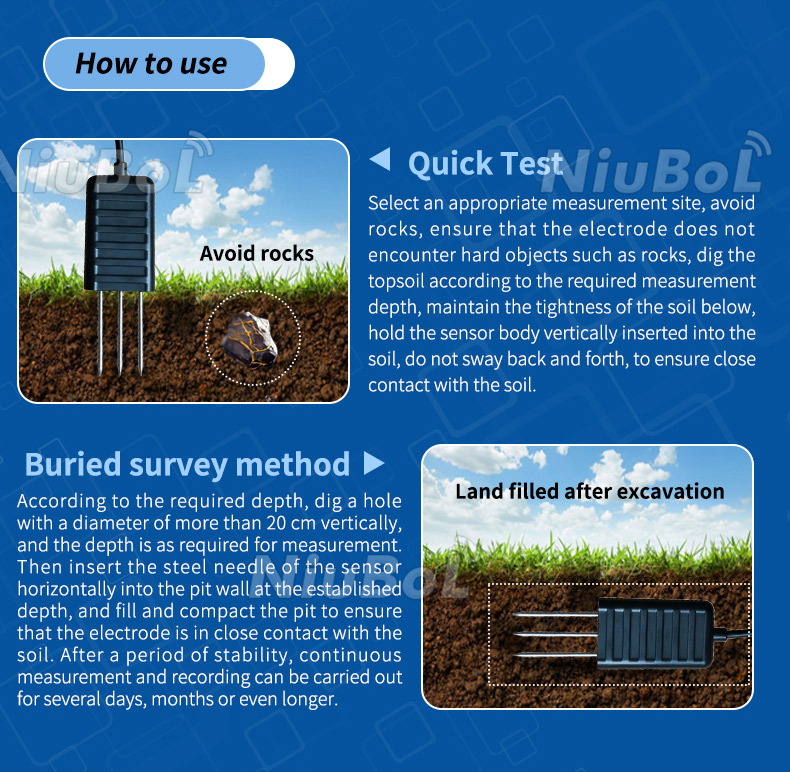
The correct installation depth depends on crop type, root distribution, soil properties and the intended monitoring objective. A fixed depth such as 20 cm or 30 cm is not appropriate for every application.
The output interface should match the receiving controller, PLC, RTU, data logger or IoT gateway. Different NiuBoL soil sensor models are available with different electrical configurations.
| Output | Receiving Equipment | Typical Application |
| RS485 Modbus RTU | PLC, RTU, Data Logger, Gateway | Digital multi-sensor monitoring |
| 4–20mA | Compatible Analog Current Input | Selected industrial and agricultural systems |
| 0–5V | Compatible Voltage Input | Selected analog acquisition systems |
For continuous remote monitoring, the soil sensor normally connects to a compatible data logger or gateway. The gateway or communication device provides the network connection.
Soil Sensors → RS485 / Analog → Data Logger / PLC → 4G / Ethernet / Supported Network → Cloud Platform or Private Server
For an RS485 Modbus network, confirm that each sensor uses an appropriate unique address and that the power supply, communication interval, cable routing and bus configuration are compatible with the project.
Different agricultural applications benefit from different soil sensor combinations. Selection should be based on the parameters that help answer the project's actual monitoring questions.
| Application | Typical Sensor Selection |
| Field Irrigation | Soil moisture and temperature |
| Greenhouse Cultivation | Moisture, temperature, EC and optional pH |
| Fruit Orchards | Multi-depth soil moisture and temperature monitoring |
| Saline Soil Management | Soil EC, moisture, temperature and salinity indication |
| Soil Research | Selected sensors with appropriate calibration and reference measurements |
| Field Nutrient Screening | Empirical NPK sensor for trends; laboratory testing for accurate nutrient concentrations |
Before selecting a soil sensor, confirm the measurement parameters, installation conditions and communication requirements. A complete monitoring system may also require power equipment, cabling, a data logger and a communication gateway.
| Selection Item | Required Information |
| Measured Parameters | Moisture, temperature, EC, salinity, pH or nutrient indicators |
| Soil Type | Sand, loam, clay, organic soil or cultivation substrate |
| Measurement Depth | One measurement depth or several soil layers |
| Measurement Accuracy | Required accuracy, calibration procedure and reference method |
| Output Interface | RS485 Modbus, 4–20mA or voltage output as required |
| Power Supply | Available DC voltage and total system power consumption |
| Cable Length | Distance between the sensing location and data acquisition equipment |
| Data System | PLC, RTU, data logger, IoT gateway, cloud or private server |
| Project Quantity | Pilot samples, number of monitoring points and total quantity |
A1. Soil moisture and temperature sensors are common starting points for irrigation monitoring. Additional EC, salinity or multi-depth measurements may be useful depending on crop, soil and irrigation requirements.
A2. FDR sensors use frequency-domain dielectric measurements, while TDR sensors analyze electromagnetic pulse propagation and reflection. Both can estimate soil moisture, but field performance depends on the actual sensor design and calibration.
A3. No. Agricultural dielectric soil moisture sensors commonly report volumetric water content as VWC (%). Relative humidity (%RH) describes moisture in the air and is a different measurement.
A4. No. Soil EC alone cannot determine individual nitrogen, phosphorus and potassium concentrations. Integrated electrical-characteristic-based NPK sensors provide empirical reference values rather than standardized chemical-analysis results.
A5. Choose a multi-depth instrument when the project requires monitoring of water, temperature or salt-related changes across several soil layers at one installation location.
A6. Yes. Selected NiuBoL soil sensors support RS485 Modbus RTU, and certain models are available with analog outputs. The controller or data logger must support the selected signal.
A7. Yes. A compatible data logger or IoT gateway can collect measurements and transmit them through a supported network. Standard RS485 soil sensors do not automatically include 4G communication.
A8. The quantity depends on field size, soil variability, crop type, irrigation zones, monitoring depths and management objectives. Large or variable sites may require several representative monitoring points.
NiuBoL provides soil moisture, temperature, EC, salinity, pH, NPK reference-value and multi-depth soil sensors for agricultural irrigation, greenhouses, orchards and environmental monitoring.
For soil moisture monitoring, review the Soil Moisture Sensor range. For conductivity and salinity applications, compare Soil EC Sensors.
For product selection and quotation, provide the required measurements, soil type, installation depth, number of monitoring points, output interface, power supply, cable length, quantity and data logger or gateway requirements.
For wider product options, visit NiuBoL Agricultural Sensors.
Related recommendations
Sensors & Weather Stations Catalog
 Agriculture Sensors and Weather Stations Catalog-NiuBoL.pdf
Weather Stations Catalog-NiuBoL.pdf
Agriculture Sensors Catalog-NiuBoL.pdf
Water Quality Sensor Catalog-NiuBoL.pdf
Related products
 Combined air temperature and relative humidity sensor TDR Soil Moisture & Temperature Sensor for irrigation| RS485 |4-20mA| NBL-S-THR
 Soil pH sensor RS485 soil Testing instrument soil ph meter for agriculture |NBL-S-PH
 Wind Speed sensor Output Modbus/RS485/Analog/0-5V/4-20mA
 Tipping bucket rain gauge for weather monitoring auto rainfall sensor RS485/Outdoor/stainless steel
 Pyranometer Solar Radiation Sensor 4-20mA/RS485


Screenshot, WhatsApp to identify the QR code
WhatsApp number:+8615367865107
(Click on WhatsApp to copy and add friends)

