





— Blogs —
—Products—
 Consumer hotline +8618073152920
WhatsApp:+8615367865107
Address:Room 102, District D, Houhu Industrial Park, Yuelu District, Changsha City, Hunan Province, China
Product knowledge
Time:2025-03-18 11:25:11 Popularity:1568
Quick Answer: Ultrasonic weather stations use acoustic transit-time measurements for wind speed and wind direction, then combine those observations with the other sensors specified for the model. The term ultrasonic does not mean that temperature, humidity, rainfall and radiation are all measured by sound. Compare the actual channels, uncertainty, operating limits and output before selecting a station for meteorological monitoring.
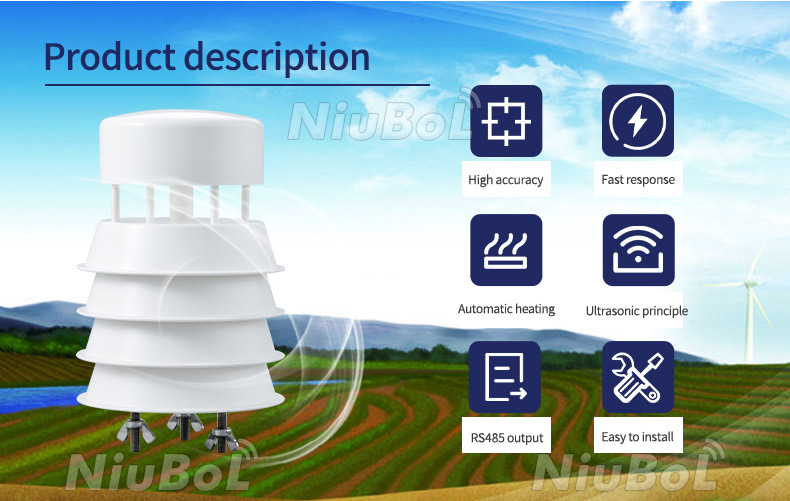
In an integrated station, the wind transducers compare sound travel times along opposing paths. Separate sensing elements provide air temperature, relative humidity and pressure. A rainfall option may use a piezoelectric impact surface, while a radiation channel uses its own detector. The technologies share a housing and communication connection, not one universal measurement principle.
This distinction matters when specifying replacements or investigating a fault. A blocked acoustic path can disturb wind observations while the temperature channel continues to report. A dirty radiation surface has a different effect from an incorrectly oriented wind reference. A valid communication response does not establish that every physical measurement remains valid.
Heating is also a configuration choice. A heating symbol on a product illustration is not evidence that every model includes a heater or that it remains accurate through every icing event. Specify the required low-temperature behavior, heater load and treatment of obstructed measurements for the ordered instrument.

An ultrasonic snow depth sensor measures the echo distance to a surface, rather than airflow along the wind sensor's paths. The NiuBoL NBL-W-SNOW is a separate 50 kHz ranging instrument with a 0-1000 mm snow-depth range. Snow depth is obtained relative to an established ground reference; it is not automatically a rainfall measurement or snow-water equivalent.
Its normal consumption is approximately 180 mW, rising to approximately 3 W when low-temperature heating is active. A winter power design must allow for that heating demand. The RS485 connection also needs the correct decoder: the standard snow-sensor configuration uses an NBL private protocol unless another protocol is specified. Do not assume that every RS485 device on a weather station uses identical Modbus registers.

Wind affects the travel time of an acoustic signal. Comparing the opposing transit times gives a wind component along the measurement path. Combining two appropriately arranged horizontal components provides horizontal speed and direction. This transit-time method should not be described as requiring a Doppler-frequency measurement for the models discussed here.
A two-dimensional instrument does not directly supply the vertical wind component. Projects involving three-dimensional turbulence, sonic temperature or flux calculations require a suitable instrument and acquisition method for those quantities. An integrated station with many environmental channels is not necessarily a three-dimensional sonic anemometer.
Direction also needs an installed geographic reference. Wind direction conventionally indicates where the wind comes from. Align the reference correctly and record any offset in the receiving system. A north-alignment error shifts every direction value even when wind speed appears plausible.
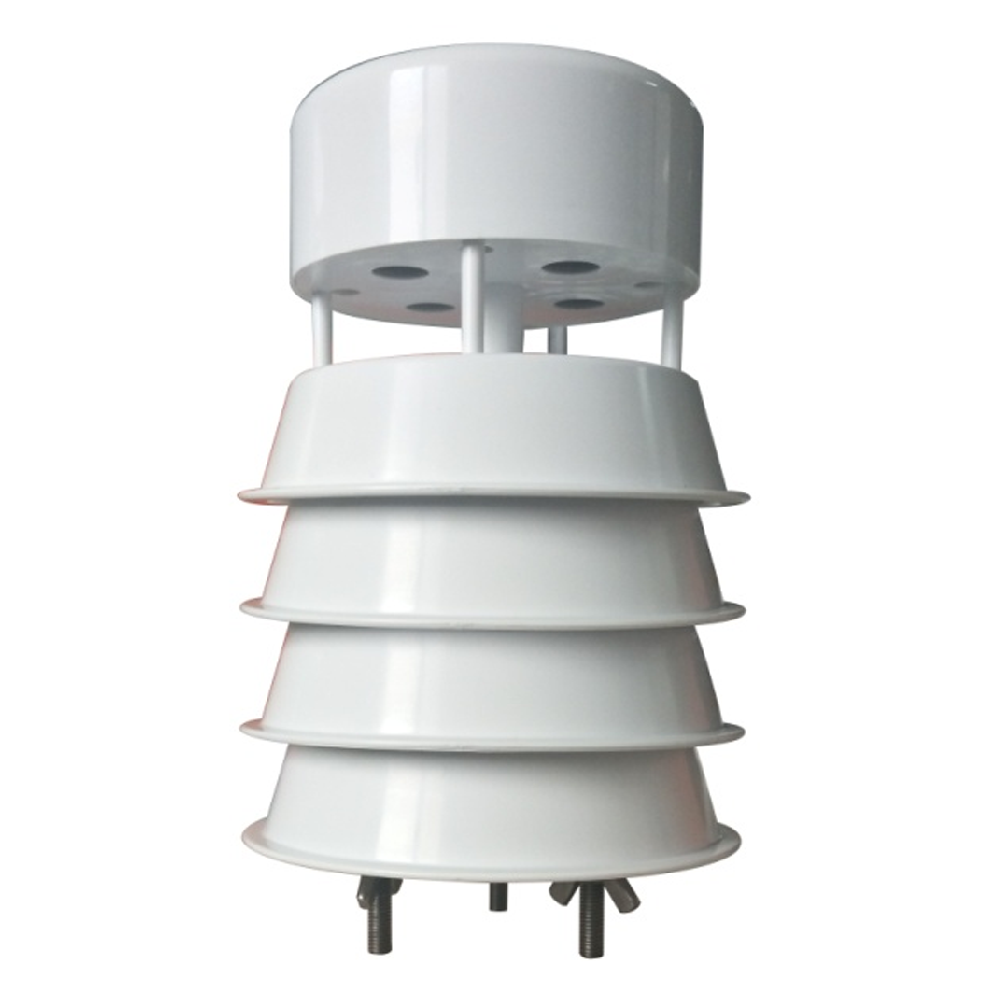
The NBL-W-51MUWS measures horizontal wind speed, wind direction, air temperature, relative humidity and barometric pressure. The following specifications apply to its 12-24 VDC configuration. They should not be transferred to another integrated model simply because the enclosure has a similar appearance.
| Parameter | NBL-W-51MUWS configuration | Interpretation |
|---|---|---|
| Wind speed | 0-40 m/s; accuracy +/-0.5 m/s + 2% FS; resolution 0.01 m/s | The full-scale error term is different from a percentage of the current reading. |
| Wind direction | 0-359 degrees; accuracy +/-3 degrees; resolution 1 degree | Use the geographic reference and an appropriate directional averaging method. |
| Temperature channel | -40 to +100 degrees C; accuracy +/-0.5 degrees C; resolution 0.1 degree C | The channel span does not extend the complete instrument's operating environment. |
| Relative humidity | 0-100% RH; accuracy +/-5% RH; resolution 0.1% RH | Measurement scale and permitted operating humidity are separate specifications. |
| Barometric pressure | 10-1100 hPa; accuracy +/-1.5 hPa; resolution 0.1 hPa | Retain station-pressure units and distinguish any later sea-level correction. |
| Power | 12-24 VDC; average consumption 0.3 W | Include acquisition, transmission and any additional heaters in the station energy budget. |
| Communication | RS485 Modbus RTU; 9600 bps | Match the delivered register map and serial settings. |
| Operating environment | -40 to +80 degrees C; 0-95% RH | Check the complete instrument's limits, not only one channel's range. |
| Housing and protection | ABS; IP65 | Ingress protection does not establish resistance to every chemical, impact or icing condition. |
| Cable | Standard 2.5 m; jacket material to be specified for the installation | Confirm the cable assembly and connector protection for the intended exposure. |
A 0.01 m/s resolution does not mean +/-0.01 m/s accuracy. At a 40 m/s full scale, the 2% FS term alone is 0.8 m/s. Review the full accuracy expression against the intended observation task instead of accepting a general claim of +/-0.1 m/s for all ultrasonic weather stations.
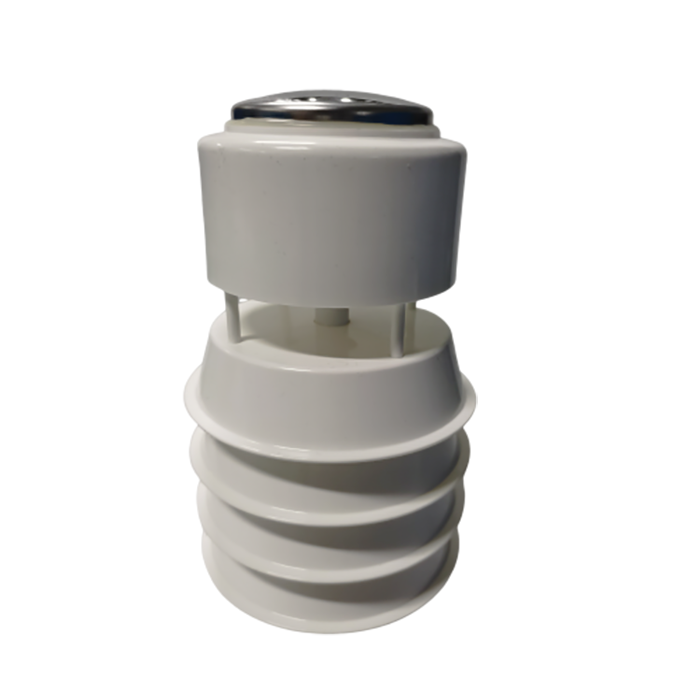
The NBL-W-61MUWS adds piezoelectric rainfall measurement to wind, temperature, humidity and pressure. Its 12-24 VDC configuration has average consumption of 0.35 W and a stated operating environment of -20 to +50 degrees C. The air-temperature channel's -40 to +80 degrees C span is not permission to operate the complete six-parameter unit throughout that span.
Piezoelectric rainfall uses signals generated by raindrop impacts. It is not measured by the ultrasonic wind transducers and is not the same mechanism as a tipping-bucket collector. Compare the required accumulation, event recording and field verification method when choosing between integrated impact sensing and a separate rain gauge.
Do not assume that an added rain channel measures freezing precipitation or conductor icing. Specify those observation tasks separately. The sensor count alone does not identify all-weather performance, and a low power figure without the optional loads does not establish winter battery autonomy.
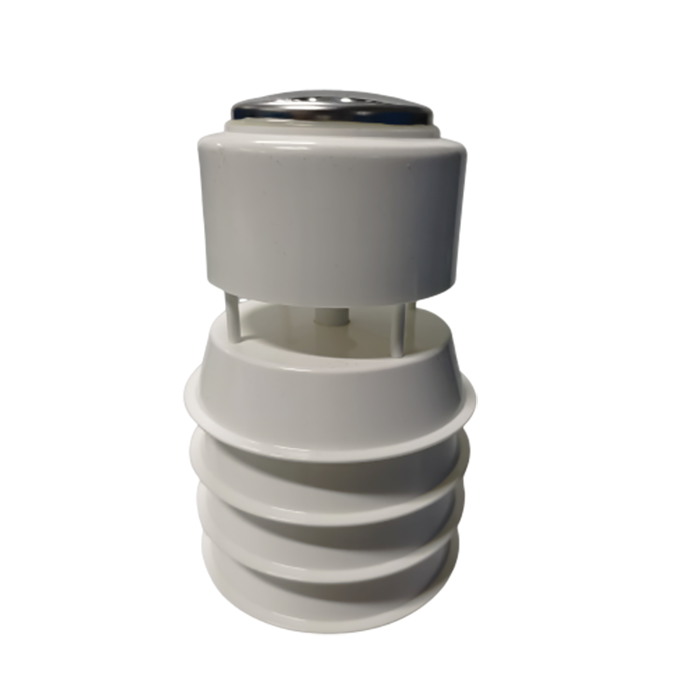
Higher-parameter ultrasonic weather stations can include light or other environmental channels. Check the channel list rather than identifying the configuration by its case or photograph. One housing family may contain several electrical and sensing arrangements, and a product name containing seven or eight does not explain the units or method used by each channel.
Illuminance in lux, solar irradiance in W/m2 and photosynthetically active radiation are different measurements. Select the quantity required by the application. A radiation detector suitable for a general environmental trend should not automatically be specified for every photovoltaic assessment or agricultural light calculation.
The logger must also distinguish an unconnected optional channel from a real zero. Before delivery, agree which channels are fitted, which registers are valid and how unavailable observations will appear. Adding empty dashboard tiles is not a functional expansion of the weather station.
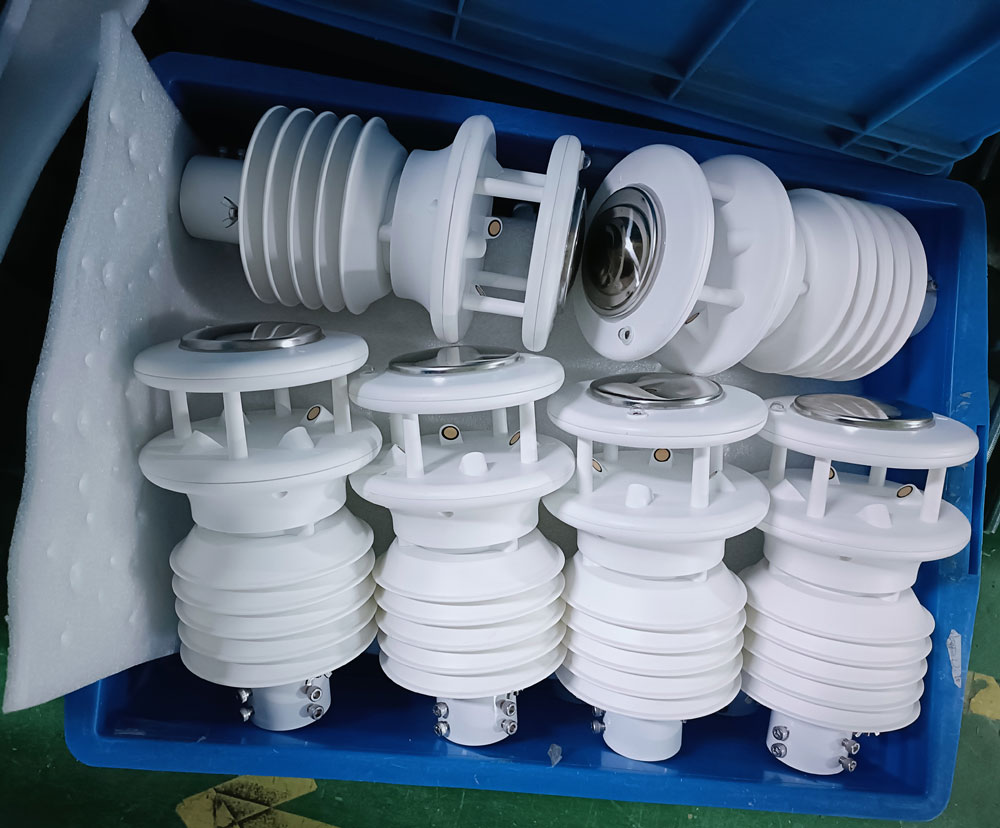
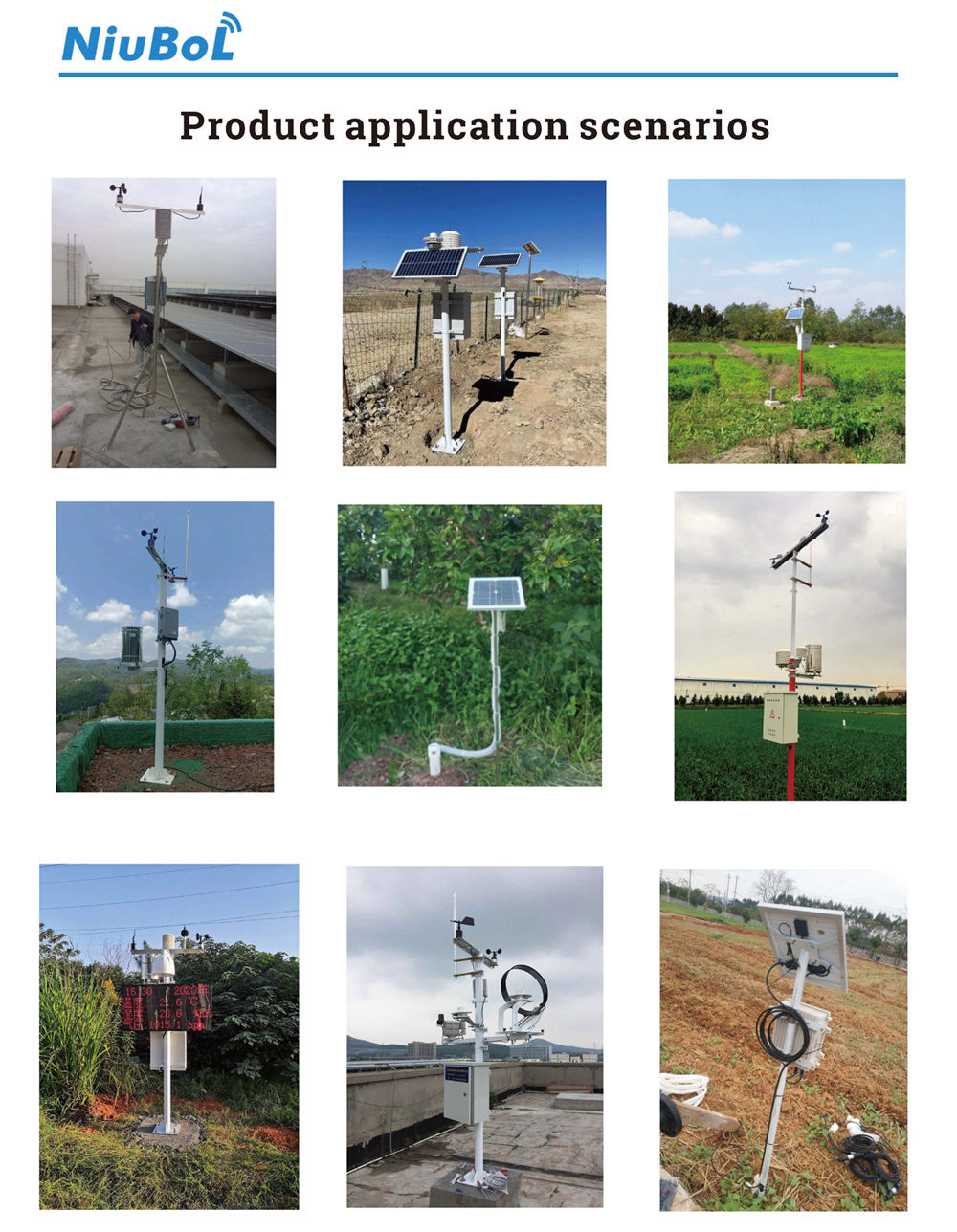
A sensor close to a wall, parapet, tree or support can record disturbed airflow. If the task is exposed meteorological observation, assess the surrounding obstacles and the wind sectors they affect. If the task is a street-level or canopy microclimate study, keep that local purpose explicit instead of treating the results as an unrestricted regional reference.
Keep the acoustic paths clear and the assembly level and secure. Record orientation, mounting height and nearby structures. A later move of the support, new vegetation or an added solar panel can change the measurement environment without creating an electrical fault.
Inspection remains necessary even without cup bearings. Check contamination, birds, ice, support movement and connector condition. A clean-looking instrument is not proof of calibration, while a stable output is not proof that the sensor is observing representative air.

An integrated unit reduces separate instrument brackets and connections. A modular station permits wind, shielded air measurements and precipitation instruments to occupy different positions or heights. This can be important when the observation method does not allow every sensor to share one mounting point.
For a replacement project, list the quantities the current system actually uses. Retaining an existing PLC or data logger may favor a configuration with a compatible digital point map. Where individual instruments have different service intervals or reference requirements, separate sensors may be easier to verify and replace independently.
Remote connectivity is supplied by the selected acquisition and communication equipment. RS485 Modbus RTU on an integrated sensor does not by itself include cellular transmission, internet storage or a forecast service. A station can provide observations to those systems without generating forecasts or built-in machine-learning decisions.
For agricultural monitoring, verify the required weather inputs and exposure before using the records in a crop model. For urban observations, retain the local mounting context. For transport or airport projects, establish the applicable acceptance and approval requirements; a general industrial weather sensor is not automatically an approved operational aviation instrument.
Bench-test the ordered channel list, then compare the installed measurements with suitable references under interpretable conditions. Keep sampling, averaging and reporting periods distinct. A fast internal measurement does not establish a millisecond update at a remote dashboard after polling, processing and transmission.
Test missing-channel behavior as well as normal readings. The system should not display an old wind value as current after a sensor or communication fault. For selection, send NiuBoL the required quantities, uncertainty, climate conditions and receiving equipment so the configuration can be matched to the actual monitoring task.
No. Ultrasonic transit-time sensing measures wind in these integrated models. Temperature, humidity, pressure, rainfall and radiation use their respective sensing elements. Snow depth uses a separate ranging instrument when required.
No. Two horizontal components do not directly measure the vertical component. Select an appropriate three-dimensional instrument when turbulence or other calculations require that measurement.
It removes cup and vane bearing wear from the ultrasonic wind measurement. Acoustic obstruction, contamination, ice, mounting changes and connector faults still require inspection and appropriate measurement checks.
Not automatically. The configurations described here have different complete-instrument temperature limits. Check the ordered model's environment, supply and fitted channels rather than transferring specifications between similar housings.
No. The integrated wind models discussed here use Modbus RTU, but the separate NBL-W-SNOW has a private-protocol default configuration. Confirm both the electrical interface and the actual communication format.
It can when power, serial settings, point count and register interpretation are compatible. Verify signed temperature values, units and unavailable-channel states before relying on the final display.
Confirm the exact model, fitted channels, environmental limits, output, cable assembly and any heating requirement. Include the receiving logger or controller and any application-specific approval or uncertainty requirement.
Ultrasonic weather stations are useful when their wind technology, additional channels and installation match a defined observation task. Compare actual model specifications, separate display resolution from uncertainty, and verify the complete acquisition path. NiuBoL integrated and modular configurations offer different ways to build that measurement arrangement without treating every sensor or application as interchangeable.
Seven-parameter configuration:  All-in-One-Ultrasonic-Weather-Sensor-Instruction-Manual.pdf
Six-parameter configuration: NBL-W-61MUWS-Ultrasonic-Weather-Station-Instruction-Manual.pdf
Eight-parameter configuration: All-in-One-Ultrasonic-Weather-Sensor-Instruction-Manual.pdf
Prev:Small Outdoor Weather Station Installation: Fit the Sensors, Not Just the Mast
Next:Weather Station Specification Sheet: Check Complete-System Claims
Related recommendations
Sensors & Weather Stations Catalog
Agriculture Sensors and Weather Stations Catalog-NiuBoL.pdf
Weather Stations Catalog-NiuBoL.pdf
Agriculture Sensors Catalog-NiuBoL.pdf
Water Quality Sensor Catalog-NiuBoL.pdf
Related products
 Combined air temperature and relative humidity sensor
 TDR Soil Moisture & Temperature Sensor for irrigation| RS485 |4-20mA| NBL-S-THR
 Soil pH sensor RS485 soil Testing instrument soil ph meter for agriculture |NBL-S-PH
 Wind Speed sensor Output Modbus/RS485/Analog/0-5V/4-20mA
 Tipping bucket rain gauge for weather monitoring auto rainfall sensor RS485/Outdoor/stainless steel
 Pyranometer Solar Radiation Sensor 4-20mA/RS485


Screenshot, WhatsApp to identify the QR code
WhatsApp number:+8615367865107
(Click on WhatsApp to copy and add friends)

