





— Blogs —
—Products—
 Consumer hotline +8618073152920
WhatsApp:+8615367865107
Address:Room 102, District D, Houhu Industrial Park, Yuelu District, Changsha City, Hunan Province, China
Product knowledge
Time:2026-08-13 09:00:00 Popularity:212
Quick Answer: When a dissolved oxygen sensor in water changes sharply as aeration switches, compare the reading with actual airflow, mixing and probe exposure before retuning the blower controller. The change may reflect real oxygen transfer, bubbles at the cap, or different water reaching the sensing point. One trace alone does not distinguish those causes.
In wastewater aeration, dissolved oxygen measurement influences treatment operation and blower demand. Basins can have gradients, so the sensing point should represent the intended control zone rather than a concentrated bubble plume near a diffuser. An intermittent-aeration process adds another issue: the water and mixing around the probe can change when the air stops.
Keep the original operating sequence intact while investigating it. Record DO, water temperature, aeration commands and available airflow or equipment feedback on a common time basis. A command to start a blower is not proof that air reached the basin, and a fast DO rise is not proof that the entire zone recovered.
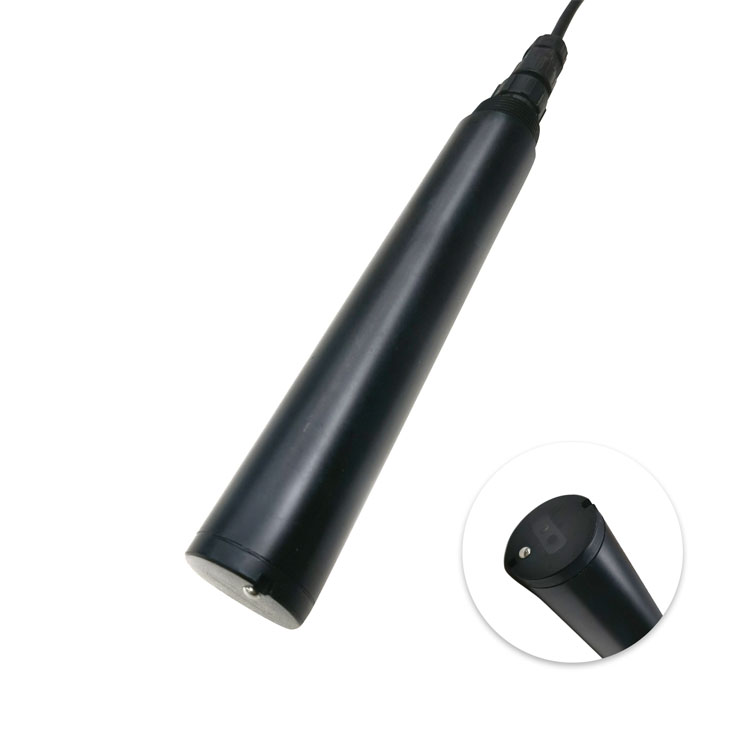
The turbidity probe above measures suspended material, not oxygen. Its response may help describe a mixing change, but it cannot validate the DO concentration or establish oxygen demand. Treat each observation as context until the process and sensing point have been checked.
| Possible cause | What to inspect | What not to conclude immediately |
|---|---|---|
| Real oxygen change | Air delivery, process load and comparable DO observations in the zone | That a single point describes the complete basin |
| Bubbles or deposits at the optical cap | Cap condition, bubble accumulation and location relative to diffusers | That the process needs a new setpoint |
| Changed mixing or local water exchange | What water reaches the probe during both air-on and air-off phases | That the optical sensor requires a minimum flow to replenish consumed oxygen |
The optical method does not consume oxygen. It therefore does not need flow to replace oxygen consumed by the measurement itself. This does not make location irrelevant: stagnant local water, deposits or gas bubbles can still prevent the cap from representing the treatment zone.
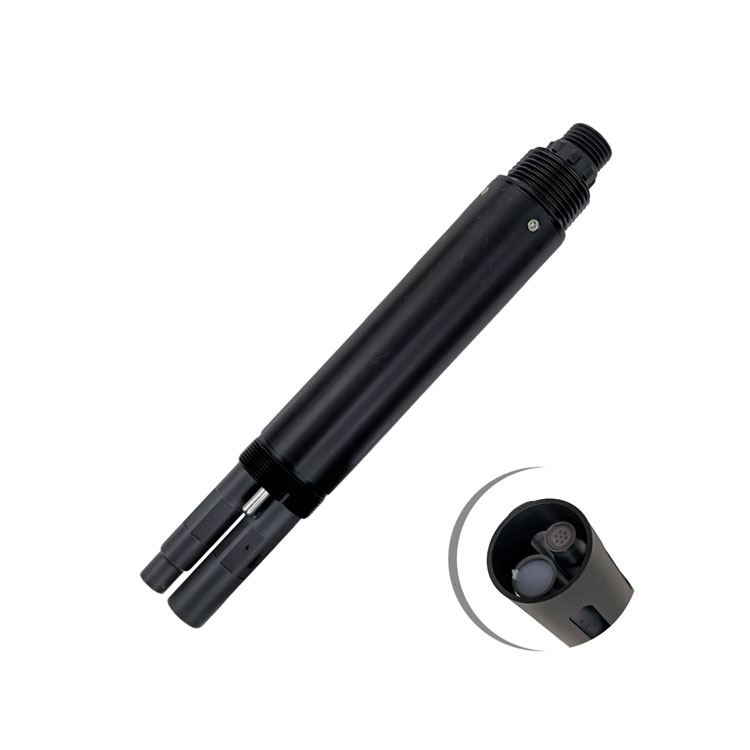
An ammonium-selective probe, pictured below, may support a separate nitrogen-control question. Its concentration and response do not provide an independent DO reference. Do not increase or reduce aeration solely because two different channels appear to move together during a short transition.
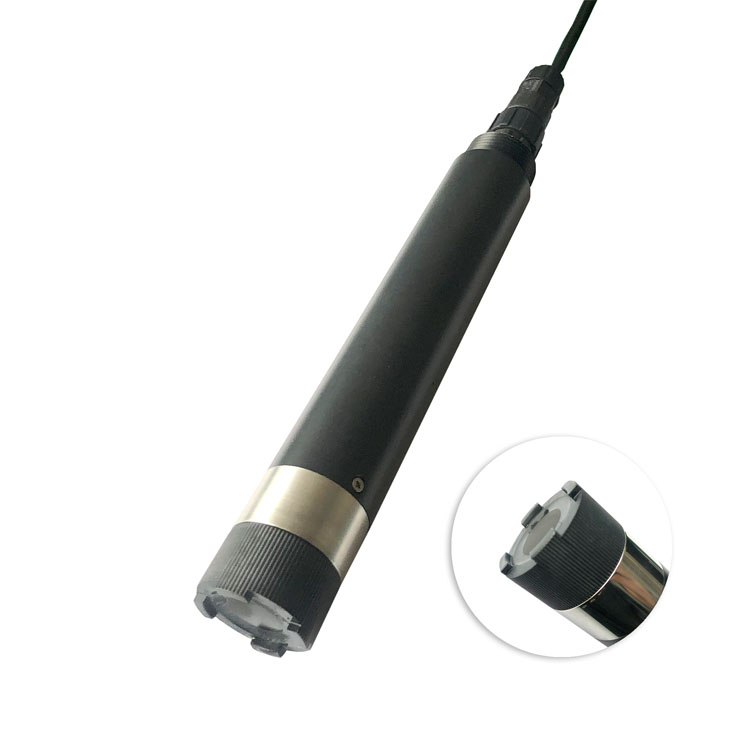
The NiuBoL NBL-WQ-DO is a fluorescence-based immersion probe. Its operating limits and accuracy apply to the measurement, not to the complete blower-control loop. Confirm the required measurement tolerance near the plant's operating point rather than choosing from display resolution alone.
| NBL-WQ-DO item | Specification | Practical implication |
|---|---|---|
| Range / resolution | 0-20.00 mg/L / 0.01 mg/L | A small displayed step is not the accuracy limit |
| Accuracy | +/-2% FS; equivalent to +/-0.4 mg/L on this range | Assess suitability for the proposed low-level control band |
| Temperature / pressure | 0-45 C; <0.2 MPa | Check the installed water conditions |
| Compensation | Pt1000 automatic temperature compensation; configured salinity compensation | Do not assume independent salinity measurement |
| Supply / consumption | 12-24 VDC / <0.3 W at 12 V | Add controller and other station loads separately |
| Output / protection | RS485 Modbus RTU / IP68 | Verify the receiver and waterproof cable terminations |
| Materials / installation / cable | POM and 316L stainless steel; immersion, 3/4 NPT; standard 5 m | Provide safe retrieval and confirm cable-jacket compatibility |
The replaceable fluorescent cap requires inspection and cleaning; no electrolyte is required. A clean cap and a suitable reference check should precede an investigation of controller tuning. Do not use calibration to hide a probe that changes its exposure every time aeration starts.
Compare readings collected at known times with the actual process sequence. Receiver averaging, polling and data-upload delays can make a genuine response appear late. Excessive filtering can also conceal a short event. Determine which equipment applies each filter before adjusting it.
Use the delivered register map to verify mg/L, scaling, device address and serial settings in the PLC or data logger. Distinguish communication loss, stale values and maintenance from valid low DO. The receiving system must implement the agreed behavior; the probe does not itself establish a safe blower fallback state.
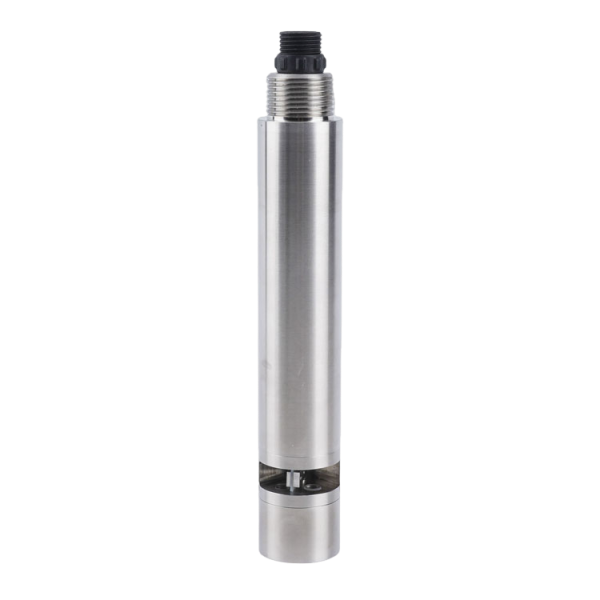
A COD sensor below addresses an optical organic-load indicator. It may support longer-term process interpretation, but it does not calculate the instantaneous oxygen uptake rate from a COD display alone. Keep process engineering decisions separate from an apparent short-term correlation.
Investigate real transfer, bubbles at the sensing surface and changed water circulation. Compare the installed exposure and actual air delivery before assigning the entire rise to basin recovery.
Yes, the measuring method does not consume oxygen. It still needs suitable immersion and representative water; loss of mixing can change what the local reading represents.
Possibly, but choose a representative point for both phases rather than an arbitrary distance. Check that relocation does not move the probe into a stagnant or different process zone.
Not automatically. It does not improve sensor accuracy or repair poor exposure. Match acquisition and filtering to the process after the measuring point is validated.
No. Energy performance depends on the treatment duty, air-delivery equipment, control design and operating practice. A valid DO measurement is an input, not an energy-saving guarantee.
Provide basin layout, air-on/off operation, proposed depth and position, water conditions, required control band and PLC interface. Include time-aligned readings and equipment feedback if the problem already occurs.
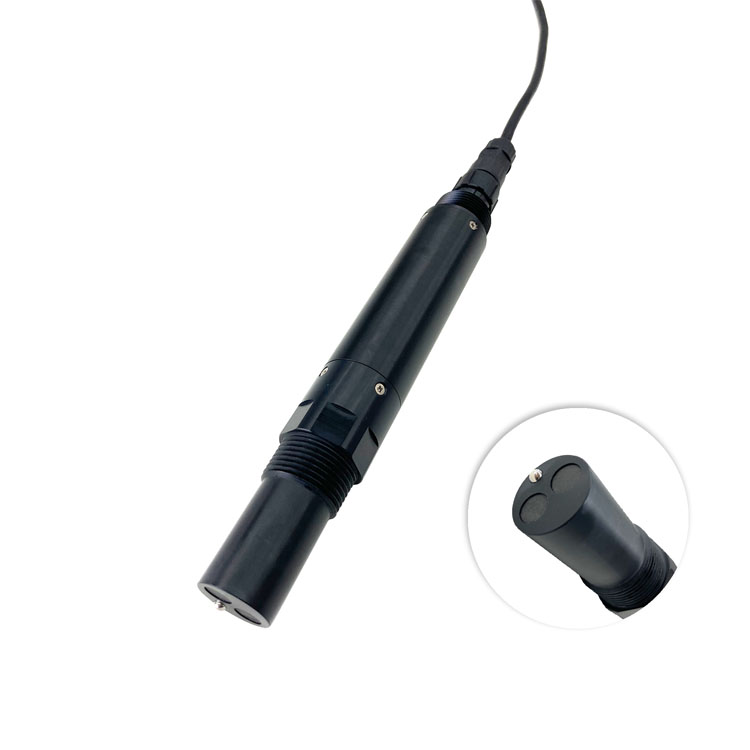
A dissolved oxygen sensor in water should be checked through the complete aeration cycle. Validate the water reaching the cap, distinguish process response from acquisition delay and verify the receiver's invalid-data behavior before changing control settings or replacing the probe.
Prev:TDS and pH Tester for Blended Water: Verify the Final Mixture
Next:Insect Monitoring After a Catch Surge: Can the Images Still Be Counted?
Related recommendations
Sensors & Weather Stations Catalog
 Agriculture Sensors and Weather Stations Catalog-NiuBoL.pdf
Weather Stations Catalog-NiuBoL.pdf
Agriculture Sensors Catalog-NiuBoL.pdf
Water Quality Sensor Catalog-NiuBoL.pdf
Related products
 Combined air temperature and relative humidity sensor
 TDR Soil Moisture & Temperature Sensor for irrigation| RS485 |4-20mA| NBL-S-THR
 Soil pH sensor RS485 soil Testing instrument soil ph meter for agriculture |NBL-S-PH
 Wind Speed sensor Output Modbus/RS485/Analog/0-5V/4-20mA
 Tipping bucket rain gauge for weather monitoring auto rainfall sensor RS485/Outdoor/stainless steel
 Pyranometer Solar Radiation Sensor 4-20mA/RS485


Screenshot, WhatsApp to identify the QR code
WhatsApp number:+8615367865107
(Click on WhatsApp to copy and add friends)

