





— Blogs —
—Products—
 Consumer hotline +8618073152920
 WhatsApp:+8615367865107
Address:Room 102, District D, Houhu Industrial Park, Yuelu District, Changsha City, Hunan Province, China
Product knowledge
Time:2026-06-10 10:00:35 Popularity:359
Quick Answer: Textile dyeing wastewater monitoring should keep color, turbidity and conductivity separate when comparing production batches. Dissolved dye can change color without a proportional change in particle scattering; dissolved salts can change EC without creating visible turbidity. Use each channel for its own quantity and validate any optical-to-COD or solids relationship against the actual dye and auxiliary mixture.
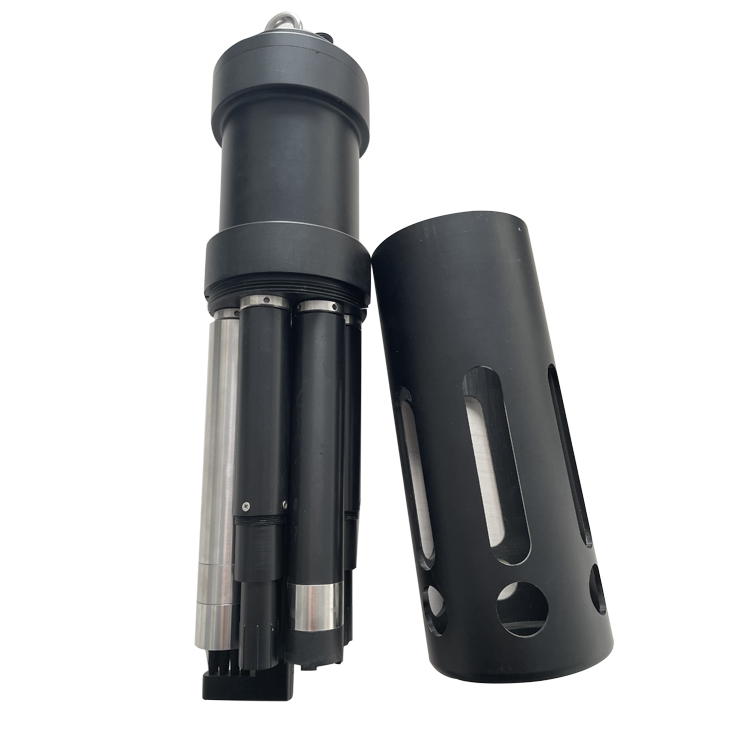
Different dyes, salt additions, washing steps and auxiliary chemicals can produce different wastewater even when production volume is similar. A change in one online channel may therefore reflect a new composition rather than a failure of treatment.
Label records with the relevant production stage and batch or campaign. Separate concentrated dye-bath discharges from rinsing and mixed equalization observations. If a sensor is downstream of equalization, compare its timing with the mixed tank rather than assuming that every production change appears immediately at the probe.
For the broader treatment-stage overview, see printing and dyeing wastewater treatment. The narrower task here is interpreting disagreement between measurements during changing production.
| Observation | What can change it | What it does not directly establish |
|---|---|---|
| Color under a defined method | Dissolved dye, optical absorption and sample preparation | Dry suspended-solids mass or complete organic removal |
| Turbidity | Particle scattering, flocs, bubbles and optical conditions | Dissolved dye concentration |
| Conductivity | Dissolved ions, their mobility and temperature | Which dye or salt is present, or its individual concentration |
| Optical COD estimate | The optical signal and the calibration relationship for the water | A universal digestion-COD result across all dye recipes |
After coagulation, lower turbidity may show that fewer scattering particles reach the probe. It does not alone prove removal of dissolved color. Conversely, a visually lighter sample may still contain dissolved organic matter. Keep the actual analytical method in the comparison record rather than writing only "water quality improved."
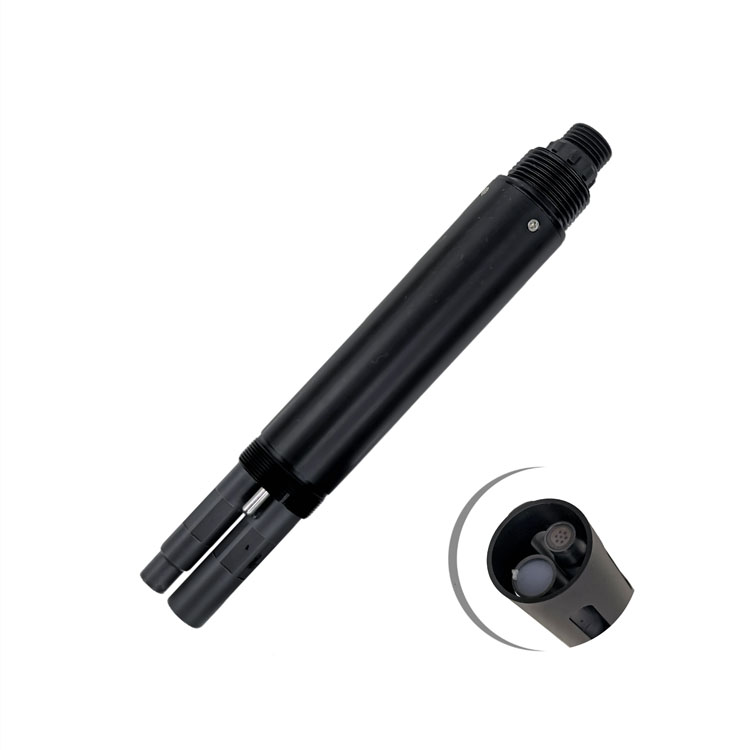
Before changing an alarm or calibration, identify the sample point, production recipe, time, temperature and whether the sample was settled or filtered. A color result from a filtered sample and an online optical reading of mixed wastewater are not observations of the same preparation.
For conductivity, retain the temperature-compensation basis. An EC rise during a salt-rich discharge may be useful context, but it is not a selective concentration measurement. If the water composition changes, reassess a TDS factor rather than assuming the old conversion remains valid.
For an optical COD or suspended-solids estimate, collect paired reference samples across the recipes and operating bands that the instrument must cover. Review errors by batch, not only one pooled correlation. One overall fit can conceal a consistent error for a particular dye mixture.
| Example NiuBoL instrument | Relevant limits | Selection consequence |
|---|---|---|
| NBL-WQ-EC | Selectable 0-20 or 0-200 or 0-5000 uS/cm, or 0-200 mS/cm; +/-1% FS | Use measured normal and peak EC, not visual color, to choose the range |
| NBL-WQ-TS | Selectable 0-20, 0-100 or 0-1000 NTU | Review its range-specific accuracy and sample response before setting an alarm |
| Standalone probe supply | EC and TS: 12-24 V DC; 0.2 W at 12 V | Not a complete station power budget |
| Water conditions | Both 0-50 degrees C; EC below 0.6 MPa, TS below 0.2 MPa | Check the actual sample, including production and cleaning excursions |
| Output / protection | RS485 Modbus RTU; IP68 sensor bodies | Receiving interfaces and field joints still need their own specification |
| Installation / cable | 3/4 NPT immersion arrangements; standard 5 m cables | Confirm holder, wetted materials and cable jacket for the actual chemistry |
The standalone EC probe and TS turbidity probe are not interchangeable with every fitted channel in a multiparameter assembly. Keep the model beside each limit. Do not assume that a hot process stream is suitable because a sensor body is described as industrial.
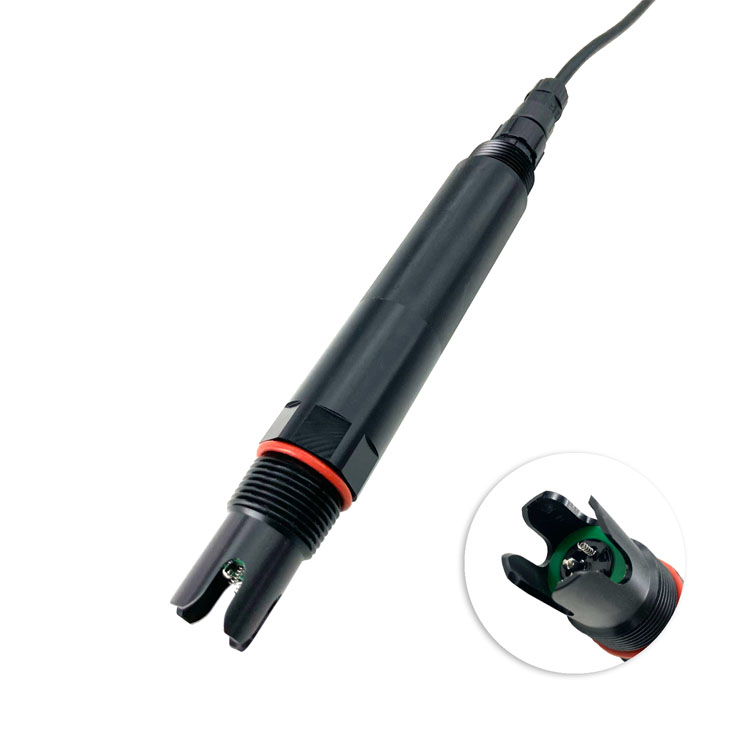
If a bleaching stream contains an oxidant relevant to the treatment decision, identify that species and choose an appropriate method. The chlorine electrode below illustrates a specific chemical measurement, not a generic oxidant or color detector.
An HClO-based sensor must not be used as a peroxide analyzer or relabeled total chlorine. Nor should it be added to a textile monitoring package without a chlorine-related duty. The purpose of separating channels is to make the operator's next check clearer, not to maximize the number of readings.
At the PLC or data logger, retain raw acquired values and distinguish them from calculated channels. A new conversion coefficient should be recorded as a configuration change. Do not silently rewrite previous batches with a different factor and then treat the resulting trend as original measured history.
For a project inquiry, provide representative water from relevant campaigns, anticipated pH and temperature, chemical exposure, ranges and the decision each channel supports. The turbidity probe below can provide particle information; dissolved color or a named contaminant requires its own justified method.
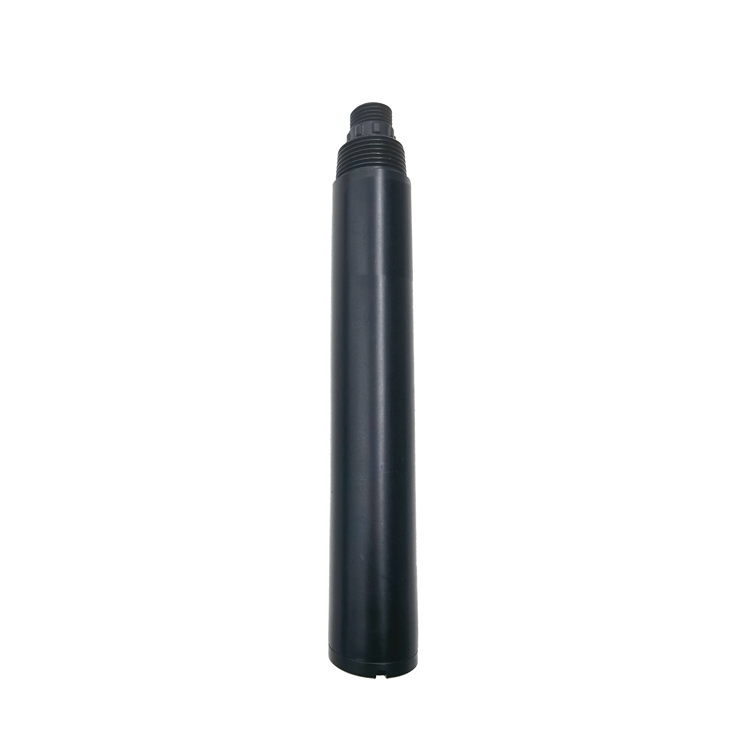
Not directly. It measures a scattered-light response associated with particles and optical conditions. Dissolved color needs an appropriate defined color method.
Dissolved ions can raise EC without forming scattering particles. Investigate the relevant production stream rather than assuming that one instrument has failed.
Only if validation demonstrates that it meets the required performance across those waters. Review recipe-specific errors and reassess after material changes.
No. Identify the instrument's behavior outside its measuring range and select a suitable configuration. A clipped maximum is not the actual peak value.
It supports a particle-related observation at that point. It does not independently establish dissolved-color, COD or specific contaminant removal.
Provide production variation, sample location and preparation, normal and peak ranges, temperature and chemicals, plus the required reference method and receiver. A photograph of colored water alone is insufficient.
Textile dyeing wastewater monitoring is more useful when batch identity and measurement meaning stay together. Treat color, turbidity, EC and optical estimates as different observations. Match NiuBoL sensor ranges to the actual stream and investigate recipe changes before altering calibration or claiming treatment removal.
Prev:Hospital Wastewater Monitoring: Disinfection and Discharge Sample Points
Next:Online Residual Chlorine Analyzer Selection: CL or CL-4A?
Related recommendations
Sensors & Weather Stations Catalog
 Agriculture Sensors and Weather Stations Catalog-NiuBoL.pdf
Weather Stations Catalog-NiuBoL.pdf
Agriculture Sensors Catalog-NiuBoL.pdf
Water Quality Sensor Catalog-NiuBoL.pdf
Related products
 Combined air temperature and relative humidity sensor
 TDR Soil Moisture & Temperature Sensor for irrigation| RS485 |4-20mA| NBL-S-THR
 Soil pH sensor RS485 soil Testing instrument soil ph meter for agriculture |NBL-S-PH
 Wind Speed sensor Output Modbus/RS485/Analog/0-5V/4-20mA
 Tipping bucket rain gauge for weather monitoring auto rainfall sensor RS485/Outdoor/stainless steel
 Pyranometer Solar Radiation Sensor 4-20mA/RS485

Screenshot, WhatsApp to identify the QR code
WhatsApp number:+8615367865107
(Click on WhatsApp to copy and add friends)

