





— Blogs —
—Products—
 Consumer hotline +8618073152920
 WhatsApp:+8615367865107
Address:Room 102, District D, Houhu Industrial Park, Yuelu District, Changsha City, Hunan Province, China
Product knowledge
Time:2026-06-11 11:24:32 Popularity:1089
Quick Answer: Common water quality sensors can share a cabinet or acquisition system without sharing identical sampling requirements. Before combining pH, ORP, conductivity, DO, turbidity, ammonium and chlorine measurements, check whether pumping, pressure reduction, bubbles, settling or calibration work changes the water seen by another channel. A common RS485 connection does not make the wet installation interchangeable.
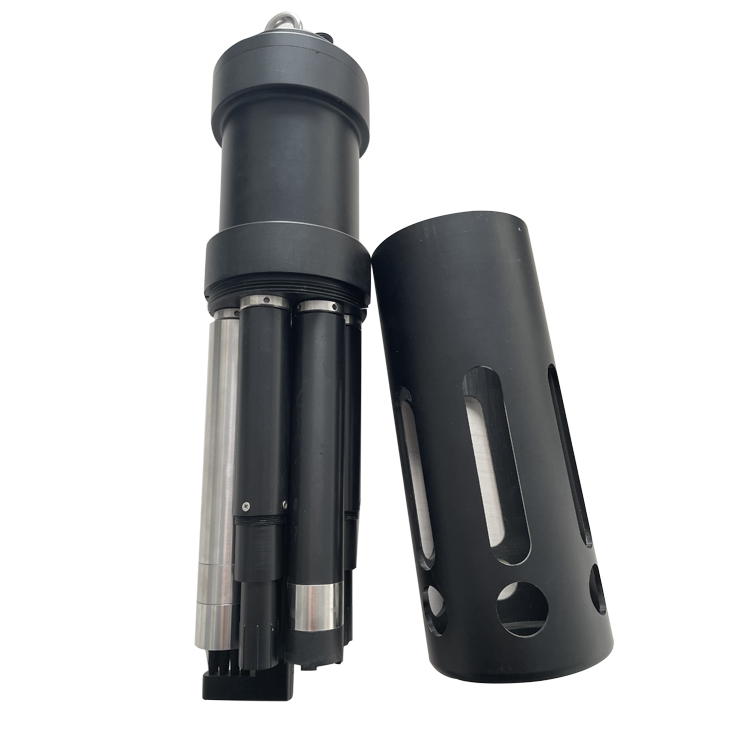
A compact monitoring panel is often drawn as several probes connected to one line. That arrangement may be practical, but it needs a chemical and hydraulic review. An immersion optical probe, an ion-selective electrode and a flow-cell chlorine sensor do not acquire meaningful data merely because the same water passes nearby.
Start with the original water point and the decision for each measurement. If the goal is dissolved oxygen in an aeration tank, moving the water through a long, aerated sample route may change what is being observed. If the goal is residual chlorine, transport and the sample system can affect the residual before it reaches the measuring cell.
Separate the shared services from the measurement-specific parts. A power enclosure, logger and network connection may be reusable across channels. Sample conditioning, wetted fittings, reference solutions and cleaning procedures need an individual check.
| Sensor group | Measurement role | Question before sharing a sample route |
|---|---|---|
| pH and ORP electrodes | Acid-base condition and oxidation-reduction potential | Are both exposed to the intended mixed water, with appropriate orientation and junction contact? |
| Conductivity | Electrical response associated with dissolved ions | Are temperature basis and cell conditions appropriate, without treating conductivity-derived values as all dissolved constituents? |
| Optical DO | Oxygen-dependent optical response | Does transport or air contact change oxygen before measurement? |
| Turbidity or optical solids | Particle scattering or a calibrated mass estimate | Are particles settling, being screened out or being confused with introduced bubbles? |
| Ammonium ion-selective electrode | Specified ammonium-related measurement | Does the water matrix suit the electrode, and is its reporting basis clear? |
| Constant-voltage chlorine probe | Specified chlorine measurement in its matching cell | Are sample flow, pressure, pH and transport appropriate for that model? |
| TOC, COD or BOD instrument | A method-specific organic-content or oxygen-demand result | Does the analyzer require its own preparation, cycle or sample treatment? |
These questions are reasons to evaluate the arrangement, not a blanket prohibition on shared sampling. A suitable engineered panel can use a common intake with appropriate branches, isolation and verification. The design must establish what each branch does to the sample.
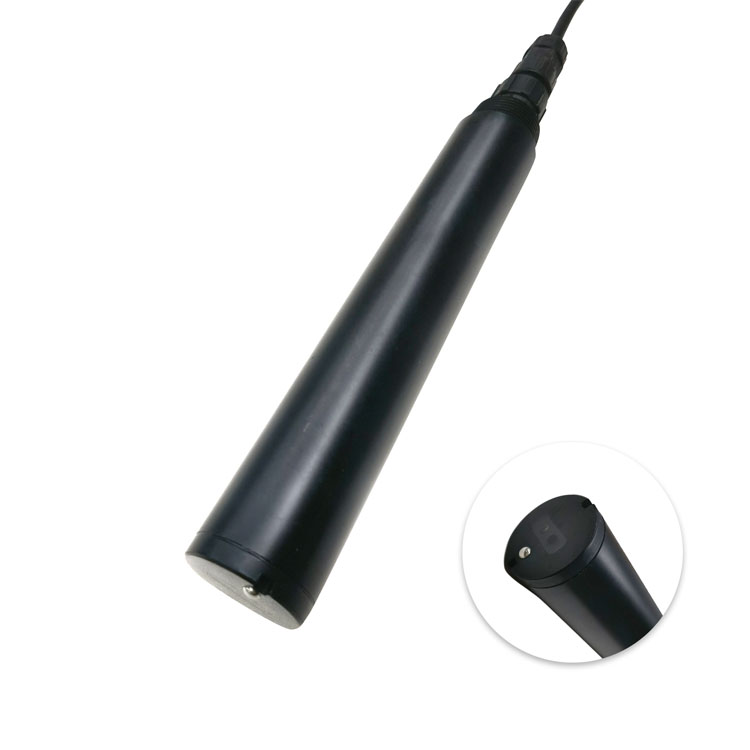
Keep buffer solutions, electrode storage liquids and cleaning chemicals out of the operating sample path. Provide an isolation and rinse arrangement appropriate to the installation so servicing one instrument does not send its maintenance solution through another.
For turbidity, use the optical clearance and sample-handling requirements of the chosen instrument. The NiuBoL basic TS uses immersion mounting; a small improvised cup is not automatically a suitable flow cell. Inspect bubbles and particle settling before applying calibration to make a confined sample agree with an in-process observation.
For DO, distinguish lack of oxygen consumption by an optical sensing principle from lack of sampling requirements. Water still needs to represent the intended location. A quiet or aerated sample branch can yield a different oxygen condition even when the optical cap is functioning correctly.
The following examples are separate NiuBoL configurations, not the combined specification of one universal probe.
| Instrument | Range and accuracy | Water and service requirements |
|---|---|---|
| Basic NBL-WQ-TS turbidity | 0-20, 0-100 or 0-1000 NTU; range-specific percentage-or-absolute accuracy expressions | 0-50 degrees C; pressure <0.2 MPa; POM and ABS; IP68; 3/4 NPT immersion mounting |
| Basic NBL-WQ-NHN | 0-10, 0-100 or 0-1000 mg/L; +/-10% or +/-1 mg/L, with expression basis to confirm | Use water at 0-40 degrees C; pressure <0.1 MPa; pH 4-10; immersion mounting; confirm complete wetted materials |
| Basic NBL-WQ-CL | 0-2.000 mg/L HClO; +/-5% or +/-0.05 mg/L, with expression basis to confirm | 5-50 degrees C; pressure <0.1 MPa; pH 4-9; matching flow cell at 30-60 L/h; POM and PTFE; IP68 |
The basic TS and NHN list 12-24 V DC and 0.2 W at 12 V. The CL lists 12-24 V DC +/-10% and 0.2 W at 12 V. Standard cables are 5 m; verify cable-jacket compatibility and required lengths. RS485 Modbus RTU is the digital acquisition route; confirm any ordered analog output separately.
The basic NHN membrane responds to ammonium; it is not a total nitrogen or direct un-ionized ammonia toxicity measurement. The basic CL's HClO measurement must be compared on an appropriate chemical basis, not assumed interchangeable with every total- or free-chlorine result. These distinctions affect both sampling and the reference check.
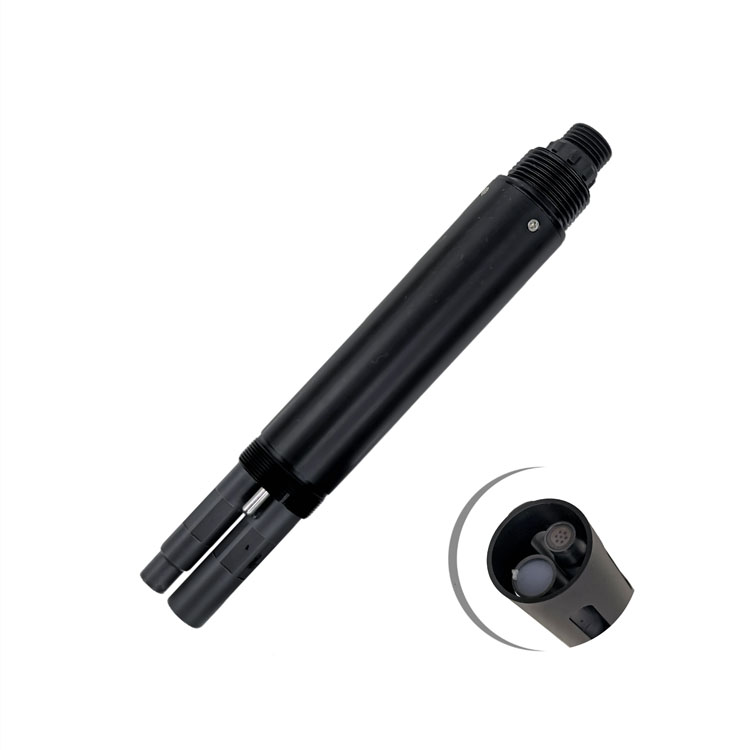
Review a common intake under normal and disturbed conditions. Is there enough sample exchange at each branch? Can one isolated instrument stop the others? Does a pressure regulator, strainer or overflow alter the intended sample? Select fittings and flow arrangements for the actual measurement rather than treating every accessory as neutral.
Use the manufacturer's specified flow condition for the chlorine cell; do not impose 30-60 L/h on every other probe as a universal requirement. Equally, an immersion probe's pressure limit does not authorize its insertion into a higher-pressure manifold. Confirm the full mounting assembly and a safe service arrangement.
A multiparameter assembly may simplify a common immersion point for its fitted channels. It does not establish that a separate chlorine cell or reagent analyzer can be attached under the same conditions. Confirm the assembly's own voltage, pressure and service needs instead of borrowing standalone values.
Compare each final channel with its appropriate reference at the intended sample point. Record branch condition and timing, especially after switching sources or completing maintenance. Agreement on pH cannot qualify an ammonium measurement, and a chlorine check cannot establish turbidity performance.
At the PLC, RTU or data logger, keep parameter units, device addresses and validity separate. A shared RS485 Modbus RTU bus is not a shared register map. Define how an isolated or empty sample branch is identified without inventing diagnostic functions that the probe does not provide.
For a combined-panel enquiry, send NiuBoL the source water, required parameters, water temperature and pressure, expected concentrations, sample drawing and maintenance access. Identify which instruments must stay operating while another is serviced. This supports a useful configuration decision before cabinet space and fittings are fixed.
Not by default. Review geometry, water exchange, pressure, material compatibility and the individual method. An engineered shared arrangement can work, but the cell must be suitable for each installed sensor.
No. It can remove the particles that turbidity or suspended-solids monitoring is intended to observe and may change another method's sample fraction. Specify conditioning according to the measurement, not as a universal improvement.
No. The basic CL's 30-60 L/h applies to its matching cell. Other probes need their own installation review; they do not inherit that flow specification.
No. Share site access and records where useful, but use the correct cleaning, storage and verification procedure for each sensing principle. Prevent one channel's service liquids from reaching the others.
Both should identify actual models, methods, sample arrangement, flow or pressure conditioning, outputs and service accessories. A bare group of probes is not the same scope as a verified sampling panel.
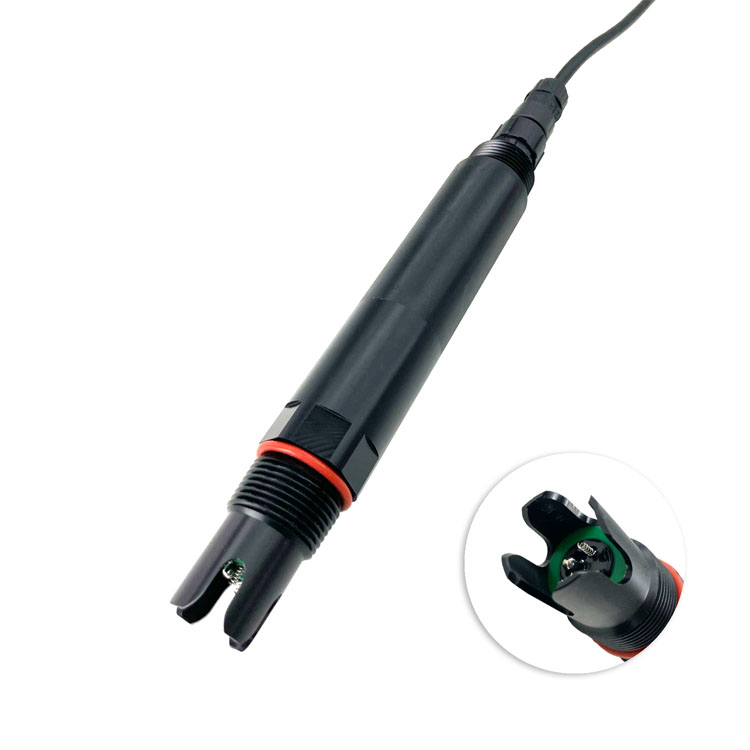
Common water quality sensors are selected through both measurement purpose and sampling compatibility. Keep shared acquisition separate from individual wet conditions, maintenance and reference checks. A suitable NiuBoL panel configuration should preserve the meaning of each result rather than merely fit several probes into one cabinet.
Prev:Water Quality Monitoring Section Layout: Reference, Impact and Depth
Next:Aquaculture Water Quality Monitoring Parameters: Review Production Changes
Related recommendations
Sensors & Weather Stations Catalog
 Agriculture Sensors and Weather Stations Catalog-NiuBoL.pdf
Weather Stations Catalog-NiuBoL.pdf
Agriculture Sensors Catalog-NiuBoL.pdf
Water Quality Sensor Catalog-NiuBoL.pdf
Related products
 Combined air temperature and relative humidity sensor
 TDR Soil Moisture & Temperature Sensor for irrigation| RS485 |4-20mA| NBL-S-THR
 Soil pH sensor RS485 soil Testing instrument soil ph meter for agriculture |NBL-S-PH
 Wind Speed sensor Output Modbus/RS485/Analog/0-5V/4-20mA
 Tipping bucket rain gauge for weather monitoring auto rainfall sensor RS485/Outdoor/stainless steel
 Pyranometer Solar Radiation Sensor 4-20mA/RS485

Screenshot, WhatsApp to identify the QR code
WhatsApp number:+8615367865107
(Click on WhatsApp to copy and add friends)

