





— Blogs —
—Products—
 Consumer hotline +8618073152920
WhatsApp:+8615367865107
Address:Room 102, District D, Houhu Industrial Park, Yuelu District, Changsha City, Hunan Province, China
Product knowledge
Time:2026-09-17 11:00:00 Popularity:159
Drinking water quality parameters for online monitoring should be chosen around treatment performance and distribution-system changes. Turbidity, disinfectant residual, pH, conductivity and temperature often provide useful operating information, but their importance varies by location. They do not constitute a complete drinking-water safety test. Select each channel for a specific question and retain the laboratory and microbiological checks required for the supply.
A filter outlet, a clear-water tank and a remote network point can all produce a useful dashboard while needing different instruments. The filter operator may need to detect a small turbidity change. The network operator may be investigating residual loss or a source-water blend change. Installing the same parameter package everywhere can miss the relevant event while adding channels that nobody uses.
The EPA's online water-quality monitoring resources distinguish source-water and distribution-system applications. Use that distinction when preparing the channel list: an instrument suitable for changing raw water is not automatically suitable for a small deviation in treated water. The selection must include the expected range and the magnitude of change that matters operationally.
| Online parameter | Useful operating question | Important limit of interpretation |
|---|---|---|
| Turbidity | Has particle-related cloudiness changed after clarification, filtration or within the network? | Does not identify a pathogen or directly measure every suspended-solids mass concentration |
| Disinfectant residual | Is the specified residual present at this point? | Must match the disinfectant and chlorine fraction; a reading alone does not verify complete disinfection |
| pH | Have acid-base conditions changed in treatment or distribution? | Does not independently determine corrosion or chemical composition |
| Conductivity | Has the dissolved-ion pattern changed, for example during source blending? | Does not identify individual ions or establish potability |
| Temperature | Are thermal conditions or compensation inputs changing? | Provides context rather than a substitute for chemical or microbiological analysis |
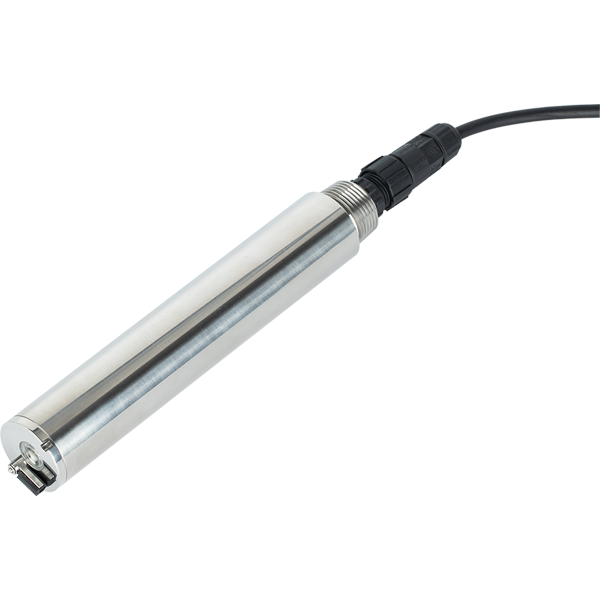
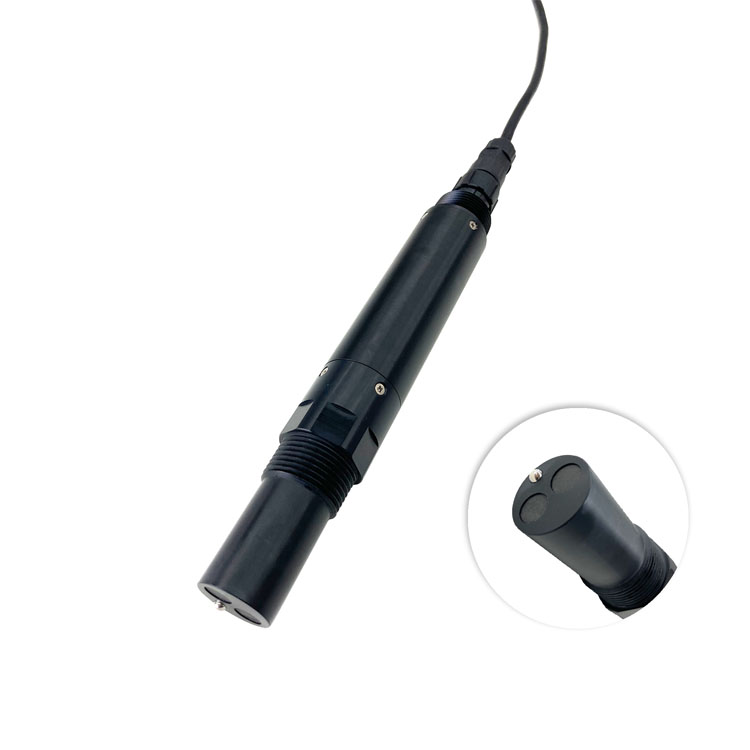
Raw-water turbidity may require a wider range and an immersion installation. The TS probe pictured below is relevant to that type of measuring point. For treated-water monitoring, evaluate the low-range performance of a dedicated instrument instead of choosing an immersion probe solely because its maximum range is larger.
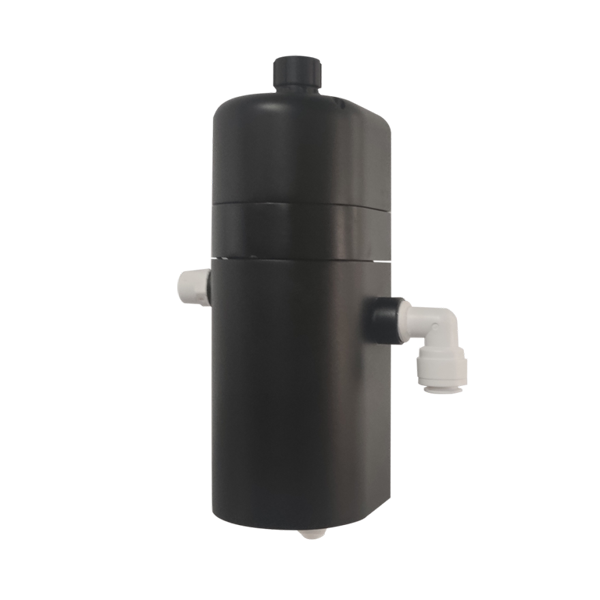
The NiuBoL NBL-WQ-TSA-4 is a wall-mounted flow-through turbidity sensor with an integrated cell. Its 0-10.000 NTU range and 0.001 NTU resolution make it a candidate for low-range monitoring where the required uncertainty and method are compatible. Three decimal places on a display do not demonstrate that a change of 0.001 NTU can be distinguished reliably.
| NBL-WQ-TSA-4 item | Technical detail | Implication for selection |
|---|---|---|
| Optical principle | 90-degree scattered light, infrared source | Confirm that the method is acceptable for the project's intended reporting use |
| Range and resolution | 0-10.000 NTU; 0.001 NTU | Select against the actual operating band and required decision threshold |
| Accuracy | +/-5% or +/-0.02 NTU, whichever is greater | Confirm the percentage basis; the absolute term already exceeds the display increment |
| Temperature and pressure | 0-50 C operating envelope; no greater than 0.2 MPa | Provide pressure control where the sample supply exceeds the limit |
| Flow arrangement | Keep the drain straight; recommended outlet flow below 300 mL/min | Avoid backpressure and verify sample renewal at the selected flow |
| Supply and consumption | 12-24 V DC; 0.2 W at 12 V | Add the controller and any sample-handling loads separately |
| Output | RS485, Modbus RTU; optional 4-20 mA | Identify the ordered output and its scaling before panel fabrication |
| Housing and protection | Composite housing; IP65; wall mounting | Install as a flow-through instrument, not as an immersed IP68 probe |
| Cable construction | Five-core shielded cable | Verify length, jacket requirements and termination protection for the panel |
Check low-range behavior with appropriate standards and representative samples, including the effects of bubbles and contamination in the cell. Do not set an alarm so close to the normal baseline that normal measurement variation repeatedly crosses it. Conversely, averaging should not hide a short event that the monitoring point was installed to detect.
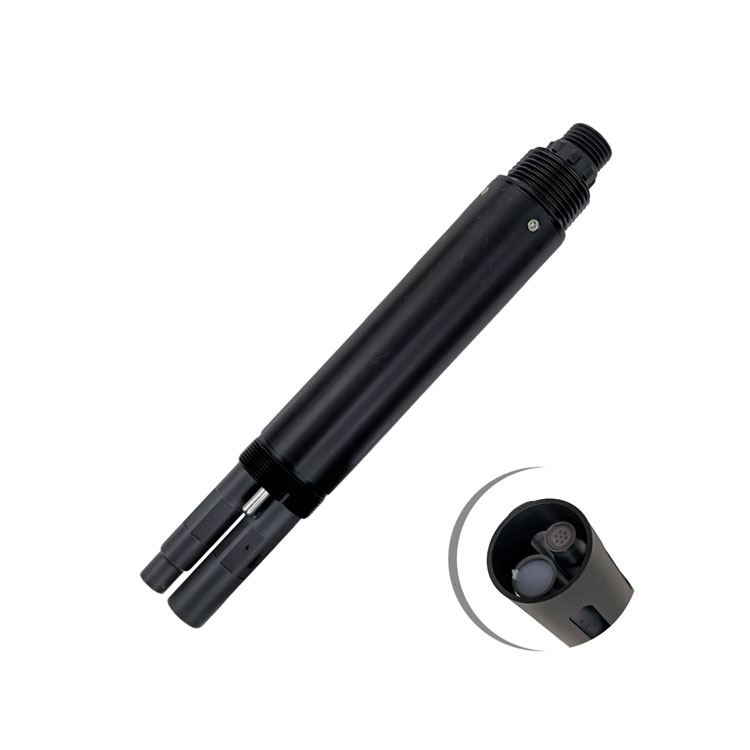
A multi-parameter assembly can suit an accessible source-water point where several channels share the same water. It should not replace a dedicated low-turbidity flow cell merely to keep the equipment list short. Nor should chlorine measurement be assumed to exist in an assembly whose configured channels do not include it.

For a free-chlorine system, determine whether the proposed sensor measures the required free residual or responds to a particular species such as HOCl. For a chloraminated supply, evaluate the required total residual, monochloramine or associated chemistry rather than substituting a free-chlorine probe. A shared mg/L unit does not make these measurements equivalent.
The NiuBoL NBL-WQ-CL has a specified 0-2.000 mg/L HOCl range and circulation-cell flow of 30-60 L/h. Its pH operating range is 4-9, but that range does not establish that its response is independent of pH. Agree the measurement basis, compensation approach and comparison method for the intended water before using the channel for residual alarms.
Ammonia is a specialized addition rather than a universal drinking-water channel. It may be relevant to source-water assessment or the management of a chloraminated system. The required low-level performance, interferences and analytical method must fit that specific task. A broad-range wastewater ammonia probe should not be selected solely because it reports the same parameter name.
A stable set of online readings is valuable, but it cannot show that every contaminant is absent. Conductivity may remain steady during an event that does not significantly change ionic content. Turbidity cannot identify the organism responsible for a microbiological result. Residual chlorine is an operating indicator, not a direct measurement of every pathogen or disinfection by-product.
Maintain a separate verification program appropriate to the supply and its risks. Its sample locations and analytical methods may differ from those of the online station. Link unexpected online trends to a defined investigation and sampling response. Do not relabel a broad monitoring panel as a complete compliance analyzer without the required methods and approvals for that use.
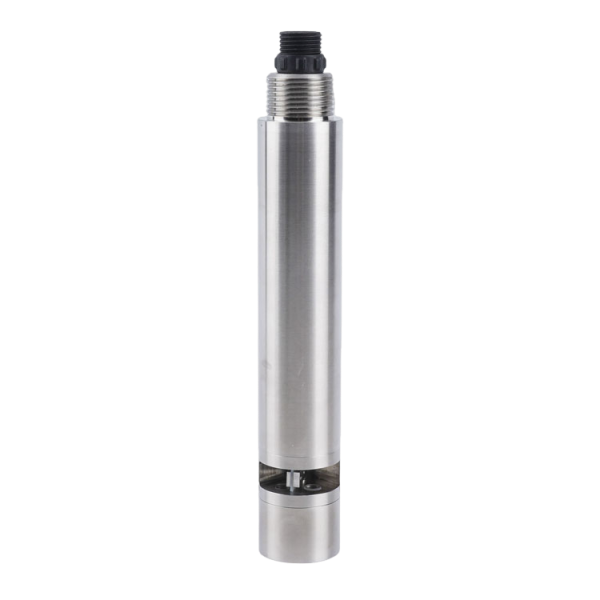
Optical COD monitoring can be useful in selected source-water investigations when its response has been correlated to the water matrix. It is not automatically a suitable low-level finished-water organic-carbon measurement, and COD is not interchangeable with TOC. Choose it only where it answers a defined source-water or process question.
Turbidity is often the central operating channel. Decide whether the point represents an individual filter or combined filtered water: a combined stream can dilute an event from one filter. Include pH or other measurements where they support the treatment process, but evaluate each addition separately. The required response time should include the sample path and instrument, not only the data-update interval.
Disinfectant residual, temperature and conductivity can help distinguish residual decay, thermal change and source mixing. Interpret them with hydraulic information such as operating state, turnover or supply source where available. A low residual at an isolated branch and a low residual across several representative points call for different investigations.
Select a sample connection that represents delivered water under the intended operating condition. A rarely used branch can describe local stagnation rather than the circulating supply. Record whether the point is intended to examine stagnation or flowing water; flushing every sample may remove the condition that the project actually needs to investigate.
Record the measured value together with sample-flow status, time and maintenance state where the equipment provides those signals. An RS485 Modbus RTU response confirms communication, not fresh sample delivery. A stopped sample pump can leave a plausible reading in a cell, while a communication timeout can leave an old value in the historian unless the host marks it invalid.
Do not place every flow-through instrument in series at one assumed flow. The NBL-WQ-CL circulation cell requires 0.5-1.0 L/min, whereas the TSA-4 outlet-flow recommendation is below 0.3 L/min. A station using both needs an arrangement that meets each branch's requirements. Include isolation and inspection access so one channel can be serviced without silently interrupting the other.
Before applying thresholds, establish the location's normal variation under known operating conditions. Compare source changes, tank operation and maintenance periods with the trends. Give each alarm a defined response: inspect the sample, repeat a measurement, collect a sample or escalate an operational event. A threshold without a response simply adds an unexplained notification.
Conductivity is particularly useful for tracking a change in water origin when the sources differ measurably. Keep temperature compensation consistent and preserve conductivity itself, even if a derived TDS value is also displayed. A conversion factor cannot identify the dissolved salts or turn the channel into a complete water-quality assessment.
There is no universal list. Turbidity, residual disinfectant, pH, conductivity and temperature are common candidates, but the final selection depends on the measuring location and operating task. State the question each channel must answer before choosing the instrument package.
No. These conventional online channels provide operating indicators rather than a complete microbiological assessment. Retain the verification tests and methods required for the water supply. Use abnormal trends to support timely investigation, not to infer a specific organism count.
Compare the required decision margin with the full uncertainty and method requirements. The 0.001 NTU resolution alone is insufficient. Evaluate the +/-0.02 NTU absolute accuracy term, the percentage term and field conditions before selecting it for that duty.
Only if the exact instrument has demonstrated capability for the required fraction and water chemistry. Do not transfer a free-chlorine or HOCl configuration to a chloraminated supply without verifying its analytical response. Specify the disinfectant and reporting basis in the inquiry.
No. Add them when a source-water or treatment question justifies the method and range. Their usefulness in wastewater does not establish adequate performance in low-level treated water. Request a representative-sample evaluation where suitability is uncertain.
Provide the water source, treatment stage, disinfectant strategy, expected parameter ranges and intended alarm decisions. Include sample pressure, available flow, panel location and PLC or data logger interface. Identify any mandatory analytical method separately from the desired communication protocol.
Choose drinking water quality parameters by the decisions needed at each point. Dedicated low-range turbidity, method-matched residual monitoring and supporting pH, conductivity and temperature channels can provide useful operating data. NiuBoL can help match those channels to the sample arrangement, while laboratory verification remains a separate part of the water-quality program.
Prev:Hospital Wastewater Residual Chlorine Analyzer Price Factors
Next:Drinking Water Source Monitoring System for Reservoirs and Intake Stations
Related recommendations
Sensors & Weather Stations Catalog
 Agriculture Sensors and Weather Stations Catalog-NiuBoL.pdf
Weather Stations Catalog-NiuBoL.pdf
Agriculture Sensors Catalog-NiuBoL.pdf
Water Quality Sensor Catalog-NiuBoL.pdf
Related products
 Combined air temperature and relative humidity sensor
 TDR Soil Moisture & Temperature Sensor for irrigation| RS485 |4-20mA| NBL-S-THR
 Soil pH sensor RS485 soil Testing instrument soil ph meter for agriculture |NBL-S-PH
 Wind Speed sensor Output Modbus/RS485/Analog/0-5V/4-20mA
 Tipping bucket rain gauge for weather monitoring auto rainfall sensor RS485/Outdoor/stainless steel
 Pyranometer Solar Radiation Sensor 4-20mA/RS485


Screenshot, WhatsApp to identify the QR code
WhatsApp number:+8615367865107
(Click on WhatsApp to copy and add friends)

